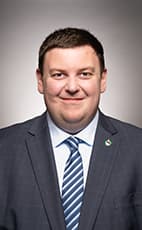
Andrew Lawton
In the 90 days to September 18, 2026, 8 organizations lobbied Andrew Lawton across 9 meetings — most often about Taxation and Finance. The most frequent visitor was eBay Canada (2 meetings, via their in-house lobbyist Ashley Lawrence). Its registration describes the goal as “Implications of tax measures and eBay's contribution to sustainability efforts in Canada through the circular economy while maximizing…”. That's more than the average MP, who had 6 meetings over the same period.
Based on federal lobbying registry data to September 18, 2026
In the House · Sep 21–25
Andrew Lawton this week
“This is a bill that is very personal. It is an issue that is very personal. Through the course of the work of the Special Joint Committee on Medical Assistance in Dying, we heard from a number of experts who have worked with patients going through challenges…”
- Spoke 6 times in the House · the average MP spoke 4 times
- FORC-266, second reading — Establish a national framework respecting skilled trades and labour mobility · passed 295–21
Get Andrew Lawton's week in your inbox every Monday
What they said, how they voted, and who lobbied them. Free, no ads, unsubscribe anytime.
How Andrew Lawton actually voted
Their recorded positions on the issues Canadians care about — pulled straight from the parliamentary record.
- Voted For
Labour & Employment
Establish a national framework respecting skilled trades and labour mobility
C-266 · Sep 2026 · Passed · Tell your MP what you think
- Voted Against
Economy & Taxation
Implement certain provisions of the spring economic update tabled in Parliament on April 28, 2026
C-30 · Jun 2026 · Passed · Tell your MP what you think
- Voted Against
Housing
Authorize certain payments to be made out of the Consolidated Revenue Fund for the purpose of improving housing supply
C-26 · Jun 2026 · Passed · Tell your MP what you think
- Voted Against
Criminal Justice
Hate propaganda, hate crime and access to religious or cultural places
C-9 · Jun 2026 · Passed · Tell your MP what you think
- Voted Against
Overall leanings
100%
voted with the Conservative line this Parliament
100%
vote attendance (174/174)
Who’s in Andrew’s ear
74
lobbying meetings
59
companies & groups
334
speeches in Parliament
Top lobbying relationship: National Council of Canadian Muslims (NCCM) — met 4 times · most lobbied on Taxation and Finance.
See who’s lobbying Andrew →Who's lobbying Andrew
Individual meeting records from the federal lobbying registry
| Date | Organization | |
|---|---|---|
| 2026-09-08 | Canadian Canola Growers Association | |
| 2026-09-02 | Canadian ETF Association (CETFA) | |
| 2026-08-26 | TerraVest Industries Inc. | |
| 2026-08-26 | CANADIAN CONSUMER SPECIALTY PRODUCTS ASSOCIATION | |
| 2026-08-23 | Ontario Federation of Agriculture |
Write to Andrew Lawton
Pick what it's about. You'll get a letter you can edit, then send it from your own email.
Other ways to reach Andrew
613-992-4211 is the House of Commons switchboard — ask to be connected to your MP's office. For constituency office contact details, or if andrew.lawton@parl.gc.ca bounces, visit their Parliament profile.
Committee Memberships
What Andrew talks about
- Combatting Hate Act39 speeches · 2025–2026
- The Economy18 speeches · 2025–2026
- Justice17 speeches · 2025–2026
- Strong Borders Act12 speeches · 2025
- Citizenship Act9 speeches · 2025
Recent Speeches
Madam Speaker, this is a bill that is very personal. It is an issue that is very personal. Through the course of the work of the Special Joint Committee on Medical Assistance in Dying, we heard from a number of experts who have worked with patients going through challenges, much like those I went th… Read full speechShow less
Madam Speaker, this is a bill that is very personal. It is an issue that is very personal. Through the course of the work of the Special Joint Committee on Medical Assistance in Dying, we heard from a number of experts who have worked with patients going through challenges, much like those I went through 15, 16 years ago, people who felt that they were better off dead than alive. These are people who deserve support. These are people who deserve treatment. These are people who should be welcomed into wanting to live, not assisted with end of life. The bill from my colleague from Cloverdale—Langley City, who so eloquently called it the right to recover act, is a bill that would do exactly what the title says. It would offer people a right to recover. It would offer hope. It would offer light to people in the darkest moments of their lives. I was so honoured, with my story, to be able to be a champion for this, even before my colleague introduced her bill. I was equally honoured to be named to the Special Joint Committee on Medical Assistance in Dying, at which we were able to tackle—
Mr. Speaker, I may remind the House that, unlike the member prior, only my tie is red today. It is very important for us to stand up in the House for affordability for Canadians. A new Royal Bank of Canada survey found that more than half of parents with adult children aged 18 to 40 provided financi… Read full speechShow less
Mr. Speaker, I may remind the House that, unlike the member prior, only my tie is red today. It is very important for us to stand up in the House for affordability for Canadians. A new Royal Bank of Canada survey found that more than half of parents with adult children aged 18 to 40 provided financial support over the past year, contributing an average of $6,151. It is not just that generation. I met with a group of seniors in St. Thomas a couple of weeks ago. One of them said that she does not eat lunch because of the price of groceries. More shocking was when almost every other senior at the table said that they did not either. This is a fact of life in Canada, the same Canada of which the Prime Minister says affordability is the best it has been in a decade. Would the Prime Minister like me to tell these seniors that, or will he do it himself?
Mr. Speaker, it is a great privilege and honour, as always, to rise on behalf of the people of Elgin County, St. Thomas and London, although, despite our absence from this chamber over the last few months, I note that not much has changed with the Liberals. They are still out of alignment with where… Read full speechShow less
Mr. Speaker, it is a great privilege and honour, as always, to rise on behalf of the people of Elgin County, St. Thomas and London, although, despite our absence from this chamber over the last few months, I note that not much has changed with the Liberals. They are still out of alignment with where the majority of Canadians are right now, which is finding that they cannot afford life in this country after 11 years of the Liberals. They are still unwilling to look in the mirror and recognize that they themselves are the problem and, therefore, not the solution. More importantly, they must be dragged kicking and screaming into doing the right thing. The bill they are coming forward with today is a step in the right direction, but only a step, and only a little nudge towards where we ultimately need to be. Back in April, when we were seeing the rising high gas prices in this country, Conservatives said we need to cut all of the federal taxes on fuel for Canadians to give them a break. The Liberals eventually came around, but they offered a fraction of the tax relief we were pushing for, for a fraction of the time. Even this proposed extension does not go nearly far enough when Canadians still cannot afford to fill up their fuel tanks. I will say that is especially clear in ridings such as mine where driving is a necessity and not a luxury. If someone is living in Vienna, Fingal or Port Stanley, Ontario, they have to drive to get around. Oftentimes, workers have to drive to get to work. Students have to drive to get to school. This is a reality. High fuel prices and high fuel taxes bear a disproportionate weight on rural Canadians, the people who the Liberals have often looked down upon and have not really acknowledged. We know this by looking at what the Liberals themselves have said about fuel taxes in the past. Now, interestingly enough, going back to April, when we originally called for this fuel tax cut, the bigger one, not the Liberal one, Liberals pooh-poohed it. They kind of brushed it off. The finance minister said, when we asked if they were going to cut the fuel taxes, “we will not take lessons from the Conservatives.” That was on Monday. On Tuesday, they took our policy. We have had other examples of this where people have risen in the House of Commons on the Conservative bench and asked the Liberal government when it was going to provide tax relief at the pumps for Canadians, and the Liberals said anything other than yes, because they fundamentally do not believe in it. We know this. For example, the member for Winnipeg North actually said that it was “far right” to oppose the Liberal carbon tax. Mark Holland, the former Liberal health minister, rose in this chamber and, believe it or not, said that if a family takes a road trip, they are letting “the planet burn” because they are filling up the tank to go on a nice, affordable family vacation. This is what we have heard from the Liberals, time and time again, about their true allegiance. They actually support fuel taxes because they do not want people to fuel up their cars. Steven Guilbeault, a former Liberal cabinet minister, said opposing the carbon tax is a plan “to let the planet burn. It is immoral.” This is what we get from these Liberals who, when it is politically to their advantage, decide to pretend that they are actually against the carbon tax and that they are actually against fuel taxes. A fuel tax is a tax on productivity. It is a tax on anything that needs to be shipped. It is a tax on groceries. It is a tax on transport. It is a tax on literally anything in a productive society, but when Liberals see taxes, they see opportunity. Funnily enough, going back to April, when we were calling on the Liberal government to cut fuel taxes, the Minister of Jobs and Families rose in the chamber and saw dollar signs. She said there was “a generational windfall.” Her response in question period to my colleague, the deputy leader of the Conservative Party, was that Liberals would spend the money better than Conservatives would. That is what the Liberals see. They see opportunities. They see Canadians as a cash cow, while Canadians see a life that is unaffordable and has only gotten less and less affordable under the Liberals. That is why we reiterate our call to eliminate all federal taxes on fuel. We think it should go until at least Canada Day, but I would personally say that we need to be looking at ways to get federal fuel taxes off entirely. This is a lever the government has at its disposal. It is a direct way to make life more affordable for Canadians and to ease the pressure, not just on rural Canadians, but on industry, students, single parents, seniors and anyone who needs fuel to live, either directly or indirectly. This is common sense. The Liberals have already come part of the way. Why do they not come the whole way? Why do they not actually take a stand for a real, concrete affordability measure that would support Canadians where they are right now? This is where I go back to my thesis from the beginning of my comments. The Liberals have to be dragged kicking and screaming into doing the right thing. This was true with the consumer carbon tax, and it is true with the federal fuel excise tax holiday. It will probably be true with the industrial carbon tax. At some point, they will come along with us because they realize the error of their ways, and they will pretend that they were with us the whole time. Ironically, gaslighting comes without a carbon tax when the Liberals do it. I do not know how they have managed to make that work, but why do they take so long? I do not know if it is that they had to see the polling. I do not know if it is that they were waiting to find out if it was politically to their advantage, but it is the right thing to do. It is interesting that all the deficit hawks somehow emerge from the Liberal benches when we start talking about the need to give Canadians a break on fuel. These folks are nowhere to be seen when the Prime Minister is posting $70-billion dollar deficits. They do not care about the deficit then. Just to pre-empt a potential question that may come from one of my colleagues opposite, this is because of heightened fuel prices due to things that are matters outside the government's control. No one is claiming the government is responsible for some of the global factors, but it is responsible for taxes. This is because of a sudden surge in prices, which means that the fuel tax revenue the government is going to get was never actually budgeted for. Unless the government's previous budget was based around this war, which I do not think it was, the government never foresaw the increase in fuel revenue, so it is not actually hurting the government coffers, of which there is a lot that needs to be trimmed, but that is a topic for another day. This measure would not actually hurt the government coffers, but not doing it is hurting Canadians. Not doing it is putting pressure and strain on families who already cannot withstand it. I mentioned earlier today in the House a story that was actually very difficult for me to hear. It was not as difficult as it was for the people sharing it. A group of seniors I met with spoke about the fact that they are literally skipping meals because of food affordability problems, and ever since I posted that clip on social media, I have had other people reach out to share very similar things, heartbreaking things. They are the human faces that go along with the stats we have seen about the millions and millions of Canadians who are now using food banks, who have never before had to. People who are employed, people who have jobs and careers, are finding that that is not enough to survive in Canada after 11 years of the Liberals, who do not put affordability front and centre, who are not devoted to saving Canadians money, who are not putting forward a concrete plan to save Canadian jobs and who are following their Prime Minister, the very model of all talk and no results. The results are that the Liberals have to put forward this bill because they have failed Canadians. The Liberals have to put forward this bill because Canadians cannot afford the price at the fuel pumps after the Liberals have driven up the cost of absolutely everything. We are the party that is fighting for Canadians. We are the party that is fighting for Canada. We are the party that is going to make sure that fuel taxes are not driving more people into untenable situations with household finances that are sending them to the food bank. It is a sad reality that most people would never have thought possible in a G7 country, that food bank stats would become the norm. We are not even surprised. The Liberals smirk and chuckle when we raise them because it is just window dressing to them, but we will continue to stand up for that. I want to say to the Liberals now that I would be happy to support any measure that saves working Canadians money, but I want to know, if they are going to take our policy on this, why they are not taking the whole thing. They should get rid of the federal fuel taxes once and for all, not just for a few months, but in a way that is meaningful in the long term. If it is right for Canadians now, it is right for Canadians always.
Mr. Speaker, my colleague from Nanaimo—Ladysmith has been doing tremendous work on the affordability file, and it is an honour to be sitting near her once again in my new seat in the chamber. Stability is absolutely important. I have already heard from businesses that have dealt with the lack of abi… Read full speechShow less
Mr. Speaker, my colleague from Nanaimo—Ladysmith has been doing tremendous work on the affordability file, and it is an honour to be sitting near her once again in my new seat in the chamber. Stability is absolutely important. I have already heard from businesses that have dealt with the lack of ability by the Liberals and the Prime Minister to get a deal that will protect Canadian jobs. They are already having trouble planning ahead with not knowing what tariffs and countertariffs are going to be in front of them. Fuel costs are another great example of this. They do not know how to possibly budget for something when the Liberal government is trying to provide this incremental approach without dealing with the totality of the problem. What I said in my initial remarks holds true here. Governments need to use every lever available to them to protect affordability for Canadians. The government is only pushing that lever just a bit and not telling Canadians what they can expect in the future.
Mr. Speaker, I am a student of history, and I have really venerated this chamber. I have a great deal of respect for the loquaciousness of my colleague from Winnipeg North. For example, in December 2023, he said that anyone who opposed the carbon tax was “far right”. In February 2024, he said Conser… Read full speechShow less
Mr. Speaker, I am a student of history, and I have really venerated this chamber. I have a great deal of respect for the loquaciousness of my colleague from Winnipeg North. For example, in December 2023, he said that anyone who opposed the carbon tax was “far right”. In February 2024, he said Conservatives were “climate deniers” for opposing the carbon tax, and later on that same day, he said opposing the carbon tax meant we wanted to let her rip. I do not know what he meant by “let her rip”, but I think he was catastrophizing about something that the Liberals are now claiming credit for. They have no credibility on this issue whatsoever. The sooner they come around to our position, the sooner Canadians will get the break they deserve.
Bills Sponsored
Recent activity
22 activities across speeches, bills, and lobbying communications.
September 2026
Private Members' Business
Madam Speaker, this is a bill that is very personal. It is an issue that is very personal. Through the course of the work of the Special Joint Committee on Medical Assistance in Dying, we heard from a… Read full speechShow less
Madam Speaker, this is a bill that is very personal. It is an issue that is very personal. Through the course of the work of the Special Joint Committee on Medical Assistance in Dying, we heard from a number of experts who have worked with patients going through challenges, much like those I went through 15, 16 years ago, people who felt that they were better off dead than alive. These are people who deserve support. These are people who deserve treatment. These are people who should be welcomed into wanting to live, not assisted with end of life. The bill from my colleague from Cloverdale—Langley City, who so eloquently called it the right to recover act, is a bill that would do exactly what the title says. It would offer people a right to recover. It would offer hope. It would offer light to people in the darkest moments of their lives. I was so honoured, with my story, to be able to be a champion for this, even before my colleague introduced her bill. I was equally honoured to be named to the Special Joint Committee on Medical Assistance in Dying, at which we were able to tackle—
Statements by Members
Mr. Speaker, I may remind the House that, unlike the member prior, only my tie is red today. It is very important for us to stand up in the House for affordability for Canadians. A new Royal Bank of C… Read full speechShow less
Mr. Speaker, I may remind the House that, unlike the member prior, only my tie is red today. It is very important for us to stand up in the House for affordability for Canadians. A new Royal Bank of Canada survey found that more than half of parents with adult children aged 18 to 40 provided financial support over the past year, contributing an average of $6,151. It is not just that generation. I met with a group of seniors in St. Thomas a couple of weeks ago. One of them said that she does not eat lunch because of the price of groceries. More shocking was when almost every other senior at the table said that they did not either. This is a fact of life in Canada, the same Canada of which the Prime Minister says affordability is the best it has been in a decade. Would the Prime Minister like me to tell these seniors that, or will he do it himself?
Government Orders
Mr. Speaker, it is a great privilege and honour, as always, to rise on behalf of the people of Elgin County, St. Thomas and London, although, despite our absence from this chamber over the last few mo… Read full speechShow less
Mr. Speaker, it is a great privilege and honour, as always, to rise on behalf of the people of Elgin County, St. Thomas and London, although, despite our absence from this chamber over the last few months, I note that not much has changed with the Liberals. They are still out of alignment with where the majority of Canadians are right now, which is finding that they cannot afford life in this country after 11 years of the Liberals. They are still unwilling to look in the mirror and recognize that they themselves are the problem and, therefore, not the solution. More importantly, they must be dragged kicking and screaming into doing the right thing. The bill they are coming forward with today is a step in the right direction, but only a step, and only a little nudge towards where we ultimately need to be. Back in April, when we were seeing the rising high gas prices in this country, Conservatives said we need to cut all of the federal taxes on fuel for Canadians to give them a break. The Liberals eventually came around, but they offered a fraction of the tax relief we were pushing for, for a fraction of the time. Even this proposed extension does not go nearly far enough when Canadians still cannot afford to fill up their fuel tanks. I will say that is especially clear in ridings such as mine where driving is a necessity and not a luxury. If someone is living in Vienna, Fingal or Port Stanley, Ontario, they have to drive to get around. Oftentimes, workers have to drive to get to work. Students have to drive to get to school. This is a reality. High fuel prices and high fuel taxes bear a disproportionate weight on rural Canadians, the people who the Liberals have often looked down upon and have not really acknowledged. We know this by looking at what the Liberals themselves have said about fuel taxes in the past. Now, interestingly enough, going back to April, when we originally called for this fuel tax cut, the bigger one, not the Liberal one, Liberals pooh-poohed it. They kind of brushed it off. The finance minister said, when we asked if they were going to cut the fuel taxes, “we will not take lessons from the Conservatives.” That was on Monday. On Tuesday, they took our policy. We have had other examples of this where people have risen in the House of Commons on the Conservative bench and asked the Liberal government when it was going to provide tax relief at the pumps for Canadians, and the Liberals said anything other than yes, because they fundamentally do not believe in it. We know this. For example, the member for Winnipeg North actually said that it was “far right” to oppose the Liberal carbon tax. Mark Holland, the former Liberal health minister, rose in this chamber and, believe it or not, said that if a family takes a road trip, they are letting “the planet burn” because they are filling up the tank to go on a nice, affordable family vacation. This is what we have heard from the Liberals, time and time again, about their true allegiance. They actually support fuel taxes because they do not want people to fuel up their cars. Steven Guilbeault, a former Liberal cabinet minister, said opposing the carbon tax is a plan “to let the planet burn. It is immoral.” This is what we get from these Liberals who, when it is politically to their advantage, decide to pretend that they are actually against the carbon tax and that they are actually against fuel taxes. A fuel tax is a tax on productivity. It is a tax on anything that needs to be shipped. It is a tax on groceries. It is a tax on transport. It is a tax on literally anything in a productive society, but when Liberals see taxes, they see opportunity. Funnily enough, going back to April, when we were calling on the Liberal government to cut fuel taxes, the Minister of Jobs and Families rose in the chamber and saw dollar signs. She said there was “a generational windfall.” Her response in question period to my colleague, the deputy leader of the Conservative Party, was that Liberals would spend the money better than Conservatives would. That is what the Liberals see. They see opportunities. They see Canadians as a cash cow, while Canadians see a life that is unaffordable and has only gotten less and less affordable under the Liberals. That is why we reiterate our call to eliminate all federal taxes on fuel. We think it should go until at least Canada Day, but I would personally say that we need to be looking at ways to get federal fuel taxes off entirely. This is a lever the government has at its disposal. It is a direct way to make life more affordable for Canadians and to ease the pressure, not just on rural Canadians, but on industry, students, single parents, seniors and anyone who needs fuel to live, either directly or indirectly. This is common sense. The Liberals have already come part of the way. Why do they not come the whole way? Why do they not actually take a stand for a real, concrete affordability measure that would support Canadians where they are right now? This is where I go back to my thesis from the beginning of my comments. The Liberals have to be dragged kicking and screaming into doing the right thing. This was true with the consumer carbon tax, and it is true with the federal fuel excise tax holiday. It will probably be true with the industrial carbon tax. At some point, they will come along with us because they realize the error of their ways, and they will pretend that they were with us the whole time. Ironically, gaslighting comes without a carbon tax when the Liberals do it. I do not know how they have managed to make that work, but why do they take so long? I do not know if it is that they had to see the polling. I do not know if it is that they were waiting to find out if it was politically to their advantage, but it is the right thing to do. It is interesting that all the deficit hawks somehow emerge from the Liberal benches when we start talking about the need to give Canadians a break on fuel. These folks are nowhere to be seen when the Prime Minister is posting $70-billion dollar deficits. They do not care about the deficit then. Just to pre-empt a potential question that may come from one of my colleagues opposite, this is because of heightened fuel prices due to things that are matters outside the government's control. No one is claiming the government is responsible for some of the global factors, but it is responsible for taxes. This is because of a sudden surge in prices, which means that the fuel tax revenue the government is going to get was never actually budgeted for. Unless the government's previous budget was based around this war, which I do not think it was, the government never foresaw the increase in fuel revenue, so it is not actually hurting the government coffers, of which there is a lot that needs to be trimmed, but that is a topic for another day. This measure would not actually hurt the government coffers, but not doing it is hurting Canadians. Not doing it is putting pressure and strain on families who already cannot withstand it. I mentioned earlier today in the House a story that was actually very difficult for me to hear. It was not as difficult as it was for the people sharing it. A group of seniors I met with spoke about the fact that they are literally skipping meals because of food affordability problems, and ever since I posted that clip on social media, I have had other people reach out to share very similar things, heartbreaking things. They are the human faces that go along with the stats we have seen about the millions and millions of Canadians who are now using food banks, who have never before had to. People who are employed, people who have jobs and careers, are finding that that is not enough to survive in Canada after 11 years of the Liberals, who do not put affordability front and centre, who are not devoted to saving Canadians money, who are not putting forward a concrete plan to save Canadian jobs and who are following their Prime Minister, the very model of all talk and no results. The results are that the Liberals have to put forward this bill because they have failed Canadians. The Liberals have to put forward this bill because Canadians cannot afford the price at the fuel pumps after the Liberals have driven up the cost of absolutely everything. We are the party that is fighting for Canadians. We are the party that is fighting for Canada. We are the party that is going to make sure that fuel taxes are not driving more people into untenable situations with household finances that are sending them to the food bank. It is a sad reality that most people would never have thought possible in a G7 country, that food bank stats would become the norm. We are not even surprised. The Liberals smirk and chuckle when we raise them because it is just window dressing to them, but we will continue to stand up for that. I want to say to the Liberals now that I would be happy to support any measure that saves working Canadians money, but I want to know, if they are going to take our policy on this, why they are not taking the whole thing. They should get rid of the federal fuel taxes once and for all, not just for a few months, but in a way that is meaningful in the long term. If it is right for Canadians now, it is right for Canadians always.
Government Orders
Mr. Speaker, my colleague from Nanaimo—Ladysmith has been doing tremendous work on the affordability file, and it is an honour to be sitting near her once again in my new seat in the chamber. Stabilit… Read full speechShow less
Mr. Speaker, my colleague from Nanaimo—Ladysmith has been doing tremendous work on the affordability file, and it is an honour to be sitting near her once again in my new seat in the chamber. Stability is absolutely important. I have already heard from businesses that have dealt with the lack of ability by the Liberals and the Prime Minister to get a deal that will protect Canadian jobs. They are already having trouble planning ahead with not knowing what tariffs and countertariffs are going to be in front of them. Fuel costs are another great example of this. They do not know how to possibly budget for something when the Liberal government is trying to provide this incremental approach without dealing with the totality of the problem. What I said in my initial remarks holds true here. Governments need to use every lever available to them to protect affordability for Canadians. The government is only pushing that lever just a bit and not telling Canadians what they can expect in the future.
Government Orders
Mr. Speaker, I am a student of history, and I have really venerated this chamber. I have a great deal of respect for the loquaciousness of my colleague from Winnipeg North. For example, in December 20… Read full speechShow less
Mr. Speaker, I am a student of history, and I have really venerated this chamber. I have a great deal of respect for the loquaciousness of my colleague from Winnipeg North. For example, in December 2023, he said that anyone who opposed the carbon tax was “far right”. In February 2024, he said Conservatives were “climate deniers” for opposing the carbon tax, and later on that same day, he said opposing the carbon tax meant we wanted to let her rip. I do not know what he meant by “let her rip”, but I think he was catastrophizing about something that the Liberals are now claiming credit for. They have no credibility on this issue whatsoever. The sooner they come around to our position, the sooner Canadians will get the break they deserve.
Government Orders
Mr. Speaker, whatever our policy disagreements, I know that my colleague is tremendously consistent and clear in her position, which, as she alludes to, is more than can be said for the Liberals. The … Read full speechShow less
Mr. Speaker, whatever our policy disagreements, I know that my colleague is tremendously consistent and clear in her position, which, as she alludes to, is more than can be said for the Liberals. The Prime Minister is for pipelines in Alberta and is against them in British Columbia. He has people in his caucus who are very much against pipelines and others who claim they have turned over a new leaf. Sooner or later, Canadians are going to wonder where the results are. The reason the Prime Minister is all talk and no results is that delivering results will mean having to pick a side on these contradictory positions. I am glad there is some moral clarity on this issue from one side of the aisle. We are certainly not getting it from the Liberals.
June 2026
Oral Questions
Mr. Speaker, it is time once again. All of the G7 leaders are gathering together, and our Prime Minister has lots to talk about. He can brag that he is the only one of them to lead his country into a … Read full speechShow less
Mr. Speaker, it is time once again. All of the G7 leaders are gathering together, and our Prime Minister has lots to talk about. He can brag that he is the only one of them to lead his country into a recession in the time he has been in office. In fact, he is the only leader in the G20 to do that. The fact that Canada is in a recession is just one measure of the way things are not going well for so many Canadians. We have families living in RVs in parking lots, we have seniors sleeping in Tim Hortons because they have nowhere else to go, and we have food bank usage at record highs, yet the Prime Minister says affordability is the best it has been in years. If this is the best, will he tell us what the worst would look like?
Oral Questions
Mr. Speaker, we have heard the Prime Minister's announcements before. What we have not seen is real action. Again, the Prime Minister has travelled around the world and failed to deliver a single new … Read full speechShow less
Mr. Speaker, we have heard the Prime Minister's announcements before. What we have not seen is real action. Again, the Prime Minister has travelled around the world and failed to deliver a single new free trade agreement, while Canadians suffer. Even the Liberals' so-called surveillance pricing announcement yesterday will not even be in effect until at least 2028, meaning it is yet another announcement that is not delivering results for Canadians. Of food bank users in Canada, 2.2 million in a single month last year, one-third are children. When will the Prime Minister reverse course and stop driving Canadians into the food banks?
Private Members' Business
Mr. Speaker, I appreciate the whip drawing attention to the entire Liberal caucus rejecting efforts to remove Bill C-9 from the orders of the House.
Routine Proceedings
Mr. Speaker, I have two petitions to present today. It is with great pride and pleasure that I present a petition on behalf of representatives of the Elgin County Drowning Prevention Coalition, includ… Read full speechShow less
Mr. Speaker, I have two petitions to present today. It is with great pride and pleasure that I present a petition on behalf of representatives of the Elgin County Drowning Prevention Coalition, including Briar McCaw, Linda King and Nathan MacIntyre of the RIP Current Information Project. The signatories of this petition point out that there are an average of 485 drowning fatalities in Canada every year, and non-fatal drowning incidents are nearly four times as common as fatal drowning. Drowning has one of the highest cost-per-case figures of all unintentional injury types, leading to estimates of over $191 million spent on drowning-related care, as reported by Parachute Canada. Drowning is a public health issue with a very significant impact, especially in communities like mine. Petitioners call for the development of a Canadian drowning prevention strategy.
Routine Proceedings
Mr. Speaker, my second petition urges the transport minister to do the work of making CN reconnect the tracks between St. Thomas and London, which CTA order 1990-R-673 said it did not have the right t… Read full speechShow less
Mr. Speaker, my second petition urges the transport minister to do the work of making CN reconnect the tracks between St. Thomas and London, which CTA order 1990-R-673 said it did not have the right to remove. The London and Port Stanley Railway was one of the first railway lines built in Ontario. It has historical and cultural significance to Elgin County and, specifically, to the communities of Port Stanley and St. Thomas. The national transportation agency, as petitioners point out, ruled that CN Rail could not sever the connection to the southern Port Stanley line and ordered this restorative action. Petitioners want to restore railway heritage in my community and have the transport minister reconnect this line.
Private Members' Business
Mr. Speaker, it is a great privilege, as always, to rise and speak on behalf of the people of Elgin—St. Thomas—London South. It is a particular privilege to speak to a bill such as this one, which spe… Read full speechShow less
Mr. Speaker, it is a great privilege, as always, to rise and speak on behalf of the people of Elgin—St. Thomas—London South. It is a particular privilege to speak to a bill such as this one, which speaks directly to one of the most persistent concerns I hear from people in the rural communities in my riding, scattered across Elgin County from Rodney to West Lorne, Straffordville, Vienna and Port Burwell. Oftentimes, they do not have dropped calls because they live in dead zones where they cannot even make a call. They cannot so much as send a text message or load a web page on their phone. Obviously, we cannot have coverage everywhere we go in the country, but we look on the coverage maps that are published by many of the large telecoms companies and realize that much of what is on those maps is pure fiction. They will claim full coverage, as we see across southwestern Ontario in particular, when everyone who lives there knows that is just a joke. I thank my colleague across the aisle from Compton—Stanstead for introducing this very important discussion. I have actually spent some time in her riding in the past, and I know it is very rural. Parts of it are very similar to my own riding. I know her constituents see many of the same challenges that mine do and that members across the aisle have seen in their own communities. It is something we encounter. One of the things I love the most about my role is getting to criss-cross all of these different parts of these ridings and communities where people have to be on the go. Sometimes, it is a great privilege to be in areas where no one can call me. That is sometimes a convenience. Sometimes, it is an inconvenience. I am sure that we have all had periods when the whip could not get a hold of us because we were in an area without cell coverage. Still, for a lot of Canadians, that is incredibly important. I want to explain what cellular service is, fundamentally. We can often trivialize the idea of being connected, and for good reason. In this world, we are overconnected sometimes, but we are not talking about the ability to download a game. We are not talking about the ability to idly scroll the Internet. For people in rural communities, the ability to connect to a cellular network is absolutely critical. As technology evolves, we see farmers incorporating more and more technology into their work that requires cellular connectivity, especially if they are out in the field, far from the Wi-Fi routers they may have in their homes or, increasingly, in their barns. In our work on the justice committee, we heard from Liz Brown of Valora Place, which is an abused women's centre in St. Thomas, about how domestic and intimate partner violence in rural communities can be aggravated by not having the cell signal to make emergency calls. I do not wish to be overly dramatic or alarmist, but sometimes, a lack of cellular connectivity is literally a life-or-death issue if a person cannot get a signal to make a call. That is the case not just in an intimate partner violence situation, but in any emergency. If a person cannot call 911, they cannot get the help they may need in a crisis. We also have, in general, the economic needs of travelling around rural communities. Stores increasingly want to use QR codes to load a menu at a restaurant, for example, or to redeem a coupon someone may have found. These rely on cellular connectivity that, increasingly in rural communities, is not available. One important point I will raise here is that rural communities have, for much of the last 10 years, felt very ignored by the Liberal government. We see announcement after announcement devoted to big cities. We have people in rural communities truly feeling left behind. While there has been leadership from provincial governments and, in some cases, from the federal government over the past years on rural broadband, this idea of rural cellular connectivity seems to have been almost entirely ignored. I go back to two things that I believe need to change fundamentally. One is something that I hope and am optimistic this bill could address, which is the accuracy of coverage maps. The bill would require the CRTC to establish a process to ensure the accuracy of mobile network coverage data provided by Canadian carriers. This means that when people in Sparta, Iona, Iona Station or Dutton look at the coverage areas for a company that might want their business as a cellular customer, there has to be accuracy in those maps. It is important to note that I am not talking about situations where, every once in a while, a call drops in an area. I am talking about perennial dead zones, where the telecoms companies are claiming they offer coverage, but the people attempting to use their phones there are not receiving it. That is a very important distinction. We know that there are always going to be glitches and down points. We know that there are going to be slight variances and variations in coverage from day to day. We know that the weather can affect this. We know that there are going to be technical issues on the coverage maps. However, we are talking about establishing, as a baseline, an expectation that a lot of Canadians have that they are not going to pay for a service they are not receiving, and that they are not going to pay for a service that is not available to them at all points, especially when they may need it most. It is interesting that the bill happened to come up today. Last week, I rose in the House and asked a question in question period about this very issue, which was about what the industry minister would do to ensure accuracy in telecom maps. I was very pleased that the parliamentary secretary to the industry minister rose to answer my question, but he did not actually address the substance of the issue. He talked about affordability, which again is a very important issue, but I would love to see concrete action from the government on the actual question of accuracy in the coverage maps. Here is where I hope we can go if Bill C-268 is referred to committee. The bill requires a process for ensuring accuracy, but that is only the first step. We also have to be able to expand that coverage. In that sense, I hope this can be the beginning of a longer-term discussion about not just identifying where these dead zones are, but also fixing them. I do not wish to be biased, but actually I do wish to be biased towards my part of the country, because it is a beautiful place. However, the regions I am talking about are not even insanely rural and remote areas. We are sometimes talking about communities that are 15 to 20 minutes outside of very large cities, like London or St. Thomas, which are still seeing these coverage dead zones. If we cannot have full coverage in an area as densely populated as southwestern Ontario, we are certainly not going to have it in areas of the country that are far more sparsely populated and far more rural. We know that the telecom companies have tried to respond to some of these concerns by saying that we can move ahead with satellite technology. We have seen Rogers, in particular, Bell as well, advance satellite phones as an answer to some of these problems, but again, if people are near the Canada-U.S. border, as the vast majority of Canadians are, this satellite technology is not available to them. We still have the same problem, which is that we have people looking to a new technology, but that not solving the problem, which is applicable to not just the farmers in my riding, but all the people who live in these rural communities who want to work in these communities, want to study in these communities and, as my colleague for Avalon said a few moments ago, hopefully want to stay in these communities. We do not want people having to leave the place they call home because they feel they do not have the technical capabilities they need to live their lives there, to feel secure there and to feel like they can be on the go and run their businesses there. I want to see from this Liberal government a real commitment to rural communities, like the ones I have the great privilege and honour of representing. I want to see us identify ways to ensure accuracy in telecom coverage maps in rural Canada, but I also want to see us fix and expand those areas where we know the coverage is not there. This is a crucial issue, and it is one that has wide-ranging implications for the economy and business, for connectivity and well-being, and yes, even for public safety and justice. Conservatives will always stand in support of transparency and accountability. I believe that companies have a moral obligation to provide accurate information, and I believe that government, given the manner in which it regulates telecom companies, needs to do its job and ensure this. My question I would like to leave everyone with is this: We have a framework proposed here. What do we do to turn this into real action? That is what I would like to see. I appreciate my colleague raising this issue. It is about time we get some attention for rural Canada from the Liberal government.
Oral Questions
Mr. Speaker, what a mess this is. I actually feel bad for the Prime Minister that this is the cabinet he has to deal with. The fisheries minister shrugged because she did not even know what a question… Read full speechShow less
Mr. Speaker, what a mess this is. I actually feel bad for the Prime Minister that this is the cabinet he has to deal with. The fisheries minister shrugged because she did not even know what a question was about, before winging it anyway with a non-answer. The foreign affairs minister just said she is consulting to cover up three years of inaction. The public safety minister is refusing to listen to Canadians' concerns on Bill C-22 and is hell-bent on ramming it through. I thought we actually had an overperformer with the treasury board president's finding his notes today, but then the Liberals did not let him answer a question anyway, because he did not have the answer. Is the Prime Minister happy with his front bench? Canadians sure as heck are not.
Government Orders
Madam Speaker, I thank my colleague for his speech. We disagree on many things, but he was right to point out that the Liberals have a tendency to impose their own solutions on the provinces and on Ca… Read full speechShow less
Madam Speaker, I thank my colleague for his speech. We disagree on many things, but he was right to point out that the Liberals have a tendency to impose their own solutions on the provinces and on Canadians. As for Bill C‑30, the Liberals cut the debate short. They refused to give important witnesses the opportunity to appear before the committee and they tried to push through ideas that they did not campaign on. What does the member think that says about the Liberals' commitment to accountability?
Oral Questions
Mr. Speaker, we know how bad inflation has gotten in Canada. We know grocery prices are through the roof. Fuel prices are skyrocketing, and even the cars that Canadians need to fuel up are becoming mo… Read full speechShow less
Mr. Speaker, we know how bad inflation has gotten in Canada. We know grocery prices are through the roof. Fuel prices are skyrocketing, and even the cars that Canadians need to fuel up are becoming more and more unaffordable for the middle class. The prices of used cars have doubled in the last seven years in this country, and the government is still putting the federal sales tax on them each and every time they are sold, sometimes collecting double, triple or quadruple revenue off the backs of Canadians. Conservatives come armed with solutions. We have Bill C-285, which would take the GST off of used cars and save Canadians thousands. Will the Liberals support it?
Oral Questions
Mr. Speaker, if we took the tax off all used goods, their talking points would be tax-free. We asked the question four times, and got zero answers. We came with a solution: a Conservative bill to save… Read full speechShow less
Mr. Speaker, if we took the tax off all used goods, their talking points would be tax-free. We asked the question four times, and got zero answers. We came with a solution: a Conservative bill to save Canadians thousands of dollars by taking the GST off used cars, which are taxed two, three and even four times, as many times as the Liberals avoided answering the question. It is a very simple question: In my part of the country and for MPs across the House, driving is not a luxury but a necessity, so will the Liberals join us and take the GST off used cars?
Government Orders
Mr. Speaker, this point of order pertains to footnote 23 of section 22 of the green book, regarding presenting petitions. I think if you seek it, you will find unanimous consent to return to Routine P… Read full speechShow less
Mr. Speaker, this point of order pertains to footnote 23 of section 22 of the green book, regarding presenting petitions. I think if you seek it, you will find unanimous consent to return to Routine Proceedings for the sole purpose of allowing the presentation of petitions.
Government Orders
Mr. Speaker, pursuant to Standing Order 57, under closure, no member may speak more than once. I believe that the recognition of the member is out of order.
Government Orders
Mr. Speaker, I was hoping to claim the rightful spot on speaking to this.
Government Orders
Mr. Speaker, on a point of order, Standing Order 57 says that: Immediately before the order of the day for resuming an adjourned debate is called, or if the House be in committee of the whole, any min… Read full speechShow less
Mr. Speaker, on a point of order, Standing Order 57 says that: Immediately before the order of the day for resuming an adjourned debate is called, or if the House be in committee of the whole, any minister of the Crown who shall have given notice at a previous sitting of his or her intention so to do, may move that the debate shall not be further adjourned, or that the further consideration of any resolution or resolutions, clause or clauses, section or sections, preamble or preambles, title or titles, shall be.... It is a long sentence. The point of this is that Standing Order 57 is clear that a minister of the Crown must do it. This is the Secretary of State for Combatting Crime, who does not have a department and is not the minister sponsoring the bill. I believe that the standing order does not actually permit her to move this motion of closure or to introduce this motion today.
C-285 — Used Car Tax Cut Act
View bill details →March 2026
House of Commons
42 communications with 37 clients
Top clients: [{"name": "National Council of Canadian Muslims (NCCM)", "count": 4}, {"name": "…