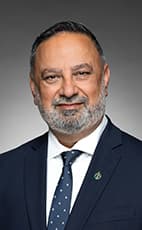
Harb Gill
In the 90 days to September 18, 2026, 2 organizations lobbied Harb Gill across 2 meetings — most often about Industry. The most frequent visitor was Greater Toronto Airports Authority (1 meeting, via their in-house lobbyist Deborah Flint). Its registration describes the goal as “Engagement on planning for FIFA related to tourism, economic development, and opportunities to pilot programs at Toronto Pearson to improve…”. That's fewer than the average MP, who had 6 meetings over the same period.
Based on federal lobbying registry data to September 18, 2026
In the House · Sep 21–25
Harb Gill this week
“The Supreme Court has recognized the right to strike as constitutionally protected. Can the parliamentary secretary tell us why his government is giving its own minister the power to interfere or replace that fundamental right with binding arbitration?”
- Spoke 1 time in the House · the average MP spoke 4 times
- FORC-266, second reading — Establish a national framework respecting skilled trades and labour mobility · passed 295–21
Get Harb Gill's week in your inbox every Monday
What they said, how they voted, and who lobbied them. Free, no ads, unsubscribe anytime.
How Harb Gill actually voted
Their recorded positions on the issues Canadians care about — pulled straight from the parliamentary record.
- Voted For
Labour & Employment
Establish a national framework respecting skilled trades and labour mobility
C-266 · Sep 2026 · Passed · Tell your MP what you think
- Voted Against
Economy & Taxation
Implement certain provisions of the spring economic update tabled in Parliament on April 28, 2026
C-30 · Jun 2026 · Passed · Tell your MP what you think
- Voted Against
Housing
Authorize certain payments to be made out of the Consolidated Revenue Fund for the purpose of improving housing supply
C-26 · Jun 2026 · Passed · Tell your MP what you think
- Voted Against
Criminal Justice
Hate propaganda, hate crime and access to religious or cultural places
C-9 · Jun 2026 · Passed · Tell your MP what you think
- Voted Against
Overall leanings
100%
voted with the Conservative line this Parliament
100%
vote attendance (174/174)
Who’s in Harb’s ear
56
lobbying meetings
35
companies & groups
153
speeches in Parliament
Top lobbying relationship: Canadian Automobile Dealers Association (CADA) — met 5 times · most lobbied on International Trade.
See who’s lobbying Harb →Who's lobbying Harb
Individual meeting records from the federal lobbying registry
| Date | Organization | |
|---|---|---|
| 2026-08-26 | Greater Toronto Airports Authority | |
| 2026-08-21 | Canadian Vehicle Manufacturers' Association | |
| 2026-06-18 | Erie Meats | |
| 2026-06-18 | HONDA CANADA INC. | |
| 2026-06-18 | Toyota Canada Inc. |
Write to Harb Gill
Pick what it's about. You'll get a letter you can edit, then send it from your own email.
Other ways to reach Harb
613-992-4211 is the House of Commons switchboard — ask to be connected to your MP's office. For constituency office contact details, or if harb.gill@parl.gc.ca bounces, visit their Parliament profile.
What Harb talks about
- Strengthening Canada's Immigration System and Borders Act12 speeches · 2025
- Canada's Auto Industry9 speeches · 2025
- Budget 2025 Implementation Act, No. 17 speeches · 2025
- Lawful Access Act, 20267 speeches · 2026
- Automotive Industry6 speeches · 2025–2026
Recent Speeches
Mr. Speaker, the Supreme Court has recognized the right to strike as constitutionally protected. Can the parliamentary secretary tell us why his government is giving its own minister the power to interfere or replace that fundamental right with binding arbitration?
Mr. Speaker, it is always a pleasure and an honour to rise on behalf of the good people of Windsor West. Today, I rise to speak on their behalf to Bill C-9. Before I do, I would like to take a moment to recognize two brave police officers who made the ultimate sacrifice while serving their communiti… Read full speechShow less
Mr. Speaker, it is always a pleasure and an honour to rise on behalf of the good people of Windsor West. Today, I rise to speak on their behalf to Bill C-9. Before I do, I would like to take a moment to recognize two brave police officers who made the ultimate sacrifice while serving their communities. Last week, Toronto police officer Marc Pinizzotto was killed in the line of duty while taking part in the execution of search warrants connected to a series of shootings, including attacks at the U.S. consulate and a synagogue in Toronto. Just days earlier, OPP officer Tarun Bali also lost his life while serving the people of Ontario. To their families, friends, loved ones and fellow officers, I offer my sincere condolences. These losses hit close to home for me. More than 30 years ago, I began my career in public service as a police officer with the Toronto Police Service. I spent nearly seven years there before continuing my police career in the Windsor-Essex region, serving a total of 29 years in law enforcement. I still remember what it felt like to put on the uniform and head out on patrol. I remember the pride that came with it, but I also remember the risks that came with the job. Police officers leave home every day not knowing what the next radio call will bring. Their families understand that reality too. That is why the deaths of Officer Pinizzotto and Officer Bali are felt so deeply, not just by their families and colleagues, but by police officers and former police officers across this country. Their sacrifice deserves our respect and our gratitude, and their memory deserves to be honoured. One officer came from an Italian Canadian family, the other from an Indo-Canadian family. Different backgrounds, different communities, yet both wore the same uniform, took the same oath and made the same sacrifice in service to Canada. They protected everyone. That is what police officers across this country do. As I thought about these officers, I could not help but think about the debate we are having today. A police officer has lost his life while investigating violent criminals connected to attacks on places of worship and innocent people. That reality should remind all of us that hatred is not an abstract concept. It has real consequences. It destroys lives. It tears at communities. When left unchecked, it can lead to violence. A few weeks ago, many Canadians joined Rwandan communities across this country by marking Kwibuka, the remembrance of genocide against the Tutsi people in Rwanda. Kwibuka means “to remember”. It is a solemn reminder of one of the darkest chapters in modern history. Last Saturday, I had the privilege of attending such a commemoration in Windsor, where I listened to Kizito Kalima, known to many as “Big Z”, and to other members of Windsor's Rwandan community as they shared stories of loss, resilience, reconciliation and hope. Their message was powerful. It was not a message rooted in bitterness or revenge. It was a message rooted in remembrance, healing, reconciliation and hope. That message stayed with me, and I believe it carries lessons for all Canadians. Let me be absolutely clear: Canada is not Rwanda. Our institutions are strong. Our democracy is strong. Our people are united by far more than what divides us, but history still has lessons to teach us. One of those lessons is that hatred rarely begins with violence. It begins when people stop seeing their neighbours as fellow citizens. It begins when stereotypes replace understanding and when fear replaces trust. The lesson of Rwanda is not that hatred suddenly appeared. The lesson is that too many leaders ignored the warning signs for far too long. Fortunately, Canada is not facing those circumstances, but that does not mean we should ignore our responsibility to build trust, strengthen communities and unite Canadians. General Dallaire has spent decades reminding Canadians that the lessons of Rwanda are not simply about one country at one moment in history. They are lessons about humanity. They are lessons about leadership. They are lessons about the responsibility we all share to confront hatred before it turns to violence. That is why this debate matters. Racism is real. Anti-Semitism is real. Islamophobia is real. Hinduphobia is real. Every one of us has a responsibility to challenge those things wherever they appear. However, laws alone cannot solve them. No Criminal Code amendment can teach respect, build trust or replace leadership. The words spoken by elected officials matter. The examples set by government matter. The way we speak about one another matters. Good intentions matter too, but good intentions alone are not enough. What ultimately matters is the results of government policies. We are living in unprecedented times. Many Canadians are carrying real burdens. Some are worried about paying their bills. Some are worried about finding a home for their family. Some are worried about crime in their communities. Some are worried about discrimination and hatred. Some are worried about the future their children will inherit. When people are worried, frustrated or uncertain, the tone of public discussion can change. That does not excuse hatred, racism, anti-Semitism or Islamophobia, and it certainly does not excuse violence. However, it should remind us that leadership matters. The responsibility of leaders is to lower the temperature, build trust and bring people together around our common values. That is how strong societies remain strong. That is how diverse societies remain united. The question before us is not whether hate is wrong. The question is whether Bill C-9 is necessary and whether it will achieve what the government says it will achieve. There are provisions in this legislation that deserve support. Every Canadian should be able to attend a church, synagogue, mosque, temple, gurdwara, community centre or school without fear of intimidation or violence. I also support the Senate amendment adding the noose as a prohibited symbol of anti-Black hate. As a former police officer, I understand the historical weight that symbol carries and the fear it is intended to create. There is value in providing clarity to police officers and prosecutors dealing with such cases. After spending nearly three decades in policing, I tend to look at legislation through a very specific lens. I look at it and ask two questions. First, is it enforceable? Second, will it make Canadians safer without stepping on their rights and freedoms? Those are the questions all police officers ask. Those are the questions Parliament should be asking as well. The government speaks as though Canada has no laws to deal with hate crimes. That is simply not true. We already have laws against the public incitement of hatred. We already have laws against the wilful promotion of hatred. We already have laws against threats, intimidation, harassment, vandalism and violence directed at people because of their religion, race, ethnicity or background. Judges can already impose tougher sentences when crimes are motivated by hate. These tools already exist. The problem is not that we lack laws. The problem is having the courage to enforce the laws. This is where I believe the government is missing the point, unfortunately. Canadians are increasingly concerned about public safety. They are concerned about violent repeat offenders. They are concerned about organized crime, gang violence, extortion and human trafficking. They are concerned about the lack of consequences for repeat offenders. These concerns are real. They are being discussed around kitchen tables and at coffee shops across this country. After 10 years of policies that have weakened confidence in our justice system, Canadians are asking whether Parliament is focused on the right priorities. Removing a long-standing protection for good-faith expression will not stop a gang shooting, a human trafficker or an extortion ring. It will not stop repeat violent offenders or the transnational gangs that continue to terrorize communities across Canada. Officer Pinizzotto was not investigating a sermon; he was investigating violent criminal activity. That is where the danger is, and that is where Canadians expect their government to be focused. As lawmakers, we should always ask whether a proposed law addresses the problem it claims to solve. In this case, I am not convinced it does. One of the most significant concerns with this legislation involves the government's decision to remove long-standing protections in the Criminal Code for good-faith expression of religious beliefs. For decades, Canadian law has struck a careful balance. It protected vulnerable communities from genuine hatred while protecting good-faith expression of religious beliefs. That balance was not preventing police from investigating crimes or prosecutors from laying charges. It certainly did not stop courts from handing out convictions. These distinctions matter. Acts of hatred, intimidation and vandalism should be investigated, prosecuted and punished. No one disputes that. However, the way we do it matters. At the end of the day, we have to understand that Canada's strength comes from our ability to live together despite our differences. It comes from our ability to disagree without being disagreeable. It comes from our willingness to remember that before we are Conservatives, Liberals, New Democrats, Bloc members or Greens, we are Canadians. As we remember Officer Pinizzotto and Officer Bali, let us remember what they were doing. They were protecting innocent people. They were protecting communities of every faith and every background. They were confronting violent criminals and standing up against those who would use fear, intimidation and violence to divide us. That is the Canada they served.
Mr. Speaker, that is a good question. I would say that, yes, there is a lack of courage and a degree of timidity among the ranks, especially the higher ranks, not the frontline folks. They are ready to do the work they are assigned, but one has to have the courage to do what needs to be done. Courag… Read full speechShow less
Mr. Speaker, that is a good question. I would say that, yes, there is a lack of courage and a degree of timidity among the ranks, especially the higher ranks, not the frontline folks. They are ready to do the work they are assigned, but one has to have the courage to do what needs to be done. Courage has to be shown by prosecutors, as well as judges. When somebody drops the ball, it is not a judge who goes to a mic and answers questions, or a Crown prosecutor for that matter. The guy who is left holding the bag is the police officer, who has to explain why the judge made a certain decision or why the Crown prosecutor did not proceed. These are the challenges that our friends from the opposite side are not quite getting.
That is incorrect, Mr. Speaker. The legislation already exists. If anybody, regardless of what text they use, is inciting violence against any Canadian, or non‑Canadian for that matter, that is already an offence and we have the tools necessary to lay those charges. As I said, we just need the coura… Read full speechShow less
That is incorrect, Mr. Speaker. The legislation already exists. If anybody, regardless of what text they use, is inciting violence against any Canadian, or non‑Canadian for that matter, that is already an offence and we have the tools necessary to lay those charges. As I said, we just need the courage to lay those charges.
Mr. Speaker, Officer Pinizzotto did not die investigating a sermon. He died investigating hate crimes. He died investigating a shooting at the U.S. consulate. I can tell members from experience that, generally speaking, police officers are not out there challenging people at a religious ceremony to … Read full speechShow less
Mr. Speaker, Officer Pinizzotto did not die investigating a sermon. He died investigating hate crimes. He died investigating a shooting at the U.S. consulate. I can tell members from experience that, generally speaking, police officers are not out there challenging people at a religious ceremony to say whether the sermon is allowed or not allowed. Police officers are not the experts. They do not have the wherewithal to do all of those things. The challenge is that when we have unclear legislation, it causes confusion. That lack of clarity is going to cause more harm in our country, rather than solve any problems.
Recent activity
21 activities across speeches, bills, and lobbying communications.
September 2026
Government Orders
Mr. Speaker, the Supreme Court has recognized the right to strike as constitutionally protected. Can the parliamentary secretary tell us why his government is giving its own minister the power to inte… Read full speechShow less
Mr. Speaker, the Supreme Court has recognized the right to strike as constitutionally protected. Can the parliamentary secretary tell us why his government is giving its own minister the power to interfere or replace that fundamental right with binding arbitration?
June 2026
Government Orders
Mr. Speaker, it is always a pleasure and an honour to rise on behalf of the good people of Windsor West. Today, I rise to speak on their behalf to Bill C-9. Before I do, I would like to take a moment … Read full speechShow less
Mr. Speaker, it is always a pleasure and an honour to rise on behalf of the good people of Windsor West. Today, I rise to speak on their behalf to Bill C-9. Before I do, I would like to take a moment to recognize two brave police officers who made the ultimate sacrifice while serving their communities. Last week, Toronto police officer Marc Pinizzotto was killed in the line of duty while taking part in the execution of search warrants connected to a series of shootings, including attacks at the U.S. consulate and a synagogue in Toronto. Just days earlier, OPP officer Tarun Bali also lost his life while serving the people of Ontario. To their families, friends, loved ones and fellow officers, I offer my sincere condolences. These losses hit close to home for me. More than 30 years ago, I began my career in public service as a police officer with the Toronto Police Service. I spent nearly seven years there before continuing my police career in the Windsor-Essex region, serving a total of 29 years in law enforcement. I still remember what it felt like to put on the uniform and head out on patrol. I remember the pride that came with it, but I also remember the risks that came with the job. Police officers leave home every day not knowing what the next radio call will bring. Their families understand that reality too. That is why the deaths of Officer Pinizzotto and Officer Bali are felt so deeply, not just by their families and colleagues, but by police officers and former police officers across this country. Their sacrifice deserves our respect and our gratitude, and their memory deserves to be honoured. One officer came from an Italian Canadian family, the other from an Indo-Canadian family. Different backgrounds, different communities, yet both wore the same uniform, took the same oath and made the same sacrifice in service to Canada. They protected everyone. That is what police officers across this country do. As I thought about these officers, I could not help but think about the debate we are having today. A police officer has lost his life while investigating violent criminals connected to attacks on places of worship and innocent people. That reality should remind all of us that hatred is not an abstract concept. It has real consequences. It destroys lives. It tears at communities. When left unchecked, it can lead to violence. A few weeks ago, many Canadians joined Rwandan communities across this country by marking Kwibuka, the remembrance of genocide against the Tutsi people in Rwanda. Kwibuka means “to remember”. It is a solemn reminder of one of the darkest chapters in modern history. Last Saturday, I had the privilege of attending such a commemoration in Windsor, where I listened to Kizito Kalima, known to many as “Big Z”, and to other members of Windsor's Rwandan community as they shared stories of loss, resilience, reconciliation and hope. Their message was powerful. It was not a message rooted in bitterness or revenge. It was a message rooted in remembrance, healing, reconciliation and hope. That message stayed with me, and I believe it carries lessons for all Canadians. Let me be absolutely clear: Canada is not Rwanda. Our institutions are strong. Our democracy is strong. Our people are united by far more than what divides us, but history still has lessons to teach us. One of those lessons is that hatred rarely begins with violence. It begins when people stop seeing their neighbours as fellow citizens. It begins when stereotypes replace understanding and when fear replaces trust. The lesson of Rwanda is not that hatred suddenly appeared. The lesson is that too many leaders ignored the warning signs for far too long. Fortunately, Canada is not facing those circumstances, but that does not mean we should ignore our responsibility to build trust, strengthen communities and unite Canadians. General Dallaire has spent decades reminding Canadians that the lessons of Rwanda are not simply about one country at one moment in history. They are lessons about humanity. They are lessons about leadership. They are lessons about the responsibility we all share to confront hatred before it turns to violence. That is why this debate matters. Racism is real. Anti-Semitism is real. Islamophobia is real. Hinduphobia is real. Every one of us has a responsibility to challenge those things wherever they appear. However, laws alone cannot solve them. No Criminal Code amendment can teach respect, build trust or replace leadership. The words spoken by elected officials matter. The examples set by government matter. The way we speak about one another matters. Good intentions matter too, but good intentions alone are not enough. What ultimately matters is the results of government policies. We are living in unprecedented times. Many Canadians are carrying real burdens. Some are worried about paying their bills. Some are worried about finding a home for their family. Some are worried about crime in their communities. Some are worried about discrimination and hatred. Some are worried about the future their children will inherit. When people are worried, frustrated or uncertain, the tone of public discussion can change. That does not excuse hatred, racism, anti-Semitism or Islamophobia, and it certainly does not excuse violence. However, it should remind us that leadership matters. The responsibility of leaders is to lower the temperature, build trust and bring people together around our common values. That is how strong societies remain strong. That is how diverse societies remain united. The question before us is not whether hate is wrong. The question is whether Bill C-9 is necessary and whether it will achieve what the government says it will achieve. There are provisions in this legislation that deserve support. Every Canadian should be able to attend a church, synagogue, mosque, temple, gurdwara, community centre or school without fear of intimidation or violence. I also support the Senate amendment adding the noose as a prohibited symbol of anti-Black hate. As a former police officer, I understand the historical weight that symbol carries and the fear it is intended to create. There is value in providing clarity to police officers and prosecutors dealing with such cases. After spending nearly three decades in policing, I tend to look at legislation through a very specific lens. I look at it and ask two questions. First, is it enforceable? Second, will it make Canadians safer without stepping on their rights and freedoms? Those are the questions all police officers ask. Those are the questions Parliament should be asking as well. The government speaks as though Canada has no laws to deal with hate crimes. That is simply not true. We already have laws against the public incitement of hatred. We already have laws against the wilful promotion of hatred. We already have laws against threats, intimidation, harassment, vandalism and violence directed at people because of their religion, race, ethnicity or background. Judges can already impose tougher sentences when crimes are motivated by hate. These tools already exist. The problem is not that we lack laws. The problem is having the courage to enforce the laws. This is where I believe the government is missing the point, unfortunately. Canadians are increasingly concerned about public safety. They are concerned about violent repeat offenders. They are concerned about organized crime, gang violence, extortion and human trafficking. They are concerned about the lack of consequences for repeat offenders. These concerns are real. They are being discussed around kitchen tables and at coffee shops across this country. After 10 years of policies that have weakened confidence in our justice system, Canadians are asking whether Parliament is focused on the right priorities. Removing a long-standing protection for good-faith expression will not stop a gang shooting, a human trafficker or an extortion ring. It will not stop repeat violent offenders or the transnational gangs that continue to terrorize communities across Canada. Officer Pinizzotto was not investigating a sermon; he was investigating violent criminal activity. That is where the danger is, and that is where Canadians expect their government to be focused. As lawmakers, we should always ask whether a proposed law addresses the problem it claims to solve. In this case, I am not convinced it does. One of the most significant concerns with this legislation involves the government's decision to remove long-standing protections in the Criminal Code for good-faith expression of religious beliefs. For decades, Canadian law has struck a careful balance. It protected vulnerable communities from genuine hatred while protecting good-faith expression of religious beliefs. That balance was not preventing police from investigating crimes or prosecutors from laying charges. It certainly did not stop courts from handing out convictions. These distinctions matter. Acts of hatred, intimidation and vandalism should be investigated, prosecuted and punished. No one disputes that. However, the way we do it matters. At the end of the day, we have to understand that Canada's strength comes from our ability to live together despite our differences. It comes from our ability to disagree without being disagreeable. It comes from our willingness to remember that before we are Conservatives, Liberals, New Democrats, Bloc members or Greens, we are Canadians. As we remember Officer Pinizzotto and Officer Bali, let us remember what they were doing. They were protecting innocent people. They were protecting communities of every faith and every background. They were confronting violent criminals and standing up against those who would use fear, intimidation and violence to divide us. That is the Canada they served.
Government Orders
Mr. Speaker, that is a good question. I would say that, yes, there is a lack of courage and a degree of timidity among the ranks, especially the higher ranks, not the frontline folks. They are ready t… Read full speechShow less
Mr. Speaker, that is a good question. I would say that, yes, there is a lack of courage and a degree of timidity among the ranks, especially the higher ranks, not the frontline folks. They are ready to do the work they are assigned, but one has to have the courage to do what needs to be done. Courage has to be shown by prosecutors, as well as judges. When somebody drops the ball, it is not a judge who goes to a mic and answers questions, or a Crown prosecutor for that matter. The guy who is left holding the bag is the police officer, who has to explain why the judge made a certain decision or why the Crown prosecutor did not proceed. These are the challenges that our friends from the opposite side are not quite getting.
Government Orders
That is incorrect, Mr. Speaker. The legislation already exists. If anybody, regardless of what text they use, is inciting violence against any Canadian, or non‑Canadian for that matter, that is alread… Read full speechShow less
That is incorrect, Mr. Speaker. The legislation already exists. If anybody, regardless of what text they use, is inciting violence against any Canadian, or non‑Canadian for that matter, that is already an offence and we have the tools necessary to lay those charges. As I said, we just need the courage to lay those charges.
Government Orders
Mr. Speaker, Officer Pinizzotto did not die investigating a sermon. He died investigating hate crimes. He died investigating a shooting at the U.S. consulate. I can tell members from experience that, … Read full speechShow less
Mr. Speaker, Officer Pinizzotto did not die investigating a sermon. He died investigating hate crimes. He died investigating a shooting at the U.S. consulate. I can tell members from experience that, generally speaking, police officers are not out there challenging people at a religious ceremony to say whether the sermon is allowed or not allowed. Police officers are not the experts. They do not have the wherewithal to do all of those things. The challenge is that when we have unclear legislation, it causes confusion. That lack of clarity is going to cause more harm in our country, rather than solve any problems.
Government Orders
Mr. Speaker, that is a very valid question. The question is about leadership. The leadership starts from the top. It starts with the government of the day. The government has to provide that leadershi… Read full speechShow less
Mr. Speaker, that is a very valid question. The question is about leadership. The leadership starts from the top. It starts with the government of the day. The government has to provide that leadership. The words should match the actions. Hence, we would have the results to prove that we are doing what we need to do.
Oral Questions
Mr. Speaker, as a cop, I was trained to ask questions when the facts did not match the story. On Tuesday, the Prime Minister said the Gordie Howe bridge was opening this weekend, and yesterday he said… Read full speechShow less
Mr. Speaker, as a cop, I was trained to ask questions when the facts did not match the story. On Tuesday, the Prime Minister said the Gordie Howe bridge was opening this weekend, and yesterday he said Canada agreed to a delay at the request of the U.S., because of technical issues, apparently. When asked the question of what the issue was, he had no answer. The bridge is built, and the staff are in place. The people in Windsor have been patient for years. Now they are getting fed up and tired of this drama, so what is the real reason for this delay, and why will the Liberal government not be honest with Canadians, who paid $6.4 billion U.S. for this bridge?
Routine Proceedings
Mr. Speaker, I am pleased to rise today to present a petition on behalf of residents of Windsor-Essex, such as Mike Fisher and The Friends of Ojibway Prairie, regarding the future of national urban pa… Read full speechShow less
Mr. Speaker, I am pleased to rise today to present a petition on behalf of residents of Windsor-Essex, such as Mike Fisher and The Friends of Ojibway Prairie, regarding the future of national urban parks and the proposed Ojibway National Urban Park. The petitioners recognize Canada's commitment to establish up to 15 national urban parks and believe these important national spaces require clear legislative protection, ecologically grounded boundaries, and governance that includes the meaningful participation of indigenous nations and local communities. They also know the ecological significance of the Ojibway Prairie Complex and other nationally important landscapes. Therefore, the petitioners call upon the House of Commons to establish a legislative framework for national urban parks and to expedite the creation of this important network of protected spaces across Canada.
Government Orders
Mr. Speaker, after a decade of Liberal government scandals, foreign interference concerns and loss of public trust, the government wants Parliament to rush through the bill and change the rules govern… Read full speechShow less
Mr. Speaker, after a decade of Liberal government scandals, foreign interference concerns and loss of public trust, the government wants Parliament to rush through the bill and change the rules governing federal elections. This process deprives Canadians of a fulsome debate. Why is the government focused on rewriting election laws instead of rebuilding the trust that Canadians have lost? They need trust brought back to democratic institutions. That is not what the Liberals are doing. They have spent years undermining that trust. Why do they not work on affordability, crime prevention and economic growth so Canadians can once again trust what their government is doing?
Oral Questions
Mr. Speaker, under the Liberal Prime Minister, Canada is the only G20 country in a recession, and the Prime Minister has zero respect for the sacrifices Canadians are making every day. We know familie… Read full speechShow less
Mr. Speaker, under the Liberal Prime Minister, Canada is the only G20 country in a recession, and the Prime Minister has zero respect for the sacrifices Canadians are making every day. We know families are cutting back. Businesses are delaying investment. Productivity is falling. A former central banker is driving the economy, and the Parliamentary Budget Officer, appointed by him, is saying there is a 99% chance he is going to drive the economy into a ditch. Will the Prime Minister admit Canada is in a recession, or does he believe Canadians are better off after 10 years of Liberal rule?
Government Orders
Mr. Speaker, while we debate billions in government spending, Canadians and Windsorites learned today about the opening of the Gordie Howe International Bridge, and from Michigan officials, no less. T… Read full speechShow less
Mr. Speaker, while we debate billions in government spending, Canadians and Windsorites learned today about the opening of the Gordie Howe International Bridge, and from Michigan officials, no less. This government is still silent about it. This project, as my colleague knows, is years behind schedule and nearly half a billion dollars over budget. If the government cannot even tell us clearly about one of the largest infrastructure projects in our country's history, which Canadians paid for, by the way, how can Canadians have confidence in the government that it can properly manage the billions of dollars the government is asking us to approve today?
May 2026
Oral Questions
Mr. Speaker, Canada is the only G7 nation facing a recession under this Liberal Prime Minister. After months of “elbows up” rhetoric, he went to New York this week and said he would be making America … Read full speechShow less
Mr. Speaker, Canada is the only G7 nation facing a recession under this Liberal Prime Minister. After months of “elbows up” rhetoric, he went to New York this week and said he would be making America great again. If flip-flopping generated electricity, the Liberal Prime Minister could power the EV sector all by himself. As a former cop, I have seen plenty of U-turns, but I have never seen one presented as a trade strategy. Can the Prime Minister just make up his mind and get to work, or are Canadians expected to live with a government that is always a day late and several dollars short?
Government Orders
Mr. Chair, firstly, I will be splitting my time. Secondly, I am an immigrant, and I value the hard work, sacrifices and contributions of all immigrants across this great country. Organized crime, exto… Read full speechShow less
Mr. Chair, firstly, I will be splitting my time. Secondly, I am an immigrant, and I value the hard work, sacrifices and contributions of all immigrants across this great country. Organized crime, extortion, immigration fraud and criminals gaining entry to our country all increased under the minister's watch. Canadians are asking a simple question: Was the minister completely reckless, or was the minister completely clueless?
Government Orders
Mr. Chair, that was no answer. In connection to a major international extortion network targeting business owners, 17 people were arrested earlier this week in Peel Region. How many of them came as st… Read full speechShow less
Mr. Chair, that was no answer. In connection to a major international extortion network targeting business owners, 17 people were arrested earlier this week in Peel Region. How many of them came as students, visitors or temporary residents under her watch, and when is the minister deporting them?
Government Orders
Mr. Chair, that was no answer again. Extortion cases in Surrey exploded by more than 1,000% in barely a year. These gangs did not swim here. How many entered Canada through temporary visa programs tha… Read full speechShow less
Mr. Chair, that was no answer again. Extortion cases in Surrey exploded by more than 1,000% in barely a year. These gangs did not swim here. How many entered Canada through temporary visa programs that this minister approved?
Government Orders
Mr. Chair, lack of screening at the border has allowed known criminals into our country. We have fake colleges, fake jobs and fraudulent visas. The warning signs were everywhere. My former colleagues … Read full speechShow less
Mr. Chair, lack of screening at the border has allowed known criminals into our country. We have fake colleges, fake jobs and fraudulent visas. The warning signs were everywhere. My former colleagues in law enforcement want to know why the minister was negligent in her duties.
Government Orders
Mr. Chair, the minister flooded the system with temporary visas while fraud, fake schools and criminal exploitation exploded nationwide. Did the Minister of Public Safety ever talk to her about doing … Read full speechShow less
Mr. Chair, the minister flooded the system with temporary visas while fraud, fake schools and criminal exploitation exploded nationwide. Did the Minister of Public Safety ever talk to her about doing basic security checks on people before allowing them into the country?
Government Orders
Mr. Chair, that was no answer. There are at least seven international cartels operating in Canada. Does the minister know how many of these suspected cartel members entered Canada through programs tha… Read full speechShow less
Mr. Chair, that was no answer. There are at least seven international cartels operating in Canada. Does the minister know how many of these suspected cartel members entered Canada through programs that she signed off on?
Government Orders
Mr. Chair, extortion cases across Canada have jumped roughly 330% since 2015. Did it ever occur to the minister that her lack of basic security checks have caused a major public disaster? Some people … Read full speechShow less
Mr. Chair, extortion cases across Canada have jumped roughly 330% since 2015. Did it ever occur to the minister that her lack of basic security checks have caused a major public disaster? Some people have lost their lives, and many their livelihoods, because of her inaction.
Government Orders
Mr. Chair, Canadians were told that foreign students and skilled workers were being let in. Instead, our communities are now dealing with organized extortion rings, fraud networks and intimidation. Is… Read full speechShow less
Mr. Chair, Canadians were told that foreign students and skilled workers were being let in. Instead, our communities are now dealing with organized extortion rings, fraud networks and intimidation. Is it fair to say that the minister has no idea what she is doing or who she is letting into the country?
February 2026
House of Commons
22 communications with 17 clients
Top clients: [{"name": "Canadian Vehicle Manufacturers' Association", "count": 3}, {"name": "…