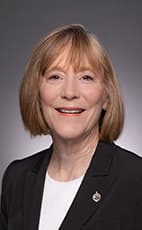
Helena Konanz
In the 90 days to September 18, 2026, 2 organizations lobbied Helena Konanz across 2 meetings — most often about Telecommunications. The most frequent visitor was Rogers Communications Inc. (1 meeting, via their in-house lobbyist Anthony Staffieri). Its registration describes the goal as “implications and interpretations of proposed privacy legislation, C-36”. That's fewer than the average MP, who had 6 meetings over the same period.
Based on federal lobbying registry data to September 18, 2026
In the House · Sep 21–25
Helena Konanz this week
“On the evening of August 7, when the Bald Range wildfire ignited and spread with frightening speed, brave firefighters and first responders put their lives on the line to keep us safe and to protect our lives, our homes and our communities.”
- Spoke 6 times in the House · the average MP spoke 4 times
- FORC-266, second reading — Establish a national framework respecting skilled trades and labour mobility · passed 295–21
Get Helena Konanz's week in your inbox every Monday
What they said, how they voted, and who lobbied them. Free, no ads, unsubscribe anytime.
How Helena Konanz actually voted
Their recorded positions on the issues Canadians care about — pulled straight from the parliamentary record.
- Voted For
Labour & Employment
Establish a national framework respecting skilled trades and labour mobility
C-266 · Sep 2026 · Passed · Tell your MP what you think
- Voted Against
Economy & Taxation
Implement certain provisions of the spring economic update tabled in Parliament on April 28, 2026
C-30 · Jun 2026 · Passed · Tell your MP what you think
- Voted Against
Housing
Authorize certain payments to be made out of the Consolidated Revenue Fund for the purpose of improving housing supply
C-26 · Jun 2026 · Passed · Tell your MP what you think
- Voted Against
Criminal Justice
Hate propaganda, hate crime and access to religious or cultural places
C-9 · Jun 2026 · Passed · Tell your MP what you think
- Voted Against
Overall leanings
100%
voted with the Conservative line this Parliament
100%
vote attendance (174/174)
Who’s in Helena’s ear
30
lobbying meetings
28
companies & groups
198
speeches in Parliament
Top lobbying relationship: CANADIAN HEALTH FOOD ASSOCIATION — met 2 times · most lobbied on Health.
See who’s lobbying Helena →Who's lobbying Helena
Individual meeting records from the federal lobbying registry
| Date | Organization | |
|---|---|---|
| 2026-08-19 | Rogers Communications Inc. | |
| 2026-07-03 | Tourism Industry Association of Canada | |
| 2026-06-16 | Forest Products Association of Canada | |
| 2026-06-15 | Canadian AIDS Treatment Information Exchange | |
| 2026-06-12 | Canadian Mental Health Association |
Write to Helena Konanz
Pick what it's about. You'll get a letter you can edit, then send it from your own email.
Other ways to reach Helena
613-992-4211 is the House of Commons switchboard — ask to be connected to your MP's office. For constituency office contact details, or if helena.konanz@parl.gc.ca bounces, visit their Parliament profile.
Committee Memberships
What Helena talks about
- Health12 speeches · 2026
- Budget 2025 Implementation Act, No. 17 speeches · 2025–2026
- Commissioner for Modern Treaty Implementation Act7 speeches · 2025
- Carbon Pricing6 speeches · 2025–2026
- Natural Resources6 speeches · 2025–2026
Recent Speeches
Mr. Speaker, on the evening of August 7, when the Bald Range wildfire ignited and spread with frightening speed, brave firefighters and first responders put their lives on the line to keep us safe and to protect our lives, our homes and our communities. Within hours, the entire community of Summerla… Read full speechShow less
Mr. Speaker, on the evening of August 7, when the Bald Range wildfire ignited and spread with frightening speed, brave firefighters and first responders put their lives on the line to keep us safe and to protect our lives, our homes and our communities. Within hours, the entire community of Summerland was evacuated. Thousands of evacuees poured into Penticton, many with little more than the shirts on their backs. Citizens opened up their homes, served meals and handed out water. Comfort centres opened for families who had lost everything, but in that darkness, we saw courage and compassion. we thank the firefighters, first responders, volunteers and every neighbour who stepped forward for showing us, in the face of disaster, how much we all mean to each other.
Mr. Speaker, it is always an honour to rise in the House to represent the great residents of Similkameen—South Okanagan—West Kootenay. Their words and their feedback will always guide me in this chamber, as they do in this debate on Bill C-38. For rural and remote communities like the one I represen… Read full speechShow less
Mr. Speaker, it is always an honour to rise in the House to represent the great residents of Similkameen—South Okanagan—West Kootenay. Their words and their feedback will always guide me in this chamber, as they do in this debate on Bill C-38. For rural and remote communities like the one I represent, driving is a fact of life. It is not a choice. When I checked GasBuddy before coming to the House today, I found that regular gas was priced as high as $2.09 per litre and diesel was $2.95 a litre. Whether someone lives in Tulameen, Princeton, Keremeos, Cawston, Osoyoos, Rock Creek, Midway, Greenwood, Grand Forks, Christina Lake or Castlegar, a basic fact of life is that they drive, which means that almost everyone is paying high prices at the pump. The journey I just described across my riding is 360 kilometres. Unlike the urban regions of the country that many Liberal colleagues across from me represent, there is no SkyTrain. There is no subway, no LimeBike and no e-scooter that my constituents can turn to and travel across our riding in. Transportation costs are also affected by high gas prices. These costs then transfer to nearly every item on store shelves. Keeping prices down at the pump, as we have been speaking about for the past year, means keeping prices down on essential items at Walmart, Canadian Tire and Safeway. This is true not just for my constituents, but for anyone across the country who lives in a remote or rural region, from island communities to our Arctic territories. This is why, since the spring, my colleagues and I on this side of the House have been arguing that at a time of higher gas prices, the result of both conflict abroad and policy decisions at home, it was of the utmost importance for all members of Parliament to act to reduce the price of gas where we can do so. No one is pretending it can or should magically fall to zero, but providing tax relief at the pump is the least we can do when so many Canadians are in need. It is no coincidence that the lack of an affordable life is the number one thing I heard from my constituents this summer. I am guessing everyone else heard the same thing while they were in their ridings this summer. Of course, there were other issues, including health care, tariffs and wildfires. In my region, as many know, wildfires hit Summerland and the Penticton area tremendously. This was obviously what people talked about, but gas prices were very important because they have skyrocketed 25.7%, while overall energy costs have surged 16%. This pushed transportation costs up 7% while grocery prices rose 3%. A recent poll found that 63% of Canadians oppose the Liberals bringing back the fuel excise tax, including 43% who strongly oppose it. This includes 72% of seniors, 68% of women and 61% of those aged 35 to 54. Opposition crosses every region of the country: 71% in Manitoba and Saskatchewan; 64% in British Columbia, Alberta and Atlantic Canada; 62% in Ontario; and 60% in Quebec. Everyone is opposed to this tax, in other words. There is no reason the House cannot deliver for them. When the Liberals offered what they called summer gas tax relief, it was clear that what they were offering was not only insufficient, but very confusing. When I asked government members about this policy, they made no commitment to it beyond the summer, and the member for Delta also made it sound like the policy was meant to help people explore our home province and go camping. While I did have the opportunity to see much of my beautiful province this summer, it was not cheap to do so. In fact, I know several British Columbians who cancelled road trips and hunting expeditions this summer because the cost was too much and the price of gas was too high. Those costs will only rise as the snow starts to fall. That is why my colleagues and I were clear on the need for an extension to the gas tax relief so it could go further and for longer than just the summer until Labour Day. The bill before us today is because of those efforts, stopping what would have been a punishing tax hike at the pumps just this month. The Liberals' rosy rhetoric has not matched what Canadians are seeing in their wallets or on their bank statements. They cannot afford higher taxes. Thanks to Conservatives keeping up the fight for affordability, Canadians will keep more money in their pockets when they are filling up at the gas station this month, but we can go further. We can improve the bill before us. Bill C-38, as it is currently written, would suspend the fuel tax until January 31, 2027. Half the tax would return on February 1 and the full tax on April 1. Is the Liberal government predicting that Canadians will not be challenged by the costs at the grocery store, by their heating bills or by the price of the pump by April 1? Is everything going to change by then? I do not believe the Liberals have invented that kind of crystal ball, so why time-limit the relief people need? Why reimpose taxes they are currently recognizing as unnecessary? The Liberals have filled their treasury with unnecessary taxes and fees from Canadians' pockets. They have wasted far more tax dollars than we need in order to fund health care, road repairs or national defence properly. Canadians should not have to pay more for Liberal waste. The Minister of Finance himself said that truckers, farmers, home builders and delivery drivers benefit from fuel tax relief. Would they not benefit more if the government extended this relief to Canada next year, as we are calling for? Would they not benefit by permanently eliminating some of the government's gas taxes at the pump, as Conservatives are calling for? Of course, the only reason to allow gas taxes to go higher is that the government would choose to prioritize raising taxes instead of providing limited relief. Removing all federal taxes on gas and diesel, including the fuel excise tax, is what we are calling for. Eliminating costly fuel taxes like the fuel standard tax permanently would help keep prices lower. The Liberal government does not need more of Canadians' gas tax dollars for wasteful boutique projects like Alto rail, which will cost Canadians $60 billion to $90 billion in its life cycle. Instead of forcing families of four in my community to spend between $8,000 and $9,000 on eastern Canadian priorities, they want to see their gas tax dollars spent on efficient local infrastructure, like a secondary route for the South Okanagan to Kelowna, which we have been calling for for years. Conservatives support the Liberals' half measures like those in Bill C-38 if it means Canadians can get some savings, but we will be pushing for more. The legislation has the potential to provide more relief for longer, but only if we amend it. I hope all colleagues in the House can work together to do just that.
Mr. Speaker, the Conservatives have been pushing to make life more affordable. When we have packages of bills that come at us or policies that come at us that do not make sense, of course we are not going to accept every one. We need Canadians' lives to be more affordable. We have been pushing for l… Read full speechShow less
Mr. Speaker, the Conservatives have been pushing to make life more affordable. When we have packages of bills that come at us or policies that come at us that do not make sense, of course we are not going to accept every one. We need Canadians' lives to be more affordable. We have been pushing for lower taxes on gasoline everywhere, but in a riding like mine, where it is a seven- to eight-hour drive from end to end, one can understand why Canadians or why the people in my riding need to have gas prices go down. That is what we have been pushing for since last year.
Mr. Speaker, obviously this is a temporary fix. I do not think there is anyone in the House or anyone in Canada right now who thinks that life is going to be a lot more affordable by April, when this tax relief is due to end in the bill. We need to look at the long run here. This is going to be a to… Read full speechShow less
Mr. Speaker, obviously this is a temporary fix. I do not think there is anyone in the House or anyone in Canada right now who thinks that life is going to be a lot more affordable by April, when this tax relief is due to end in the bill. We need to look at the long run here. This is going to be a tough winter. This is going to be very difficult in my riding. In particular, as many members know, many people in my riding have suffered through the recent wildfire disasters. Our tourism has hit, unfortunately, rock bottom right now, because of the fires during our big tourist season. It is not just in my riding. Throughout Canada, we are going through a very difficult time, and we are going to need relief far beyond this April.
Mr. Speaker, I am so glad the member is looking a gift horse in the mouth so readily. The Liberals have a deficit of nearly $100 billion. It is one of the highest deficits ever. It is my children and the children of Canadians right now who are going to suffer when they try to pay back that deficit.
Recent activity
21 activities across speeches, bills, and lobbying communications.
September 2026
Statements by Members
Mr. Speaker, on the evening of August 7, when the Bald Range wildfire ignited and spread with frightening speed, brave firefighters and first responders put their lives on the line to keep us safe and… Read full speechShow less
Mr. Speaker, on the evening of August 7, when the Bald Range wildfire ignited and spread with frightening speed, brave firefighters and first responders put their lives on the line to keep us safe and to protect our lives, our homes and our communities. Within hours, the entire community of Summerland was evacuated. Thousands of evacuees poured into Penticton, many with little more than the shirts on their backs. Citizens opened up their homes, served meals and handed out water. Comfort centres opened for families who had lost everything, but in that darkness, we saw courage and compassion. we thank the firefighters, first responders, volunteers and every neighbour who stepped forward for showing us, in the face of disaster, how much we all mean to each other.
Government Orders
Mr. Speaker, it is always an honour to rise in the House to represent the great residents of Similkameen—South Okanagan—West Kootenay. Their words and their feedback will always guide me in this chamb… Read full speechShow less
Mr. Speaker, it is always an honour to rise in the House to represent the great residents of Similkameen—South Okanagan—West Kootenay. Their words and their feedback will always guide me in this chamber, as they do in this debate on Bill C-38. For rural and remote communities like the one I represent, driving is a fact of life. It is not a choice. When I checked GasBuddy before coming to the House today, I found that regular gas was priced as high as $2.09 per litre and diesel was $2.95 a litre. Whether someone lives in Tulameen, Princeton, Keremeos, Cawston, Osoyoos, Rock Creek, Midway, Greenwood, Grand Forks, Christina Lake or Castlegar, a basic fact of life is that they drive, which means that almost everyone is paying high prices at the pump. The journey I just described across my riding is 360 kilometres. Unlike the urban regions of the country that many Liberal colleagues across from me represent, there is no SkyTrain. There is no subway, no LimeBike and no e-scooter that my constituents can turn to and travel across our riding in. Transportation costs are also affected by high gas prices. These costs then transfer to nearly every item on store shelves. Keeping prices down at the pump, as we have been speaking about for the past year, means keeping prices down on essential items at Walmart, Canadian Tire and Safeway. This is true not just for my constituents, but for anyone across the country who lives in a remote or rural region, from island communities to our Arctic territories. This is why, since the spring, my colleagues and I on this side of the House have been arguing that at a time of higher gas prices, the result of both conflict abroad and policy decisions at home, it was of the utmost importance for all members of Parliament to act to reduce the price of gas where we can do so. No one is pretending it can or should magically fall to zero, but providing tax relief at the pump is the least we can do when so many Canadians are in need. It is no coincidence that the lack of an affordable life is the number one thing I heard from my constituents this summer. I am guessing everyone else heard the same thing while they were in their ridings this summer. Of course, there were other issues, including health care, tariffs and wildfires. In my region, as many know, wildfires hit Summerland and the Penticton area tremendously. This was obviously what people talked about, but gas prices were very important because they have skyrocketed 25.7%, while overall energy costs have surged 16%. This pushed transportation costs up 7% while grocery prices rose 3%. A recent poll found that 63% of Canadians oppose the Liberals bringing back the fuel excise tax, including 43% who strongly oppose it. This includes 72% of seniors, 68% of women and 61% of those aged 35 to 54. Opposition crosses every region of the country: 71% in Manitoba and Saskatchewan; 64% in British Columbia, Alberta and Atlantic Canada; 62% in Ontario; and 60% in Quebec. Everyone is opposed to this tax, in other words. There is no reason the House cannot deliver for them. When the Liberals offered what they called summer gas tax relief, it was clear that what they were offering was not only insufficient, but very confusing. When I asked government members about this policy, they made no commitment to it beyond the summer, and the member for Delta also made it sound like the policy was meant to help people explore our home province and go camping. While I did have the opportunity to see much of my beautiful province this summer, it was not cheap to do so. In fact, I know several British Columbians who cancelled road trips and hunting expeditions this summer because the cost was too much and the price of gas was too high. Those costs will only rise as the snow starts to fall. That is why my colleagues and I were clear on the need for an extension to the gas tax relief so it could go further and for longer than just the summer until Labour Day. The bill before us today is because of those efforts, stopping what would have been a punishing tax hike at the pumps just this month. The Liberals' rosy rhetoric has not matched what Canadians are seeing in their wallets or on their bank statements. They cannot afford higher taxes. Thanks to Conservatives keeping up the fight for affordability, Canadians will keep more money in their pockets when they are filling up at the gas station this month, but we can go further. We can improve the bill before us. Bill C-38, as it is currently written, would suspend the fuel tax until January 31, 2027. Half the tax would return on February 1 and the full tax on April 1. Is the Liberal government predicting that Canadians will not be challenged by the costs at the grocery store, by their heating bills or by the price of the pump by April 1? Is everything going to change by then? I do not believe the Liberals have invented that kind of crystal ball, so why time-limit the relief people need? Why reimpose taxes they are currently recognizing as unnecessary? The Liberals have filled their treasury with unnecessary taxes and fees from Canadians' pockets. They have wasted far more tax dollars than we need in order to fund health care, road repairs or national defence properly. Canadians should not have to pay more for Liberal waste. The Minister of Finance himself said that truckers, farmers, home builders and delivery drivers benefit from fuel tax relief. Would they not benefit more if the government extended this relief to Canada next year, as we are calling for? Would they not benefit by permanently eliminating some of the government's gas taxes at the pump, as Conservatives are calling for? Of course, the only reason to allow gas taxes to go higher is that the government would choose to prioritize raising taxes instead of providing limited relief. Removing all federal taxes on gas and diesel, including the fuel excise tax, is what we are calling for. Eliminating costly fuel taxes like the fuel standard tax permanently would help keep prices lower. The Liberal government does not need more of Canadians' gas tax dollars for wasteful boutique projects like Alto rail, which will cost Canadians $60 billion to $90 billion in its life cycle. Instead of forcing families of four in my community to spend between $8,000 and $9,000 on eastern Canadian priorities, they want to see their gas tax dollars spent on efficient local infrastructure, like a secondary route for the South Okanagan to Kelowna, which we have been calling for for years. Conservatives support the Liberals' half measures like those in Bill C-38 if it means Canadians can get some savings, but we will be pushing for more. The legislation has the potential to provide more relief for longer, but only if we amend it. I hope all colleagues in the House can work together to do just that.
Government Orders
Mr. Speaker, the Conservatives have been pushing to make life more affordable. When we have packages of bills that come at us or policies that come at us that do not make sense, of course we are not g… Read full speechShow less
Mr. Speaker, the Conservatives have been pushing to make life more affordable. When we have packages of bills that come at us or policies that come at us that do not make sense, of course we are not going to accept every one. We need Canadians' lives to be more affordable. We have been pushing for lower taxes on gasoline everywhere, but in a riding like mine, where it is a seven- to eight-hour drive from end to end, one can understand why Canadians or why the people in my riding need to have gas prices go down. That is what we have been pushing for since last year.
Government Orders
Mr. Speaker, obviously this is a temporary fix. I do not think there is anyone in the House or anyone in Canada right now who thinks that life is going to be a lot more affordable by April, when this … Read full speechShow less
Mr. Speaker, obviously this is a temporary fix. I do not think there is anyone in the House or anyone in Canada right now who thinks that life is going to be a lot more affordable by April, when this tax relief is due to end in the bill. We need to look at the long run here. This is going to be a tough winter. This is going to be very difficult in my riding. In particular, as many members know, many people in my riding have suffered through the recent wildfire disasters. Our tourism has hit, unfortunately, rock bottom right now, because of the fires during our big tourist season. It is not just in my riding. Throughout Canada, we are going through a very difficult time, and we are going to need relief far beyond this April.
Government Orders
Mr. Speaker, I am so glad the member is looking a gift horse in the mouth so readily. The Liberals have a deficit of nearly $100 billion. It is one of the highest deficits ever. It is my children and … Read full speechShow less
Mr. Speaker, I am so glad the member is looking a gift horse in the mouth so readily. The Liberals have a deficit of nearly $100 billion. It is one of the highest deficits ever. It is my children and the children of Canadians right now who are going to suffer when they try to pay back that deficit.
Routine Proceedings
Mr. Speaker, today I am presenting an e-petition with over 800 signatures on a very serious subject, which is cases involving high-risk federal offenders convicted of intimate partner violence. The pe… Read full speechShow less
Mr. Speaker, today I am presenting an e-petition with over 800 signatures on a very serious subject, which is cases involving high-risk federal offenders convicted of intimate partner violence. The petitioners ask that they would have to wear an active GPS electronic monitoring system, including either geofencing or exclusion zone enforcement where appropriate, which would provide a more effective means of supervising compliance with release conditions and enhancing victim safety. I have heard about this over and over again from my constituents, and I know everyone sitting here today also has. I hope this will bring notice to the fact that people need to feel safe. They should not have to sign a petition like this, but it is extremely necessary, and I am proud to present this today.
June 2026
Oral Questions
Mr. Speaker, we need to hear from the chair of the health committee as to why he cancelled tomorrow's meeting. Hundreds of millions of health care dollars remain unaccounted for in the $300‑million Pr… Read full speechShow less
Mr. Speaker, we need to hear from the chair of the health committee as to why he cancelled tomorrow's meeting. Hundreds of millions of health care dollars remain unaccounted for in the $300‑million PrescribeIT scandal. Why? It is because Liberal MPs keep turning off the cameras at the health committee. They turned off the cameras again yesterday. Canadians will not know what was said there for 30 years. Will the chair of the health committee tell Canadians today why he cancelled tomorrow's meeting, blocking Parliament from investigating PrescribeIT?
Routine Proceedings
Mr. Speaker, I rise to table a petition brought forward by a passionate group of residents in my community who remain deeply concerned that our laws continue to fail to safeguard the victims of intima… Read full speechShow less
Mr. Speaker, I rise to table a petition brought forward by a passionate group of residents in my community who remain deeply concerned that our laws continue to fail to safeguard the victims of intimate partner violence. Most situations of intimate partner violence begin with patterns of behaviour that involve severe mental, emotional and psychological abuse, yet our justice system and our police system too often fail to recognize this abuse and to intervene before the violence begins. The petitioners are asking us to look at legislation criminalizing this behaviour in the U.K., Ireland and Australia. They would like the Government of Canada to amend the Criminal Code to criminalize targeted mental and emotional abuse. They are also asking for changes to be reflected in our bail and judicial system, as well as in law enforcement training, so we can recognize and investigate this abuse.
Government Orders
Mr. Speaker, we are the only G7 country in a recession. Two years ago, we had a $40-billion deficit that was considered outrageous by the Canadian people, and now we have an almost $100-billion defici… Read full speechShow less
Mr. Speaker, we are the only G7 country in a recession. Two years ago, we had a $40-billion deficit that was considered outrageous by the Canadian people, and now we have an almost $100-billion deficit. In what way does the Liberal government think that is okay?
Government Orders
Mr. Speaker, I largely share my colleague's view. I would like to know what he thinks about the fact that the Liberals refuse to acknowledge the economic situation in Canada, that they do not believe … Read full speechShow less
Mr. Speaker, I largely share my colleague's view. I would like to know what he thinks about the fact that the Liberals refuse to acknowledge the economic situation in Canada, that they do not believe Canadians are going through a difficult time, and that they believe everything is fine for the average Canadian.
Government Orders
Mr. Speaker, I rise to speak to the motion as it relates to the Liberal government's spring economic statement. It may be the spring season that prompted the Liberals to use this update to paint a ros… Read full speechShow less
Mr. Speaker, I rise to speak to the motion as it relates to the Liberal government's spring economic statement. It may be the spring season that prompted the Liberals to use this update to paint a rosy picture of our economy, but the reality on the ground is that the real and non-partisan numbers show a stark picture for residents in my community, especially among working families and struggling seniors. The economic statement shows spending continuing to rise rapidly and no binding fiscal anchors. The growing deficit will only worsen as the Liberal government borrows more against the national debt. Debt service costs are rising rapidly, eating up more of each tax dollar than total spending on health care or defence. The fact is, Canada's economy has entered a recession. That is not a political talking point but an agreed economic viewpoint for decades. Any period in which our economy sees two consecutive quarters of declining GDP is widely called a recession. This has been a mantra of economic statistics for decades. If others want to fight over the difference between a recession and a technical recession, the fact remains that there is nothing technical about a weak economy, as the Governor of the Bank of Canada described it just last week. A weak economy is what we see in 2026, when 112,000 more Canadians are out of work in just the first four months of this year and where, by per-person GDP, Canadians still have a lower standard of living than they did in 2022. Worsening signs like this for Canadian household finances are, sadly, not hard to come by. Household savings fell to the lowest level in two years, with Canada having the highest household debt in the G7 by far. Statistics Canada found that Canadian household debt has outstripped income for six consecutive quarters. Equifax reported that insolvency volumes increased to levels not seen since 2009, up nearly 19% year over year. There are 1.5 million Canadians who have missed a debt payment in the first three months of this year alone, with mortgage delinquency rates climbing 32% year over year. The Prime Minister promised us he would build the fastest-growing economy in the G7, yet we are alone among the G7 in having our economy shrink in three of the last four quarters. Promises to build quickly and build big to fortify the Canadian economy, through measures like the major projects act, a bill that I voted for, have not come to pass. Canada has neither designated nor started a single major economic project to fast-track a year after we passed that legislation. Instead, years of Liberal laws creating burdensome regulations, high taxes and persistent large-budget deficits have all made it increasingly expensive for businesses to invest in Canada. I understand that many want to hold on to the belief that the rosy picture the Prime Minister paints of the country is accurate, but looking at his peers outside politics, we see the real story. The Prime Minister's own choice for the non-partisan Parliamentary Budget Officer said that the Liberals' deficits are billions higher than they claim. She showed that promises to reduce government spending are not reflected in rising personal costs, which will also increase by billions of dollars over the next several years. She showed that the government's revenue forecasts will fall short because of expected weaker wages and slower salary growth in a worsening economy. Lastly, she said the government's fiscal plan has a 1% chance of meeting its fiscal anchor to reduce the deficit-to-GDP ratio each year. As someone who knows balance sheets in both the private and public sectors, I can say that if a fiscal plan showed only a 1% chance of succeeding, any small business or local government would be revising the plan. Instead, the Liberal government moves forward with more spending and more debt, which will only result in more taxes and more inflation. These are the national figures, but I would like to take a moment to focus on how these national trends are causing real tension in communities like mine in Similkameen—South Okanagan—West Kootenay. A real and growing consequence of higher-than-average unemployment, sluggish wages and food inflation is that more people are turning to local food banks. No one should ever be ashamed of turning to food banks, but government should be ashamed of the worsening affordability crisis pushing more workers, more seniors and groups that have historically not availed themselves of food banks to use their services for the very first time in their lives. The government's allocated funding for food banks is insufficient. It will not curb the worsening affordability curve. We have seen that it is pushing these groups toward food bank services. The Liberal government has overseen the worst rise in food bank use in a generation, surpassing levels during the 2008 financial crisis and the height of COVID-19, and rural Canada is really suffering. The amazing volunteers I recently met with at the Boundary Community Food Bank told me that they have seen a 73% increase in demand for their services since 2020, with 25% of their regular clients having only applied within the last year and 20% of their clients working full- or part-time. They told me that they now see over 100 seniors from within this little community needing their services each month, and this is just in the Boundary. It does not cover the Kootenays, the Similkameen, the South Okanagan or Penticton. Similkameen—South Okanagan—West Kootenay has one of the oldest demographics in Canada. Seniors used to be the demographic most likely to donate to food banks. They were more likely to fill out a volunteer form than to apply for a food hamper. That is now changing rapidly. This increased turn for our seniors is leaving them financially vulnerable and less able to participate in their own communities as much as they once did. This is a huge loss. Volunteers at community events have traditionally been older, partially because they had a little more in their bank accounts to fill an extra tank of gas for volunteer driving, for buying extra hamburgers or hot dogs, or for giving a little more of their day. After speaking with people in my region, and after speaking with colleagues from across the country, I feel that seniors are increasingly unable to volunteer because of the cost of living. Over the last few years in my region, we have seen the loss of community events, such as those in the community of Penticton. In the last few years, we have lost Ironman, the Pentastic Jazz Fest, Ribfest and Okanagan Granfondo. Service clubs, which in the past were made up of seniors volunteering, are dwindling. It is impacting the entire community as a whole, and many seniors who are facing a financial crunch are considering even more dire options than simply not volunteering. My office has heard from too many seniors who have exhausted their benefits and drained their savings and are inquiring into the terms of an application for MAID. It is a horrifying thought that, in Canada, the financial burden being carried by seniors should have them think that the best option is to end their life early, not on medical grounds but because of a harshly rising cost of living. This symbolizes an unaffordable Canada none of us should accept. Unfortunately, the spring economic update shows us little change in course to restore an affordable Canada for workers, families and seniors. I move, seconded by the member for Oshawa: That the amendment be amended, in paragraph (b), by replacing the words “paragraphs (b) to (f)” with the words “paragraphs (b) and (d) to (f)”.
Government Orders
Mr. Speaker, any time that anybody is supporting the military in the House, it is extremely important to do so. Unfortunately, the Liberals have not supported it in the past. It is the Conservatives w… Read full speechShow less
Mr. Speaker, any time that anybody is supporting the military in the House, it is extremely important to do so. Unfortunately, the Liberals have not supported it in the past. It is the Conservatives who have stood up for the people who fight for this country.
Government Orders
Mr. Speaker, as my colleague may know, health spending is extremely important to me. I sit on the Standing Committee on Health right now. I agree that there are certain places where we need an increas… Read full speechShow less
Mr. Speaker, as my colleague may know, health spending is extremely important to me. I sit on the Standing Committee on Health right now. I agree that there are certain places where we need an increase in health spending, but we have to make sure that it is spent properly. We cannot spend any more on infrastructure or buildings for which we need to hire more and more bureaucracy. We need to spend it on boots on the ground. We need more doctors. We need more nurses. We need more MRI machines. We need things that would help people actually have a doctor. Thousands of people in my riding alone do not have a doctor.
Government Orders
Mr. Speaker, that is an excellent question. It is obvious. Anyone who runs a business knows that, if something costs more, they are going to have to charge more. It is not even advanced economics. Peo… Read full speechShow less
Mr. Speaker, that is an excellent question. It is obvious. Anyone who runs a business knows that, if something costs more, they are going to have to charge more. It is not even advanced economics. People all over who have small businesses know that it is common sense. Yes, we need to take away the red tape. We need to lower taxes. We need to take away taxes such as the industrial carbon tax. Especially in my riding, which is extremely rural, any time it costs more to transport goods to a grocery store, the owner of that store is going to have to charge more for that product.
Oral Questions
Mr. Speaker, 300 million tax dollars were wasted on PrescribeIT. Liberal members of the health committee have refused every request to answer why or how. The Minister of Health and the CEO must testif… Read full speechShow less
Mr. Speaker, 300 million tax dollars were wasted on PrescribeIT. Liberal members of the health committee have refused every request to answer why or how. The Minister of Health and the CEO must testify. Canadians want to know how their tax dollars were wasted on this boondoggle. Will the Liberal minister agree it is time to stop the secrets, keep the cameras on and investigate PrescribeIT in public?
Oral Questions
Mr. Speaker, I would take that member more seriously if she did not keep turning the cameras off and voting to seal committee records for 30 years when we call for an audit. Conservatives have been cl… Read full speechShow less
Mr. Speaker, I would take that member more seriously if she did not keep turning the cameras off and voting to seal committee records for 30 years when we call for an audit. Conservatives have been clear that we will work through the summer to get a full accounting on $300 million wasted on PrescribeIT, but they must leave the cameras on. Canadians want to know: Will they hear about PrescribeIT on Tuesday or will the Liberal parliamentary secretary turn the cameras off again?
Routine Proceedings
Mr. Speaker, I am tabling a couple of petitions from Similkameen—South Okanagan—West Kootenay, which I am honoured to represent. The first petition has to do with rural transit, which is vital in our … Read full speechShow less
Mr. Speaker, I am tabling a couple of petitions from Similkameen—South Okanagan—West Kootenay, which I am honoured to represent. The first petition has to do with rural transit, which is vital in our communities. The petitioners are concerned that the Government of Canada's rural transit solutions fund has invested in bus transit feasibility studies in rural Ontario and Alberta, but Similkameen—South Okanagan—West Kootenay has been poorly served by the loss of Greyhound buses in 2018, and there is no transit service available for residents that they can rely on. Transport Canada is owner and operator of the Penticton Airport. Many times, airports are being utilized across the country as hubs for bus services, so the petitioners are asking that we establish in their communities a rural transit options service for residents and communities in Similkameen—South Okanagan—West Kootenay and to declare that Penticton Airport be available for private busing operators who wish to utilize it as a passenger hub.
Routine Proceedings
Mr. Speaker, the second petition relates to the Government of Canada's gun buyback plan. The Liberals call it a gun buyback plan, but it is obviously not working. It should be focused on gun violence … Read full speechShow less
Mr. Speaker, the second petition relates to the Government of Canada's gun buyback plan. The Liberals call it a gun buyback plan, but it is obviously not working. It should be focused on gun violence and illegal guns being smuggled, from the United States in particular. We have six border crossings in our riding, so one can imagine that residents are very concerned about smuggled guns, as everyone member of the House is. Instead, right now, the plan places new burdens on law-abiding firearms owners, who already follow some of the strictest rules in the world for owning firearms. The program is expected to cost more than $700 million. Therefore, the petitioners are asking that the Government of Canada scrap what it calls the gun buyback program, and focus on border security, stopping illegal gun smuggling and going after real criminals, rather than targeting responsible gun owners in Canada.
Private Members' Business
Mr. Speaker, before I begin, I want to give a quick shout-out and congratulations to the kids at Penticton Secondary School, who recently raised, if members can believe it, $80,000 for the Canadian Ca… Read full speechShow less
Mr. Speaker, before I begin, I want to give a quick shout-out and congratulations to the kids at Penticton Secondary School, who recently raised, if members can believe it, $80,000 for the Canadian Cancer Society's Relay for Life with the help of Princess Margaret Secondary, Summerland Secondary and many other local organizations, businesses and community members. I congratulate these great kids, and the best news is that people can still donate, at cancer.ca. I want to start with a simple question. Why does a physician in this country have to fill out the same paperwork for the same drug, for the same condition, over and over again, while their patients wait? That is the problem the bill is trying to solve, and it is a real problem. According to Health Canada's own records, obtained through Order Paper Question No. 1104, the special access program has received over 148,000 requests since 2015. Last year alone, nearly 12,000 requests came through. Many of these are repeat applications for drugs that Canadian clinicians have been successfully requesting for years. These are therapies that are well established and approved by regulators, with real-world track records behind them, yet the system treats every single one as if it is the first time anyone has ever asked. A physician who has prescribed the same therapy for the same rare condition 10 times must submit a fresh application for patient number 11. They fill out the forms, they wait, they answer Health Canada's follow-up questions, and they wait some more. According to the government's own written response to questions tabled in this House, the average processing time for a special access program request is 4.65 days. That might not sound like that much, but the longest processing time on record was 1,641 days. For patients with serious and emergency needs, even a few days of unnecessary delay can mean permanent, irreversible harm. The Canadian Organization for Rare Disorders has put numbers to what this costs. Only 60% of rare disease treatments reach Canada at all. Most arrive up to six years after patients in the United States and Europe have access to them. This is the broken system that Bill C-265 is trying to address. The bill would direct the Minister of Health to establish a standing pre-approved list of non-marketed therapeutic products for serious or life-threatening conditions. Physicians could prescribe directly from that list without starting from scratch every time. Products would be eligible based on prior special access program authorization, a clean safety record or current approval by a recognized foreign regulator. An expert advisory committee would be consulted on the list. However, who those experts would be is not defined. I want to acknowledge the member for Thunder Bay—Rainy River for his work on this. He has approached it collaboratively and with genuine intent. His background as a physician gives him first-hand understanding of just how much time Canadian doctors waste on repetitive administrative processes. Conservatives will support sending this bill to committee, where we will work to address our concerns. My colleague from Riding Mountain raised these concerns before, but I will raise them again. Our first concern is the presumption of approval when two specialist clinicians submit a joint treatment plan. The problem is that the bill places no requirements on these two clinicians to be independent of each other or independent of the treating practitioner. There is nothing in the legislation to prevent the second opinion from coming from a colleague in the same clinic, a supervisor, a business partner or even a family member. A second opinion is only meaningful if it is genuinely independent. Our second concern is the absence of any exclusion of controlled substances from the pre-approved list. In 2013, Conservative health minister Rona Ambrose took special action to restrict the special access program after it was used to approve access to pharmaceutical heroin for patients with chronic addiction. Those restrictions were deliberate and warranted. The Trudeau government later dismantled them. As currently drafted, Bill C-265 would give the Minister of Health the authority to place substances like dangerous hard drugs directly onto a pre-approved list, from which any qualifying practitioner could order them without individual case-by-case review. We have watched the government use every lever available to it to normalize and expand access to hard drugs under the banner of harm reduction. Conservatives are not going to support legislation that would create another pathway for that agenda. The bill's own sponsor has said that diversion of these substances must be prevented. We take him at his word, and we will hold him to it at committee with an explicit amendment to exclude hard drugs from the scope of the pre-approved list. Our third concern involves who gets to nominate products for the pre-approved list. As written, the bill would allow not just licensed practitioners but also pharmacists, hospitals and medical non-profit organizations to submit products for inclusion. The term “medical non-profit organization” is nowhere defined in the legislation. When my colleague from Riding Mountain asked the government in an Order Paper question to tell us how many special access program requests were made, broken down by requester category, whether practitioners, pharmacists, hospitals or non-profit organizations, Health Canada told us that this information is not centrally tracked. That is not good. The government cannot even tell the House who is submitting these applications, and now we are being asked to expand the nomination criteria to include an undefined class of organizations with no meaningful guardrails. That appears like an open door that can be abused. Conservatives will propose amendments to restrict nomination rights to licensed practitioners who use the special access program in their day-to-day clinical work. There is a broader point worth making also. The health minister has had every opportunity to reform how this program operates currently and has not done so. Bill C-265 would offer some relief but would not fix the underlying problem. What it would do, if strengthened at committee, is reduce the repetitive administrative burden on physicians, provide a clear and faster pathway to proven therapies for patients who have no other options and do so without opening new doors to hard drugs or creating a regulatory bypass for pharmaceutical manufacturers. If amendments are accepted, the legislation would make a meaningful difference for Canadians who are waiting for treatments that already exist and are already proven. They have waited long enough.
Government Orders
Mr. Speaker, housing is so important right now in Canada. We cannot waste the moment by building more bureaucracy, more talking and not doing. For example, Build Canada Homes is another bureaucracy. I… Read full speechShow less
Mr. Speaker, housing is so important right now in Canada. We cannot waste the moment by building more bureaucracy, more talking and not doing. For example, Build Canada Homes is another bureaucracy. In Penticton, housing is getting so expensive. In Similkameen—South Okanagan—West Kootenay, multiple communities in my huge riding have applied for the housing accelerator fund in the last few years. Not one of them has gotten it. Why would we build another bureaucracy when that is not working?
March 2026
House of Commons
20 communications with 19 clients
Top clients: [{"name": "CANADIAN HEALTH FOOD ASSOCIATION", "count": 2}, {"name": "ParticipACT…