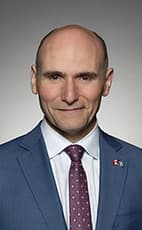
Jean-Yves Duclos
In the 90 days to September 18, 2026, 4 organizations lobbied Jean-Yves Duclos across 6 meetings — most often about Industry. The most frequent visitor was Ocean Group Inc. (1 meeting, via their in-house lobbyist Jacques Tanguay). Its registration describes the goal as “Représentation pour le développement de programmes visant à soutenir les chantiers maritimes”. That's about the same as the average MP, who had 6 meetings over the same period.
Based on federal lobbying registry data to September 18, 2026
In the House · Sep 21–25
Jean-Yves Duclos this week
“I was obviously delighted, as many others were, to listen to one of our newest members of Parliament on this side of the aisle. I listened carefully and heard from her that she believes it is important both to fight for the interests of Canadians and Canada…”
- Spoke 10 times in the House · the average MP spoke 4 times
- FORC-266, second reading — Establish a national framework respecting skilled trades and labour mobility · passed 295–21
Get Jean-Yves Duclos's week in your inbox every Monday
What they said, how they voted, and who lobbied them. Free, no ads, unsubscribe anytime.
How Jean-Yves Duclos actually voted
Their recorded positions on the issues Canadians care about — pulled straight from the parliamentary record.
- Voted For
Labour & Employment
Establish a national framework respecting skilled trades and labour mobility
C-266 · Sep 2026 · Passed · Tell your MP what you think
- Voted For
Economy & Taxation
Implement certain provisions of the spring economic update tabled in Parliament on April 28, 2026
C-30 · Jun 2026 · Passed · Tell your MP what you think
- Voted For
Housing
Authorize certain payments to be made out of the Consolidated Revenue Fund for the purpose of improving housing supply
C-26 · Jun 2026 · Passed · Tell your MP what you think
- Voted For
Criminal Justice
Hate propaganda, hate crime and access to religious or cultural places
C-9 · Jun 2026 · Passed · Tell your MP what you think
- Voted For
Overall leanings
100%
voted with the Liberal line this Parliament
100%
vote attendance (174/174)
Who’s in Jean-Yves’s ear
476
lobbying meetings
209
companies & groups
861
speeches in Parliament
Top lobbying relationship: Unknown — met 42 times · most lobbied on Health.
See who’s lobbying Jean-Yves →Who's lobbying Jean-Yves
Individual meeting records from the federal lobbying registry
| Date | Organization | |
|---|---|---|
| 2026-09-15 | Ocean Group Inc. | |
| 2026-09-10 | Women's Network PEI | |
| 2026-09-02 | Unknown | |
| 2026-08-12 | Spotify Canada Inc. | |
| 2026-08-10 | GlaxoSmithKline Inc. |
Write to Jean-Yves Duclos
Pick what it's about. You'll get a letter you can edit, then send it from your own email.
Other ways to reach Jean-Yves
613-992-4211 is the House of Commons switchboard — ask to be connected to your MP's office. For constituency office contact details, or if jean-yves.duclos@parl.gc.ca bounces, visit their Parliament profile.
Committee Memberships
Top Lobbying Clients
Companies with the most meetings with this MP
What Jean-Yves talks about
- Health179 speeches · 2021–2024
- Public Services and Procurement96 speeches · 2023–2024
- Housing46 speeches · 2023–2024
- Finance29 speeches · 2022–2024
- An Act Respecting Certain Measures Related to COVID-1922 speeches · 2022
Recent Speeches
Mr. Speaker, I have the honour to present, in both official languages, the sixth report of the Standing Committee on Public Safety and National Security in relation to Bill C-221, an act to amend the Corrections and Conditional Release Act with regard to the disclosure of information to victims. The… Read full speechShow less
Mr. Speaker, I have the honour to present, in both official languages, the sixth report of the Standing Committee on Public Safety and National Security in relation to Bill C-221, an act to amend the Corrections and Conditional Release Act with regard to the disclosure of information to victims. The committee has studied the bill and has decided to report the bill back to the House with amendments.
Mr. Speaker, I was obviously delighted, as many others were, to listen to one of our newest members of Parliament on this side of the aisle. I listened carefully and heard from her that she believes it is important both to fight for the interests of Canadians and Canada outside of Canada by building… Read full speechShow less
Mr. Speaker, I was obviously delighted, as many others were, to listen to one of our newest members of Parliament on this side of the aisle. I listened carefully and heard from her that she believes it is important both to fight for the interests of Canadians and Canada outside of Canada by building more alliances and by diversifying our trade relationships and to fight for the interests of Canadians, especially those who are struggling more with the high cost of living. Why, in her view, is it important to do those two things, especially in the context of what we hear from opposition MPs, who say that the Prime Minister should not try to address both challenges at the same time?
Mr. Speaker, I am very grateful to have the opportunity to speak this evening to highlight the Government of Canada's efforts to make life more affordable. This very important piece of legislation, Bill C-38, is part of those efforts. As we know, Canadians are having to cope with an increasingly com… Read full speechShow less
Mr. Speaker, I am very grateful to have the opportunity to speak this evening to highlight the Government of Canada's efforts to make life more affordable. This very important piece of legislation, Bill C-38, is part of those efforts. As we know, Canadians are having to cope with an increasingly complex and unpredictable world and, unfortunately, this world is also, in many respects, more dangerous and more expensive. In view of this, the Canadian government continues to focus on what it can control: building a stronger Canadian economy, diversifying our foreign trade, forging more alliances with countries that share our values, ensuring responsible fiscal management and supporting Canadians in managing the cost of living. Allow me to give a very concrete example. For several months now, shipping traffic in the Strait of Hormuz has been disrupted. This has led to soaring oil prices, a sharp rise in gas prices and increased costs for other essential goods. Did the Canadian government, or Canada, start this war in Iran? Of course not. Has the Canadian government taken action, and should it take action, to reduce costs for Canadians? Of course it has, and it should. Global conflicts and the persistent, significant disruptions to these supply chains stemming from the Middle East or elsewhere, including the conflict in Ukraine, are not things the Government of Canada can stop or even control. However, what we can do here in Canada and in the House of Commons, and what we are already doing, is help Canadians who are bearing the brunt of these conflicts through no fault of their own. The federal fuel excise tax has been suspended since April 20. Earlier in September, the Minister of Finance and National Revenue announced that the Canadian government had decided to extend the temporary suspension of the federal fuel excise tax until January 31, 2027, and then to apply a rate equal to 50% of the regular excise tax rate from February 1 to March 31, 2027. This will help reduce daily expenses for Canadians, particularly those related to road transportation and the food, agriculture, housing, construction, and delivery sectors. The suspension of this tax is expected to save Canadians up to about $5.75 on a 50-litre tank of gas. These are real savings for families. It also means lower costs for truckers and businesses. This measure is expected to provide more than $2.4 billion in relief to Canadians in 2026–27. By lowering the price of gas and diesel at the pump, the Government of Canada is taking real action to support all those who are currently facing very real challenges. I want to point out that this temporary suspension of the federal excise tax builds on other measures that have already been announced and put in place. I will give an example. Even before the conflict in the Strait of Hormuz began, economies, businesses and workers in many countries, including Canada, were thrown into uncertainty by a historic increase in tariffs. Is Canada responsible for the upheaval in global trade and the resulting rise in the cost of essential goods? Of course not. Should the Government of Canada take action and has it done so? Of course it should, and it has. To help Canadian families make ends meet, earlier this year, for example, we launched the new Canada groceries and essentials benefit. This new benefit is based on the GST tax credit and provides increased support to two million low- and modest-income Canadians. That is just the beginning. Starting in July of this year, middle- and lower-income Canadians received higher quarterly payments. The benefit will be increased by 25% for another five years and will add approximately $8.6 billion in additional support to families that are struggling to make ends meet, including middle-income and modest-income families. In total, a family of four could receive up to $1,890 this year and then about $1,400 a year for the next four years. A single person could receive up to $950 this year and then about $700 a year for the next four years. This is real support. It is concrete and tangible. It is helping people buy groceries, pay bills and cover essentials. That is not all. We also cut taxes for 22 million Canadians by lowering the tax rate for the first personal income tax bracket from 15% to 14%. In 2026, that reflects savings of $420 per person and $840 for a two-income family. We also eliminated the goods and services tax, or GST, for first-time homebuyers of new homes valued up to $1 million and reduced it for homes valued between $1 million and $1.5 million. In addition, we made permanent Canada's national school food program, which is helping 400,000 children and their families access high-quality meals at home and at school, saving the parents of two children an average of $800 a year on groceries. We have also taken very real action to improve the banking system's fairness and affordability for Canadians, especially those struggling to make ends meet. Since March, for example, consumers can no longer be charged more than $10 if their personal bank account balance is too low to cover a payment. In addition, non-sufficient fund fees cannot be applied if the account overdraft is less than $10. This year, we are also going to begin automating the payment of federal benefits. This will help up to 5.5 million low-income Canadians get the benefits they need and are entitled to receive. In conclusion, the Government of Canada is focusing on the things it can control, like building a stronger, more resilient Canadian economy, while at the same time helping Canadians who struggle in their daily lives under cost-of-living pressures caused by the many severe global disruptions that we are familiar with. For all of these reasons, I sincerely ask all members of the House to vote in favour of the bill.
Mr. Speaker, in fact, we are doing two things. First, we reduced income tax for 22 million Canadians, which is quite a large number. It has been, unfortunately, opposed by the Conservatives. The second thing we are doing is helping those who struggle more than richer Canadians. The member has heard … Read full speechShow less
Mr. Speaker, in fact, we are doing two things. First, we reduced income tax for 22 million Canadians, which is quite a large number. It has been, unfortunately, opposed by the Conservatives. The second thing we are doing is helping those who struggle more than richer Canadians. The member has heard my list of measures. For example, the national school food program is helping thousands, in fact more than 10,000 children in my region, who otherwise would struggle to go to school with a full belly and therefore would also struggle to learn what they need to learn to become good citizens.
Mr. Speaker, I am very grateful for such an excellent question. I want to briefly mention three points. First, as my colleague is aware, OAS has been increased for people over the age of 75 in light of the very clear evidence that seniors over the age of 75 not only have greater needs, but also lowe… Read full speechShow less
Mr. Speaker, I am very grateful for such an excellent question. I want to briefly mention three points. First, as my colleague is aware, OAS has been increased for people over the age of 75 in light of the very clear evidence that seniors over the age of 75 not only have greater needs, but also lower incomes, and that older women, among others, live in more precarious circumstances for a variety of reasons that are well understood. Second, I want to mention the Canadian dental care plan, which helps approximately 25,000 people in his riding, including several thousand seniors. This represents savings of about $800 a year. I encourage my colleague—whose leader, unfortunately, opposes the Canadian dental care plan—to talk about it at length with the seniors in his riding when he sees them. I am sure he meets with them regularly. The third point is automatic benefits. As I was saying, there are nearly 5.5 million Canadians whose tax returns will be processed automatically, which will maximize the chances for these seniors, for the most part, to receive the benefits they need.
Bills Sponsored
Recent activity
36 activities across speeches, bills, and lobbying communications.
September 2026
Routine Proceedings
Mr. Speaker, I have the honour to present, in both official languages, the sixth report of the Standing Committee on Public Safety and National Security in relation to Bill C-221, an act to amend the … Read full speechShow less
Mr. Speaker, I have the honour to present, in both official languages, the sixth report of the Standing Committee on Public Safety and National Security in relation to Bill C-221, an act to amend the Corrections and Conditional Release Act with regard to the disclosure of information to victims. The committee has studied the bill and has decided to report the bill back to the House with amendments.
Government Orders
Mr. Speaker, I was obviously delighted, as many others were, to listen to one of our newest members of Parliament on this side of the aisle. I listened carefully and heard from her that she believes i… Read full speechShow less
Mr. Speaker, I was obviously delighted, as many others were, to listen to one of our newest members of Parliament on this side of the aisle. I listened carefully and heard from her that she believes it is important both to fight for the interests of Canadians and Canada outside of Canada by building more alliances and by diversifying our trade relationships and to fight for the interests of Canadians, especially those who are struggling more with the high cost of living. Why, in her view, is it important to do those two things, especially in the context of what we hear from opposition MPs, who say that the Prime Minister should not try to address both challenges at the same time?
Government Orders
Mr. Speaker, I am very grateful to have the opportunity to speak this evening to highlight the Government of Canada's efforts to make life more affordable. This very important piece of legislation, Bi… Read full speechShow less
Mr. Speaker, I am very grateful to have the opportunity to speak this evening to highlight the Government of Canada's efforts to make life more affordable. This very important piece of legislation, Bill C-38, is part of those efforts. As we know, Canadians are having to cope with an increasingly complex and unpredictable world and, unfortunately, this world is also, in many respects, more dangerous and more expensive. In view of this, the Canadian government continues to focus on what it can control: building a stronger Canadian economy, diversifying our foreign trade, forging more alliances with countries that share our values, ensuring responsible fiscal management and supporting Canadians in managing the cost of living. Allow me to give a very concrete example. For several months now, shipping traffic in the Strait of Hormuz has been disrupted. This has led to soaring oil prices, a sharp rise in gas prices and increased costs for other essential goods. Did the Canadian government, or Canada, start this war in Iran? Of course not. Has the Canadian government taken action, and should it take action, to reduce costs for Canadians? Of course it has, and it should. Global conflicts and the persistent, significant disruptions to these supply chains stemming from the Middle East or elsewhere, including the conflict in Ukraine, are not things the Government of Canada can stop or even control. However, what we can do here in Canada and in the House of Commons, and what we are already doing, is help Canadians who are bearing the brunt of these conflicts through no fault of their own. The federal fuel excise tax has been suspended since April 20. Earlier in September, the Minister of Finance and National Revenue announced that the Canadian government had decided to extend the temporary suspension of the federal fuel excise tax until January 31, 2027, and then to apply a rate equal to 50% of the regular excise tax rate from February 1 to March 31, 2027. This will help reduce daily expenses for Canadians, particularly those related to road transportation and the food, agriculture, housing, construction, and delivery sectors. The suspension of this tax is expected to save Canadians up to about $5.75 on a 50-litre tank of gas. These are real savings for families. It also means lower costs for truckers and businesses. This measure is expected to provide more than $2.4 billion in relief to Canadians in 2026–27. By lowering the price of gas and diesel at the pump, the Government of Canada is taking real action to support all those who are currently facing very real challenges. I want to point out that this temporary suspension of the federal excise tax builds on other measures that have already been announced and put in place. I will give an example. Even before the conflict in the Strait of Hormuz began, economies, businesses and workers in many countries, including Canada, were thrown into uncertainty by a historic increase in tariffs. Is Canada responsible for the upheaval in global trade and the resulting rise in the cost of essential goods? Of course not. Should the Government of Canada take action and has it done so? Of course it should, and it has. To help Canadian families make ends meet, earlier this year, for example, we launched the new Canada groceries and essentials benefit. This new benefit is based on the GST tax credit and provides increased support to two million low- and modest-income Canadians. That is just the beginning. Starting in July of this year, middle- and lower-income Canadians received higher quarterly payments. The benefit will be increased by 25% for another five years and will add approximately $8.6 billion in additional support to families that are struggling to make ends meet, including middle-income and modest-income families. In total, a family of four could receive up to $1,890 this year and then about $1,400 a year for the next four years. A single person could receive up to $950 this year and then about $700 a year for the next four years. This is real support. It is concrete and tangible. It is helping people buy groceries, pay bills and cover essentials. That is not all. We also cut taxes for 22 million Canadians by lowering the tax rate for the first personal income tax bracket from 15% to 14%. In 2026, that reflects savings of $420 per person and $840 for a two-income family. We also eliminated the goods and services tax, or GST, for first-time homebuyers of new homes valued up to $1 million and reduced it for homes valued between $1 million and $1.5 million. In addition, we made permanent Canada's national school food program, which is helping 400,000 children and their families access high-quality meals at home and at school, saving the parents of two children an average of $800 a year on groceries. We have also taken very real action to improve the banking system's fairness and affordability for Canadians, especially those struggling to make ends meet. Since March, for example, consumers can no longer be charged more than $10 if their personal bank account balance is too low to cover a payment. In addition, non-sufficient fund fees cannot be applied if the account overdraft is less than $10. This year, we are also going to begin automating the payment of federal benefits. This will help up to 5.5 million low-income Canadians get the benefits they need and are entitled to receive. In conclusion, the Government of Canada is focusing on the things it can control, like building a stronger, more resilient Canadian economy, while at the same time helping Canadians who struggle in their daily lives under cost-of-living pressures caused by the many severe global disruptions that we are familiar with. For all of these reasons, I sincerely ask all members of the House to vote in favour of the bill.
Government Orders
Mr. Speaker, in fact, we are doing two things. First, we reduced income tax for 22 million Canadians, which is quite a large number. It has been, unfortunately, opposed by the Conservatives. The secon… Read full speechShow less
Mr. Speaker, in fact, we are doing two things. First, we reduced income tax for 22 million Canadians, which is quite a large number. It has been, unfortunately, opposed by the Conservatives. The second thing we are doing is helping those who struggle more than richer Canadians. The member has heard my list of measures. For example, the national school food program is helping thousands, in fact more than 10,000 children in my region, who otherwise would struggle to go to school with a full belly and therefore would also struggle to learn what they need to learn to become good citizens.
Government Orders
Mr. Speaker, I am very grateful for such an excellent question. I want to briefly mention three points. First, as my colleague is aware, OAS has been increased for people over the age of 75 in light o… Read full speechShow less
Mr. Speaker, I am very grateful for such an excellent question. I want to briefly mention three points. First, as my colleague is aware, OAS has been increased for people over the age of 75 in light of the very clear evidence that seniors over the age of 75 not only have greater needs, but also lower incomes, and that older women, among others, live in more precarious circumstances for a variety of reasons that are well understood. Second, I want to mention the Canadian dental care plan, which helps approximately 25,000 people in his riding, including several thousand seniors. This represents savings of about $800 a year. I encourage my colleague—whose leader, unfortunately, opposes the Canadian dental care plan—to talk about it at length with the seniors in his riding when he sees them. I am sure he meets with them regularly. The third point is automatic benefits. As I was saying, there are nearly 5.5 million Canadians whose tax returns will be processed automatically, which will maximize the chances for these seniors, for the most part, to receive the benefits they need.
Government Orders
Mr. Speaker, I am always very pleased to hear and even see my colleague from Acadie—Bathurst. As my colleague knows, and as I have seen myself, his constituents really like him. They see him as an exc… Read full speechShow less
Mr. Speaker, I am always very pleased to hear and even see my colleague from Acadie—Bathurst. As my colleague knows, and as I have seen myself, his constituents really like him. They see him as an excellent MP who is on the ground and always there to advocate for his riding. It is a particularly important riding in northern New Brunswick. The Acadian community needs him, and he is always there to support it, despite all the challenges of serving a region that is a little farther from the major centres. Speaking of the most important programs, I know that roughly 20,000 families in his riding receive the Canada child benefit. It reduces child poverty in his riding by 50%. He has been there to support that measure from the start.
Government Orders
Madam Speaker, I am very grateful for the opportunity to rise today to speak to Bill C‑10, an act respecting the commissioner for modern treaty implementation. This bill seeks to create a new, indepen… Read full speechShow less
Madam Speaker, I am very grateful for the opportunity to rise today to speak to Bill C‑10, an act respecting the commissioner for modern treaty implementation. This bill seeks to create a new, independent officer of Parliament. It is a way to hold current and future governments accountable for the commitments made under modern treaties with indigenous peoples across the country. It is because of the need for a more consistent approach to modern treaty implementation that we strongly encourage the swift passage of Bill C‑10. I would like to reiterate that modern treaties are legally binding agreements that recognize the rights, priorities and aspirations of indigenous peoples. They aim to support indigenous self-government, establish better frameworks for economic development and environmental management and protection, and promote cultural vitality. Modern treaty implementation is crucial. While significant progress is being made, there are still opportunities to strengthen this implementation. Modern treaty partners have made it clear that Canada could become an even stronger partner and do more to honour agreements and commitments protected under the Constitution. For many years, indigenous partners have driven home the vital importance of proactive federal action in addressing modern treaty challenges. They are not alone. The Auditor General's 2003, 2007 and 2015 reports identified similar areas for improvement in the Canadian government's implementation efforts. One such area of improvement concerns independent oversight and accountability. That is why the bill before us today is so important. The commissioner for modern treaty implementation would be able to help resolve long-standing issues through targeted reports and audits. He or she could also look at specific issues concerning one or more treaties and choose the best path forward. In doing so, the commissioner would highlight opportunities for Canada to strengthen the role of the Canadian government as a treaty partner, which should lead to more sustained federal implementation efforts and improved relationships all around. David Wright, an associate professor at the faculty of law at the University of Calgary, used a very clear analogy before the Standing Committee on Indigenous and Northern Affairs on March 12. The Auditor General is more like a family doctor, a generalist, while the commissioner will be a specialist whose mission will be precisely to diagnose and address the specific effects of modern treaty implementation. That is a powerful analogy. The commissioner will draw on their specific expertise in modern treaties to ensure that reviews and audits are based on a solid understanding of the spirit and intent of those treaties. The commissioner will have their own office, just like the Auditor General and the Privacy Commissioner. They will not be accountable to any specific department or to the Prime Minister, but will report directly to Parliament. This bill will also provide access to analyses and recommendations from independent experts. Furthermore, over the years, in response to feedback from modern treaty partners, successive governments have worked to strengthen the implementation of modern treaties. In 2015, the Government of Canada adopted the cabinet directive on the federal approach to modern treaty implementation. This measure marked the beginning of an important step toward greater transparency and accountability to help overcome systemic barriers in this regard. In 2023, the Canadian government also adopted Canada's collaborative modern treaty implementation policy. In May 2024, the government announced its intention to create a new officer of Parliament, which I strongly support today. Bill C-10 is a vital means of supporting our relationships with modern treaty partners. We have a duty to uphold our treaty obligations. Bill C-10 responds to more than 20 years of calls for independent oversight and for Canada to act as a stronger partner. This bill is the result of a co-development process and a genuine partnership between our government and modern treaty partners. Modern treaties have the power to strengthen the social, cultural and economic foundations of indigenous communities, thereby fostering more robust local economies, job creation, better infrastructure for everyone and support for clean energy. Currently, 27 modern treaties are in effect with 30 indigenous partners. These agreements cover more than 40% of Canada's territory, 80% of which is in the northern part of the country. In conclusion, we have come a long way, but there is still more we can do to increase transparency and accountability, and to fully honour our commitments to modern treaty partners. That is why we have drafted this bill and why we are calling for its swift passage. That is why it is so important. This bill demonstrates Canada's commitment and dedication and represents a step toward a better future for our important modern treaty partners. It is time for the House to show unity. The implementation of modern treaties is a national imperative. Finally, like others have done, I would like to thank all the strong indigenous voices who paved the way for this bill to be introduced in the House. Their leadership inspires us to keep our promises.
Government Orders
Madam Speaker, I would like to emphasize the importance and insightfulness of this question, which relates specifically to Quebec and the Quebec City region. I would like to emphasize how important my… Read full speechShow less
Madam Speaker, I would like to emphasize the importance and insightfulness of this question, which relates specifically to Quebec and the Quebec City region. I would like to emphasize how important my colleague's support is, as well as how important his voice is here in the House. He regularly reminds our colleagues in the Conservative Party that this bill will benefit Canada as a whole. In Quebec, for example, people are talking about the extremely important work that will take place in connection with Churchill Falls. One of our colleagues pointed out that signing a modern treaty with the Cree Nation was a game-changer in Quebec, enabling progress on the construction of vital energy and economic infrastructure. I predict, as he probably does, that this sort of example will also help us work effectively with the indigenous peoples who will be partners in the Churchill Falls project.
Government Orders
Madam Speaker, our colleague is quite right to mention listening. Listening is key to this bill. Over the last 20 years, many indigenous peoples have asked the Canadian government to create this commi… Read full speechShow less
Madam Speaker, our colleague is quite right to mention listening. Listening is key to this bill. Over the last 20 years, many indigenous peoples have asked the Canadian government to create this commissioner role. We must listen to what indigenous peoples are asking us to do if we are to work with them in a spirit of respect. I urge my colleague to encourage his fellow Conservative Party members to move forward. People have been waiting for this office for 20 years. We must now take the next step.
Government Orders
Madam Speaker, the member used some deeply meaningful words: transparency, responsibility, accountability, listening and collaboration. All of these are very important if we want to make progress on s… Read full speechShow less
Madam Speaker, the member used some deeply meaningful words: transparency, responsibility, accountability, listening and collaboration. All of these are very important if we want to make progress on some of the major projects that the Canadian government is trying to implement. All of these major projects are going to transform our economy, create more, better jobs for our children, young people and others, and lead to a cleaner economy and environment. None of this is possible unless we work respectfully with indigenous peoples and respect their rights specifically. As my colleague mentioned several times today, the purpose of the office of the commissioner for modern treaty implementation is to ensure that the Canadian government has all the tools, including oversight tools, to ensure that its relations with indigenous peoples support other federal initiatives.
May 2026
Routine Proceedings
Mr. Speaker, I have the honour to virtually present, in both official languages, the fourth report of the Standing Committee on Public Safety and National Security, entitled “Canada-United States Bord… Read full speechShow less
Mr. Speaker, I have the honour to virtually present, in both official languages, the fourth report of the Standing Committee on Public Safety and National Security, entitled “Canada-United States Border Management”. Pursuant to Standing Order 109, the committee requests that the government table a comprehensive response to this report.
April 2026
Government Orders
Mr. Speaker, I am pleased to have heard my colleague's views. He emphasized the importance of investing in Canada and Quebec to grow our economy and create more and better jobs. He really emphasized i… Read full speechShow less
Mr. Speaker, I am pleased to have heard my colleague's views. He emphasized the importance of investing in Canada and Quebec to grow our economy and create more and better jobs. He really emphasized investment and the importance of investment. However, he concluded by saying that Canada, unlike other countries around the world, would be unable to do this properly while following appropriate rules of governance. Why is he so skeptical about Canada's ability to perform as well as other countries?
Statements by Members
Mr. Speaker, I would like to congratulate the 250,000 residents of the greater Quebec City and Chaudière-Appalaches region who are now covered by the new Canadian dental care plan, helping them to sav… Read full speechShow less
Mr. Speaker, I would like to congratulate the 250,000 residents of the greater Quebec City and Chaudière-Appalaches region who are now covered by the new Canadian dental care plan, helping them to save an average of $900 a year on the cost of dental care. I would also like to congratulate the staff and students of the faculty of dentistry at Laval University, who will be using an additional investment of nearly $4 million to further improve access to dental care in our beautiful region. This investment will fund new placements in social dentistry at the SPOT clinic in Quebec City's lower town, as well as at a new clinic on the south shore. It will also mean placements can be offered in private practices located in underserved areas of the greater Quebec City region. I would like to once again thank and congratulate all the partners involved in this important project.
Statements by Members
Mr. Speaker, on April 2, we announced that the first Build Canada Homes project in Quebec will be built on the iconic Îlot Saint-Vincent-de-Paul site at the top of Côte d'Abraham, right in the heart o… Read full speechShow less
Mr. Speaker, on April 2, we announced that the first Build Canada Homes project in Quebec will be built on the iconic Îlot Saint-Vincent-de-Paul site at the top of Côte d'Abraham, right in the heart of Quebec City. This project includes 151 community housing units, a child care centre with 80 spots, and a public plaza featuring gardens and scenic views, which will breathe new life into and enhance the value of a unique site at the junction of Old Quebec and the beautiful Saint-Jean-Baptiste neighbourhood. I would like to congratulate the members of the Saint-Jean-Baptiste citizens' committee, the Old Quebec citizens' committee, and the many partners involved in this project, including Action-Habitation, La Bouée, and the Patrotôt solidarity co-op for their collaboration on this initiative, which is a source of pride for our city and will continue to be so for generations to come.
March 2026
Statements by Members
Mr. Speaker, filing a tax return is essential for receiving benefits such as the new Canada groceries and essentials benefit, which can provide up to $900 for a single individual and up to $2,000 for … Read full speechShow less
Mr. Speaker, filing a tax return is essential for receiving benefits such as the new Canada groceries and essentials benefit, which can provide up to $900 for a single individual and up to $2,000 for a family of four this year. This new benefit will support 12 million low- and modest-income individuals to offset increased expenses related to food inflation. I want to say a big thank you to the dozens of volunteers at Patro Laval, in my riding, who will be providing nearly 3,000 people with a free and confidential tax filing service until April 23. I also want to thank the Government of Canada for supporting this important initiative from Patro Laval and many other organizations across the country through the community volunteer income tax program.
Government Orders
Madam Speaker, I was very interested to listen to our colleague's speech and also to compare it to what we heard yesterday on the topic of Indonesia, when we heard some Conservative voices saying that… Read full speechShow less
Madam Speaker, I was very interested to listen to our colleague's speech and also to compare it to what we heard yesterday on the topic of Indonesia, when we heard some Conservative voices saying that we were spending or wasting too much of members' time talking about trade. Does the member believe we are spending too much time in the House investing in trade relationships and building a stronger economy?
Government Orders
Madam Speaker, I am very pleased to hear that the member points to the fact that we need to double our exports to non-U.S. destinations in the next few years. He also knows that Canada has what the wo… Read full speechShow less
Madam Speaker, I am very pleased to hear that the member points to the fact that we need to double our exports to non-U.S. destinations in the next few years. He also knows that Canada has what the world needs in that context. I am surprised, however, to hear his leader say that the PM needs to stay at home; that if he were the PM, he would stay at home; that we should not travel to meet global and business leaders who will be investing billions of dollars into our economy and building a stronger Canada for all workers; and that we should not engage and meet people where they are in the world. Does the member agree with that point of view of his leader?
Government Orders
Mr. Speaker, I feel good about two things that my colleague mentioned in his remarks. The first is that we are once again debating a free trade agreement that is excellent for jobs across Canada, incl… Read full speechShow less
Mr. Speaker, I feel good about two things that my colleague mentioned in his remarks. The first is that we are once again debating a free trade agreement that is excellent for jobs across Canada, including in Quebec. The second is that the Canadian government and the Prime Minister are successfully working on economic security and national security. He rightly mentioned the aerospace industry. Is he also aware that this work is having a significant impact on the shipbuilding industry in the greater Quebec City area? The Davie shipyard and its thousand suppliers are creating a major shipbuilding hub in the greater Quebec City area because of this combination of national security and economic security.
Routine Proceedings
Mr. Speaker, I have the honour to present, in both official languages, the third report of the Standing Committee on Public Safety and National Security in relation to Bill C-8, an act respecting cybe… Read full speechShow less
Mr. Speaker, I have the honour to present, in both official languages, the third report of the Standing Committee on Public Safety and National Security in relation to Bill C-8, an act respecting cyber security, amending the Telecommunications Act and making consequential amendments to other acts. The committee has studied the bill and has decided to report the bill back to the House with amendments.
Government Orders
Mr. Speaker, unfortunately, over the past few years, I have had little opportunity to observe my colleague's work at the committee. However, listening to him, it is clear that he has worked very hard … Read full speechShow less
Mr. Speaker, unfortunately, over the past few years, I have had little opportunity to observe my colleague's work at the committee. However, listening to him, it is clear that he has worked very hard and very effectively for the people in his riding. I am very pleased to hear him talk about the solid benefits of this agreement for farmers, including those in his riding. I would like to ask him the following question. We know very well that there is no such thing as an ideal world; there is only the world as it is. There is no such thing as an ideal agreement; there are only agreements that could be signed. Given all the criticism that has been levelled at the agreement, does he still believe, ultimately, that it is a good agreement and a good deal?
February 2026
House of Commons
445 communications with 197 clients
Top clients: [{"name": "null", "count": 23}, {"name": "Canadian Medical Association", "count"…
February 2025
Employment and Social Development Canada (ESDC)
13 communications with 7 clients
Top clients: [{"name": "Co-operative Housing Federation of Canada", "count": 2}, {"name": "FE…