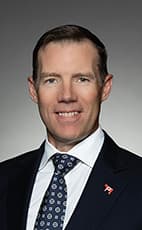
John Barlow
In the 90 days to September 18, 2026, 4 organizations lobbied John Barlow across 4 meetings — most often about Agriculture. The most frequent visitor was Canadian Propane Association (1 meeting, via their in-house lobbyist Shannon Watt). Its registration describes the goal as “Discussions with government officials regarding the national electricity strategy and the role of propane, renewable propane and rDME in…”. That's fewer than the average MP, who had 6 meetings over the same period.
Based on federal lobbying registry data to September 18, 2026
In the House · Oct 5–6
John Barlow this week
“Potato farmers in P.E.I. have told me that they are bracing themselves for the impact that high diesel prices are going to have on their farms. Nathan told me that fuel prices have already doubled to $14,000 for harvest this year.”
- Spoke 9 times in the House · the average MP spoke 2 times
- FORC-218, second reading — Medical assistance in dying · defeated 141–187
- FOROpposition Motion (Diesel prices) · defeated 133–196
- AGAINSTFifth report of the Standing Committee on Health · passed 196–132
Get John Barlow's week in your inbox every Monday
What they said, how they voted, and who lobbied them. Free, no ads, unsubscribe anytime.
How John Barlow actually voted
Their recorded positions on the issues Canadians care about — pulled straight from the parliamentary record.
- Voted For
- Voted Against
Healthcare
Fifth report of the Standing Committee on Health
Oct 2026 · Passed
- Voted For
Labour & Employment
Establish a national framework respecting skilled trades and labour mobility
C-266 · Sep 2026 · Passed · Tell your MP what you think
- Voted Against
Economy & Taxation
Implement certain provisions of the spring economic update tabled in Parliament on April 28, 2026
C-30 · Jun 2026 · Passed · Tell your MP what you think
- Voted Against
Housing
Authorize certain payments to be made out of the Consolidated Revenue Fund for the purpose of improving housing supply
C-26 · Jun 2026 · Passed · Tell your MP what you think
Overall leanings
100%
voted with the Conservative line this Parliament
99%
vote attendance (176/177, missed 1)
Who's lobbying John
Individual meeting records from the federal lobbying registry
| Date | Organization | |
|---|---|---|
| 2026-08-19 | Canadian Propane Association | |
| 2026-08-05 | Gwich'in Tribal Council | |
| 2026-07-08 | Alberta Greenhouse Growers Association | |
| 2026-07-07 | Canadian Cattle Association | |
| 2026-06-16 | Permolex Ltd. |
Write to John Barlow
Pick what it's about. You'll get a letter you can edit, then send it from your own email.
Other ways to reach John
613-992-4211 is the House of Commons switchboard — ask to be connected to your MP's office. For constituency office contact details, or if john.barlow@parl.gc.ca bounces, visit their Parliament profile.
Committee Memberships
Top Lobbying Clients
Companies with the most meetings with this MP since July 2008
What John talks about
- Carbon Pricing97 speeches · 2022–2025
- Agriculture and Agri-Food33 speeches · 2021–2026
- The Economy29 speeches · 2022–2026
- Taxation23 speeches · 2022–2026
- Health of Animals Act17 speeches · 2021–2023
Recent Speeches
Mr. Speaker, I appreciate all the work of my colleague. The Liberals talk about consistency and predictability. What about the next version of the bill? The building Canada really strong act is, I am sure, what the next one will be. We have had three different iterations of a pilot project on inters… Read full speechShow less
Mr. Speaker, I appreciate all the work of my colleague. The Liberals talk about consistency and predictability. What about the next version of the bill? The building Canada really strong act is, I am sure, what the next one will be. We have had three different iterations of a pilot project on interswitching for grain movement in Canada. We had one in 2014, one in 2018 and one in 2023. Continuing these pilot projects makes it impossible for grain haulers and shippers to make investments in sidings to make sure that interswitching is actually successful. If predictability is important in the bill, why are the Liberals doing yet another pilot project on interswitching and not making that element permanent?
Mr. Speaker, it is a pleasure to rise to speak to our opposition day motion, which would give some solutions and save Canadians money right across this country. I am honoured to be splitting my time with the hon. member for Battle River—Crowfoot today as well. I have often said in this House, “No fa… Read full speechShow less
Mr. Speaker, it is a pleasure to rise to speak to our opposition day motion, which would give some solutions and save Canadians money right across this country. I am honoured to be splitting my time with the hon. member for Battle River—Crowfoot today as well. I have often said in this House, “No farms, no food.” It is very important that we add to that: “No affordable farms, no affordable food.” It is critical that Canadians understand the connection between what happens on the farm in food production and the impact of those input costs on the farm on the cost of groceries on the grocery store shelves. I will get to that later today. I want to start my speech by thanking all of the farmers in my riding of Foothills who are finishing up the harvest. Many of them have worked 24 hours a day, religiously, to get that crop in the bin. Many of them have just finished up, and it looks like a good harvest throughout southern Alberta. We are very happy and proud of all the work they have done over this seeding, through the summer and the harvest. Because we know the pride that farmers take in their work, we know the anxiety they have felt as they watched their input prices increase exponentially from last year to this year. I want to highlight some of the stories I have heard from farmers not only in my riding but certainly right across Canada. I spoke to one of them as I was driving to the airport on Sunday. Roy was telling me they were finishing up the harvest on Monday and now he has to have a very difficult conversation with his family. Normally, he budgets about $50,000 for his fuel bill for harvest. This year, his bill was over $130,000. He is having to have that discussion with his family about where they are going to find the money to pay that fuel bill. He is being honest with his family. He does not know know how they are going to pay that bill, and that is a story that I have heard from farmers right across this country. Unfortunately, it is a story that has become all too common. Another farmer in my riding has a small farm. He has about a 2,000-acre farm, and the fuel bill is another $20,000 this year above what he is used to, and it was almost 18,000 litres of fuel. On Kate's family farm in Saskatchewan, they will pay an additional $90,000 on their fuel bill for harvest this year. A potato farmer in P.E.I., Aike, said that when fuel gets more expensive, everything in P.E.I. gets more expensive. To put things in perspective, he said, he is looking at a 70% jump in the fuel costs this year from the same time last year. That is from one farmer. Another P.E.I. farmer, Nathan, said the high diesel prices are “putting a squeeze on our bottom line”. Last year, his total diesel cost for the entire harvest was about $7,000. This year, he is only halfway through the harvest, and it has already gone over $14,000. He said, “Every year I'm saying this is the most expensive crop we're putting in, [and] I'm getting kinda tired of saying that”. A grain farmer in southern Alberta said diesel is costing him another $5,000 a day just through harvest. That is costing him another $100,000 on his fuel bill, and that is just one farm. Now, we are talking about farmers, but our fishers are facing much the same costs. In fact, I saw some comments from Carl, who is out in B.C. He said some are wondering if they will even be able to survive, and some question if the boats will even leave the harbour. Bob says this is taking the profit right out of fishing. He said, “Some of us aren't even going to take our boats out.” Again, that correlation between the costs of producing the food and the costs at the grocery store shelves is very real. The Liberals like to say every day that the impact of their policies, like an industrial carbon tax and the Liberal fuel standard, do not impact the cost of groceries. One of Canada's pre-eminent experts, Dr. Sylvain Charlebois, said the other day, “The correlation between diesel prices and food prices that you see at the grocery store [shelves] is one of the highest of all factors”. One of the pre-eminent experts on food prices in the country has said there is a direct correlation between the costs of fuel prices and the costs on the grocery store shelves. These costs that our farmers and our fishers are facing are not abstract. These are very real costs that are being carried by our farm families right across this country and by our small business owners, our fishers and the workers who are trying to manufacture and process those foods to get them to our grocery store shelves. These are costs being borne by the shippers, the truckers and the manufacturers. Every time we add those costs, at every link in that supply chain, that cost just grows exponentially until we get to the case where we are, at the grocery store shelves, where more than a third of Canadians now say that the cost of food is their biggest budget anxiety, where we have record numbers of Canadians lined up at food banks and where we among the countries with the highest food inflation in the G7. There are very real consequences of the bad policies and bad decisions of the Liberal government. How do we absorb these costs? How do we ask our fishermen and our farmers to absorb these costs? Many of them are asking themselves right now, as the harvest has just been completed, and they do not know. They cannot pass all of those costs on to their customers. In many cases, they have to absorb those costs, and that is the difference between them being economically viable and us losing, once again, more of those family farms, which our rural communities so desperately rely on. Our farmers are tough. We know they are resilient. They will find a way to make it through and get that crop off this year. However, I would say to my Liberal colleagues that we cannot keep asking our farmers to be tough and resilient. Tough and resilient does not pay the bills. Tough and resilient does not get that crop off into the bin, get it trucked to the terminal, get it trucked to the processor or get it trucked to the grocery store. Being tough and resilient does not pay the bills, and it does not put affordable food on the table. Ultimately, this is about what impacts each and every one of us, and that is Canada's food security. The farmer is not the end of the story; he is just the beginning. He is a very integral part of that story, but he is not all of it. We know that energy, and diesel especially, drives our country. The anti-energy Liberals have put this at their feet. For this diesel crisis, this cost crisis we are facing, they like to blame global factors, but this crisis lies in the decisions they have made, and it lies squarely within their responsibility. I found it interesting yesterday during question period, when our leader was asking some questions about the buy Canadian policy the Liberals keep talking about when in fact they are investing in American companies, that the Prime Minister got up and said the government is committed to building the Pacific link pipeline, and the Liberal members were cheering. I could not help but kind of laugh at that because for the past 11 years, those same members, that same Liberal cabinet, were doing everything they possibly could to crush Canada's energy sector. They scared investors away from energy east. As a result, eastern Canada is importing 130,000 barrels of oil and gas every single day to power eastern Canada when we could be doing that from western Canadian resources through the energy east pipeline. The northern gateway pipeline was approved by the Harper government, but the Liberal government came in and cancelled the northern gateway pipeline. Northern gateway would have been built at this time, moving Canadian energy and ensuring that we were more self-sufficient. As a result of that, last year, diesel was about $1.53 a litre. As of September 21, it is $2.74 a litre. According to Grain Growers of Canada, that is adding another $1,100 worth of diesel per day per combine per farm, which is another $5,000 a day. This is what it is costing Canadian farmers every single day. This is why I am encouraging the Liberals to support our Conservative motion, which not only provides a break on diesel prices and tax relief for Canadian farmers but ensures that we put the mechanisms in place to increase production and refining capacity here in Canada, which is critical and would not only solve this problem today but solve it for the future. I would encourage my Liberal colleagues to support our Conservative motion today to ensure that we save Canadians money today and tomorrow and, most importantly, that we show our Canadian farmers we are standing with them and we understand the anxiety they are facing. We want to make sure they can afford to put affordable food on Canadian tables every single day.
Mr. Speaker, what I do recognize are commitments to do something at some point. I will go back to Bill C-5, which Conservatives helped the Liberals pass, the Building Canada Act, because we wanted to be there to support building Canadian projects, nation-building projects, at speeds not seen in gene… Read full speechShow less
Mr. Speaker, what I do recognize are commitments to do something at some point. I will go back to Bill C-5, which Conservatives helped the Liberals pass, the Building Canada Act, because we wanted to be there to support building Canadian projects, nation-building projects, at speeds not seen in generations. Nothing happened. We now have the building Canada strong act because the first one was not enough. I am expecting that about a year from now, we will have another bill from the Liberal government. It will be called the building Canada really, really strong act, because we could not get it right the first two times. That is what I am expecting from the Liberal government.
Mr. Speaker, I thank my colleague from northern Alberta for the question. He has been such a great champion for the honey and bee industry. I always appreciate working with him. My colleague is exactly right. We have seen cattle numbers in Canada continue to decline, which is driving up cattle price… Read full speechShow less
Mr. Speaker, I thank my colleague from northern Alberta for the question. He has been such a great champion for the honey and bee industry. I always appreciate working with him. My colleague is exactly right. We have seen cattle numbers in Canada continue to decline, which is driving up cattle prices, but there are also those input costs with having to truck these products from one end of the country to the other. The Liberals like to think this does not impact the cost of doing business. We are adding costs to every link in the supply chain: growing the food, processing the food, transporting the food and putting it on grocery store shelves. What happens when we tax every single part of a supply chain? Of course, the cost of that product on the grocery store shelf is going to go up. That is what Canadian consumers are having to face right now.
Mr. Speaker, my colleague is exactly right, which is why I think it is so important that one of the elements of our opposition day motion is not only to take the tax off diesel today but also to put in elements to fast-track permitting to increase that refining capacity not only in western Canada bu… Read full speechShow less
Mr. Speaker, my colleague is exactly right, which is why I think it is so important that one of the elements of our opposition day motion is not only to take the tax off diesel today but also to put in elements to fast-track permitting to increase that refining capacity not only in western Canada but also in eastern Canada. In western Canada, we export diesel. We have more than we can supply because we do not have a pipeline to eastern Canada. However, if we were able to put policies in place to fast-track that permitting, to increase refining in eastern Canada so it could be self-sufficient, I think that would be a great step forward. That is why I am hoping my colleague will support our opposition day motion.
Bills Sponsored
4 since 2001