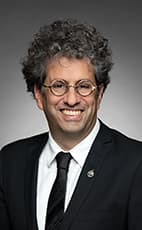
Karim Bardeesy
In the 90 days to September 18, 2026, 14 organizations lobbied Karim Bardeesy across 15 meetings — most often about Science and Technology. The most frequent visitor was University of Alberta (2 meetings, via their in-house lobbyist Bill Flanagan). Its registration describes the goal as “Advocacy related to university engagement in Canadian priorities in artificial intelligence, data systems and related computing science and…”. That's more than the average MP, who had 6 meetings over the same period.
Based on federal lobbying registry data to September 18, 2026
In the House · Sep 21–25
Karim Bardeesy this week
“I am very engaged in this debate and my colleague's speech. We share adjoining ridings. Therefore, some of the concerns and questions that my colleague is hearing are also being asked in Taiaiako'n—Parkdale—High Park.”
- Spoke 8 times in the House · the average MP spoke 4 times
- FORC-266, second reading — Establish a national framework respecting skilled trades and labour mobility · passed 295–21
Get Karim Bardeesy's week in your inbox every Monday
What they said, how they voted, and who lobbied them. Free, no ads, unsubscribe anytime.
How Karim Bardeesy actually voted
Their recorded positions on the issues Canadians care about — pulled straight from the parliamentary record.
- Voted For
Labour & Employment
Establish a national framework respecting skilled trades and labour mobility
C-266 · Sep 2026 · Passed · Tell your MP what you think
- Voted For
Economy & Taxation
Implement certain provisions of the spring economic update tabled in Parliament on April 28, 2026
C-30 · Jun 2026 · Passed · Tell your MP what you think
- Voted For
Housing
Authorize certain payments to be made out of the Consolidated Revenue Fund for the purpose of improving housing supply
C-26 · Jun 2026 · Passed · Tell your MP what you think
- Voted For
Criminal Justice
Hate propaganda, hate crime and access to religious or cultural places
C-9 · Jun 2026 · Passed · Tell your MP what you think
- Voted For
Overall leanings
100%
voted with the Liberal line this Parliament
99%
vote attendance (173/174, missed 1)
Who’s in Karim’s ear
270
lobbying meetings
172
companies & groups
204
speeches in Parliament
Top lobbying relationship: Brain Canada Foundation — met 6 times · most lobbied on Science and Technology.
See who’s lobbying Karim →Who's lobbying Karim
Individual meeting records from the federal lobbying registry
| Date | Organization | |
|---|---|---|
| 2026-08-28 | McMaster University | |
| 2026-08-26 | BILD | |
| 2026-08-14 | Ontario Centre of Innovation | |
| 2026-08-12 | Council of Canadian Innovators | |
| 2026-08-12 | Cohere Inc. |
Write to Karim Bardeesy
Pick what it's about. You'll get a letter you can edit, then send it from your own email.
Other ways to reach Karim
613-992-4211 is the House of Commons switchboard — ask to be connected to your MP's office. For constituency office contact details, or if karim.bardeesy@parl.gc.ca bounces, visit their Parliament profile.
Committee Memberships
Top Lobbying Clients
Companies with the most meetings with this MP
What Karim talks about
- Automotive Industry18 speeches · 2025–2026
- Canada's Auto Industry8 speeches · 2025
- Weights and Measures Act7 speeches · 2026
- Build Canada Homes Act6 speeches · 2026
- Finance6 speeches · 2025–2026
Recent Speeches
Mr. Speaker, I am very engaged in this debate and my colleague's speech. We share adjoining ridings. Therefore, some of the concerns and questions that my colleague is hearing are also being asked in Taiaiako'n—Parkdale—High Park. I want to ask her, given her experience in this Parliament, to speak … Read full speechShow less
Mr. Speaker, I am very engaged in this debate and my colleague's speech. We share adjoining ridings. Therefore, some of the concerns and questions that my colleague is hearing are also being asked in Taiaiako'n—Parkdale—High Park. I want to ask her, given her experience in this Parliament, to speak about the continuity pieces around the environmental regulations here. Also, would she not agree that it is important for people on the many sides of the environmental and resources extraction debate to agree that a quick decision is better than a slow decision, no matter which side of the debate they are on?
Mr. Speaker, my colleague did a very good job of explaining the context that gave rise to this bill. Can she tell us more about what this bill will do for the people of Terrebonne?
Mr. Speaker, I really enjoyed the speech by my colleague from Bourassa. As he pointed out, this bill is targeted and aims to address a very specific situation in today's global context. Could he explain how this measure is in keeping with the government's wider range of efforts, including those he h… Read full speechShow less
Mr. Speaker, I really enjoyed the speech by my colleague from Bourassa. As he pointed out, this bill is targeted and aims to address a very specific situation in today's global context. Could he explain how this measure is in keeping with the government's wider range of efforts, including those he himself had in mind to improve affordability and the cost of living?
Mr. Speaker, it is a pleasure to be back here with our colleagues of all sides. I will be sharing my time with the member for Winnipeg Centre. We are all treaty people. This is something we sometimes say in our communities. This is something we sometimes say in the House of Commons. This is somethin… Read full speechShow less
Mr. Speaker, it is a pleasure to be back here with our colleagues of all sides. I will be sharing my time with the member for Winnipeg Centre. We are all treaty people. This is something we sometimes say in our communities. This is something we sometimes say in the House of Commons. This is something we say to each other in classrooms, hopefully in boardrooms, in places across Canada. The question is, what do we mean by that? How do we animate those words? Regardless of when a person or their family arrived on this land, all of us live within relationships that were shaped by treaties. We are all immigrants, except for the first peoples of this place. Treaties are living arrangements. They are a recognition that indigenous peoples were and remain self-governing nations with which Canada must maintain an ongoing relationship. Today, at this third reading, Bill C-10 asks us to strengthen those foundations. Long before Confederation, indigenous nations entered into treaties and diplomatic relationships with European powers and later with the Crown. These agreements were often understood by everyone involved, including indigenous peoples, as commitments to share land, to coexist peacefully, and to maintain enduring nation-to-nation relationships. In fact, we use those words often in our own land acknowledgements. We refer to these treaties explicitly. We talk about what those treaties were committing to. The treaty relationship was not meant to be temporary; it was meant to last. It was a commitment that was signed. These were oaths that were made, commitments made, and yet, as we know, the history that followed was marked more often by broken promises, unilateral decisions, exclusion from governance, and policies of displacement and assimilation. Many treaty commitments were delayed, others ignored. Some were interpreted, incredibly narrowly, by governments. Indigenous peoples, later nations, and others spent generations advocating, organizing, litigating, cajoling and negotiating, simply to have those existing treaties which, yes, were decades or centuries old, to be honoured; agreements that were signed for generations to come. The good news is that in this era, treaties continue to be signed. Yes, we are getting a bit better, hopefully, at recognizing those treaties or reacting to the litigation that results in the recognition of those treaties. In this era, in the modern era, modern treaties, sometimes called comprehensive land claim agreements, reflect contemporary realities while building on long-standing indigenous rights and relationships to the land, including rights that are recognized in the charter and in other pieces of legislation. Since the 1970s, dozens of these agreements have been concluded across the country, particularly in northern Canada and British Columbia, addressing matters such as self-government, land management, resource sharing, environmental stewardship and economic development, but the challenge is, as it was, implementation. Indigenous treaty partners have repeatedly pointed out that signing an agreement is only the first step. An agreement on paper means little if governments fail to follow through consistently and transparently. That is where Bill C-10 comes in. Bill C-10 would establish an independent commissioner for modern treaty implementation and an accompanying office to support that work. The commissioner would review and audit how federal institutions are fulfilling Canada's obligations under modern treaties and would report publicly on findings. I hear some mention on the other side about bureaucracy, about process, but this is actually about accountability. I think our forefathers and foremothers would have wanted some further accountability on the treaties that were signed. Is it not possible that those treaties that were signed decades and centuries ago would have been less honoured in the breach and more honoured in the practice if we had had a commissioner, if we had some institution that was a bit removed from government, that was answerable to Parliament, to call for accountability on the treaties that had been signed? Treaties that, yes, are decades or centuries old, but that represented real, enduring commitments that were being made by all parties, not just for themselves, not just for the people that they represent, but for the future generations that they were binding. That is what treaties are. They are binding commitments across generations as well as peoples. I believe this piece of legislation, and my colleague, the Minister of Crown-Indigenous Relations, has done an excellent job outlining some of its benefits, including in this era, is going to be a very important piece of accountability, a very important piece of the framework that we need to continue on this reconciliation journey, to continue to honour not only the spirit, but also the meaning, of what it means to all be treaty people. This legislation also gives me an opportunity to speak a bit about how this issue relates to our riding of Taiaiako'n—Parkdale—High Park. Those who are more veterans of this place know that the name of the riding used to be Parkdale—High Park and through the federal electoral boundaries commission, the decision was made and adopted to add the name Taiaiako'n. What is Taiaiako'n, and where is Taiaiako'n? It is a settlement near what is now Baby Point, in the northwest corner of our riding, in a beautiful corner of west Toronto, just along the Humber River, and it has been a place of commerce, fishing and recreational activity for millennia. It was part of something called the Carrying Place trail, an important trading route that linked Lake Ontario to the upper Great Lakes. Taiaiako'n has been settled or inhabited in some way since at least 6000 BCE. There have been millennia of continuous human settlement in this beautiful part of west Toronto. It is a former Iroquois village, but many different inhabitants, the historical record suggests, have been there over the years. The record shows the presence of the Seneca, the Haudenosaunee under the Iroquois, the Wendat peoples, the Mississaugas, the Anishinabe and, much more recently, French Canadians. It is an important commercial space, place of exchange and place of dialogue. As I have learned from conversations with community members, historians and indigenous knowledge keepers, the story of Taiaiako'n is neither simple nor singular. In the English reckoning, there are different spellings of the word Taiaiako'n. There are also different pronunciations. Some pronounce it Taiaiako'n. We in the riding have chosen to pronounce it as Taiaiako'n, but there are multiple ways to speak about this community, this beautiful part of west Toronto that is now part of the Baby Point neighbourhood. The archaeological record continues to show a really significant presence of indigenous peoples and a variety of indigenous settlements all the way along the trail and the river, including what we believe are some burial mounds in High Park. All of this is the story of the indigenous presence in west Toronto. All of this is the story of Taiaiako'n. All of this is the story also of reconciliation. As I mentioned, there are multiple different ways of pronouncing our riding's name. There are different stories about who was there when. A lot of good research has been done, including by the City of Toronto and by the Taiaiako'n Historical Preservation Society. Just to refer to the ongoing connections of these ideas and these practices in our riding, I want to point out to constituents and people across west Toronto the opportunity to gather in our riding on Wednesday, September 30, the National Day for Truth and Reconciliation, when at the Dundas Roncesvalles Peace Garden, starting at 3:30 p.m., there will be the sixth annual Orange Shirt Day walk in commemoration of that very important day, and we will walk south from there. The event starts at 3:30 p.m. eastern time. The walk starts at around 4:15 p.m. eastern time. Too often we look for a singular story, but indigenous knowledge systems frequently teach us to value multiple perspectives, multiple voices and multiple ways of understanding the same place. We continue to be enriched through events connected to the National Day for Truth and Reconciliation, through events related to Indigenous History Month, including through the variety of activities that continue to happen in Toronto, particularly in Taiaiako'n—Parkdale—High Park, and work by groups like the Taiaiako'n Historical Preservation Society, organizations such as the High Park Nature Centre, and by people such as Abby Bushby, those of the Dundas Roncesvalles Peace Garden, and young spiritual elder Philip Cote, who has enriched my understanding of these issues significantly. This bill would create the legal underpinning of the values we all espouse, a further legal underpinning to follow from the charter, the Constitution and the United Nations Declaration on the Rights of Indigenous Peoples, which has been adopted by the House and reflected in the calls to action and recommendations. These emerged from the commissions for which indigenous peoples, along with allies, fought for tirelessly to establish and were eventually recognized in the House through really significant and important reports on missing and murdered indigenous women and on the disaster of residential schools. This bill creates part of the legal underpinning to live our values and respond to some of that advocacy, to those stories, to what we heard in those reports, and to build on what we committed to, whether it was in 1982, in 2006-07 or decades or centuries ago, or whether it is with new treaties that are going to follow. It strengthens the nation-to-nation relationships that are essential to Canada's future. For that reason, I am pleased to support Bill C-10 at third reading. I encourage all members of the House to do the same.
Mr. Speaker, it is a very good question. We create these structures to drive accountability. The existence of officers of Parliament is a very important structure to create accountability. The existence of the Department of Indigenous Services has helped in responding to some of the issues that were… Read full speechShow less
Mr. Speaker, it is a very good question. We create these structures to drive accountability. The existence of officers of Parliament is a very important structure to create accountability. The existence of the Department of Indigenous Services has helped in responding to some of the issues that were identified, especially those around clean drinking water, something that I recall working on when I was working in the Premier of Ontario Kathleen Wynne's office, knowing that the response was not fast enough and that we needed some pressure, yes, from the inside but also from the outside to respond. It is that combination of institutions, along with the commitments we make in Parliament when we decide to endorse a piece of legislation like this, that is part of the solution.
Recent activity
23 activities across speeches, bills, and lobbying communications.
September 2026
Government Orders
Mr. Speaker, I am very engaged in this debate and my colleague's speech. We share adjoining ridings. Therefore, some of the concerns and questions that my colleague is hearing are also being asked in … Read full speechShow less
Mr. Speaker, I am very engaged in this debate and my colleague's speech. We share adjoining ridings. Therefore, some of the concerns and questions that my colleague is hearing are also being asked in Taiaiako'n—Parkdale—High Park. I want to ask her, given her experience in this Parliament, to speak about the continuity pieces around the environmental regulations here. Also, would she not agree that it is important for people on the many sides of the environmental and resources extraction debate to agree that a quick decision is better than a slow decision, no matter which side of the debate they are on?
Government Orders
Mr. Speaker, my colleague did a very good job of explaining the context that gave rise to this bill. Can she tell us more about what this bill will do for the people of Terrebonne?
Government Orders
Mr. Speaker, I really enjoyed the speech by my colleague from Bourassa. As he pointed out, this bill is targeted and aims to address a very specific situation in today's global context. Could he expla… Read full speechShow less
Mr. Speaker, I really enjoyed the speech by my colleague from Bourassa. As he pointed out, this bill is targeted and aims to address a very specific situation in today's global context. Could he explain how this measure is in keeping with the government's wider range of efforts, including those he himself had in mind to improve affordability and the cost of living?
Government Orders
Mr. Speaker, it is a pleasure to be back here with our colleagues of all sides. I will be sharing my time with the member for Winnipeg Centre. We are all treaty people. This is something we sometimes … Read full speechShow less
Mr. Speaker, it is a pleasure to be back here with our colleagues of all sides. I will be sharing my time with the member for Winnipeg Centre. We are all treaty people. This is something we sometimes say in our communities. This is something we sometimes say in the House of Commons. This is something we say to each other in classrooms, hopefully in boardrooms, in places across Canada. The question is, what do we mean by that? How do we animate those words? Regardless of when a person or their family arrived on this land, all of us live within relationships that were shaped by treaties. We are all immigrants, except for the first peoples of this place. Treaties are living arrangements. They are a recognition that indigenous peoples were and remain self-governing nations with which Canada must maintain an ongoing relationship. Today, at this third reading, Bill C-10 asks us to strengthen those foundations. Long before Confederation, indigenous nations entered into treaties and diplomatic relationships with European powers and later with the Crown. These agreements were often understood by everyone involved, including indigenous peoples, as commitments to share land, to coexist peacefully, and to maintain enduring nation-to-nation relationships. In fact, we use those words often in our own land acknowledgements. We refer to these treaties explicitly. We talk about what those treaties were committing to. The treaty relationship was not meant to be temporary; it was meant to last. It was a commitment that was signed. These were oaths that were made, commitments made, and yet, as we know, the history that followed was marked more often by broken promises, unilateral decisions, exclusion from governance, and policies of displacement and assimilation. Many treaty commitments were delayed, others ignored. Some were interpreted, incredibly narrowly, by governments. Indigenous peoples, later nations, and others spent generations advocating, organizing, litigating, cajoling and negotiating, simply to have those existing treaties which, yes, were decades or centuries old, to be honoured; agreements that were signed for generations to come. The good news is that in this era, treaties continue to be signed. Yes, we are getting a bit better, hopefully, at recognizing those treaties or reacting to the litigation that results in the recognition of those treaties. In this era, in the modern era, modern treaties, sometimes called comprehensive land claim agreements, reflect contemporary realities while building on long-standing indigenous rights and relationships to the land, including rights that are recognized in the charter and in other pieces of legislation. Since the 1970s, dozens of these agreements have been concluded across the country, particularly in northern Canada and British Columbia, addressing matters such as self-government, land management, resource sharing, environmental stewardship and economic development, but the challenge is, as it was, implementation. Indigenous treaty partners have repeatedly pointed out that signing an agreement is only the first step. An agreement on paper means little if governments fail to follow through consistently and transparently. That is where Bill C-10 comes in. Bill C-10 would establish an independent commissioner for modern treaty implementation and an accompanying office to support that work. The commissioner would review and audit how federal institutions are fulfilling Canada's obligations under modern treaties and would report publicly on findings. I hear some mention on the other side about bureaucracy, about process, but this is actually about accountability. I think our forefathers and foremothers would have wanted some further accountability on the treaties that were signed. Is it not possible that those treaties that were signed decades and centuries ago would have been less honoured in the breach and more honoured in the practice if we had had a commissioner, if we had some institution that was a bit removed from government, that was answerable to Parliament, to call for accountability on the treaties that had been signed? Treaties that, yes, are decades or centuries old, but that represented real, enduring commitments that were being made by all parties, not just for themselves, not just for the people that they represent, but for the future generations that they were binding. That is what treaties are. They are binding commitments across generations as well as peoples. I believe this piece of legislation, and my colleague, the Minister of Crown-Indigenous Relations, has done an excellent job outlining some of its benefits, including in this era, is going to be a very important piece of accountability, a very important piece of the framework that we need to continue on this reconciliation journey, to continue to honour not only the spirit, but also the meaning, of what it means to all be treaty people. This legislation also gives me an opportunity to speak a bit about how this issue relates to our riding of Taiaiako'n—Parkdale—High Park. Those who are more veterans of this place know that the name of the riding used to be Parkdale—High Park and through the federal electoral boundaries commission, the decision was made and adopted to add the name Taiaiako'n. What is Taiaiako'n, and where is Taiaiako'n? It is a settlement near what is now Baby Point, in the northwest corner of our riding, in a beautiful corner of west Toronto, just along the Humber River, and it has been a place of commerce, fishing and recreational activity for millennia. It was part of something called the Carrying Place trail, an important trading route that linked Lake Ontario to the upper Great Lakes. Taiaiako'n has been settled or inhabited in some way since at least 6000 BCE. There have been millennia of continuous human settlement in this beautiful part of west Toronto. It is a former Iroquois village, but many different inhabitants, the historical record suggests, have been there over the years. The record shows the presence of the Seneca, the Haudenosaunee under the Iroquois, the Wendat peoples, the Mississaugas, the Anishinabe and, much more recently, French Canadians. It is an important commercial space, place of exchange and place of dialogue. As I have learned from conversations with community members, historians and indigenous knowledge keepers, the story of Taiaiako'n is neither simple nor singular. In the English reckoning, there are different spellings of the word Taiaiako'n. There are also different pronunciations. Some pronounce it Taiaiako'n. We in the riding have chosen to pronounce it as Taiaiako'n, but there are multiple ways to speak about this community, this beautiful part of west Toronto that is now part of the Baby Point neighbourhood. The archaeological record continues to show a really significant presence of indigenous peoples and a variety of indigenous settlements all the way along the trail and the river, including what we believe are some burial mounds in High Park. All of this is the story of the indigenous presence in west Toronto. All of this is the story of Taiaiako'n. All of this is the story also of reconciliation. As I mentioned, there are multiple different ways of pronouncing our riding's name. There are different stories about who was there when. A lot of good research has been done, including by the City of Toronto and by the Taiaiako'n Historical Preservation Society. Just to refer to the ongoing connections of these ideas and these practices in our riding, I want to point out to constituents and people across west Toronto the opportunity to gather in our riding on Wednesday, September 30, the National Day for Truth and Reconciliation, when at the Dundas Roncesvalles Peace Garden, starting at 3:30 p.m., there will be the sixth annual Orange Shirt Day walk in commemoration of that very important day, and we will walk south from there. The event starts at 3:30 p.m. eastern time. The walk starts at around 4:15 p.m. eastern time. Too often we look for a singular story, but indigenous knowledge systems frequently teach us to value multiple perspectives, multiple voices and multiple ways of understanding the same place. We continue to be enriched through events connected to the National Day for Truth and Reconciliation, through events related to Indigenous History Month, including through the variety of activities that continue to happen in Toronto, particularly in Taiaiako'n—Parkdale—High Park, and work by groups like the Taiaiako'n Historical Preservation Society, organizations such as the High Park Nature Centre, and by people such as Abby Bushby, those of the Dundas Roncesvalles Peace Garden, and young spiritual elder Philip Cote, who has enriched my understanding of these issues significantly. This bill would create the legal underpinning of the values we all espouse, a further legal underpinning to follow from the charter, the Constitution and the United Nations Declaration on the Rights of Indigenous Peoples, which has been adopted by the House and reflected in the calls to action and recommendations. These emerged from the commissions for which indigenous peoples, along with allies, fought for tirelessly to establish and were eventually recognized in the House through really significant and important reports on missing and murdered indigenous women and on the disaster of residential schools. This bill creates part of the legal underpinning to live our values and respond to some of that advocacy, to those stories, to what we heard in those reports, and to build on what we committed to, whether it was in 1982, in 2006-07 or decades or centuries ago, or whether it is with new treaties that are going to follow. It strengthens the nation-to-nation relationships that are essential to Canada's future. For that reason, I am pleased to support Bill C-10 at third reading. I encourage all members of the House to do the same.
Government Orders
Mr. Speaker, it is a very good question. We create these structures to drive accountability. The existence of officers of Parliament is a very important structure to create accountability. The existen… Read full speechShow less
Mr. Speaker, it is a very good question. We create these structures to drive accountability. The existence of officers of Parliament is a very important structure to create accountability. The existence of the Department of Indigenous Services has helped in responding to some of the issues that were identified, especially those around clean drinking water, something that I recall working on when I was working in the Premier of Ontario Kathleen Wynne's office, knowing that the response was not fast enough and that we needed some pressure, yes, from the inside but also from the outside to respond. It is that combination of institutions, along with the commitments we make in Parliament when we decide to endorse a piece of legislation like this, that is part of the solution.
Government Orders
Mr. Speaker, I absolutely would agree. As my friend so well knows, these are not commitments that are made and then forgotten. We continue to make new commitments, and we continue to attempt to honour… Read full speechShow less
Mr. Speaker, I absolutely would agree. As my friend so well knows, these are not commitments that are made and then forgotten. We continue to make new commitments, and we continue to attempt to honour the commitments already made, including those structures that my hon. friend has pointed out, as well as the commitments we make in this House and the commitments we make in debate by drawing attention to the treaties. In my riding, it is the Williams Treaty and the Dish with One Spoon Treaty. There are some very specific treaties that are involved that, even centuries later, we have to be attentive to. There are new treaties, as my colleague points out, that result in real commitments and real benefits. To have a lens on that with an outside voice that is commenting on this to parliamentarians is really critical.
Government Orders
Mr. Speaker, I have great respect for my colleague across the way, but regarding Bill C-5, we will have to agree to disagree. There is text right there in Bill C-5, which is now the law of the land, t… Read full speechShow less
Mr. Speaker, I have great respect for my colleague across the way, but regarding Bill C-5, we will have to agree to disagree. There is text right there in Bill C-5, which is now the law of the land, that is explicit about the recognition of indigenous rights and treaty rights in a variety of ways. It is a sign of our commitment on this side of the House that we put that into one of the very first pieces of legislation. On heeding the work of the commissioner, that is something we would all have to attempt to do in the most committed way possible upon the establishment of this office.
Government Orders
Madam Speaker, I very much appreciated my colleague's speech. He made a very important point that I am going to ask him to elaborate on now, which is that this bill has the prospect of not only improv… Read full speechShow less
Madam Speaker, I very much appreciated my colleague's speech. He made a very important point that I am going to ask him to elaborate on now, which is that this bill has the prospect of not only improving our treaty relationships and improving the likelihood of really good adherence to treaties, but also creating more economic certainty. If we have adherence to treaties that have an economic dimension, that means an accountability function through Parliament allows more potential certainty with respect to the underlying economic relations of the treaty. I am wondering if my colleague could elaborate on that.
June 2026
Oral Questions
Mr. Speaker, we know that small businesses do well when consumer spending is up, and that is why we have made investments like the Canada groceries and essentials benefit. Wages are increasing faster … Read full speechShow less
Mr. Speaker, we know that small businesses do well when consumer spending is up, and that is why we have made investments like the Canada groceries and essentials benefit. Wages are increasing faster than inflation, and we have cut taxes through measures like the superproductivity deduction to make it easier for businesses to invest. We are taking the right approaches during this time of tariffs, which we never hear about on the other side. We are making investments in small businesses and the people who spend money with small businesses.
Adjournment Proceedings
Mr. Speaker, I appreciate the continuing work of the member for Saanich—Gulf Islands, the leader of the Green Party, on issues related to contaminants and leakage. I also want to thank her for the int… Read full speechShow less
Mr. Speaker, I appreciate the continuing work of the member for Saanich—Gulf Islands, the leader of the Green Party, on issues related to contaminants and leakage. I also want to thank her for the interventions regarding the work of the late Dr. David Schindler, who raised some of these issues, as she mentioned, in the decades and years past. These were issues I covered for some time in my previous life as a journalist. In terms of the issues that the hon. member has raised, we take these concerns regarding oil sands, tailings and related infrastructure seriously. The impacts of tailings pollution on water, ecosystems and community well-being continue to inform federal action. It is something we take very seriously, as we do the protection of the health of communities and the integrity of Canada's water and ecosystems. It is a core responsibility of the current government, and, I would say, of government, both now and for future generations. We need to address risks associated with tailings management in a way that gives sustained attention and brings solutions grounded in sound science. Environment and Climate Change Canada is advancing work on oil sands mining effluent through structured, ongoing engagement with indigenous communities, the Government of Alberta and the Government of Northwest Territories, industry, environmental NGOs and other governmental departments. The hon. member referred to the Crown-indigenous working group. That work continues, with Environment and Climate Change Canada and indigenous groups working together through that working group to develop long-term, science-based solutions that will form recommendations to the minister. I think the hon. member knows that Environment and Climate Change Canada also co-leads the oil sands monitoring program with the Government of Alberta, together with indigenous communities and industry. The program, for the interest and knowledge of people watching at home, seeks to enhance the understanding of the effects of oil sands development activities through ambient environmental monitoring in the oil sands region. Monitoring data and reports are publicly available on the oil sands monitoring program portal. I would add that, with some of the investments we have been making in science and research and some of the advances in technology, we hope this work can continue to accelerate and to inform policy-makers, government and hon. members in an even more timely fashion. In conclusion, the Government of Canada will continue to work with all partners, stakeholders, indigenous communities, and provinces and territories to support ongoing reconciliation efforts, ensure sustained environmental protections and uphold public trust.
Adjournment Proceedings
Mr. Speaker, treaty rights are sacrosanct to this government, as are the regimes that we have in place, including the regimes for non-compliance and the environmental damages penalties that we have un… Read full speechShow less
Mr. Speaker, treaty rights are sacrosanct to this government, as are the regimes that we have in place, including the regimes for non-compliance and the environmental damages penalties that we have under the legislation. Incidents such as the recent spill at Cold Lake are taken very seriously. Federal officials are in contact with their provincial counterparts and indigenous leadership to ensure that appropriate response and oversight measures are in place. If there is non-compliance with federal legislation, there is enforcement action that is available and will be pursued. This shows why the work to strengthen oversight of tailings and mine water is so critical. How do we do that work? We do that work through indigenous partnership, through transparency and through rigorous scientific work. Canadians expect strong environmental protection, informed, in part, through the advocacy of the member for Saanich—Gulf Islands. That is precisely what we will do to guide our actions.
Statements by Members
Mr. Speaker, I rise to congratulate and thank Young Voices Toronto on its 40th anniversary concert at Runnymede United Church. Founder Ann Cooper Gay grew up in Palacios, Texas, came to Canada during … Read full speechShow less
Mr. Speaker, I rise to congratulate and thank Young Voices Toronto on its 40th anniversary concert at Runnymede United Church. Founder Ann Cooper Gay grew up in Palacios, Texas, came to Canada during the height of the Vietnam War, started teaching music here and founded what was then called the High Park Choirs in 1986, yet another example of the contribution of immigrants to our country. Since then, this remarkable organization, now led by artistic director and conductor Carole Anderson, has helped young people find confidence, friendship and a sense of belonging in Taiaiako'n—Parkdale—High Park and beyond through the timeless power of song. The anniversary concert last month was a celebration of Canada, featuring Canadian composers and featuring a stirring opening rendition of O Canada, one that sets a new bar for us as we plan to sing the same anthem here tomorrow. To all the voices at Young Voices Toronto, past and present, and their families, I thank them. In this era of doomscrolling, when we lift our voices together we are stronger. We are better.
Oral Questions
Mr. Speaker, there are some very promising signs in the Canadian economy, especially in Ontario and especially for youth. The Ontario unemployment rate is now the lowest in two and a half years. The T… Read full speechShow less
Mr. Speaker, there are some very promising signs in the Canadian economy, especially in Ontario and especially for youth. The Ontario unemployment rate is now the lowest in two and a half years. The Toronto unemployment rate is the lowest since November 2023. Full-time jobs are up 154,000, 99,000 of which were for youth. There are some very promising signs in this economy. We have investment both going to Canada and in—
Oral Questions
Mr. Speaker, we have very promising results with incoming investment, the highest investment in over 18 years in foreign direct investment into Canada. It is very good to have very strong Canadian com… Read full speechShow less
Mr. Speaker, we have very promising results with incoming investment, the highest investment in over 18 years in foreign direct investment into Canada. It is very good to have very strong Canadian companies that are both exporting their products and finding trading opportunities elsewhere. I think we should celebrate and talk up these strong Canadian technology companies instead of running them down.
Oral Questions
Mr. Speaker, for this government, rural connectivity is very important and affordability is very important. That is why the average cellphone rate has actually gone down 43% over the last three years,… Read full speechShow less
Mr. Speaker, for this government, rural connectivity is very important and affordability is very important. That is why the average cellphone rate has actually gone down 43% over the last three years, while companies continue to invest in their infrastructure. We work hard with these companies and through the CRTC to make sure investments continue, including in rural Canada.
Adjournment Proceedings
Mr. Speaker, I appreciate the intervention and the concern of the member for Swift Current—Grasslands—Kindersley. I want to acknowledge the deeply troubling circumstances that have prompted this debat… Read full speechShow less
Mr. Speaker, I appreciate the intervention and the concern of the member for Swift Current—Grasslands—Kindersley. I want to acknowledge the deeply troubling circumstances that have prompted this debate and, I think rightly, his concern. The seizure of a significant quantity of fentanyl near Swift Current is a stark reminder of the lethal impact this drug is having on communities across Canada. I have seen it even in my riding in west Toronto. I recognize the anguish and anger that people in Canada feel when organized crime exploits communities and fuels violence. As organized crime is evolving, our legislative frameworks need to address emerging forms of advanced, online and globalized crimes while protecting our communities. We have been doing this with a series of pieces of legislation through reforms designed to enhance community safety and increase confidence in the criminal justice system. Our proposed reforms aim to strengthen bail and sentencing for violent repeat offending, improve protections for victims and modernize lawful access and other Criminal Code tools to better address serious and organized crime. We have been part of the debate in this House on Bill C-14, the bail and sentencing reform act. The hon. member referred to criminals who are out on bail. That is a central part of our government's efforts to improve community safety and keep criminals off the street. We campaigned on this in the election campaign. Our proposed reforms would amend the Criminal Code to strengthen bail and sentencing responses to serious and organized crime, including those connected to the production and trafficking of illicit drugs. The bill would make bail more difficult to obtain in certain cases, including for individuals involved in organized crime, through a very important new measure, new reverse onus provisions, something the party on the other side has been calling for. This is a critical step forward. In these situations, detention would be the starting point, and the onus would be on the accused to demonstrate why they should be released. Reforms would also require police and courts to place greater weight on public safety, victims' needs and witnesses when making bail decisions, and would mandate closer scrutiny of bail plans, including in cases involving random or unprovoked violence, again, making bail harder to get. Bill C-14 would also create tougher sentencing provisions for organized crime offences, ensuring that sentences better reflect the serious harms caused by the illicit drug trade, while discouraging others from participating in these activities. We also have Bill C-16, the protecting victims act, which would further strengthen the Criminal Code so that dangerous offenders are held to account and victims are better protected. Notably, it would create a new offence for recruiting youth into crime, directly targeting the way organized crime draws young people specifically into drug trafficking and other serious offences. Finally, a subject of great interest to the House, Bill C-22, the lawful access act, would modernize Canada's lawful access framework so law enforcement has the tools it needs to investigate serious organized crime networks, including those that drive the fentanyl trade. Taken together, these measures, the strongest set of criminal justice bills proposed by the party on this side of the House in generations, demonstrate a very strong commitment to public safety by dismantling organized crime and addressing the significant harms caused by drug-related offending in communities across Canada.
Adjournment Proceedings
Mr. Speaker, the investments that we have made, including those commitments of 1,000 RCMP officers and 1,000 CBSA officers, have the promise to really make a dent into this. I had the pleasure of tour… Read full speechShow less
Mr. Speaker, the investments that we have made, including those commitments of 1,000 RCMP officers and 1,000 CBSA officers, have the promise to really make a dent into this. I had the pleasure of touring a CBSA facility last summer in the Windsor area and hearing from the frontline leaders of the CBSA. They told us how important this was and how the advanced scanning available through the CBSA is making real inroads. Those operational things, reforms and those things happening on the ground, combined with the legislative reforms I mentioned earlier, reflect the government's determined and balanced approach to protecting community safety while bolstering confidence in the criminal justice system.
Adjournment Proceedings
Mr. Speaker, I appreciate my colleague from Saanich—Gulf Islands' concern about this and her long-standing advocacy for evidence-based approaches to public policy. With respect to the chief science of… Read full speechShow less
Mr. Speaker, I appreciate my colleague from Saanich—Gulf Islands' concern about this and her long-standing advocacy for evidence-based approaches to public policy. With respect to the chief science officer, she is somebody I engage with and the Minister of Industry and her department engage with regularly. That is where the chief science officer is based. Also, she has significant engagement with parliamentarians, including through the Standing Committee on Science and Research. I want to join my colleague in paying tribute, which I think we have each done in different forms in the last few months, to the late Kirsty Duncan, who had a significant responsibility in helping with the existence of the Standing Committee on Science and Research. When we think about the ways to honour her, it is by continuing the ideals and principles for which she stood, and I see those quite well reflected in the recent actions of this government. In the 2024 budget, we made historic investments in the tri-council agencies, which are the Natural Sciences and Engineering Research Council, the Canadian Institutes of Health Research and the Social Sciences and Humanities Research Council, as well as the Canada Foundation for Innovation. They are the federal government's main mechanisms for driving scientific discovery all the way from the discovery phase to the application phase. We made historic investments, making up after a significant period of relative underinvestment, with billions of dollars of investment going to those agencies. We followed up on that in 2025 with another new major set of investments toward the impact+ research chairs program. We just announced almost 700 new doctoral and post-doctoral fellows coming from outside of Canada to help support the next generation of scientific research. These funds, as well as our forthcoming impact+ research chairs program, are not only crowding in other private and philanthropic funds, but generating excitement around the prospect of doing leading-edge research in science that has the translational piece, results in policy advice and helps inform government in very significant ways. Those investments in the 2024 budget and the 2025 budget are informing Canada, Canadians, the public policy community and parliamentarians with new information to help tackle some recent challenges. I will also note a number of our new major strategies, whether it is the national food strategy, which was launched today; the AI strategy, which was launched last week; our critical minerals strategy; our national electricity strategy; or a number of other strategies. They place at the centre evidence, research and the innovation that derives from that research. Sprinkled across a number of different recent actions of this government, we see investments in science. The hon. member is a champion of a particular set of institutions that are very important. We are very proud on this side to be hosting the Our Ocean Conference in 2027. I know the health of the oceans is of particular concern to the member, and we have committed, through our nature plan, to protecting 30% of Canada's lands and waters by 2030. That, too, is evidence-informed, evidence-based and scientifically informed. We believe in the investments we have made. Yes, there is some attention to be paid to government-direct research, but if the member looks at the full set of research in which we are investing and the full set of science in which we are investing, we are the place to do this scientific research. I think the results with respect to the interest of those outside of Canada wanting to come to Canada to do this work speak for themselves.
Adjournment Proceedings
Mr. Speaker, I appreciate the intervention. Although I cannot speak to the circumstances of that specific committee, I know that as a government we try to resource all the activities we say we are doi… Read full speechShow less
Mr. Speaker, I appreciate the intervention. Although I cannot speak to the circumstances of that specific committee, I know that as a government we try to resource all the activities we say we are doing as effectively and efficiently as possible. I want to reiterate that the status of science for this government is the status of science as represented by the investments we are making, the status of science as represented by the image we are projecting to the world of the kinds of investments we are seeking, and the status of science in the public spirit that we are trying to share, whether it is with the Artemis mission or with some of the leading work being done by some of our leading scientists, whom we try to elevate on this side of the House. That speaks very strongly to the status of science overall for this government.
Government Orders
Mr. Speaker, it is a pleasure to speak about my colleague from Beaches—East York. I come to this place as a relatively new MP, but I had the privilege of collaborating with the member in my former lif… Read full speechShow less
Mr. Speaker, it is a pleasure to speak about my colleague from Beaches—East York. I come to this place as a relatively new MP, but I had the privilege of collaborating with the member in my former life, leading a think tank at Toronto Metropolitan University. I greatly appreciated that we had the chance to engage on a number of the ideas he mentioned in his speech, particularly competition policy and responsible technology. What I especially appreciate about our departing colleague is his ability and commitment to attach thoughtful policy to committed politics. Our colleague is a person of ideas and he is deeply committed to the underlying change that can happen with more attention to those issues. We collaborated for a brief time on the industry committee. In fact, we had an exchange at the industry committee yesterday with a representative of one of those mega-platforms, which I think summoned the spirit of our departing member for Beaches—East York. In that time, I had the chance to understand his commitment to deep engagement on the issues and why and how it matters to get the details right, to get deep into the weeds of an issue, to call those involved in that issue to account and to be responsible, and to engage more broadly in how these big systems that are so removed from people, on the face of them, actually touch our constituents in all kinds of ways. These issues include affordability, protection online or those precious creatures that do not have their own voices in this place. I deeply appreciate my colleague's commitment to bringing those system-level issues and questions and bringing them down to our constituents, not only in his riding but on behalf of those who care about similar issues across Canada. Our colleague represented an area east of the Don River. I represent an area west of the Don River. In the Toronto caucus and in some of the political engagements we had, I learned a lot about the way we can have committed politics and attach them to thoughtful policy. With that, I wish my colleague the best in his new venture and new adventures. I know this place and our country have been stronger because of his service.
March 2026
House of Commons
157 communications with 115 clients
Top clients: [{"name": "U15-Group of Canadian Research Universities", "count": 4}, {"name": "…
December 2025
Innovation, Science and Economic Development Canada (ISED)
5 communications with 5 clients
Top clients: [{"name": "Hoffmann-La Roche Limited", "count": 1}, {"name": "National Council o…
November 2025
House of Commons
10 communications with 10 clients
Top clients: [{"name": "Small Change Fund", "count": 1}, {"name": "TransAlta Corporation", "c…