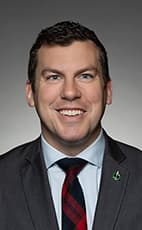
Kody Blois
In the 90 days to September 18, 2026, 28 organizations lobbied Kody Blois across 35 meetings — most often about International Trade. The most frequent visitor was Ligado Networks Corp. (3 meetings, via Greg MacNeil of NorthStar Public Affairs Inc.). Its registration describes the goal as “Discussions with federal government officials regarding Innovation, Science and Economic Development Canada's consultation on L-band…”. That's more than the average MP, who had 6 meetings over the same period.
Based on federal lobbying registry data to September 18, 2026
In the House · Sep 21–25
Kody Blois this week
“Let me start by saying that, and this is certainly true on this side of the House, all members of Parliament know the important work that Canadian farmers do across the country. That is exactly why we have eliminated the excise tax on gasoline and diesel.”
- Spoke 11 times in the House · the average MP spoke 4 times
- FORC-266, second reading — Establish a national framework respecting skilled trades and labour mobility · passed 295–21
Get Kody Blois's week in your inbox every Monday
What they said, how they voted, and who lobbied them. Free, no ads, unsubscribe anytime.
How Kody Blois actually voted
Their recorded positions on the issues Canadians care about — pulled straight from the parliamentary record.
- Voted For
Labour & Employment
Establish a national framework respecting skilled trades and labour mobility
C-266 · Sep 2026 · Passed · Tell your MP what you think
- Voted For
Criminal Justice
Hate propaganda, hate crime and access to religious or cultural places
C-9 · Jun 2026 · Passed · Tell your MP what you think
- Voted For
- Voted For
Criminal Justice
Child protection, gender-based violence, delays and other measures
C-16 · Jun 2026 · Passed · Tell your MP what you think
- Voted Against
Overall leanings
100%
voted with the Liberal line this Parliament
99%
vote attendance (172/174, missed 2)
Who’s in Kody’s ear
894
lobbying meetings
316
companies & groups
814
speeches in Parliament
Top lobbying relationship: Canadian Canola Growers Association — met 42 times · most lobbied on Agriculture.
See who’s lobbying Kody →Who's lobbying Kody
Individual meeting records from the federal lobbying registry
| Date | Organization | |
|---|---|---|
| 2026-09-14 | Canadian ETF Association | |
| 2026-09-10 | Women's Network PEI | |
| 2026-09-09 | Canadian ETF Association | |
| 2026-08-31 | AST & Science, LLC | |
| 2026-08-31 | Canadian Propane Association |
Write to Kody Blois
Pick what it's about. You'll get a letter you can edit, then send it from your own email.
Other ways to reach Kody
613-992-4211 is the House of Commons switchboard — ask to be connected to your MP's office. For constituency office contact details, or if kody.blois@parl.gc.ca bounces, visit their Parliament profile.
Top Lobbying Clients
Companies with the most meetings with this MP
What Kody talks about
- Criminal Code24 speeches · 2021–2023
- The Budget18 speeches · 2021–2025
- Economic and Fiscal Update Implementation Act, 202116 speeches · 2022
- Budget 2025 Implementation Act, No. 115 speeches · 2025
- Canada-Newfoundland and Labrador Atlantic Accord Implementation Act15 speeches · 2023–2024
Recent Speeches
Mr. Speaker, let me start by saying that, and this is certainly true on this side of the House, all members of Parliament know the important work that Canadian farmers do across the country. That is exactly why we have eliminated the excise tax on gasoline and diesel. It is why we have increased bus… Read full speechShow less
Mr. Speaker, let me start by saying that, and this is certainly true on this side of the House, all members of Parliament know the important work that Canadian farmers do across the country. That is exactly why we have eliminated the excise tax on gasoline and diesel. It is why we have increased business risk management programs. It is why we have introduced the national food security strategy, which is over three billion dollars' worth of targeted support to the agriculture sector and the agri-food sector across the country. We have a plan to help support farmers in the country. That member is from farm country. What should be a little embarrassing to the Conservative Party is that, a year ago, when they had the opportunity to present their plan, there was nothing for Canadians.
Mr. Speaker, we have been focused on lowering costs for farmers. That is exactly why we have an action plan for reducing regulatory tape with the CFIA and the pesticides regulatory directorate. I do not know if the member shared that with the farmers in his constituency. I certainly have in my neck … Read full speechShow less
Mr. Speaker, we have been focused on lowering costs for farmers. That is exactly why we have an action plan for reducing regulatory tape with the CFIA and the pesticides regulatory directorate. I do not know if the member shared that with the farmers in his constituency. I certainly have in my neck of the woods in Canada. The member talks about the importance of market access. I do not ever hear the Conservatives talking about the seven billion dollars' worth of agriculture and agri-food market access that the government established in China or the work we are doing to establish market access around the world, whether that is in Europe or the Asia Pacific. The Conservative Party does not even talk about the work that the government is doing to support farmers across the country.
Mr. Speaker, the Parliamentary Secretary to the Minister of Fisheries just made it absolutely clear. Notwithstanding all the theatrics we have on that side from the member, we will always stand up for the Canadian fishery. We will stand up for the fishermen in Newfoundland and Labrador, and we alrea… Read full speechShow less
Mr. Speaker, the Parliamentary Secretary to the Minister of Fisheries just made it absolutely clear. Notwithstanding all the theatrics we have on that side from the member, we will always stand up for the Canadian fishery. We will stand up for the fishermen in Newfoundland and Labrador, and we already have. I wonder if the member has told fishermen in his community about the $1 billion that this government has put into small craft harbours. I wonder if the member has actually engaged his constituents and talked about the $10 billion that our government put into Churchill Falls as part of the agreement that will create 23,000 jobs in this country, including a lot in his province. Is he doing his work to share the work that this government is doing in his province?
Mr. Speaker, the member can stand up in this House and talk about the Prime Minister undermining our sovereignty, but it is fundamentally not true. As I have already put on the record, the Minister of Fisheries, the Parliamentary Secretary to the Minister of Fisheries and the Parliamentary Secretary… Read full speechShow less
Mr. Speaker, the member can stand up in this House and talk about the Prime Minister undermining our sovereignty, but it is fundamentally not true. As I have already put on the record, the Minister of Fisheries, the Parliamentary Secretary to the Minister of Fisheries and the Parliamentary Secretary to the Prime Minister of this country are making very clear that we will not be shedding one single element of the sovereignty of our fisheries in Canada and Newfoundland and Labrador. In fact, let me go on the record again and remind the member that there was one billion dollars' worth of small craft harbour investment. Under the Conservative government, our harbours had deteriorated. We are investing in the fisheries. We are investing in processing through the national food security strategy. We will be there for Newfoundland and Labrador.
Mr. Speaker, it is great to be back. I hope you had a great summer with your constituents in the Montreal area. I had the opportunity to engage with the people I have the privilege of representing, and it is great to bring their voices to Parliament. I hope all of my colleagues had an opportunity to… Read full speechShow less
Mr. Speaker, it is great to be back. I hope you had a great summer with your constituents in the Montreal area. I had the opportunity to engage with the people I have the privilege of representing, and it is great to bring their voices to Parliament. I hope all of my colleagues had an opportunity to do the same throughout the summer months. I will be splitting my time this morning with the hon. member for Davenport. Today, we are here to talk about the building Canada strong act, but I would be remiss if I did not take 30 seconds, given the fact that I was in my constituency this summer, to recognize some tremendous young athletes from my community. I am a former fast pitch softball player. I do not know if any members in the House have played fast pitch softball. It is a sport played mostly in smaller and rural communities across the country. I want to put into the Hansard that Nova Scotia had four medals on the men's side in four different categories. At the under-17 level, the Brookfield Elks, with a number of athletes from my riding, won the Canadian championship. At the under-20 level, the Brookfield Elks won a bronze medal. At the under-23 level, the Nova Scotia team, again, composed of many athletes from Kings—Hants, won a silver medal, and at the top level of senior men's softball, East Hants won a bronze medal. I want to make sure that is on the record. We are proud of our athletes and certainly proud of the work they are doing at the national level. On to more important things, we were elected as a government to focus on building a more resilient economy. We know there are headwinds and challenges globally. We are facing tariffs from the U.S. administration, which is changing its trade policy, but the focus of the Prime Minister and the government has been to focus on controlling what we can control as a country. The Prime Minister and the Minister of Transport have made very clear that the building Canada strong act is the most important piece of economic legislation the government has introduced to date to really focus on driving projects that matter in the national interest of the country, such as the modernization of key trade corridors, including ports, across this country, and to also look at our supply chains and the way our labour context works in this country. Generally, collective bargaining has worked very well, but in some key strategic areas, we want to ensure there are additional measures and initiatives that can ensure that both the employer and the union representing workers can get to a deal that is fair for parties. We feel it is incumbent on the government to actually establish the initiatives and supports to help make that happen. Those are the three pillars of this very important piece of legislation. I will take us through why that matters, and I am going to start on the regulatory permitting piece. Many members of the House would agree with me that Canada has what the world needs. We are an agricultural superpower in our ability to help feed the world. We have a major potash industry that is, in fact, the largest in the world. It is global in nature. We need to get that supply to the world. We have the energy the world needs. We have the ability to fuel the world. Again, whether that is in pipeline access or the ability to get energy to world markets, we have to have the supply chain to make that happen. We have to be willing, particularly at this moment when Canada is being called upon by countries around the world, to be even more of a secure energy supplier. We have to work on the major projects that help drive our economy forward. We can talk about critical minerals, whether from the perspective of a military application or of clean energy. As one of the younger members of the House, I think about the future that I would like to leave for my future family, our constituents and people around the world. Critical minerals are going to be a really important part to our clean energy future. However, Canada has an outsized role globally to make sure those critical minerals are available to our allies and that we have alternative supply chains. That requires us, as parliamentarians, and certainly as a government, to make sure the regulatory conditions are in place so we can drive that process forward. What the government is proposing is essentially one window, one regulator and a one-year review once the proponent has submitted all the necessary information to the federal regulator. Members of Parliament will remember that our government introduced Bill C-5 for this type of principle on major national projects. There have been 17 major projects that have been referred to the MPO. While I am on my feet, I would like to recognize the work of Dawn Farrell, someone who has great experience in the private sector and who is doing very important work to lead that agency and help ensure that we can advance projects that are in the national interest. Some members of Parliament have rightly asked if that is a good principle for major national projects. They have asked about how we take those principles and how we could ensure that perhaps mid-sized projects and projects of more local or regional interest could also have the same principles applied regarding the rigour in which we are trying to move processes forward quickly without shortcuts. I think it is important for Canadians at home to understand the values that underpin not only how we want to ensure environmental safety and participation with indigenous groups in this country, but also the desire to make sure we can create certainty for businesses to invest in this country. We are trying to reconcile all that and to do so on a more expedited timeline, and that is exactly what we are proposing today. What that looks like is that as opposed to having multiple line departments, such as Transport Canada, the Department of Fisheries and Oceans, perhaps ECCC or, of course, indigenous engagement through Crown-Indigenous Relations, we should find a way to have it under one federal project review. While there could be a multitude of federal departments that would perhaps under current legislation have a role and responsibility, and we do not want to take away that expertise or that understanding of why those elements are important for projects, we have to be able to find the way to make it under one federal project review, not multiple ones, which is just challenging for the proponents trying to advance them. It is also challenging for indigenous communities. I have the privilege of representing three of them. One piece of feedback I have had in the seven years I have been involved in Parliament is that if we have ongoing consultation through multiple line departments, this does create a capacity challenge to ensure that indigenous communities are actively participating and have the resources to make sure they can share their perspective, as per our constitutional requirements in this country. Therefore, one thing this legislation proposes is a Crown consultation hub. This is the idea that in consultation, the multitude of federal departments that may have a say on a federal permitting decision could actually go through one body to engage with the nation in question to be able to provide the multitude of different perspectives we may need, as opposed to a series, a multitude, of departments playing that out over time. This is what we would, I guess, refer to as common sense. We think this is something that would reconcile the interests of ensuring that indigenous communities are engaged and we are meeting our constitutional requirements, with, at the same time, providing the proponent and a federal regulator with the ability to make that happen. Instead of a multitude of departments, it would be the Canada Energy Regulator, the Canada Nuclear Safety Commission or the Impact Assessment Agency. One of those three agencies would have the purview to make all the federal decisions, with engagement from federal departments, with the goal of having a one-year decision once all applicable information is submitted. That is incumbent. We as parliamentarians across the House, I hope, can recognize that is important. It is something we have to be able to push forward. On supply chain certainty, we have heard, and I have heard, commentary outside the House that the bill is trying to limit the ability to strike in this country. Let me say that this is simply not the case. What the bill is proposing is to put additional measures in terms of mediation support, such as a special mediator when there are complex cases between an employer and labour. I go back to the point I made, which is that we have what the world needs, we have an obligation and we are in a critical moment for this country. We as a government feel it is absolutely incumbent to ensure that we are putting all the resources possible to be able to get to a resolution between the employer and the union. We understand the importance of labour in this country. At the same time, we are putting critical provisions around the utilization of section 107, which is held by the Minister of Jobs. We feel that is an appropriate balance to make sure we are protecting the constitutional rights of workers and at the same time trying to ensure we are putting the resources to get the best deal at the table. When we look at the legislation and the proposals from the government, we see there is actually a proposal to put 100 additional resources, this being full-time equivalents, to the Canadian Industrial Review Board. Again, this is a mechanism where, if parties get to an impasse, we could be trying to provide assistance to ensure that there is good-faith bargaining and that we could get to an outcome that matters for employers and also matters, most importantly, for the workers and the people who drive our economy across this country. There is a lot in the bill, and I wish I had more than 10 minutes, but last is a modernization around port governance. Ports play an extremely important role in our country, and the provisions in the bill would allow for additional discretion for port boards in their capacity to make regulatory decisions, which we think is streamlined and the right way to go. At the end of the day, the bill is about building Canada. I look forward to taking questions from my colleagues.
Bills Sponsored
Recent activity
22 activities across speeches, bills, and lobbying communications.
September 2026
Oral Questions
Mr. Speaker, let me start by saying that, and this is certainly true on this side of the House, all members of Parliament know the important work that Canadian farmers do across the country. That is e… Read full speechShow less
Mr. Speaker, let me start by saying that, and this is certainly true on this side of the House, all members of Parliament know the important work that Canadian farmers do across the country. That is exactly why we have eliminated the excise tax on gasoline and diesel. It is why we have increased business risk management programs. It is why we have introduced the national food security strategy, which is over three billion dollars' worth of targeted support to the agriculture sector and the agri-food sector across the country. We have a plan to help support farmers in the country. That member is from farm country. What should be a little embarrassing to the Conservative Party is that, a year ago, when they had the opportunity to present their plan, there was nothing for Canadians.
Oral Questions
Mr. Speaker, we have been focused on lowering costs for farmers. That is exactly why we have an action plan for reducing regulatory tape with the CFIA and the pesticides regulatory directorate. I do n… Read full speechShow less
Mr. Speaker, we have been focused on lowering costs for farmers. That is exactly why we have an action plan for reducing regulatory tape with the CFIA and the pesticides regulatory directorate. I do not know if the member shared that with the farmers in his constituency. I certainly have in my neck of the woods in Canada. The member talks about the importance of market access. I do not ever hear the Conservatives talking about the seven billion dollars' worth of agriculture and agri-food market access that the government established in China or the work we are doing to establish market access around the world, whether that is in Europe or the Asia Pacific. The Conservative Party does not even talk about the work that the government is doing to support farmers across the country.
Oral Questions
Mr. Speaker, the Parliamentary Secretary to the Minister of Fisheries just made it absolutely clear. Notwithstanding all the theatrics we have on that side from the member, we will always stand up for… Read full speechShow less
Mr. Speaker, the Parliamentary Secretary to the Minister of Fisheries just made it absolutely clear. Notwithstanding all the theatrics we have on that side from the member, we will always stand up for the Canadian fishery. We will stand up for the fishermen in Newfoundland and Labrador, and we already have. I wonder if the member has told fishermen in his community about the $1 billion that this government has put into small craft harbours. I wonder if the member has actually engaged his constituents and talked about the $10 billion that our government put into Churchill Falls as part of the agreement that will create 23,000 jobs in this country, including a lot in his province. Is he doing his work to share the work that this government is doing in his province?
Oral Questions
Mr. Speaker, the member can stand up in this House and talk about the Prime Minister undermining our sovereignty, but it is fundamentally not true. As I have already put on the record, the Minister of… Read full speechShow less
Mr. Speaker, the member can stand up in this House and talk about the Prime Minister undermining our sovereignty, but it is fundamentally not true. As I have already put on the record, the Minister of Fisheries, the Parliamentary Secretary to the Minister of Fisheries and the Parliamentary Secretary to the Prime Minister of this country are making very clear that we will not be shedding one single element of the sovereignty of our fisheries in Canada and Newfoundland and Labrador. In fact, let me go on the record again and remind the member that there was one billion dollars' worth of small craft harbour investment. Under the Conservative government, our harbours had deteriorated. We are investing in the fisheries. We are investing in processing through the national food security strategy. We will be there for Newfoundland and Labrador.
Government Orders
Mr. Speaker, it is great to be back. I hope you had a great summer with your constituents in the Montreal area. I had the opportunity to engage with the people I have the privilege of representing, an… Read full speechShow less
Mr. Speaker, it is great to be back. I hope you had a great summer with your constituents in the Montreal area. I had the opportunity to engage with the people I have the privilege of representing, and it is great to bring their voices to Parliament. I hope all of my colleagues had an opportunity to do the same throughout the summer months. I will be splitting my time this morning with the hon. member for Davenport. Today, we are here to talk about the building Canada strong act, but I would be remiss if I did not take 30 seconds, given the fact that I was in my constituency this summer, to recognize some tremendous young athletes from my community. I am a former fast pitch softball player. I do not know if any members in the House have played fast pitch softball. It is a sport played mostly in smaller and rural communities across the country. I want to put into the Hansard that Nova Scotia had four medals on the men's side in four different categories. At the under-17 level, the Brookfield Elks, with a number of athletes from my riding, won the Canadian championship. At the under-20 level, the Brookfield Elks won a bronze medal. At the under-23 level, the Nova Scotia team, again, composed of many athletes from Kings—Hants, won a silver medal, and at the top level of senior men's softball, East Hants won a bronze medal. I want to make sure that is on the record. We are proud of our athletes and certainly proud of the work they are doing at the national level. On to more important things, we were elected as a government to focus on building a more resilient economy. We know there are headwinds and challenges globally. We are facing tariffs from the U.S. administration, which is changing its trade policy, but the focus of the Prime Minister and the government has been to focus on controlling what we can control as a country. The Prime Minister and the Minister of Transport have made very clear that the building Canada strong act is the most important piece of economic legislation the government has introduced to date to really focus on driving projects that matter in the national interest of the country, such as the modernization of key trade corridors, including ports, across this country, and to also look at our supply chains and the way our labour context works in this country. Generally, collective bargaining has worked very well, but in some key strategic areas, we want to ensure there are additional measures and initiatives that can ensure that both the employer and the union representing workers can get to a deal that is fair for parties. We feel it is incumbent on the government to actually establish the initiatives and supports to help make that happen. Those are the three pillars of this very important piece of legislation. I will take us through why that matters, and I am going to start on the regulatory permitting piece. Many members of the House would agree with me that Canada has what the world needs. We are an agricultural superpower in our ability to help feed the world. We have a major potash industry that is, in fact, the largest in the world. It is global in nature. We need to get that supply to the world. We have the energy the world needs. We have the ability to fuel the world. Again, whether that is in pipeline access or the ability to get energy to world markets, we have to have the supply chain to make that happen. We have to be willing, particularly at this moment when Canada is being called upon by countries around the world, to be even more of a secure energy supplier. We have to work on the major projects that help drive our economy forward. We can talk about critical minerals, whether from the perspective of a military application or of clean energy. As one of the younger members of the House, I think about the future that I would like to leave for my future family, our constituents and people around the world. Critical minerals are going to be a really important part to our clean energy future. However, Canada has an outsized role globally to make sure those critical minerals are available to our allies and that we have alternative supply chains. That requires us, as parliamentarians, and certainly as a government, to make sure the regulatory conditions are in place so we can drive that process forward. What the government is proposing is essentially one window, one regulator and a one-year review once the proponent has submitted all the necessary information to the federal regulator. Members of Parliament will remember that our government introduced Bill C-5 for this type of principle on major national projects. There have been 17 major projects that have been referred to the MPO. While I am on my feet, I would like to recognize the work of Dawn Farrell, someone who has great experience in the private sector and who is doing very important work to lead that agency and help ensure that we can advance projects that are in the national interest. Some members of Parliament have rightly asked if that is a good principle for major national projects. They have asked about how we take those principles and how we could ensure that perhaps mid-sized projects and projects of more local or regional interest could also have the same principles applied regarding the rigour in which we are trying to move processes forward quickly without shortcuts. I think it is important for Canadians at home to understand the values that underpin not only how we want to ensure environmental safety and participation with indigenous groups in this country, but also the desire to make sure we can create certainty for businesses to invest in this country. We are trying to reconcile all that and to do so on a more expedited timeline, and that is exactly what we are proposing today. What that looks like is that as opposed to having multiple line departments, such as Transport Canada, the Department of Fisheries and Oceans, perhaps ECCC or, of course, indigenous engagement through Crown-Indigenous Relations, we should find a way to have it under one federal project review. While there could be a multitude of federal departments that would perhaps under current legislation have a role and responsibility, and we do not want to take away that expertise or that understanding of why those elements are important for projects, we have to be able to find the way to make it under one federal project review, not multiple ones, which is just challenging for the proponents trying to advance them. It is also challenging for indigenous communities. I have the privilege of representing three of them. One piece of feedback I have had in the seven years I have been involved in Parliament is that if we have ongoing consultation through multiple line departments, this does create a capacity challenge to ensure that indigenous communities are actively participating and have the resources to make sure they can share their perspective, as per our constitutional requirements in this country. Therefore, one thing this legislation proposes is a Crown consultation hub. This is the idea that in consultation, the multitude of federal departments that may have a say on a federal permitting decision could actually go through one body to engage with the nation in question to be able to provide the multitude of different perspectives we may need, as opposed to a series, a multitude, of departments playing that out over time. This is what we would, I guess, refer to as common sense. We think this is something that would reconcile the interests of ensuring that indigenous communities are engaged and we are meeting our constitutional requirements, with, at the same time, providing the proponent and a federal regulator with the ability to make that happen. Instead of a multitude of departments, it would be the Canada Energy Regulator, the Canada Nuclear Safety Commission or the Impact Assessment Agency. One of those three agencies would have the purview to make all the federal decisions, with engagement from federal departments, with the goal of having a one-year decision once all applicable information is submitted. That is incumbent. We as parliamentarians across the House, I hope, can recognize that is important. It is something we have to be able to push forward. On supply chain certainty, we have heard, and I have heard, commentary outside the House that the bill is trying to limit the ability to strike in this country. Let me say that this is simply not the case. What the bill is proposing is to put additional measures in terms of mediation support, such as a special mediator when there are complex cases between an employer and labour. I go back to the point I made, which is that we have what the world needs, we have an obligation and we are in a critical moment for this country. We as a government feel it is absolutely incumbent to ensure that we are putting all the resources possible to be able to get to a resolution between the employer and the union. We understand the importance of labour in this country. At the same time, we are putting critical provisions around the utilization of section 107, which is held by the Minister of Jobs. We feel that is an appropriate balance to make sure we are protecting the constitutional rights of workers and at the same time trying to ensure we are putting the resources to get the best deal at the table. When we look at the legislation and the proposals from the government, we see there is actually a proposal to put 100 additional resources, this being full-time equivalents, to the Canadian Industrial Review Board. Again, this is a mechanism where, if parties get to an impasse, we could be trying to provide assistance to ensure that there is good-faith bargaining and that we could get to an outcome that matters for employers and also matters, most importantly, for the workers and the people who drive our economy across this country. There is a lot in the bill, and I wish I had more than 10 minutes, but last is a modernization around port governance. Ports play an extremely important role in our country, and the provisions in the bill would allow for additional discretion for port boards in their capacity to make regulatory decisions, which we think is streamlined and the right way to go. At the end of the day, the bill is about building Canada. I look forward to taking questions from my colleagues.
Government Orders
Mr. Speaker, we have a new government under a new Prime Minister, and it is a government that is deeply focused on economic growth across the country. I would remind the hon. member that the oil and g… Read full speechShow less
Mr. Speaker, we have a new government under a new Prime Minister, and it is a government that is deeply focused on economic growth across the country. I would remind the hon. member that the oil and gas sector did grow under the last 10 years of the Liberal government, at the same time as we also reduced emissions in the country. The last government certainly sought the balance between economic growth and environmental protection. The current government will endeavour to do the same. The last government built a pipeline to the Pacific coast. The current government, through the work of the Prime Minister and certainly by engaging Premier Smith, is open to another west coast pipeline, because it knows that being able to move the product to Asian markets is extremely important. Our ability to move liquefied natural gas off the B.C. coast to ensure that countries in the Pacific do not have to burn more coal in their energy grid is actually part of a global emissions reduction strategy. We are proud of the work we are doing here, and I know that members of the member's home province are proud of the current government as well.
Government Orders
Mr. Speaker, certainly in our system, there is cabinet, which is made up of members of Parliament who sit in the House. The member, in his remarks, his intervention, talked about tariffs. I do not kno… Read full speechShow less
Mr. Speaker, certainly in our system, there is cabinet, which is made up of members of Parliament who sit in the House. The member, in his remarks, his intervention, talked about tariffs. I do not know if there was a substantive piece where he disagrees with the policy that the government has introduced of countervailing duties to protect Canadian industry, to protect Quebec businesses, to protect Quebec workers, I should say. The member has the privilege and honour, as a member of Parliament representing his constituents, to stand in this place and to be able to take a position if he disagrees with the elected government and its utilization of our policy to protect Canadian workers. Let us be very clear that we do this reluctantly. We believe in free and open trade. We recognize the importance of the commercial relationship we have had with the United States, but the executive stands behind the decisions it has made to protect Canadian workers at a time when, if we do not respond, we will be hurting Quebec businesses as well.
Government Orders
Mr. Speaker, my colleague and I have the opportunity to work together, and I know we share an interest in the port of Halifax. If Parliament is to bring this forward, the bill itself would allow for a… Read full speechShow less
Mr. Speaker, my colleague and I have the opportunity to work together, and I know we share an interest in the port of Halifax. If Parliament is to bring this forward, the bill itself would allow for additional governance for the port of Halifax or other ports across the country, which would centre around regulatory decisions, trade corridors and the ability to work together on how best we get to the outcomes around both importation and exportation of products across the country. This is what the ports were calling for. This would give additional flexibility for governance in that area.
Government Orders
Mr. Speaker, the hon. member should be encouraging the members in his party. I think he would make a tremendous leader of the official opposition. He mixes important oratory skills with the ability to… Read full speechShow less
Mr. Speaker, the hon. member should be encouraging the members in his party. I think he would make a tremendous leader of the official opposition. He mixes important oratory skills with the ability to point to where the government is moving in the right direction, while keeping his obligation to the loyal official opposition to continue to push the government to do more. I would like to point out to my hon. colleague that this government is an action-focused government. This is not about symbolism; it is about delivering concretely. The bill before Parliament is of the nature of things that I know former prime minister Stephen Harper would support. I know Jason Kenney, who sat on the side of the House that Harper did, is supportive of the work the government is doing. The Sisson mine, Darlington new nuclear and the Nova Scotia-New Brunswick intertie are projects that are actively under way, creating good jobs. Will the member at least recognize that these projects are happening? Is he going to support this bill?
Government Orders
Mr. Speaker, I rise on a point of order. During the debate, the hon. member for Tobique—Mactaquac, which I believe is his riding's title, highlighted the importance of projects being real and proper. … Read full speechShow less
Mr. Speaker, I rise on a point of order. During the debate, the hon. member for Tobique—Mactaquac, which I believe is his riding's title, highlighted the importance of projects being real and proper. Therefore, I am seeking the opportunity to table a picture of the work that is actually happening between Nova Scotia and—
Oral Questions
Mr. Speaker, our message to Margaret and to individuals across this country would be that we have a concrete plan to build housing in this country. The Minister of Housing, through this government, ha… Read full speechShow less
Mr. Speaker, our message to Margaret and to individuals across this country would be that we have a concrete plan to build housing in this country. The Minister of Housing, through this government, has been working to build affordable units from the east coast of Canada all the way through to British Columbia. What I hope the member has the time to explain to Margaret is why, at every single turn, he and his party have voted against the affordability measures that matter for Margaret and the people she cares about in this country. He has voted against national child care. He has voted against the food and essentials rebate that we put out to 12 million Canadians. The member has voted against those measures at every single turn.
June 2026
Oral Questions
Mr. Speaker, I will give the Conservatives credit. They are now talking about actual measures that could support affordability, but I would ask them where they have been for the last number of months … Read full speechShow less
Mr. Speaker, I will give the Conservatives credit. They are now talking about actual measures that could support affordability, but I would ask them where they have been for the last number of months and years. I have been a member of Parliament for seven years in the House, and it does not matter if it is the Canada child benefit, national child care, the national school food program or the tax measures we have put in place, consistently, the Conservatives vote against these measures. We appreciate that they are finally talking about affordability, but we would ask them to actually support the measures the government consistently puts at the front to help support Canadians across the board. It is good that they are now talking, but why do they not get on board with some of the initiatives that we have had for years now?
Oral Questions
Mr. Speaker, we recognize that there are challenges across the country and that there are people struggling with the cost of affordability. That is exactly why we have put in place the groceries and e… Read full speechShow less
Mr. Speaker, we recognize that there are challenges across the country and that there are people struggling with the cost of affordability. That is exactly why we have put in place the groceries and essentials rebate—
Oral Questions
Mr. Speaker, we recognize that there are challenges across the country. That is exactly why we cut taxes for 22 million Canadians. It is why we have put in the groceries and essentials rebate. It is w… Read full speechShow less
Mr. Speaker, we recognize that there are challenges across the country. That is exactly why we cut taxes for 22 million Canadians. It is why we have put in the groceries and essentials rebate. It is why we have doubled down on social programs that matter for everyday Canadians. However, we reject the premise of the Conservatives' question, that the government's policies have resulted in the challenges that Canadians are facing. We are facing a trade war from our largest trading partner: 75% of our goods and services go to the United States. There is a war in the Middle East and a war in eastern Europe. We are dealing with the circumstances and putting forward an economic plan to build this country and support Canadians at the same time.
Oral Questions
Mr. Speaker, may I respectfully ask why that member votes against the measures that support the good people of Oshawa and the people across this country? As we said in the last answer, we are here fig… Read full speechShow less
Mr. Speaker, may I respectfully ask why that member votes against the measures that support the good people of Oshawa and the people across this country? As we said in the last answer, we are here fighting for Canadian industry and business. That member has voted against tax cuts for Canadians. That member has voted against strategic financing to support the auto sector in this country. The Minister of Industry is working with that sector to support members. That member stands up and does not recognize that we have created 88,000 jobs in the last month alone. We have a plan to help build the country strong and support Canadians who are facing vulnerability at this time.
Oral Questions
Madam Speaker, we know the challenges for certain sectors in the Canadian economy on aluminum, on steel, on auto and forestry. Our Minister responsible for Canada-U.S. Trade and our ambassador in Wash… Read full speechShow less
Madam Speaker, we know the challenges for certain sectors in the Canadian economy on aluminum, on steel, on auto and forestry. Our Minister responsible for Canada-U.S. Trade and our ambassador in Washington, Janice Charette, who has been appointed, are engaging with the U.S. administration. The member talked about jobs. I do think it is important to recognize that there were 88,000 jobs created in the Canadian economy. We know that there are challenges in particular sectors and that is why the Minister of Industry has been helping, with targeted programs to support workers and those industries being impacted. At the same time, we are focusing on building the Canadian economy across the country.
Oral Questions
Madam Speaker, what I find quite remarkable is that in the Conservatives' questions there is never a recognition that the U.S. administration has imposed tariffs on some of our key sectors in this cou… Read full speechShow less
Madam Speaker, what I find quite remarkable is that in the Conservatives' questions there is never a recognition that the U.S. administration has imposed tariffs on some of our key sectors in this country. We are continuing to make the case to try to remove them. The member blows right by the fact that 88,000 jobs were created in May, primarily in the private sector and primarily in construction, with 150,000 net jobs this year. We have a AAA credit rating. We have a lower deficit. We have the strongest fiscal position in the G7. We have strong fundamentals and are focused on building major national projects, including in that member's province, to build Canada strong, to build this country strong. We will continue to focus on those plans.
May 2026
Government Orders
Mr. Speaker, I know that the crowd is in high anticipation for my remarks today on the opposition day motion. I will remind the hon. chair of the House of Commons agriculture committee that I look for… Read full speechShow less
Mr. Speaker, I know that the crowd is in high anticipation for my remarks today on the opposition day motion. I will remind the hon. chair of the House of Commons agriculture committee that I look forward to his questions after my 20-minute remark here. Mr. Speaker, you will know from my seven years as a parliamentarian that I thoroughly enjoy opposition day motions. Obviously I have had the privilege of sitting on this side of the House since 2019, but opposition day motions are an opportunity for opposition parties to put forward their policy prescriptions, their ideas on how to solve issues for Canadians, and rightfully so. Today we are talking about affordability and the cost of living. I dare say we could not find a member of Parliament, at least I hope not, who does not believe that the work we have to do to support greater affordability for Canadians and to tackle the cost of living is an important public policy measure. Where we differ is on the prescriptions with which we go about doing that work. I want to start by saying that, when I look at the opposition day motion, I humbly believe that the policy prescriptions the Conservative Party is putting forward are actually too narrow. The motion is looking too narrowly at the way in which we have to address affordability in this country. I represent a rural riding in Nova Scotia. I have a lot of constituents who do not have the same ability to rely on public transit, who have to drive longer distances and who, I know, watch the price at the pump. The motion would be a really important measure. However, when I look at the opposition day motion, I see that it contains no recognition of why Canadians are dealing with higher costs at the pump right now. There is no recognition that the war the United States is waging against Iran and the impacts from what is happening at the Strait of Hormuz are having a major impact on the cost of living, the cost of fertilizer and the cost of fuel. Furthermore, nowhere in the opposition day motion does the Conservative Party recognize that the government has already, for the next four months, suspended the federal excise tax on gasoline. That is 10¢ a litre. It is a small but important measure with respect to the ability to fill up one's gasoline tank, but it is a sizable investment. This is almost $3 billion that the Government of Canada has committed to supporting affordability across the country. As I have said in the House before, it is a time-limited measure, until just after Labour Day in September, and we think that this is fiscally prudent. We hear the Conservatives talking out of one side of their mouth in the House of Commons about Canada's fiscal position, which I will cover in my remarks here today, but in the same breath they talk about spending even more on removing the GST on gas, which is for important public policy spending for social programs that matter to Canadians across the country. The Conservatives are playing a little on both sides. I guess that is the nature of opposition day and opposition parties, but at the end of the day, we think this is a reasonable measure that we have put in place for the next four months. There is no mention of it whatsoever. I think about how we go about tackling the question, and we see affordability not only through the lens of the price at the pump. I would remind hon. members and Canadians at home that the first act of the Prime Minister and the government was to eliminate the consumer carbon price. That was 18¢ a litre. Yes, there were rebates tied to that. Mr. Speaker, you will know that as a member of Parliament I was a strong advocate of making adjustments and was deeply supportive of the Prime Minister's work to eliminate the consumer carbon price, on the premise that there would be more ability to tackle climate and the environment and to reduce emissions. However, that policy was challenging for Canadians in rural areas who do not have the same ability, particularly with transportation, to change their policy. The government has already reduced the cost of gasoline by 28¢ a litre in the past calendar year. Never do we hear the opposition recognize that point. Never do we hear the Conservatives talk about this as something that the government is moving, in their view, in the right direction. The government believes there is a slippery slope around the GST. The GST, as we mentioned, notwithstanding the spring economic—
Government Orders
Mr. Speaker, I would like to thank my hon. colleague from Saanich—Gulf Islands for ensuring that we have proper decorum. I believe that my remarks here today have value, and I really look forward to e… Read full speechShow less
Mr. Speaker, I would like to thank my hon. colleague from Saanich—Gulf Islands for ensuring that we have proper decorum. I believe that my remarks here today have value, and I really look forward to engaging with my colleagues, particularly when we get to questions after the speech. Perhaps people were just excited to be able to see the parliamentary secretary and the hon. member for Kings—Hants, but we will never know. What I was talking about was that we see affordability through more than just one lens. We have done the work to reduce the price of gasoline by, on average, 28¢ a litre across the country. It may vary slightly across different regional realities. At the same time, that is not the only lens through which Canadians would view affordability. We have put a series of programs in place that I want to highlight to Canadians, and I would urge my Conservative colleagues to consider the ways in which we can expand the definition of how we put money back into people's pockets to support their ability to raise a family, take care of themselves or stay in their home longer, perhaps. This gives me an opportunity to talk about those. I am a proud son of a truck driver, and my mom is an administrative assistant back home in Kings—Hants. We come from pretty humble stock, as I say. We were a paycheque-to-paycheque kind of family. When some of my constituents ask about my trajectory, my involvement as a parliamentarian and why I chose the Liberal Party of Canada to stand for, I say that I was deeply proud of the work that the last prime minister was doing, particularly around the Canada child benefit. Previously, former governments had put in a flat-based type of incentive. Whether someone had a lot of different incomes to their name or they were relatively low-income, they received largely the same type of benefit to help support raising their children. My parents did not have a type of program like the Canada child benefit. I was fortunate that I had grandparents at home who were helpful and supportive and who were allowed to get me involved in organized sport. However, I still remember going to the grocery store and there being times when my mom would run the credit card, or the debit card, I guess, in that day, and not be able to pay for the groceries. I am proud to stand with a party that put social programs at the heart of our agenda, and with a new Prime Minister who has said and vowed that he will protect them. The Canada child benefit is one example. I was not here during the time it was implemented in the 42nd Parliament, but the Conservative Party voted against it, and the Conservatives do not talk about it as an important affordability measure that we can do to support everyday Canadians. For 50 years, Canadians talked about the importance of a national child care policy, not only as a policy to help support young people in their earliest years in terms of early education but also, of course, as a mechanism to support working parents who may wish to go back to the workplace to contribute to the economic side of the equation and in terms of the economy, to be able to get back into their pursuits that matter from a career side. The cost of child care had risen quite significantly. We came along, and under the last government and through a program that is continuing to be maintained under the current government, we supported a national child care policy with the objective of getting down to, on average, $10 a day. Never do we hear that mentioned in the Conservative opposition day motion. It is saving hundreds, if not thousands, of dollars a year for Canadian parents, and it is a key affordability measure. The Conservatives have wavered about where exactly they stand on this policy, but again, it is affordability. Yes, we want to save on the gas tank in terms of being able to get people to and from places in rural or urban communities across this country, but so too do we want to have the programs that matter for our youth and for affordability in terms of being able to get parents back into the workplace. That is good affordability policy. How about old age security increases and the guaranteed income supplement? A large proportion of the demographic in Kings—Hants is seniors. We have young, vibrant families and people of all ages, but we have a lot of seniors, especially in our rural communities. I am proud to stand with a government that increased the old age security by 10% for seniors 75 years old and up, and also increased the guaranteed income supplement for some of our most vulnerable seniors to ensure that they have more ability to pay the bills and keep a roof over their head. That is something that is key affordability, and we do not see this level of policy prescription from the Conservative Party. We are not seeing this type of thoughtful policy. I know it is the Conservatives' job to critique the government and hold the government to account. I completely understand and appreciate that function in our system, but it is also their job, I believe, to demonstrate that they have the ability to be a government-in-waiting. Fortunately, humbly and respectfully, I feel as though the way in which the member for Battle River—Crowfoot and the Conservatives have conducted themselves and purported themselves over the last year is actually helping and supporting our ability to say that we are the best choice for Canadians in that electoral context. This is important because better policy prescriptions from the Conservative benches, or all benches for that matter, although I obviously am talking today about His Majesty's loyal opposition, allow us and force us, as the government, to be even better in how we are putting together the programs and policy initiatives that matter. Last, I would say, is dental care and the groceries and essentials rebate. I have seniors in my riding who had not had the ability to get to a dentist in a considerable amount of time because, frankly, it would have cost more money than they could afford. That is an affordability measure that supports health care outcomes. It supports better access to care, not only in Kings—Hants but across this country. Never do we see many of the opposition politicians talking about what this means for their own constituents, even though these are, of course, national programs. The groceries and essentials rebate is an enhanced GST. The government has reframed it as a groceries and essentials rebate, but it will be up to $1,800, depending on income, and support 12 million Canadians. Again, it is a targeted benefit, trying to support those who may need the help the most. We think that is important. I do want to get to a point I have raised before. I had a coalition of agricultural groups from Saskatchewan in my office today: Sask Oilseeds, Sask Wheat and some canola representatives. We talked about the clean fuel standard. There are a number of different ways in which we can reduce emissions and make sure that for our next generation in this country, we are being thoughtful about balancing economic growth with also putting some emphasis on driving innovation and reducing emissions. I honestly believe the clean fuel regulation is one of the best policies. Members of the Conservative bench should be able to turn to it and say this is a policy that is using feedstock from farmers across this country, notably in prairie provinces, to reduce emissions. It has a minimal impact on the price of fuel, and it is helping to drive almost $30 a tonne's worth of canola benefit in the prairie provinces. In eastern Canada, it would be more the corn playing into ethanol blends. However, this is a policy that directly ties back to benefits on farms in rural communities and is driving innovation across this country. It has helped create Strathcona, a multi-billion-dollar investment in Alberta. The opposition party continues to signal that their way to affordability is tearing down a program that actually drives industrial benefit in this country, that actually supports Canadian farmers and that notably supports investment in the rural prairie provinces. That shocks me. In fact, I would love to get in this country, beyond partisan consideration, an ability for the two major parties to agree that this is a policy that has merit. We may have slightly different interpretations of the best way to go about it, but instead they just want to tear this thing down. They want to tear down a policy that has driven billions of dollars of industrial investment, notably in western Canada, and they want to create policy uncertainty in this space. I find that shocking. I find it unfortunate. This will not solve affordability for Canadians. I ask humbly, because the last platform of the Conservative Party, over a year ago, talked about tearing down the clean fuel standard and removing any form of industrial carbon pricing. They proposed to actually spend more taxpayers' dollars to get to a worse outcome on the environment. Conservatives need to come clean also with the policy prescriptions of the Conservative Party under the leadership of the hon. member for Battle River—Crowfoot. Their policy prescription, back in April 2025, was to actually spend more taxpayers' dollars, which ultimately has to come from Canadian pockets because we all pay taxes, to get to a worse environmental outcome. That is the thing we have to litigate in the House and ask questions about. I have great respect for many of the humble members on the other side, including the hon. member for Perth—Wellington, a great guy. I encourage those members, whom I feel have the right view about how to conduct and drive that party forward, to have these honest and hard conversations about how we find a pathway and how we make sure the Conservative Party actually has some policy prescriptions in this space. Right now, at least on this one, on the clean fuel standard, it is actually benefiting individuals in Conservative ridings across the country. It is driving industrial benefit. It is creating those opportunities. I want to take an opportunity to also talk about affordability through the lens of what we have done in the spring economic update, because, at its core, this motion is about affordability. I would point Canadians and hon. members to something I am proud of. I was the first in my family to get a post-secondary education. I obtained a law degree and a master's degree in public administration management. I am proud of that background. I also come from a background and a long history of individuals who did blue-collar work and worked in the skilled trades, and I am proud of that as well. There is $6 billion in the spring economic update to support, which is our hope as a government, and help train 80,000 to 100,000 Red Seal skilled trade workers. We are going to need the pipefitters, the plumbers, the electricians and the carpenters. The government is looking to catalyze $1 trillion of investment in this country over the next five years. We have a goal of building major projects in a variety of different fields, whether in renewable energy, clean energy, nuclear, conventional energy or the mining activities that we are going to need to help drive our clean energy future. We really want to see big projects and mid-tier projects get under way, but we also have to have the workforce and industrial capacity to deliver on that. We see that $6-billion investment as critical. That is supporting affordability for individuals who want to go through apprenticeship programs and have access to the means to do that, including an additional $400 to draw EI when individuals go back to that eight- to 10-week block as they continue to upgrade their education and build their skill set in the workplace. I would point to the work we have done to maintain the augment in the Canada student grants. Acadia University is in my riding of Kings—Hants. I just had the opportunity to be at a convocation and saw a lot of bright, young individuals who are doing great things today and I know will continue to do great things in the community and across this country. Education has become difficult and expensive. Part of that is tied to the ways in which some provincial governments have chosen to invest in post-secondary education. We want to make sure we are doing our part on the federal side, and we have increased the Canada student grant from $3,000 to $4,200. This was the type of programming that benefited me when I went through university and benefits lower-income students who may not have the means from their family to help pay for post-secondary education. We have also reduced the amount of money on a weekly basis that students who benefited from the federal loan program have to pay back after they are done their education. That is affordability in action. That is smart public policy helping support Canadians across the country. Again, I want to see more of this from the opposition benches because we can be more nuanced than to just tear down environmental policy. Yes, gasoline prices are important, along with fuel and housing. All of that matters, but these are some of the other elements we can do on affordability. Then there is the CPP rate reduction. It is small but meaningful. In the spring economic update, we announced the CPP rate reduction from 9.9% down to 9.5%. On average, this will save a worker with a T4 income around $70,000 just shy of $200 a year in savings. Again, I understand that may or may not move the needle for some who are dealing with a difficult situation, but I would humbly suggest what the Conservatives have put on offer today as a policy prescription would be less of an affordability measure than what we have just done with the CPP rate reduction. It is important not only for employees who pay into CPP but also for small businesses, which will benefit depending on the number of T4 employees they have. There is one last thing I am going to talk about. Members know I have been a strong champion in the House of the issues of farmers and agriculture. I have talked at great length about the need to be more agile in our regulatory structure. I think of the work and conversations I have had with the Nova Scotia fruit growers and the many different commodities across Kings—Hants. They talked about the government being more agile in using the science and evidence of other jurisdictions to inform our regulatory model in Canada to ensure farmers have the tools they need to do their job. I would point to the Prime Minister's work, when he was in Australia, with Prime Minister Albanese in terms of the joint communiqué that those two leaders released around regulatory co-operation between agencies in Canada and Australia. I would also point to the spring economic update. I give credit to the Minister of Agriculture and the Minister of Health, who have focused quite intensely on the ability to have an economic lens around the decisions of what was formerly called the Pest Management Regulatory Agency and also of the CFIA. I know this matters for affordability and competitiveness, and it will have a translation in terms of the price of food. These are examples where the government is reducing red tape and moving forward its goal to not only drive projects but make our landscape in the business community more competitive. As it relates to agriculture, this is great public policy. I was told this morning that imitation is the greatest form of flattery. I know the hon. member for Bow River has put forward his own private member's bill that looks oddly similar to one I put together three years ago. I give him credit for that. I am proud of the work we did on our platform back in April, when, respectfully, the Conservatives did not have a whole lot to say. We are going to continue to implement that platform on things like this. I am glad the Conservative Party is joining the conversation, but we are on it and we are going to keep doing it for Canadian farmers.
Government Orders
Mr. Speaker, the hon. member is one I would put in the camp of the good ones whom I have a lot of respect for. I know he is framing this around $1,200. We are looking at a comprehensive view around af… Read full speechShow less
Mr. Speaker, the hon. member is one I would put in the camp of the good ones whom I have a lot of respect for. I know he is framing this around $1,200. We are looking at a comprehensive view around affordability. We have already reduced gas taxes in Canada by 28¢ a litre. We believe that is important. The hon. member talked about, and I would reject the premise of his question, how the government has created a cost of living crisis. I would point to a lot of external events that are having impacts the government is seeking to respond to. I would go back to the Canada child benefit that his party voted against. I would go back to national child care, which his party has not made clear they would maintain if they were in government. I would go back to old age security and the GIS that his party voted against. These are prime examples of affordability. We are going to do our bit on gasoline, but we also want to support other broader affordability. We do not think getting rid of the clean fuel standard, which supports farmers, is smart public policy.
March 2026
House of Commons
740 communications with 248 clients
Top clients: [{"name": "Canadian Canola Growers Association", "count": 38}, {"name": "Canola …