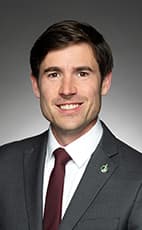
Patrick Weiler
In the 90 days to September 18, 2026, 13 organizations lobbied Patrick Weiler across 15 meetings — most often about Environment. The most frequent visitor was Environmental Defense Fund (2 meetings, via AARON FREEMAN of Pivot Strategic Consulting). Its registration describes the goal as “Improving monitoring, reporting and verification requirement for oil and gas methane emissions”. That's more than the average MP, who had 6 meetings over the same period.
Based on federal lobbying registry data to September 18, 2026
In the House · Oct 5–6
Patrick Weiler this week
“It is an honour to join the debate this evening on the building Canada strong act because Canada, at this moment, needs to build. In the interest of my limited time, I am only going to be talking about one of the three parts in this bill: build Canada now.”
- Spoke 4 times in the House · the average MP spoke 2 times
- AGAINSTC-218, second reading — Medical assistance in dying · defeated 141–187
- AGAINSTOpposition Motion (Diesel prices) · defeated 133–196
- FORFifth report of the Standing Committee on Health · passed 196–132
Get Patrick Weiler's week in your inbox every Monday
What they said, how they voted, and who lobbied them. Free, no ads, unsubscribe anytime.
How Patrick Weiler actually voted
Their recorded positions on the issues Canadians care about — pulled straight from the parliamentary record.
- Voted Against
- Voted For
Healthcare
Fifth report of the Standing Committee on Health
Oct 2026 · Passed
- Voted For
Labour & Employment
Establish a national framework respecting skilled trades and labour mobility
C-266 · Sep 2026 · Passed · Tell your MP what you think
- Voted For
Economy & Taxation
Implement certain provisions of the spring economic update tabled in Parliament on April 28, 2026
C-30 · Jun 2026 · Passed · Tell your MP what you think
- Voted For
Housing
Authorize certain payments to be made out of the Consolidated Revenue Fund for the purpose of improving housing supply
C-26 · Jun 2026 · Passed · Tell your MP what you think
Overall leanings
99%
voted with the Liberal line this Parliament · broke ranks 1×
100%
vote attendance (177/177)
Who's lobbying Patrick
Individual meeting records from the federal lobbying registry
| Date | Organization | |
|---|---|---|
| 2026-09-17 | Environmental Defense Fund | |
| 2026-08-10 | ALUS Canada | |
| 2026-08-10 | Environmental Defense Fund | |
| 2026-08-10 | World Animal Protection | |
| 2026-08-05 | David Suzuki Foundation |
Write to Patrick Weiler
Pick what it's about. You'll get a letter you can edit, then send it from your own email.
Other ways to reach Patrick
613-992-4211 is the House of Commons switchboard — ask to be connected to your MP's office. For constituency office contact details, or if patrick.weiler@parl.gc.ca bounces, visit their Parliament profile.
Committee Memberships
Top Lobbying Clients
Companies with the most meetings with this MP since July 2008
What Patrick talks about
- The Budget8 speeches · 2021–2022
- Canadian Net-Zero Emissions Accountability Act7 speeches · 2021
- Clean Coasts Act7 speeches · 2025–2026
- Indigenous Affairs7 speeches · 2021–2024
- Budget Implementation Act, 2023, No. 16 speeches · 2023
Recent Speeches
Mr. Speaker, it is an honour to join the debate this evening on the building Canada strong act because Canada, at this moment, needs to build. In the interest of my limited time, I am only going to be talking about one of the three parts in this bill: build Canada now. We need clean energy and trans… Read full speechShow less
Mr. Speaker, it is an honour to join the debate this evening on the building Canada strong act because Canada, at this moment, needs to build. In the interest of my limited time, I am only going to be talking about one of the three parts in this bill: build Canada now. We need clean energy and transmission. We need critical minerals. We need expanded port, rail and trade corridors. We need the infrastructure that will connect Canadian products to new markets and make our economy more resilient. However, there is an important question we need to ask: Can we build faster without lowering the bar? I believe the answer is yes. I believe the key is to build a better, more coordinated system. Today, projects can involve multiple federal processes, sometimes requiring similar information, with assessments, consultations and permitting decisions occurring at different stages. That creates uncertainty. It can delay investment, increase costs and make it harder for Canada to compete. Duplicative processes do not necessarily lead to better environmental outcomes. Bill C-39 is designed to address that problem by coordinating federal assessment, permitting and consultation processes so they can happen together rather than one after another. We should be finding speed by doing the necessary work at the same time, not by making the same work happen twice. That, in my view, is the most important principle behind this legislation. The same is true for how it approaches indigenous consultation. This bill would establish a more coordinated federal approach to consultation through a Crown consultation hub. Having worked with first nations, I know how some smaller first nations with more limited capacity can be overwhelmed by the number of referrals from government and the private sector. Indigenous communities should be able to engage with the federal government through a coordinated process, rather than having to navigate multiple departments and overlapping requests about the same project. That is a meaningful opportunity to make the system work better. However, getting the coordination right would depend on getting the details of this overall bill right as well. One of the issues I want to highlight is the meaning of a “comprehensive application”. That is important because the one-year timeline for project reviews and decisions under this act would begin once the proponent submits the comprehensive application and the required studies and information. That is important because the one-year period would be intended to cover the federal government's assessment, consultation, consideration of impacts and mitigation, and final decision-making. If we are going to make that timeline meaningful, proponents and communities need clarity about what is required before this clock starts. If the threshold is too low, the clock begins before the science is ready. Regulators would not have all the information they need. They would be playing catch-up. First nations and the public may lose confidence in the system. If it is vague or impossibly high, years of delay may simply move to the period before the clock begins. The principle here is that predictability should come from clarity about what is required, not on cutting corners on what is required. The second issue I would like to bring up is on public participation. This bill is intended to coordinate federal processes, but coordination also means that more information may be presented to communities at the same time. That can be challenging because large proponents can have teams of consultants, scientists, engineers and lawyers, while smaller communities, local organizations and first nations may not have that same capacity. If we want a more efficient process, we also need to make sure that people have a fair opportunity to participate in it. That could mean making sure that we have adequate participant funding, access to technical expertise, clear and accessible information, properly staffed federal review teams, and meaningful opportunities for public and first nations input at the points where that input can inform decisions. A faster process should be a more coordinated process, not a process where the people affected would have less ability to participate. The third issue I would like to bring up is on preparatory work. This bill would allow the environment minister to permit some preparatory work on a project before a decision on that project has been rendered, where it is found to be in the public interest. There is a very good practical reason to allow certain work to proceed while a broader assessment is under way. Surveys, geotechnical investigations, archaeological work and other preparatory activities can provide information that helps a project move through the review process. However, Parliament should be clear on what work can and cannot be done. It should not be irreversible, it should not prejudge the final decision or replace the assessment itself, and it should continue to respect indigenous consultation and environmental requirements. Another important issue to consider is the authority to change project conditions where the minister determines that doing so is in the public interest. This is another new power that is proposed by this bill. There are very legitimate reasons why conditions may need to evolve over the life of a project. Technology changes, project design changes, better mitigation becomes available or additional consultation identifies a better approach to a project. There is value in having that appropriate flexibility, but that flexibility should also come with transparency. I believe Parliament should look carefully at how that discretion is exercised so we understand the criteria that are going to be looked at and make sure that we have notice when changes are going to be proposed and have transparency about those reasons for those changes. If the government is going to be given this new power to change legally binding conditions, Canadians should have the transparency to understand why those changes are being made. We should also look carefully at economic feasibility, because it is reasonable to ask whether a condition can actually be implemented. In fact, this is already common practice in project reviews, but there is an important distinction between asking how an environmental objective can best be achieved and deciding that the objective is too costly. The economic feasibility should help determine how an environmental obligation is achieved. It should not become a substitute for achieving the environmental outcome. That distinction matters, because building faster and protecting the environment are not competing objectives. They can and should reinforce each other. One of the other areas I see significant opportunity in is regional assessments. Too often, project decisions are considered after a site has already been selected and significant investment has already been made. Regional assessments allow us to take a step back and ask some of the bigger questions, such as where development makes the most sense, where the most sensitive ecosystems are, what the cumulative impacts of multiple projects are, what infrastructure a region needs and what environmental limits need to be respected. This gives us a chance to think about development at the scale of the ecosystem, rather than looking at small projects in isolation. This helps us make better decisions about where and how development makes sense in the first place, which makes good environmental policy and good investment policy. Finally, I want to address fish habitat compensation and third party habitat banking, because I see considerable potential in this approach. A mining company, a road builder or a port authority is not necessarily the organization that is best equipped to design and deliver habitat restoration. Specialized conservation organizations, indigenous organizations and restoration providers may be able to undertake larger and more ecologically coherent restoration projects. Having a system of third party habitat credits would allow that work to happen strategically in advance and get proponents better predictability when compensation is required. We should also recognize an important ecological reality. Restoring habitat is not simply a matter of replacing one hectare with another. Ecosystems are complex, and there is uncertainty in how successfully restored habitat will function over time. This is why compensation should always remain at the end of the mitigation hierarchy. We should avoid impacts first, minimize them where they cannot be avoided, restore where possible and compensate for residual impacts that remain. Where that compensation is required, we should aim for outcomes that are genuinely nature-positive. Overall, I support the direction of this legislation, because Canada needs to demonstrate that we can build, and we need a federal approval system that gives investors, communities and indigenous peoples greater confidence about how those decisions will be made. The speed should come from better coordination, better planning and better execution. It should come from federal processes happening together rather than one after another, from clear information requirements and from properly resourced consultation and participation. It should come from making decisions on time when the evidence is ready. Given that the powers in this bill would be permanent, it is important that where new flexibility or discretion is created, Parliament instills clear and transparent processes. This means getting the definition of comprehensive application right, ensuring that public and indigenous participation remains meaningful, being clear about what preparatory work is, using ministerial discretion transparently, applying economic feasibility appropriately, using regional assessments to understand both development opportunities and ecological limits and ensuring that habitat compensation produces the strongest ecological outcomes possible. Canada should not have to choose between building quickly and building responsibly. We can do both. We can have a project review system that is faster because it is better organized, we can give investors greater certainty without sacrificing rigorous assessment and we can build the infrastructure Canada needs while maintaining the environmental protections and public confidence the projects depend on. This is the opportunity before us with Bill C-39.
Mr. Speaker, what we saw with the Trans Mountain pipeline was the original approval of the pipeline being challenged in court and overturned for the consultations' not meeting the standard of section 35. What this means in practice is that where a project is going to impact a proven or claimed abori… Read full speechShow less
Mr. Speaker, what we saw with the Trans Mountain pipeline was the original approval of the pipeline being challenged in court and overturned for the consultations' not meeting the standard of section 35. What this means in practice is that where a project is going to impact a proven or claimed aboriginal right, there needs to be consultation or accommodation based on the level of impact. That is what the law states and that is what would be appropriate for any other project. It is very important. Some of the changes made here would facilitate consultation, happening both before a project site is chosen and throughout the process, through the new Crown consultation hub. This is critically important. It is not something we can legislate away. This is a constitutional obligation that we have toward first nations. The processes that have been proposed today would very much help produce a better process for that.
Mr. Speaker, this one-year review timeline is critically important. We know we need to build fast and we need to build at scale. I want to give an example of a project in my riding that faced some significant delays. There is a big housing development where just the process of getting the habitat co… Read full speechShow less
Mr. Speaker, this one-year review timeline is critically important. We know we need to build fast and we need to build at scale. I want to give an example of a project in my riding that faced some significant delays. There is a big housing development where just the process of getting the habitat compensation project approved ended up taking three years. This is holding up getting thousands of new homes built. Rather than having to go through a multi-year process for habitat restoration work, this would allow for the purchasing of credits in a bigger habitat compensation project that could make a much bigger difference. This is instead of having to wait years for each individual project. This is one of the many efficiencies that would be created by this legislation that are both good for the environment and good for getting meaningful projects built in all of our communities.
Mr. Speaker, this government has made a commitment to make Canada a clean and conventional energy superpower. That means doing what we can to grow our economy right now, and it makes sure that we are diversifying our export markets. This bill would allow us to be more competitive in a global market … Read full speechShow less
Mr. Speaker, this government has made a commitment to make Canada a clean and conventional energy superpower. That means doing what we can to grow our economy right now, and it makes sure that we are diversifying our export markets. This bill would allow us to be more competitive in a global market and get our products to market. It would allow us to be competitive in terms of seeking investment and creating those opportunities right across the country. Those opportunities are there in every sector of our economy. Canada has what the world wants. We have amazing opportunities. Particularly in my province of British Columbia, we are the gateway to Asia. This is where a lot of this development is going to happen, and the measures that are in this bill would allow us to fully take advantage of that.
Mr. Speaker, as summer comes to an end, I want to recognize the wildland firefighters who spent another season on the front lines protecting our communities. Unfortunately, this year, we saw devastation across the country, including in Summerland, where hundreds of homes and properties were lost, an… Read full speechShow less
Mr. Speaker, as summer comes to an end, I want to recognize the wildland firefighters who spent another season on the front lines protecting our communities. Unfortunately, this year, we saw devastation across the country, including in Summerland, where hundreds of homes and properties were lost, and near Thunder Bay, which became the largest wildfire ever recorded in Ontario's history. Closer to home, the Signal Hill wildfire was barely a kilometre away from the community of Pemberton and reminded us just how quickly a fire can grow and put lives, homes and entire communities at risk. For most of us, when we see a wildfire approaching a community, we watch in horror at the devastation it can leave behind. Wildland firefighters do the opposite. They run toward it. They work through extreme heat, smoke and dangerous terrain, often spending weeks away from their families, and the risks that they take can follow them long after they leave the fire line through the lasting health impacts of repeated exposure to smoke and other hazards. Today, I want to recognize every wildland firefighter who stepped forward this summer, and every summer, when communities needed them the most. I thank them for their courage and their sacrifice in protecting communities across our great country.
Bills Sponsored
1 since 2001