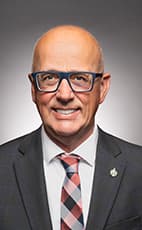
In the 90 days to September 18, 2026, the federal lobbying registry records no lobbying meetings with Tako Van Popta — the average MP had 6 meetings over the same period.
Based on federal lobbying registry data to September 18, 2026
In the House · Sep 21–25
Tako Van Popta this week
“This summer, as chair of the Conservative task force on property rights, I travelled B.C., meeting with homeowners, farmers, business owners and industry leaders. Their message was clear.”
- Spoke 6 times in the House · the average MP spoke 4 times
- FORC-266, second reading — Establish a national framework respecting skilled trades and labour mobility · passed 295–21
Get Tako Van Popta's week in your inbox every Monday
What they said, how they voted, and who lobbied them. Free, no ads, unsubscribe anytime.
How Tako Van Popta actually voted
Their recorded positions on the issues Canadians care about — pulled straight from the parliamentary record.
- Voted For
Labour & Employment
Establish a national framework respecting skilled trades and labour mobility
C-266 · Sep 2026 · Passed · Tell your MP what you think
- Voted Against
Economy & Taxation
Implement certain provisions of the spring economic update tabled in Parliament on April 28, 2026
C-30 · Jun 2026 · Passed · Tell your MP what you think
- Voted Against
Housing
Authorize certain payments to be made out of the Consolidated Revenue Fund for the purpose of improving housing supply
C-26 · Jun 2026 · Passed · Tell your MP what you think
- Voted Against
Criminal Justice
Hate propaganda, hate crime and access to religious or cultural places
C-9 · Jun 2026 · Passed · Tell your MP what you think
- Voted Against
Overall leanings
100%
voted with the their party line this Parliament
100%
vote attendance (174/174)
Who's lobbying Tako
Individual meeting records from the federal lobbying registry
| Date | Organization | |
|---|---|---|
| 2020-11-24 | Canadian Aquaculture Industry Alliance |
Write to Tako Van Popta
Pick what it's about. You'll get a letter you can edit, then send it from your own email.
Other ways to reach Tako
613-992-4211 is the House of Commons switchboard — ask to be connected to your MP's office. For constituency office contact details, or if tako.vanpopta@parl.gc.ca bounces, visit their Parliament profile.
Committee Memberships
What Tako talks about
- Criminal Code40 speeches · 2021–2024
- Judges Act27 speeches · 2022–2023
- Housing16 speeches · 2021–2026
- The Economy14 speeches · 2022–2026
- Miscarriage of Justice Review Commission Act (David and Joyce Milgaard's Law)13 speeches · 2023–2024
Recent Speeches
Mr. Speaker, this summer, as chair of the Conservative task force on property rights, I travelled B.C., meeting with homeowners, farmers, business owners and industry leaders. Their message was clear. They are worried that the private property security they once took for granted is being eroded. Pro… Read full speechShow less
Mr. Speaker, this summer, as chair of the Conservative task force on property rights, I travelled B.C., meeting with homeowners, farmers, business owners and industry leaders. Their message was clear. They are worried that the private property security they once took for granted is being eroded. Property rights are a cornerstone of a free and prosperous society. They give families the confidence to build a future and businesses the certainty to invest, grow and create jobs. However, through a series of misguided decisions, David Eby's NDP government and the Liberals here in Ottawa have created uncertainty where there should be security, and anxiety where there should be confidence. Only Conservatives are speaking clearly for the principle that what Canadians earn, invest in and own deserves the full protection of the law, because protecting property rights means protecting both prosperity and freedom.
Mr. Speaker, it is great to be back in the House of Commons after a very busy summer at home in my riding of Langley Township—Fraser Heights and throughout British Columbia. Like every member of the House, I am sure, I heard from many Canadians about their concerns about the state of Canada's econom… Read full speechShow less
Mr. Speaker, it is great to be back in the House of Commons after a very busy summer at home in my riding of Langley Township—Fraser Heights and throughout British Columbia. Like every member of the House, I am sure, I heard from many Canadians about their concerns about the state of Canada's economy, so I would like to start with this: Conservatives are focused on saving Canadians money. Liberals are all talk and no results. Liberals are costing Canadians more. They are out of touch, and Canadians are out of money. The Conservative plan, on the other hand, restores the promise of an affordable, safe and independent Canada. It will save people money. It will save Canadian jobs. It will keep people safe. It will fix immigration, and it will put Canada first, always. As I was speaking with people throughout British Columbia, I also heard deep concerns about the economic uncertainty that has arisen under the Cowichan Tribes decision, which, for the first time in Canadian history, declared aboriginal title over fee simple lands. Somehow those two competing interests have to live with each other, and that brings me to the topic of the day: Bill C-10, an act respecting the commissioner for modern treaty implementation. Let me start with this. Conservatives agree with the importance of modern treaties. Treaties are the way forward for Canada. Treaties create certainty. Treaties provide clarity. Treaties are better than endless litigation. Well-negotiated treaties can reconcile indigenous rights, support economic development and provide stable foundations for future generations. Canada continues to grapple with one of the unfinished chapters of Confederation, unresolved indigenous land claims, and nowhere is this more true than in British Columbia, my home province. This summer, as chair of the Conservative Party task force on property rights, I travelled around British Columbia with colleagues, and we met with realtors, bankers, appraisers, ranchers, builders, business owners, indigenous leaders and ordinary Canadian homeowners. I wanted to hear their concerns following the British Columbia Supreme Court decision in the Cowichan Tribes case. As I said, for the first time in Canadian history, aboriginal title has now been declared over privately held lands. The judge in that court case said that the indefeasible title provisions of the British Columbia Land Title Act do not apply to aboriginal title when it is declared over private lands. This is a seismic shift in thinking about private ownership, about private lands. This goes to the very foundation of our modern western economy. Whether one disagrees or agrees with the legal reasoning in that decision, there is no disputing that it has generated significant uncertainty across many sectors in Canada's economy. We heard concerns about mortgage lending and financing. We heard concerns about real estate valuation and investment. We heard concerns about investment decisions. We heard concerns about municipal tax bases and economic development. One real estate property appraiser described the situation this way: He said that, historically, appraisers could rely on the indefeasibility provisions of the land title office to confirm the ownership and determine exactly what interest was being valued. However, after the Cowichan decision, appraisal firms are increasingly inserting disclaimers related to aboriginal title claims. They are putting it right into their report, saying that they assume there are no aboriginal title claims on the property. Well, that goes to the value of the property and undermines certainty. It undermines confidence in our economy. Certainty matters. People buying homes need certainty. Businesses making investment decisions need certainty. Indigenous communities seeking economic development and opportunities also require certainty. Municipalities planning for the future need certainty. As one business leader at one of our round table meetings put it, if we have no certainty in Canada, we have no Canada. I would agree with that. We need to know where we are, going forward. One of our meetings was in Victoria, British Columbia. My colleagues and I met with leaders from the Cowichan tribes, the plaintiffs in the litigation. We had a great meeting. We certainly did not agree on everything, but we agreed on one very important point: The treaty-making process in British Columbia has not adequately resolved these questions for either indigenous or non-indigenous communities. One of the chiefs made an observation that has stayed with me. She described the treaty-making process and the settlement of land claims as the unfinished work of Canada's Confederation, and I agree with that. When British Columbia entered Confederation in 1871, Canada promised to connect the province to the rest of the country with a transcontinental railroad. As settlement expanded westward through Ontario and the Prairies, the federal government negotiated what we call today the numbered treaties, covering most of Ontario, all of the provinces, and even the northeastern section of British Columbia. These treaties facilitated settlement, established a relationship with indigenous communities, provided for certainty as the country grew, and facilitated development and even the railroad. However, when Canada reached the Rocky Mountains, the process largely stopped. Apart from the Douglas treaties in the southern part of Vancouver Island around Victoria and Treaty 8 in the northeast, as I already mentioned, most of British Columbia was left outside the treaty system. The result is that British Columbia remains unique in Canada. Most of the province was never covered by historic treaties. This unresolved reality has shaped decades of litigation and important court cases, all of them originating in my home province: from the Calder decision to the Delgamuukw decision, the Tsilhqot'in decision and most recently the Cowichan decision. Today, most of British Columbia's 204 identified first nations have unresolved claims. There are similar unresolved claims in other parts of Canada as well, such as in the Ottawa Valley, in the Maritimes and in some parts of Quebec, but British Columbia stands out as having a real lack of modern treaties. That is why we say modern treaties are so important. We support them. Negotiated treaties are better than litigation. Clear treaties are better than uncertainty. Final settlements are better than decades of court battles. In fact, many of the constituents I heard from this summer reinforce that very point. The answer to uncertainty is not more uncertainty. The answer is clearer agreements: treaties that define rights, responsibilities and expectations. That brings me to the topic of the day, Bill C-10. Many Canadians hearing about this legislation might reasonably assume that it is designed to accelerate treaty negotiations, settle outstanding claims or help complete the unfinished work of treaty making in Canada. Unfortunately, that is not what the bill would do. Bill C-10 would primarily create a new commissioner and a new institution to oversee the implementation of existing treaties. That work was already being done very effectively by the Office of the Auditor General, but the Liberal government simply chose to ignore those reports. How would this be different with the new treaty commissioner? The problem is not that Canada is suffering from a shortage of commissioners. It is suffering from a shortage of action and results. The Liberals' response to many problems is to create a new office, another agency, another commissioner or another layer of bureaucracy. Permits are being held up, so they create a Major Projects Office. Housing is unaffordable, so they create another office, another bureaucracy for housing that is going to overlook the previous commissions that were not doing their job. If treaty implementation is falling behind, the Liberals say to create another commission. I am saying that the appearance of action is not action itself. We already have the Auditor General's office for that work. The answer is to do the work. Reconciliation cannot be measured by how many commissions there are. It must be measured by outcomes. Canada needs a serious plan to complete the unfinished work of reconciliation and treaty making. Reconciliation and certainty are not competing goals; they are complementary goals. Indeed, the best treaties in history have advanced both. Unfortunately, Bill C-10 would do very little. We do not need more commissions. We need action.
Mr. Speaker, we are absolutely supporting the modern treaty process. We underline how important it is. We underline that treaties are better than endless litigation, which we are seeing in British Columbia. I would just add that the government has mismanaged the litigation file seriously, just as it… Read full speechShow less
Mr. Speaker, we are absolutely supporting the modern treaty process. We underline how important it is. We underline that treaties are better than endless litigation, which we are seeing in British Columbia. I would just add that the government has mismanaged the litigation file seriously, just as it was mismanaging the treaty implementation. The Auditor General has reported on it numerous times. Why do the Liberals not just fill the deficiencies, roll up their sleeves and get the job done?
Mr. Speaker, British Columbia is unique in that most of the territory is not covered by treaties, unlike Ontario, for example. However, there are areas, including my colleague's riding, where treaties have not been negotiated, so this is a Canada-wide problem. The uncertainty arising out of the liti… Read full speechShow less
Mr. Speaker, British Columbia is unique in that most of the territory is not covered by treaties, unlike Ontario, for example. However, there are areas, including my colleague's riding, where treaties have not been negotiated, so this is a Canada-wide problem. The uncertainty arising out of the litigation around property rights is undermining Canadians' confidence in one of the pillars of our economy: private property rights. It must be resolved.
Mr. Speaker, indeed there are a lot of gaps in Bill C-10. As a matter of fact, we are saying that the commissioner is not necessary. It would just be another layer of bureaucracy. We already have the Auditor General's office, which has been reporting on government deficiencies in implementing the mo… Read full speechShow less
Mr. Speaker, indeed there are a lot of gaps in Bill C-10. As a matter of fact, we are saying that the commissioner is not necessary. It would just be another layer of bureaucracy. We already have the Auditor General's office, which has been reporting on government deficiencies in implementing the modern treaties, but rather than admit that it has mismanaged the file, in typical Liberal fashion the government has just made another announcement about another organization that is finally going to solve the problems. I remain unconvinced that this is going to happen. What we need is for the government to roll up its sleeves, get the job done and get it done now.
Recent activity
22 activities across speeches, bills, and lobbying communications.
September 2026
Statements by Members
Mr. Speaker, this summer, as chair of the Conservative task force on property rights, I travelled B.C., meeting with homeowners, farmers, business owners and industry leaders. Their message was clear.… Read full speechShow less
Mr. Speaker, this summer, as chair of the Conservative task force on property rights, I travelled B.C., meeting with homeowners, farmers, business owners and industry leaders. Their message was clear. They are worried that the private property security they once took for granted is being eroded. Property rights are a cornerstone of a free and prosperous society. They give families the confidence to build a future and businesses the certainty to invest, grow and create jobs. However, through a series of misguided decisions, David Eby's NDP government and the Liberals here in Ottawa have created uncertainty where there should be security, and anxiety where there should be confidence. Only Conservatives are speaking clearly for the principle that what Canadians earn, invest in and own deserves the full protection of the law, because protecting property rights means protecting both prosperity and freedom.
Government Orders
Mr. Speaker, it is great to be back in the House of Commons after a very busy summer at home in my riding of Langley Township—Fraser Heights and throughout British Columbia. Like every member of the H… Read full speechShow less
Mr. Speaker, it is great to be back in the House of Commons after a very busy summer at home in my riding of Langley Township—Fraser Heights and throughout British Columbia. Like every member of the House, I am sure, I heard from many Canadians about their concerns about the state of Canada's economy, so I would like to start with this: Conservatives are focused on saving Canadians money. Liberals are all talk and no results. Liberals are costing Canadians more. They are out of touch, and Canadians are out of money. The Conservative plan, on the other hand, restores the promise of an affordable, safe and independent Canada. It will save people money. It will save Canadian jobs. It will keep people safe. It will fix immigration, and it will put Canada first, always. As I was speaking with people throughout British Columbia, I also heard deep concerns about the economic uncertainty that has arisen under the Cowichan Tribes decision, which, for the first time in Canadian history, declared aboriginal title over fee simple lands. Somehow those two competing interests have to live with each other, and that brings me to the topic of the day: Bill C-10, an act respecting the commissioner for modern treaty implementation. Let me start with this. Conservatives agree with the importance of modern treaties. Treaties are the way forward for Canada. Treaties create certainty. Treaties provide clarity. Treaties are better than endless litigation. Well-negotiated treaties can reconcile indigenous rights, support economic development and provide stable foundations for future generations. Canada continues to grapple with one of the unfinished chapters of Confederation, unresolved indigenous land claims, and nowhere is this more true than in British Columbia, my home province. This summer, as chair of the Conservative Party task force on property rights, I travelled around British Columbia with colleagues, and we met with realtors, bankers, appraisers, ranchers, builders, business owners, indigenous leaders and ordinary Canadian homeowners. I wanted to hear their concerns following the British Columbia Supreme Court decision in the Cowichan Tribes case. As I said, for the first time in Canadian history, aboriginal title has now been declared over privately held lands. The judge in that court case said that the indefeasible title provisions of the British Columbia Land Title Act do not apply to aboriginal title when it is declared over private lands. This is a seismic shift in thinking about private ownership, about private lands. This goes to the very foundation of our modern western economy. Whether one disagrees or agrees with the legal reasoning in that decision, there is no disputing that it has generated significant uncertainty across many sectors in Canada's economy. We heard concerns about mortgage lending and financing. We heard concerns about real estate valuation and investment. We heard concerns about investment decisions. We heard concerns about municipal tax bases and economic development. One real estate property appraiser described the situation this way: He said that, historically, appraisers could rely on the indefeasibility provisions of the land title office to confirm the ownership and determine exactly what interest was being valued. However, after the Cowichan decision, appraisal firms are increasingly inserting disclaimers related to aboriginal title claims. They are putting it right into their report, saying that they assume there are no aboriginal title claims on the property. Well, that goes to the value of the property and undermines certainty. It undermines confidence in our economy. Certainty matters. People buying homes need certainty. Businesses making investment decisions need certainty. Indigenous communities seeking economic development and opportunities also require certainty. Municipalities planning for the future need certainty. As one business leader at one of our round table meetings put it, if we have no certainty in Canada, we have no Canada. I would agree with that. We need to know where we are, going forward. One of our meetings was in Victoria, British Columbia. My colleagues and I met with leaders from the Cowichan tribes, the plaintiffs in the litigation. We had a great meeting. We certainly did not agree on everything, but we agreed on one very important point: The treaty-making process in British Columbia has not adequately resolved these questions for either indigenous or non-indigenous communities. One of the chiefs made an observation that has stayed with me. She described the treaty-making process and the settlement of land claims as the unfinished work of Canada's Confederation, and I agree with that. When British Columbia entered Confederation in 1871, Canada promised to connect the province to the rest of the country with a transcontinental railroad. As settlement expanded westward through Ontario and the Prairies, the federal government negotiated what we call today the numbered treaties, covering most of Ontario, all of the provinces, and even the northeastern section of British Columbia. These treaties facilitated settlement, established a relationship with indigenous communities, provided for certainty as the country grew, and facilitated development and even the railroad. However, when Canada reached the Rocky Mountains, the process largely stopped. Apart from the Douglas treaties in the southern part of Vancouver Island around Victoria and Treaty 8 in the northeast, as I already mentioned, most of British Columbia was left outside the treaty system. The result is that British Columbia remains unique in Canada. Most of the province was never covered by historic treaties. This unresolved reality has shaped decades of litigation and important court cases, all of them originating in my home province: from the Calder decision to the Delgamuukw decision, the Tsilhqot'in decision and most recently the Cowichan decision. Today, most of British Columbia's 204 identified first nations have unresolved claims. There are similar unresolved claims in other parts of Canada as well, such as in the Ottawa Valley, in the Maritimes and in some parts of Quebec, but British Columbia stands out as having a real lack of modern treaties. That is why we say modern treaties are so important. We support them. Negotiated treaties are better than litigation. Clear treaties are better than uncertainty. Final settlements are better than decades of court battles. In fact, many of the constituents I heard from this summer reinforce that very point. The answer to uncertainty is not more uncertainty. The answer is clearer agreements: treaties that define rights, responsibilities and expectations. That brings me to the topic of the day, Bill C-10. Many Canadians hearing about this legislation might reasonably assume that it is designed to accelerate treaty negotiations, settle outstanding claims or help complete the unfinished work of treaty making in Canada. Unfortunately, that is not what the bill would do. Bill C-10 would primarily create a new commissioner and a new institution to oversee the implementation of existing treaties. That work was already being done very effectively by the Office of the Auditor General, but the Liberal government simply chose to ignore those reports. How would this be different with the new treaty commissioner? The problem is not that Canada is suffering from a shortage of commissioners. It is suffering from a shortage of action and results. The Liberals' response to many problems is to create a new office, another agency, another commissioner or another layer of bureaucracy. Permits are being held up, so they create a Major Projects Office. Housing is unaffordable, so they create another office, another bureaucracy for housing that is going to overlook the previous commissions that were not doing their job. If treaty implementation is falling behind, the Liberals say to create another commission. I am saying that the appearance of action is not action itself. We already have the Auditor General's office for that work. The answer is to do the work. Reconciliation cannot be measured by how many commissions there are. It must be measured by outcomes. Canada needs a serious plan to complete the unfinished work of reconciliation and treaty making. Reconciliation and certainty are not competing goals; they are complementary goals. Indeed, the best treaties in history have advanced both. Unfortunately, Bill C-10 would do very little. We do not need more commissions. We need action.
Government Orders
Mr. Speaker, we are absolutely supporting the modern treaty process. We underline how important it is. We underline that treaties are better than endless litigation, which we are seeing in British Col… Read full speechShow less
Mr. Speaker, we are absolutely supporting the modern treaty process. We underline how important it is. We underline that treaties are better than endless litigation, which we are seeing in British Columbia. I would just add that the government has mismanaged the litigation file seriously, just as it was mismanaging the treaty implementation. The Auditor General has reported on it numerous times. Why do the Liberals not just fill the deficiencies, roll up their sleeves and get the job done?
Government Orders
Mr. Speaker, British Columbia is unique in that most of the territory is not covered by treaties, unlike Ontario, for example. However, there are areas, including my colleague's riding, where treaties… Read full speechShow less
Mr. Speaker, British Columbia is unique in that most of the territory is not covered by treaties, unlike Ontario, for example. However, there are areas, including my colleague's riding, where treaties have not been negotiated, so this is a Canada-wide problem. The uncertainty arising out of the litigation around property rights is undermining Canadians' confidence in one of the pillars of our economy: private property rights. It must be resolved.
Government Orders
Mr. Speaker, indeed there are a lot of gaps in Bill C-10. As a matter of fact, we are saying that the commissioner is not necessary. It would just be another layer of bureaucracy. We already have the … Read full speechShow less
Mr. Speaker, indeed there are a lot of gaps in Bill C-10. As a matter of fact, we are saying that the commissioner is not necessary. It would just be another layer of bureaucracy. We already have the Auditor General's office, which has been reporting on government deficiencies in implementing the modern treaties, but rather than admit that it has mismanaged the file, in typical Liberal fashion the government has just made another announcement about another organization that is finally going to solve the problems. I remain unconvinced that this is going to happen. What we need is for the government to roll up its sleeves, get the job done and get it done now.
Government Orders
Mr. Speaker, indeed, that is what we see with Liberal government throughout its now 11 years of history. There is a lack of accountability, a lack of getting the job done, more announcements, more pho… Read full speechShow less
Mr. Speaker, indeed, that is what we see with Liberal government throughout its now 11 years of history. There is a lack of accountability, a lack of getting the job done, more announcements, more photo ops and more of the Liberals' trying to convince Canadians that they are doing the job, but they are not. We just need them to get the job done and get the treaties negotiated.
June 2026
Oral Questions
Mr. Speaker, in Cowichan Tribes v. the Attorney General of Canada, the B.C. Supreme Court declared aboriginal title over private lands, and the private landowners, 150 of them, are worried. It has bee… Read full speechShow less
Mr. Speaker, in Cowichan Tribes v. the Attorney General of Canada, the B.C. Supreme Court declared aboriginal title over private lands, and the private landowners, 150 of them, are worried. It has been well documented that the Liberals directed their federal lawyers to drop arguments protecting private property rights, to pull their punches and allow aboriginal title to take precedence. Where are the results for private landowners?
Oral Questions
Mr. Speaker, the reality is that the appeal process in British Columbia is going to take years. In the meantime, homeowners in Richmond, British Columbia, and throughout the province are feeling insec… Read full speechShow less
Mr. Speaker, the reality is that the appeal process in British Columbia is going to take years. In the meantime, homeowners in Richmond, British Columbia, and throughout the province are feeling insecure. Here is the reality in the subject territory in Richmond. Realtors are not taking listings, appraisers are devaluing property values and bankers are not lending money on title that they see as insecure. My question again is this: Where was the federal government to stand up for private property rights?
Government Orders
Madam Speaker, earlier in debate tonight, we heard from the Liberal side of the House suggesting that anybody who was opposed to Bill C‑22 was fearmongering and spreading misinformation. However, the … Read full speechShow less
Madam Speaker, earlier in debate tonight, we heard from the Liberal side of the House suggesting that anybody who was opposed to Bill C‑22 was fearmongering and spreading misinformation. However, the very rational debate coming from the member for Vancouver East would suggest otherwise. Also, I am reading a Global News story that says that social media platforms, satellite companies and telecommunication companies will consider leaving Canada if and when Bill C‑22 passes because they are afraid they are not going to be able to maintain their customers' privacy, something that they are committed to doing. The secondary concern of these companies seems to be the additional cost of having to maintain digital information for a long period of time. Can the member for Vancouver East comment on those very rational concerns?
Oral Questions
Mr. Speaker, while the high-flying Prime Minister is racking up a $1-million debt for luxury inflight catering, many Canadians are struggling just to put food on the table. There were 2.2 million Cana… Read full speechShow less
Mr. Speaker, while the high-flying Prime Minister is racking up a $1-million debt for luxury inflight catering, many Canadians are struggling just to put food on the table. There were 2.2 million Canadians who went to a food bank in one month last year alone, but the Prime Minister is living the high life, even though he is leading the only G20 country into a recession. Will the Prime Minister reverse his failed policies that are causing this food affordability crisis so that Canadians can afford to live again?
Government Orders
Mr. Speaker, I thank the minister for her speech on this self-government agreement, which she says could inform future agreements. There is the Musqueam recognition rights agreement in Vancouver, whic… Read full speechShow less
Mr. Speaker, I thank the minister for her speech on this self-government agreement, which she says could inform future agreements. There is the Musqueam recognition rights agreement in Vancouver, which has become very controversial. It says that it is not a land agreement, and it goes on to add some comfort that nothing in this agreement is going to impact any aboriginal rights. What is missing is some comfort for the other party, the three million people in Vancouver, who are worried about private property rights. Perhaps it could say something like, “the protection and inalienability of fee simple property rights for all Canadians”. Would that be an improvement?
Government Orders
Mr. Speaker, earlier in the debate today, we heard the minister say that this agreement is a model to inform future treaties, yet the most recent treaty, the K'ómoks Treaty, which my colleague also me… Read full speechShow less
Mr. Speaker, earlier in the debate today, we heard the minister say that this agreement is a model to inform future treaties, yet the most recent treaty, the K'ómoks Treaty, which my colleague also mentioned, introduces the concept of UNDRIP, a foreign document. This is not made in Canada. Could my colleague comment on how important it is for Canada to stick to made-in-Canada solutions when we are drafting our treaties?
Government Orders
Madam Speaker, the Liberal government is going to be adding somewhere between $70 billion and $80 billion in additional debt to its already sky-high deficit with accumulated debt of over $1 trillion. … Read full speechShow less
Madam Speaker, the Liberal government is going to be adding somewhere between $70 billion and $80 billion in additional debt to its already sky-high deficit with accumulated debt of over $1 trillion. If I take the middle point and apply 4% interest to it, that is $3 billion every year just in additional interest payments on an already very high number. How does the Liberal government justify adding tens of billions of dollars of debt to the national debt when so many Canadians are already struggling with the cost of living?
May 2026
Government Orders
Mr. Speaker, I am speaking to the Conservative motion that is on the agenda today, which is calling on the Liberal government to put private property first in the Cowichan case, arguing that private p… Read full speechShow less
Mr. Speaker, I am speaking to the Conservative motion that is on the agenda today, which is calling on the Liberal government to put private property first in the Cowichan case, arguing that private property has priority over all other forms of title. We are saying this because the Cowichan Tribes v. Canada decision created massive uncertainty around fee simple property, the legal basis on which Canadians and businesses alike own their homes and their lands, and I could add their warehouses, their factories, their hotels and their high-rise apartment buildings. I want to quote from the B.C. Supreme Court decision that has shaken the confidence of the real estate market, homeowners and landowners. This is what the judge says at paragraph 2193: I agree that Aboriginal title is a prior and senior right to land. It is not an estate granted by the Crown, but rooted in prior occupation. It is constitutionally protected. The question of what remains of Aboriginal title after the granting of fee simple title to the same lands should be reversed. The proper question is: what remains of fee simple title after Aboriginal title is recognized in the same lands? This is what is unsettling so many people interested in real estate. What does “a prior and senior right” actually mean? Here is another quote, from paragraph 3551, which is close to the end of the 800-page decision. The judge says, “A precedent that will follow from this case is that provincial Crown grants of fee simple interest do not extinguish nor permanently displace Aboriginal title, and ss. 23 and 25 of the [British Columbia Land Title Act] do not apply to Aboriginal title.” Before entering Parliament as a member of Parliament in 2019, I spent many years practising corporate, real estate and land development law in the metro Vancouver area. Those decades in law taught me this with absolute clarity: Canada's economic stability rests on the bedrock of secure, indefeasible fee simple title. This principle, inherited from centuries of British common law development, is not an abstract legal doctrine. It is a foundation of our banking system, commercial investment, housing markets and, importantly, the ability of ordinary Canadians to build and preserve wealth. If we undermine that foundation, we undermine our economic stability and civic resilience as a Canadian society. The whole real estate industry banks on indefeasibility, the principle that says that when a person is registered as the legal owner of the land, their ownership cannot be challenged or defeated. The title is what the title says it is. Nobody had ever questioned the simple principle of indefeasibility until the Cowichan decision last year. One phrase bears repeating: “[Sections] 23 and 25 of the [Land Title Act] do not apply to Aboriginal title.” I am not trying to get technical, but these are the sections that underpin the principle of title indefeasibility. Today that principle is less secure than we always thought it was. This is the first in Canadian jurisprudence. There have been other cases in British Columbia where the courts ruled that a first nation had met all the criteria for proving aboriginal title. The first one was a 1997 Supreme Court of Canada case called Delgamuukw, which set out the standard for proving aboriginal title in the court of law. There was another important case, 17 years later, called the Tsilhqot’in Nation case, which declared aboriginal title over a large but remote area of British Columbia of about 2,000 square kilometres. All the land in question was Crown land. The Tsilhqot’in Nation was the plaintiff in that case. Its litigation strategy was deliberately crafted to avoid conflict with private property owners. Let us fast-forward another decade to the case we are talking about today, which declared aboriginal title over a relatively small area of only 800 acres compared to the 2,000 square kilometres in the Tsilhqot’in case. However, this land is right in the heart of metro Vancouver. Any realtor will tell us that the three most important things about real estate are location, location and location. The location in question makes the real estate very valuable. It is right in the heart of an industrial part and residential part of metro Vancouver. There are about 150 private landowners. There is a beautiful golf course. A significant landowner's project has now been put on hold. None of them had the opportunity to argue their case in court. The fact that the Cowichan plaintiffs did not restrict their claim to publicly owned lands but included privately owned lands makes this case unique. It is in that context that we accuse the Liberals of dropping the ball. A different and more far-reaching strategy on the part of the plaintiffs, compared to the Tsilhqot’in, who restricted their claim to public lands, required a different and more aggressive response from the federal Attorney General lawyers. Under the direction of the Attorney General in 2018, the justice department lawyers pulled their punches. At paragraph 2096 the judge noted, “Canada initially [argued] extinguishment but abandoned its reliance on this defence in its amended response to [the] civil claim filed November 22, 2018”, obviously in direct response to new directives coming from the Attorney General. They dropped the ball. They dropped their first and best line of defence, which says that the clear and simple act of the Crown's granting fee simple title to individuals throughout B.C.'s history had the effect of extinguishing aboriginal title, to the extent that future plaintiffs might argue for aboriginal title. We are saying that it is obvious that the government lawyers should have maintained this line of defence, considering the aggressive action by the Cowichan plaintiffs. An aggressive offence demands an aggressive defence. Some people argue that weakening private property rights is a path toward reconciliation, but Canadian courts have already warned of the opposite. In the New Brunswick case of J.D. Irving v. Wolastoqey Nation, December 2025, the Court of Appeal of New Brunswick put it this way: “a declaration of Aboriginal title over privately owned lands, which, by its very nature, gives the Aboriginal beneficiary exclusive possession, occupation, and use would sound the death knell of reconciliation with the interests of non-Aboriginal Canadians.” That is not rhetoric. It is a sober legal assessment of the consequences of eroding certainty in land ownership. The British Columbia Supreme Court, in the Cowichan decision, moved in the opposite direction. The court held that aboriginal title can extend to privately owned lands, and that aboriginal title and fee simple ownership can somehow coexist on the same land at the same time. In my respectful view, this is simply not possible. Both forms of title claim exclusive rights to occupy, to develop and to benefit economically from the land. Two competing exclusive titles cannot occupy the same legal space without destroying the certainty that underpins our entire property system. The result is not reconciliation; it is confusion. It is not economic opportunity; it is economic paralysis. It is not a path forward; it is a step backward into uncertainty at a moment when Canada desperately needs stability, investment and confidence. If the Cowichan decision stands as it is, the consequence will be profound. It risks chilling development, destabilizing markets and deepening divisions rather than healing them. Canada cannot afford a property rights regime that leaves homeowners, lenders and investors unsure if they can take their fee simple title to the bank. Reconciliation requires clarity, honesty, transparency and respect, not the erosion of the very legal foundations that allow our society to function. That is the principle that the Liberal government overlooked when it instructed its lawyers to not use all the tools in their tool box to defend property rights in Canada for Canadians. They dropped the ball, and Canadians are paying the price.
Government Orders
Mr. Speaker, if I had a half-hour or an hour, I would have talked about all the interesting cases, but I had only 10 minutes. The Haida case is obviously a very important case. It talks about and expa… Read full speechShow less
Mr. Speaker, if I had a half-hour or an hour, I would have talked about all the interesting cases, but I had only 10 minutes. The Haida case is obviously a very important case. It talks about and expands on the principle of the duty to consult. I will not argue with that. There is a duty to consult. We agree with that. We agree that reconciliation is important, but to undermine the private property regime that Canada's economy is built on is not the way forward on reconciliation.
Government Orders
Mr. Speaker, normally we would try to argue it in committee, but it got shut down. We have put forward a motion, a proposal, that the House form a committee to look at this issue. In the meantime, we … Read full speechShow less
Mr. Speaker, normally we would try to argue it in committee, but it got shut down. We have put forward a motion, a proposal, that the House form a committee to look at this issue. In the meantime, we need to argue it in the House. This is very important to Canadians. It is important to people in my riding and to people in metro Vancouver, because they are deeply concerned about the uncertainty being brought by this decision and by the lack of action by the federal government.
Government Orders
Mr. Speaker, we have heard on a number of occasions that the Liberals appealed the decision as soon as they could. That is just not true. They waited until literally the last minute to appeal it. More… Read full speechShow less
Mr. Speaker, we have heard on a number of occasions that the Liberals appealed the decision as soon as they could. That is just not true. They waited until literally the last minute to appeal it. More importantly, the Liberals say they stand for private property rights. However, they did not use all the tools in their tool box to do that. Even though private property owners have not been named as defendants, the Attorney General could and should have been there to defend private property owners, which he did not do.
Government Orders
Mr. Speaker, that is an interesting comment coming from a member who did not consult with the first nation communities in her riding when she asked to drop the indigenous name from the riding name. Ye… Read full speechShow less
Mr. Speaker, that is an interesting comment coming from a member who did not consult with the first nation communities in her riding when she asked to drop the indigenous name from the riding name. Yes, the Liberals today are saying that they will defend private property rights. However, they failed to do it before, and they have now worked themselves into a corner where they are not able to advance some of the arguments at the Court of Appeal that they should have raised at the trial level.
Government Orders
Mr. Speaker, that is a great question. Again, it was a short speech, and I did not have time to work everything into it. I have spoken to a number of the landowners, including a commercial landowner i… Read full speechShow less
Mr. Speaker, that is a great question. Again, it was a short speech, and I did not have time to work everything into it. I have spoken to a number of the landowners, including a commercial landowner in the region who has a project under way. He had financing in place. He had tenants for the new warehouse complex he was going to build. All of it is on hold. The company is now making an application to the court, doing what the federal government and the Attorney General should have done during the trial many years ago. He is making an application to argue the rights of private property owners.
Government Orders
Mr. Speaker, the Liberals keep talking about misinformation as though the Conservatives, when we raise issues with or weaknesses in the Liberal Party, are spreading misinformation. All we are doing is… Read full speechShow less
Mr. Speaker, the Liberals keep talking about misinformation as though the Conservatives, when we raise issues with or weaknesses in the Liberal Party, are spreading misinformation. All we are doing is shedding light on their incompetence. We have a real-life example in the Montrose application, which the minister has already mentioned. We talked to them. They had a project that was ready to go. It has fallen apart. This is not misinformation. This is the reality on the ground. It is not the Conservatives that are repeating this. These are the facts on the ground that are making life difficult for investors. Can the minister comment on that?
March 2026
House of Commons
228 communications with 115 clients
Top clients: [{"name": "BC Dairy Association", "count": 9}, {"name": "Association of Canadian…
June 2023
House of Commons
9 communications with 7 clients
Top clients: [{"name": "Chicken Farmers of Canada", "count": 3}, {"name": "Canadian Associati…