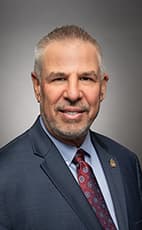
Dave Epp
In the 90 days to September 18, 2026, 10 organizations lobbied Dave Epp across 11 meetings — most often about Transportation. The most frequent visitor was Canadian Dental Association (2 meetings, via Lesli Hapak). Its registration describes the goal as “EXCISE TAX ACT: GST AND DENTAL SERVICES: Changes to the application of the GST (zero-rate) on Dental practices”. That's more than the average MP, who had 6 meetings over the same period.
Based on federal lobbying registry data to September 18, 2026
In the House · Sep 21–25
Dave Epp this week
“I wonder if my colleague from Skeena—Bulkley Valley would agree with the following statement. The presentation in this chamber of Bill C-39 is actually a proof point, in the same manner that Bill C-5 was a proof point. What do I mean?”
- Spoke 1 time in the House · the average MP spoke 4 times
- FORC-266, second reading — Establish a national framework respecting skilled trades and labour mobility · passed 295–21
Get Dave Epp's week in your inbox every Monday
What they said, how they voted, and who lobbied them. Free, no ads, unsubscribe anytime.
How Dave Epp actually voted
Their recorded positions on the issues Canadians care about — pulled straight from the parliamentary record.
- Voted For
Labour & Employment
Establish a national framework respecting skilled trades and labour mobility
C-266 · Sep 2026 · Passed · Tell your MP what you think
- Voted Against
Economy & Taxation
Implement certain provisions of the spring economic update tabled in Parliament on April 28, 2026
C-30 · Jun 2026 · Passed · Tell your MP what you think
- Voted Against
Housing
Authorize certain payments to be made out of the Consolidated Revenue Fund for the purpose of improving housing supply
C-26 · Jun 2026 · Passed · Tell your MP what you think
- Voted Against
Criminal Justice
Hate propaganda, hate crime and access to religious or cultural places
C-9 · Jun 2026 · Passed · Tell your MP what you think
- Voted Against
Overall leanings
100%
voted with the Conservative line this Parliament
100%
vote attendance (174/174)
Who’s in Dave’s ear
428
lobbying meetings
177
companies & groups
406
speeches in Parliament
Top lobbying relationship: RESULTS Canada — met 14 times · most lobbied on Agriculture.
See who’s lobbying Dave →Who's lobbying Dave
Individual meeting records from the federal lobbying registry
| Date | Organization | |
|---|---|---|
| 2026-08-26 | Greater Toronto Airports Authority | |
| 2026-08-25 | CANADIAN HEALTH FOOD ASSOCIATION | |
| 2026-08-21 | Canadian Vehicle Manufacturers' Association | |
| 2026-08-18 | Canadian Dental Association | |
| 2026-08-05 | Gwich'in Tribal Council |
Write to Dave Epp
Pick what it's about. You'll get a letter you can edit, then send it from your own email.
Other ways to reach Dave
613-992-4211 is the House of Commons switchboard — ask to be connected to your MP's office. For constituency office contact details, or if dave.epp@parl.gc.ca bounces, visit their Parliament profile.
Committee Memberships
Top Lobbying Clients
Companies with the most meetings with this MP
What Dave talks about
- The Budget17 speeches · 2021–2025
- Carbon Pricing15 speeches · 2023–2025
- The Economy12 speeches · 2021–2026
- Budget Implementation Act, 2021, No. 19 speeches · 2021
- Criminal Code9 speeches · 2021–2023
Recent Speeches
Mr. Speaker, I wonder if my colleague from Skeena—Bulkley Valley would agree with the following statement. The presentation in this chamber of Bill C-39 is actually a proof point, in the same manner that Bill C-5 was a proof point. What do I mean? Well, Bill C-5 is a proof point that 10 or 11 years … Read full speechShow less
Mr. Speaker, I wonder if my colleague from Skeena—Bulkley Valley would agree with the following statement. The presentation in this chamber of Bill C-39 is actually a proof point, in the same manner that Bill C-5 was a proof point. What do I mean? Well, Bill C-5 is a proof point that 10 or 11 years of Liberal government has basically stifled resource development in this country, so the government needed Bill C-5. We supported it, fast-tracked it through, and now, after 18 months and 500 projects, absolutely zero has been done. Now the government has added a word, calling it “building Canada strong”, and here we are with Bill C-39. Would the member agree that it is a proof point that neither 10 years of previous policy nor the issuance of Bill C-5 has developed this country at all?
Madam Speaker, I, along with a number of my colleagues, came to this place in 2019 and have gone through three elections. The member opposite just said the Liberals were elected and, yes, they were elected, in a minority Parliament. I have experienced nothing but seven years of minority Parliament u… Read full speechShow less
Madam Speaker, I, along with a number of my colleagues, came to this place in 2019 and have gone through three elections. The member opposite just said the Liberals were elected and, yes, they were elected, in a minority Parliament. I have experienced nothing but seven years of minority Parliament until, of course, a few weeks ago. Now I am experiencing a majority government for the first time in my elected career. Is this what I am to expect, time allocation, closure and cutting off debate? Is this how the government intends to reflect the minority mandate, quite frankly, that the Canadian people gave it?
Mr. Speaker, the member just responded to my colleague and said, “I believe the things I say.” She also concluded her speech with, “Our new government is on the right track.” I want to read a quote from March 10 of this year: “Mr. Speaker, the motion we are going to vote on today is another example … Read full speechShow less
Mr. Speaker, the member just responded to my colleague and said, “I believe the things I say.” She also concluded her speech with, “Our new government is on the right track.” I want to read a quote from March 10 of this year: “Mr. Speaker, the motion we are going to vote on today is another example of the government's overreach and tyranny and of how it always wants to shut down debate, especially when it comes to freedom of expression and freedom of religion.” As for the member's response of “I believe the things I say,” how does she reconcile those two quotes from herself?
Mr. Speaker, a few minutes ago, the Minister of Justice referenced the procedural tools of the trade that are used. He decried the Conservative Party's use of the tools in the past and justified the use of the tools in this present hour. How is the Conservative Party's use of procedural tools equiva… Read full speechShow less
Mr. Speaker, a few minutes ago, the Minister of Justice referenced the procedural tools of the trade that are used. He decried the Conservative Party's use of the tools in the past and justified the use of the tools in this present hour. How is the Conservative Party's use of procedural tools equivalent when comparing what is being done to stifle debate at the health committee by going in camera on PrescribeIT versus what we are witnessing here today?
Mr. Speaker, it is always an honour and a privilege to bring the voices of Chatham-Kent—Leamington to the chamber. I come today representing, especially, both the people of Ukrainian ethnicity and those of Ukrainian heritage. There is actually a difference, and I am going to come back to that in a m… Read full speechShow less
Mr. Speaker, it is always an honour and a privilege to bring the voices of Chatham-Kent—Leamington to the chamber. I come today representing, especially, both the people of Ukrainian ethnicity and those of Ukrainian heritage. There is actually a difference, and I am going to come back to that in a moment. Of course, we are talking today about Bill S-210, about designating September as Ukrainian heritage month. Here are some ties that bind our country of Canada and our country of Ukraine. Canada is home to approximately 1.4 million people of Ukrainian descent, and I am referring to ethnic descent. That actually represents 4% of Canada's population. Canada has the second-largest Ukrainian diaspora outside Russia in the world. The first Ukrainians came to Canada in 1891, with about 150,000 estimated to have landed between 1891 and 1914. These figures come from the Government of Canada in 2020, and I am actually going to dispute some of the numbers in a moment. Most Ukrainians from this period settled in Manitoba, Saskatchewan and Alberta, which we have heard from other interventions today. They came to obtain farmland, bringing their rich heritage of agricultural expertise from the steppes of what was Russia at the time and is now Ukraine, here to Canada, to our untamed west at the time and to Ontario. In fact, 28% of Canadians identifying as being of Ukrainian ethnic descent live in Ontario. These are the statistics from Canadians who identify as being of Ukrainian ethnicity, but as I mentioned earlier, there are others who claim Ukrainian heritage, and I count myself among that group. As many members know, I am from a Mennonite background, and there are a number of Mennonites here in the chamber who have the honour of representing their constituencies. This year marks 100 years since all four of my grandparents came to Canada from, at the time, the steppes of Russia, which is now part of Ukraine. All four of them were actually part of the second wave of Mennonites who left Ukraine and chose Canada as their home. The first wave came in the 1870s and settled in southern Manitoba, primarily in the east and west reserves. They were also fleeing the greater intervention of the Russian government at the time into their way of life in the colonies of what we call Russia. I consider myself of Russian Mennonite background. There are two streams: Russian Mennonite background and Swiss Mennonite background. I could spend my 10 minutes and the next three hours talking about that wave of history, as Mennonites have fled war and persecution from the Russians from the late 1500s to Danzig in northern Poland, and then to Ukraine. I am going to talk specifically for a moment about the ties that bind my own family, specifically my Epp lineage, but I am fairly confident that my Neufeld, my Reimer and my Rempel sides also trace this same path of immigration into Ukraine in 1804. My ancestors spent 122 years in Ukraine and now 100 years in Canada. They came to Ukraine at the invitation of Catherine the Great. This is important because, again, they were fleeing, at the time, greater government intervention in their lives in Gdańsk, called Danzig at the time of the Austrian Hapsburg empire, in northern Poland. They came to the steps of Ukraine at the invitation of Catherine the Great to farm, to break those steppes of Ukraine, and they turned that into part of the breadbasket of Europe. That heritage is in my blood today. They were told, actually, that the territory at the time was empty. Reflecting now and looking at history, that actually is not true. The Tatars had been cleared of that area, and the land was given to my forebears in 1804. It was the second wave that came into southern Ukraine. The first wave of Mennonites who came from the Prussian empire actually came in 1789, settled into the Khortytsya region, which is called Zaporizhzhya today. My ancestors, as I stated, came in 1804, settling into the Molotschna region, which is near the present-day city of Tokmak. I will come to that. They left 100 years later. They came into Ukraine and left Ukraine for the same reason, and that same reason is actually one of the reasons we are talking about the bill today. It was the fact that they were experiencing both war and revolution. Mennonites have a complicated relationship with government. When they feel that their allegiance to their faith is superseded by government, historically they have fled or moved, but we must not mistake that for a lack of service to country. That is evidenced by the members of the chamber, and it is evidenced by my own family history. I am going to get into two short stories. My great-grandfather Gerhard Neufeld was drafted into the service, in 1904, of Czar Nicholas II. Rather than serving in the army, he served in what was called the Forsteidienst, the forestry service, so he was stationed on the banks of the Black Sea at the czar's summer resort, Yalta. My mother's father's family, the Neufelds, came from wealth, so my great-grandfather had been educated in Europe and knew that the phylloxera virus was spread by the aphid, and he saved the czar's vineyards from the phylloxera virus. He was decorated with a silver pocket watch, which remains in our family to this day. It was given to him in 1904. Those who know me personally know that I do enjoy the odd sip of wine. I do that not for enjoyment reasons but obviously because I am genetically predisposed to enjoy wine, given my Neufeld heritage. My Neufeld family, on August 1 and 2 of this year is celebrating 100 years of settlement in Canada. We are celebrating that in the Vineland region, where my great-grandmother is buried. That same Gerhard Neufeld who was decorated by the czar was shot dead in his bed, five days before they came to Canada. My great-grandmother left, bringing five children, and I and my mother are here because of that history. On my father's side is my Epp heritage. In 1926, my great-grandfather Epp bought, yes, bought, a passport in order to flee. He saw what was coming. My grandfather came to Canada on that passport at the age of 22. His parents were going to come that fall. When they had finished the harvest in southern Ukraine, they were going to join their family. For seven years, there were letters that went back and forth between my grandfather and his parents, and here is where those histories of ethnic Ukrainians and heritage Ukrainians unite. Stalin slammed the door shut on my great-grandparents. Their visas and passports were never honoured. They tried and retried. Those seven years of letters became increasingly desperate, and eventually a letter came from my great-grandfather to my grandfather stating that his mother had passed away at the beginning of the Holodomor. My great-grandfather would follow, dying of starvation in 1933. My own heritage is intertwined with the conflict that comes from war and revolution. My parents never had a desire to visit Ukraine, and neither did any of my grandparents, even when those opportunities opened up again post-1991. I, on the other hand, have been back three times. I have been to that soil, but it actually has not been my own heritage that has allowed me to go back. It has always been tomatoes and the Ukrainian involvement in the tomato industry. I could spend another hour talking just about that, but I will not. In the final minute of my speech, I want to talk about other areas in which Canada and Ukraine have become close and have supported each other. Canada was the first western country to recognize Ukraine's independence, and since then, we have maintained a close bilateral relationship. Canada is one of the leading bilateral development assistance partners of Ukraine, and many of us continue in that work today. Our free trade agreement has allowed for the further expansion of trade. Of course, time will not allow me to get into the last four years, but it is war, again, that has brought our relationship even closer. I stand here proudly today, as proud as a humble Mennonite can be proud, to support Canada's relationship with Ukraine and the designation of September as Ukrainian heritage month.
Recent activity
21 activities across speeches, bills, and lobbying communications.
September 2026
Government Orders
Mr. Speaker, I wonder if my colleague from Skeena—Bulkley Valley would agree with the following statement. The presentation in this chamber of Bill C-39 is actually a proof point, in the same manner t… Read full speechShow less
Mr. Speaker, I wonder if my colleague from Skeena—Bulkley Valley would agree with the following statement. The presentation in this chamber of Bill C-39 is actually a proof point, in the same manner that Bill C-5 was a proof point. What do I mean? Well, Bill C-5 is a proof point that 10 or 11 years of Liberal government has basically stifled resource development in this country, so the government needed Bill C-5. We supported it, fast-tracked it through, and now, after 18 months and 500 projects, absolutely zero has been done. Now the government has added a word, calling it “building Canada strong”, and here we are with Bill C-39. Would the member agree that it is a proof point that neither 10 years of previous policy nor the issuance of Bill C-5 has developed this country at all?
June 2026
Government Orders
Madam Speaker, I, along with a number of my colleagues, came to this place in 2019 and have gone through three elections. The member opposite just said the Liberals were elected and, yes, they were el… Read full speechShow less
Madam Speaker, I, along with a number of my colleagues, came to this place in 2019 and have gone through three elections. The member opposite just said the Liberals were elected and, yes, they were elected, in a minority Parliament. I have experienced nothing but seven years of minority Parliament until, of course, a few weeks ago. Now I am experiencing a majority government for the first time in my elected career. Is this what I am to expect, time allocation, closure and cutting off debate? Is this how the government intends to reflect the minority mandate, quite frankly, that the Canadian people gave it?
Government Orders
Mr. Speaker, the member just responded to my colleague and said, “I believe the things I say.” She also concluded her speech with, “Our new government is on the right track.” I want to read a quote fr… Read full speechShow less
Mr. Speaker, the member just responded to my colleague and said, “I believe the things I say.” She also concluded her speech with, “Our new government is on the right track.” I want to read a quote from March 10 of this year: “Mr. Speaker, the motion we are going to vote on today is another example of the government's overreach and tyranny and of how it always wants to shut down debate, especially when it comes to freedom of expression and freedom of religion.” As for the member's response of “I believe the things I say,” how does she reconcile those two quotes from herself?
Government Orders
Mr. Speaker, a few minutes ago, the Minister of Justice referenced the procedural tools of the trade that are used. He decried the Conservative Party's use of the tools in the past and justified the u… Read full speechShow less
Mr. Speaker, a few minutes ago, the Minister of Justice referenced the procedural tools of the trade that are used. He decried the Conservative Party's use of the tools in the past and justified the use of the tools in this present hour. How is the Conservative Party's use of procedural tools equivalent when comparing what is being done to stifle debate at the health committee by going in camera on PrescribeIT versus what we are witnessing here today?
Private Members' Business
Mr. Speaker, it is always an honour and a privilege to bring the voices of Chatham-Kent—Leamington to the chamber. I come today representing, especially, both the people of Ukrainian ethnicity and tho… Read full speechShow less
Mr. Speaker, it is always an honour and a privilege to bring the voices of Chatham-Kent—Leamington to the chamber. I come today representing, especially, both the people of Ukrainian ethnicity and those of Ukrainian heritage. There is actually a difference, and I am going to come back to that in a moment. Of course, we are talking today about Bill S-210, about designating September as Ukrainian heritage month. Here are some ties that bind our country of Canada and our country of Ukraine. Canada is home to approximately 1.4 million people of Ukrainian descent, and I am referring to ethnic descent. That actually represents 4% of Canada's population. Canada has the second-largest Ukrainian diaspora outside Russia in the world. The first Ukrainians came to Canada in 1891, with about 150,000 estimated to have landed between 1891 and 1914. These figures come from the Government of Canada in 2020, and I am actually going to dispute some of the numbers in a moment. Most Ukrainians from this period settled in Manitoba, Saskatchewan and Alberta, which we have heard from other interventions today. They came to obtain farmland, bringing their rich heritage of agricultural expertise from the steppes of what was Russia at the time and is now Ukraine, here to Canada, to our untamed west at the time and to Ontario. In fact, 28% of Canadians identifying as being of Ukrainian ethnic descent live in Ontario. These are the statistics from Canadians who identify as being of Ukrainian ethnicity, but as I mentioned earlier, there are others who claim Ukrainian heritage, and I count myself among that group. As many members know, I am from a Mennonite background, and there are a number of Mennonites here in the chamber who have the honour of representing their constituencies. This year marks 100 years since all four of my grandparents came to Canada from, at the time, the steppes of Russia, which is now part of Ukraine. All four of them were actually part of the second wave of Mennonites who left Ukraine and chose Canada as their home. The first wave came in the 1870s and settled in southern Manitoba, primarily in the east and west reserves. They were also fleeing the greater intervention of the Russian government at the time into their way of life in the colonies of what we call Russia. I consider myself of Russian Mennonite background. There are two streams: Russian Mennonite background and Swiss Mennonite background. I could spend my 10 minutes and the next three hours talking about that wave of history, as Mennonites have fled war and persecution from the Russians from the late 1500s to Danzig in northern Poland, and then to Ukraine. I am going to talk specifically for a moment about the ties that bind my own family, specifically my Epp lineage, but I am fairly confident that my Neufeld, my Reimer and my Rempel sides also trace this same path of immigration into Ukraine in 1804. My ancestors spent 122 years in Ukraine and now 100 years in Canada. They came to Ukraine at the invitation of Catherine the Great. This is important because, again, they were fleeing, at the time, greater government intervention in their lives in Gdańsk, called Danzig at the time of the Austrian Hapsburg empire, in northern Poland. They came to the steps of Ukraine at the invitation of Catherine the Great to farm, to break those steppes of Ukraine, and they turned that into part of the breadbasket of Europe. That heritage is in my blood today. They were told, actually, that the territory at the time was empty. Reflecting now and looking at history, that actually is not true. The Tatars had been cleared of that area, and the land was given to my forebears in 1804. It was the second wave that came into southern Ukraine. The first wave of Mennonites who came from the Prussian empire actually came in 1789, settled into the Khortytsya region, which is called Zaporizhzhya today. My ancestors, as I stated, came in 1804, settling into the Molotschna region, which is near the present-day city of Tokmak. I will come to that. They left 100 years later. They came into Ukraine and left Ukraine for the same reason, and that same reason is actually one of the reasons we are talking about the bill today. It was the fact that they were experiencing both war and revolution. Mennonites have a complicated relationship with government. When they feel that their allegiance to their faith is superseded by government, historically they have fled or moved, but we must not mistake that for a lack of service to country. That is evidenced by the members of the chamber, and it is evidenced by my own family history. I am going to get into two short stories. My great-grandfather Gerhard Neufeld was drafted into the service, in 1904, of Czar Nicholas II. Rather than serving in the army, he served in what was called the Forsteidienst, the forestry service, so he was stationed on the banks of the Black Sea at the czar's summer resort, Yalta. My mother's father's family, the Neufelds, came from wealth, so my great-grandfather had been educated in Europe and knew that the phylloxera virus was spread by the aphid, and he saved the czar's vineyards from the phylloxera virus. He was decorated with a silver pocket watch, which remains in our family to this day. It was given to him in 1904. Those who know me personally know that I do enjoy the odd sip of wine. I do that not for enjoyment reasons but obviously because I am genetically predisposed to enjoy wine, given my Neufeld heritage. My Neufeld family, on August 1 and 2 of this year is celebrating 100 years of settlement in Canada. We are celebrating that in the Vineland region, where my great-grandmother is buried. That same Gerhard Neufeld who was decorated by the czar was shot dead in his bed, five days before they came to Canada. My great-grandmother left, bringing five children, and I and my mother are here because of that history. On my father's side is my Epp heritage. In 1926, my great-grandfather Epp bought, yes, bought, a passport in order to flee. He saw what was coming. My grandfather came to Canada on that passport at the age of 22. His parents were going to come that fall. When they had finished the harvest in southern Ukraine, they were going to join their family. For seven years, there were letters that went back and forth between my grandfather and his parents, and here is where those histories of ethnic Ukrainians and heritage Ukrainians unite. Stalin slammed the door shut on my great-grandparents. Their visas and passports were never honoured. They tried and retried. Those seven years of letters became increasingly desperate, and eventually a letter came from my great-grandfather to my grandfather stating that his mother had passed away at the beginning of the Holodomor. My great-grandfather would follow, dying of starvation in 1933. My own heritage is intertwined with the conflict that comes from war and revolution. My parents never had a desire to visit Ukraine, and neither did any of my grandparents, even when those opportunities opened up again post-1991. I, on the other hand, have been back three times. I have been to that soil, but it actually has not been my own heritage that has allowed me to go back. It has always been tomatoes and the Ukrainian involvement in the tomato industry. I could spend another hour talking just about that, but I will not. In the final minute of my speech, I want to talk about other areas in which Canada and Ukraine have become close and have supported each other. Canada was the first western country to recognize Ukraine's independence, and since then, we have maintained a close bilateral relationship. Canada is one of the leading bilateral development assistance partners of Ukraine, and many of us continue in that work today. Our free trade agreement has allowed for the further expansion of trade. Of course, time will not allow me to get into the last four years, but it is war, again, that has brought our relationship even closer. I stand here proudly today, as proud as a humble Mennonite can be proud, to support Canada's relationship with Ukraine and the designation of September as Ukrainian heritage month.
Oral Questions
Madam Speaker, Canada is the only G20 country in a recession, under the Liberal Prime Minister. Farmers warn that food security begins with protecting valuable farmland, yet the Liberals continue to a… Read full speechShow less
Madam Speaker, Canada is the only G20 country in a recession, under the Liberal Prime Minister. Farmers warn that food security begins with protecting valuable farmland, yet the Liberals continue to advance the $90-billion Alto rail project, despite concerns about its impact on more than 5,500 farms. While $2.5 million in bonuses has already been paid before a single inch of track has been laid, Canadians across the country pay and local communities suffer. Is the Liberals' plan for food security to slice up farmland? Is this what they call governing in a technical recession, or is it really just a technical war on agriculture?
Oral Questions
Mr. Speaker, under this Liberal Prime Minister, Canada is the only G20 country to fall into a recession. While Canadians can delay buying a home or a car, which also hurts our economy, they cannot sto… Read full speechShow less
Mr. Speaker, under this Liberal Prime Minister, Canada is the only G20 country to fall into a recession. While Canadians can delay buying a home or a car, which also hurts our economy, they cannot stop buying food. Families are stretching every dollar at the grocery store, restaurant demand is weakening and our agri-food sectors are facing exploding input costs. Experts have warned that Canada's food economy cannot outrun a shrinking national economy. Why are the Liberals content to watch Canada's competitiveness and productivity erode? Is this a technical recession or technically a failure of policy?
Oral Questions
Mr. Speaker, our “missing middle” processors have been missing. Finally, we are seeing some action, but Canada's productivity crisis did not start this year. Weak investment did not start this year. D… Read full speechShow less
Mr. Speaker, our “missing middle” processors have been missing. Finally, we are seeing some action, but Canada's productivity crisis did not start this year. Weak investment did not start this year. Declining competitiveness did not start this year. These are the consequences of a decade of bad Liberal policy choices. As Sylvain Charlebois recently stated: “The greatest threat to Canada's food economy isn't a recession. It's the illusion that someone else is responsible for our economic decline.” Does the Liberal Prime Minister plan to reverse these declines or just have a new definition of a recession?
May 2026
Government Orders
Mr. Speaker, the Prime Minister went to the Canadian people and said that he was going to move at speeds unseen in generations. We thought that was for major projects, and that is not what we have see… Read full speechShow less
Mr. Speaker, the Prime Minister went to the Canadian people and said that he was going to move at speeds unseen in generations. We thought that was for major projects, and that is not what we have seen. Now what we are seeing is speeds moving and steamrolling over committees and over the co-operative work of this House. Is that what the Prime Minister meant by moving at speeds unseen in generations, ignoring the will of this House through the committee network?
Government Orders
Mr. Speaker, while I was not personally involved, I would like to note the co-operation between our side of the House and the Bloc in getting amendments in based on the witness testimony. As I have be… Read full speechShow less
Mr. Speaker, while I was not personally involved, I would like to note the co-operation between our side of the House and the Bloc in getting amendments in based on the witness testimony. As I have been following the debate today, the question I keep asking myself is this: Why? Why are the victims being ignored? Why is all the testimony being ignored, along with the amendments that the committee worked so hard to put through? Could my colleague venture as to why the government is taking this route as opposed to following the hard work of the committee?
April 2026
Government Orders
Mr. Speaker, there is an expression that describes Canadian election outcomes: The people are always right. What did the people of Canada collectively decide as the outcome of the last election?
Government Orders
Mr. Speaker, I do not speak French, but I am learning French on Duolingo every day. Today, I reached a 1,068-day streak. One would think I would know, or I should know, more French by now. The hon. me… Read full speechShow less
Mr. Speaker, I do not speak French, but I am learning French on Duolingo every day. Today, I reached a 1,068-day streak. One would think I would know, or I should know, more French by now. The hon. member for Saanich—Gulf Islands referenced early in her speech that the fact that we are turning the House from a minority to a majority is an unprecedented scenario. Would she acknowledge that this is the first time in Canadian history that it has also been the result of a concerted campaign from the PMO?
Government Orders
Mr. Speaker, I want to congratulate the chief government whip for representing the largest riding in Canada by population. I am not sure if he is aware of that. The member cited a number of examples o… Read full speechShow less
Mr. Speaker, I want to congratulate the chief government whip for representing the largest riding in Canada by population. I am not sure if he is aware of that. The member cited a number of examples of precedents of floor crossing. However, he acknowledged that it is unprecedented that we now have a majority government by a combination of by-elections and floor crossings. Obviously, the by-elections change nothing, but would the member acknowledge that this is the first time a minority has tipped to a majority due to floor crossings and that this is a result of an orchestrated campaign from the Prime Minister's Office?
Government Orders
Mr. Speaker, my hon. colleague across the way has, at times, criticized me in this chamber for not lauding the government's efforts at supporting industries in my riding, and so I want to congratulate… Read full speechShow less
Mr. Speaker, my hon. colleague across the way has, at times, criticized me in this chamber for not lauding the government's efforts at supporting industries in my riding, and so I want to congratulate the government for hitting a single when it extended accelerated depreciation to the greenhouse industry. However, with the new-found majority the Liberals are proposing to find at committees, would he attempt, with his government, to hit a home run and extend that accelerated depreciation across all of the industries that are hurting, because the Prime Minister did not get a deal with our neighbour of the south, as promised last July?
Adjournment Proceedings
Mr. Speaker, it is always a pleasure to bring the voices of Chatham-Kent—Leamington to this chamber, and this evening I am pleased to have the opportunity to follow up on a question to the Minister of… Read full speechShow less
Mr. Speaker, it is always a pleasure to bring the voices of Chatham-Kent—Leamington to this chamber, and this evening I am pleased to have the opportunity to follow up on a question to the Minister of Agriculture from March 13, when I probed why the government is closing ag research stations. Over 20 ag organizations have written in to the AGRI committee in response to our study examining these closures. “Why?” is the question. We are coming up on one year since the last general election. As part of the preparation for our policy platforms for that election, meetings were held with all ag organizations, and there are an awful lot of ag organizations. We were after the priorities that were on the minds of those in the sector. Those ag organizations do not always agree, but they did agree on five priorities. The primary focus was to maintain, enhance and support funding for research and innovation. Time will not allow me this evening to expand into the other priorities, but I just want to list them: the harmonization of regulations and elimination of red tape; the elimination of the carbon tax; realigning the mandates of the CFIA and PMRA to include an economic lens to decision-making; and finally, ensuring continued access to labour. However, the primary ask was to keep a focus on research and innovation, on science. What did the government do? It just announced three agricultural research station closures and four site-specific field station closures. When I asked the minister why the government would do this when the sector has identified research as foundational to the food sector, I, surprisingly, did not get a defence. I got a confession. When those in the sector told us about their five priorities, we assumed they had also told the Liberal Party those same five priorities. The minister acknowledged the following in his response to me. He said public investment in ag R and D is down 15%. He acknowledged that private sector research at universities has plummeted 77% and that the number of enterprises doing research has shrunk by 30%. He is right about one thing. He concluded by saying we cannot keep going down this path, and he is absolutely right, but what he forgot to say is that it has been Liberal governments driving the ship for the last 11 years. He also acknowledged that academia and the private sector are not in the position, as is sometimes misstated at committee, to take over the shortfall on research. We need to put these cuts to agriculture research in some context. Over the past decade, the size of the federal bureaucracy has grown by 40%, but Agriculture and Agri-Food Canada by only 11%. The Prime Minister has charged many departments to cut their spending by 15% over the next three years, and we absolutely agree that the size of the federal government needs to shrink, but 15% cuts across all departments cut differently when a department has only grown by 11%. The reality is that with the previous cuts to ag, that sector is going to shrink by 27% while all other departments have gone up 40% and will then go down 15%. The minister was right that we should not go down the path that the government is contemplating with these closures. Science should be supported. There are certainly other areas in the ag portfolio where we could help them identify savings. We would be only too happy to help with that. We are talking about the renewal of the five-year ag policy framework right now. I will go back to those ag station closures. The witnesses at committee were critical of both the process and the outcome of the decisions. This needs to be reversed.
Adjournment Proceedings
Mr. Speaker, at least the minister addressed my question. The response we just heard, actually, is typical and it exemplifies the government's approach to agriculture. I recently participated in a pol… Read full speechShow less
Mr. Speaker, at least the minister addressed my question. The response we just heard, actually, is typical and it exemplifies the government's approach to agriculture. I recently participated in a poll from a national polling firm, answering the question of how I felt the government values agriculture and the agri-food sector. Here is how I responded. The sector provides $150 billion in GDP. It is the largest manufacturing sector in Canada, larger than auto and mining combined, and it provides for one in nine jobs in Canada. Let us look at the federal budget, $498 billion. Call it $500 billion. Strip away those nine zeros and just think about the number 500. The federal budget investment in AAFC is $3.6 billion. If we get rid of the nine zeros, that's 3.6. That is less than 2%. That is how much the government values agriculture, less than 2% investment in the largest manufacturing sector in this country.
Oral Questions
Mr. Speaker, manufacturers like mould-makers, steel fabricators and aluminum extruders are at risk because this Prime Minister failed them. He promised a U.S. trade deal last July, but a year later, t… Read full speechShow less
Mr. Speaker, manufacturers like mould-makers, steel fabricators and aluminum extruders are at risk because this Prime Minister failed them. He promised a U.S. trade deal last July, but a year later, the tariffs have more than doubled. With respect to machinery parts, manufacturing materials, steel and aluminum, tariffs are way up. These Canadian companies and jobs are at risk, while lower-cost countries with non-market economies are moving in to fill the gap. When will the Prime Minister, who is avoiding his responsibility, finally secure the American trade deal that he promised last July?
Government Orders
Mr. Speaker, my colleague gave an excellent speech. In interventions from the government side, we have heard that we should be confident that the government intends to do the right thing going forward… Read full speechShow less
Mr. Speaker, my colleague gave an excellent speech. In interventions from the government side, we have heard that we should be confident that the government intends to do the right thing going forward. I want to ask my hon. colleague what level of confidence he has, given that the Prime Minister committed to having a free trade agreement with our cousins to the south, and to building things at unheard of speeds. In the past we have also heard that the budgets will balance themselves. What level of confidence does my hon. colleague have that, on its own, the government would do the right thing?
Government Orders
Mr. Speaker, a previous colleague of ours shared the metaphor that one cannot be the problem and the solution at the same time. I wonder if my hon. colleague could respond to the following metaphor wi… Read full speechShow less
Mr. Speaker, a previous colleague of ours shared the metaphor that one cannot be the problem and the solution at the same time. I wonder if my hon. colleague could respond to the following metaphor with respect to the government actually behaving itself if this legislation were to pass. A previous assistant deputy minister once said to me that a hog can never slaughter itself.
Statements by Members
Mr. Speaker, I rise today to stand up for sectors of the Chatham-Kent—Leamington economy that are vital to all of Canada: the steel, aluminum and mould-making industries. These sectors support over 10… Read full speechShow less
Mr. Speaker, I rise today to stand up for sectors of the Chatham-Kent—Leamington economy that are vital to all of Canada: the steel, aluminum and mould-making industries. These sectors support over 100,000 Canadian jobs and form the backbone of the infrastructure we rely on every day, such as bridges, hospitals, vehicle parts and transit systems, yet today they are under immediate threat. After a year of trade turbulence, business uncertainty is critically high as unfairly traded imports undercut Canadian producers. U.S. tariffs, in some cases reaching as high as 4,000%, are devastating our mould-makers, forcing companies to hold shipments and putting thousands of jobs at immediate risk. While the Liberals did focus on upstream steel and aluminum production, they took far too long to acknowledge the downstream industries such as the fabricators, processors and manufacturers who actually turn those materials into the products Canadians depend upon. If they truly believe in building Canada, why are they failing to stand up for the very industries and workers who literally make that possible?
March 2026
House of Commons
382 communications with 162 clients
Top clients: [{"name": "Grain Farmers of Ontario", "count": 13}, {"name": "RESULTS Canada", "…