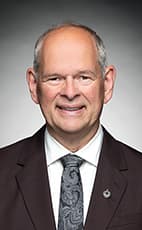
Ernie Klassen
In the 90 days to September 18, 2026, 6 organizations lobbied Ernie Klassen across 7 meetings — most often about Foreign Affairs. The most frequent visitor was Dignity Network Canada (2 meetings, via their in-house lobbyist Douglas Kerr). Its registration describes the goal as “Canadian foreign policy and programming related to human rights for LGBTIQ people abroad. Advancing a range of LGBTIQ inclusive programming…”. That's about the same as the average MP, who had 6 meetings over the same period.
Based on federal lobbying registry data to September 18, 2026
In the House · Sep 21–25
Ernie Klassen this week
“Canada will always protect our sovereignty and our fisheries, full stop. The Prime Minister has been clear. Details about any future arrangement with the European Union will be presented to all Canadians.”
- Spoke 2 times in the House · the average MP spoke 4 times
- FORC-266, second reading — Establish a national framework respecting skilled trades and labour mobility · passed 295–21
Get Ernie Klassen's week in your inbox every Monday
What they said, how they voted, and who lobbied them. Free, no ads, unsubscribe anytime.
How Ernie Klassen actually voted
Their recorded positions on the issues Canadians care about — pulled straight from the parliamentary record.
- Voted For
Labour & Employment
Establish a national framework respecting skilled trades and labour mobility
C-266 · Sep 2026 · Passed · Tell your MP what you think
- Voted For
Economy & Taxation
Implement certain provisions of the spring economic update tabled in Parliament on April 28, 2026
C-30 · Jun 2026 · Passed · Tell your MP what you think
- Voted For
Housing
Authorize certain payments to be made out of the Consolidated Revenue Fund for the purpose of improving housing supply
C-26 · Jun 2026 · Passed · Tell your MP what you think
- Voted For
Criminal Justice
Hate propaganda, hate crime and access to religious or cultural places
C-9 · Jun 2026 · Passed · Tell your MP what you think
- Voted For
Overall leanings
100%
voted with the Liberal line this Parliament
100%
vote attendance (174/174)
Who’s in Ernie’s ear
137
lobbying meetings
100
companies & groups
49
speeches in Parliament
Top lobbying relationship: Frontier Duty Free Association — met 6 times · most lobbied on Economic Development.
See who’s lobbying Ernie →Who's lobbying Ernie
Individual meeting records from the federal lobbying registry
| Date | Organization | |
|---|---|---|
| 2026-09-10 | Women's Network PEI | |
| 2026-08-11 | Special Olympics Canada | |
| 2026-08-07 | Dignity Network Canada | |
| 2026-08-05 | Dignity Network Canada | |
| 2026-07-31 | Real Estate Foundation BC |
Write to Ernie Klassen
Pick what it's about. You'll get a letter you can edit, then send it from your own email.
Other ways to reach Ernie
613-992-4211 is the House of Commons switchboard — ask to be connected to your MP's office. For constituency office contact details, or if ernie.klassen@parl.gc.ca bounces, visit their Parliament profile.
Committee Memberships
Top Lobbying Clients
Companies with the most meetings with this MP
What Ernie talks about
- Fisheries and Oceans7 speeches · 2026
- National AccessAbility Week2 speeches · 2025–2026
- The Economy2 speeches · 2026
- Alex House1 speeches · 2026
- Build Communities Strong Fund1 speeches · 2025
Recent Speeches
Mr. Speaker, Canada will always protect our sovereignty and our fisheries, full stop. The Prime Minister has been clear. Details about any future arrangement with the European Union will be presented to all Canadians. The member is back to his old scare tactics, but our government is focused on grow… Read full speechShow less
Mr. Speaker, Canada will always protect our sovereignty and our fisheries, full stop. The Prime Minister has been clear. Details about any future arrangement with the European Union will be presented to all Canadians. The member is back to his old scare tactics, but our government is focused on growing Canada's seafood economy.
Mr. Speaker, as Parliament resumes, I am reminded that the strength of Canada is found in our communities. During the last few months, I met with local businesses, community organizations and residents, attended community celebrations, hosted several round tables and saw young people developing valu… Read full speechShow less
Mr. Speaker, as Parliament resumes, I am reminded that the strength of Canada is found in our communities. During the last few months, I met with local businesses, community organizations and residents, attended community celebrations, hosted several round tables and saw young people developing valuable skills and experience through the Canada summer jobs program. I had the privilege of participating in the Special Olympics Canada Summer Games. Watching my son compete alongside other athletes with disabilities was a powerful reminder that perseverance and teamwork are at the heart of the Canadian spirit. In Amsterdam, I represented Canada at a human rights conference where I was reminded that our country continues to be respected around the world for the values we uphold. As the Prime Minister says, Canada has what the world wants. That strength begins in our communities where Canadians show that when we work together, challenges can be overcome. Let us bring that same spirit of unity, pride, optimism and determination to this House. Let us work together and build an even stronger Canada.
Mr. Speaker, as we celebrate Pride season across Canada, we are reminded that the rights and freedoms many enjoy today should never be taken for granted. Around the world, identifying as 2SLGBTQIA+ remains illegal in 65 countries, and in 12 jurisdictions, individuals still face the death penalty sim… Read full speechShow less
Mr. Speaker, as we celebrate Pride season across Canada, we are reminded that the rights and freedoms many enjoy today should never be taken for granted. Around the world, identifying as 2SLGBTQIA+ remains illegal in 65 countries, and in 12 jurisdictions, individuals still face the death penalty simply for being who they are. I would like to recognize the work of the Canadian Pride Caucus, which is well known for its work here at home, but it is also playing an increasingly important international role. Through engagement with foreign parliamentarians, human rights defenders, diplomatic missions and civil society organizations, the caucus helps advance Canada's commitment to dignity, inclusion and protection of human rights on the global scale. I invite all colleagues from all parties to join us tomorrow at noon on Parliament Hill for the Pride flag raising. Let us come together to celebrate Pride season and reaffirm Canada's commitment to equality, inclusion and protecting human rights for all. I wish everyone a happy Pride.
Mr. Speaker, this week we celebrate National AccessAbility Week, which began in 1988. Inspired by Rick Hansen's Man in Motion World Tour, this week honours the contributions of Canadians with disabilities and reminds us that we can always build a more inclusive and accessible society. This year's Ca… Read full speechShow less
Mr. Speaker, this week we celebrate National AccessAbility Week, which began in 1988. Inspired by Rick Hansen's Man in Motion World Tour, this week honours the contributions of Canadians with disabilities and reminds us that we can always build a more inclusive and accessible society. This year's Canadian theme is “Building a Strong, Accessible Canada.” More than eight million Canadians face barriers in everyday life. Many of these obstacles are built into our homes and workplaces. As the father of a son with a disability, and a friend of Rick Hansen and of Canada's first chief accessibility officer, Stephanie Cadieux, I have seen first-hand the importance of designing our communities equitably. This week, we celebrate the progress we have made so far and acknowledge the work of advocates whose leadership continues to break down barriers and inspire positive change. Together, we can continue building communities where everyone can participate and thrive. Let us create a fair and welcoming society for everyone.
Madam Speaker, I welcome the opportunity to address the issues raised by my colleague, the hon. member for Courtenay—Alberni. Fisheries and Oceans Canada is aware that many fish harvesters on the west coast are facing economic challenges. That is why, in February, the Minister of Fisheries announced… Read full speechShow less
Madam Speaker, I welcome the opportunity to address the issues raised by my colleague, the hon. member for Courtenay—Alberni. Fisheries and Oceans Canada is aware that many fish harvesters on the west coast are facing economic challenges. That is why, in February, the Minister of Fisheries announced two new objectives to guide the licensing reform work happening under the west coast commercial fisheries modernization initiative. These objectives are to support working harvesters so they have more control over their fishing activities and keep a greater share of the benefits from their fishing effort, and to modernize the licensing regime to support harvesters in pursuing their business objectives and adapting to change. Work is already under way. The government is engaging on fishery-specific policy options to achieve these objectives, starting with the crab and prawn fisheries. As part of this effort, DFO is gathering perspectives on the feasibility and implications of various policy options, such as made-in-B.C. versions of owner-operator and fleet separation requirements, and other ideas raised by participants and harvesters. DFO will also launch a survey of licence and quota holdings and leasing agreements to ensure that policies are informed by robust and current data. The government understands the challenges that harvesters are facing, but those who rely on the fishery have told us that a cookie-cutter approach will not suffice. Careful consideration will be given to different ways that fisheries have evolved in British Columbia compared to on the east coast, when contemplating owner-operator type requirements or other policy ideas that can support active harvesters and the flow of benefits to local communities. The government knows how important it is for Canada's fisheries resources to stay in the hands of Canadians. That is why we completed a beneficial ownership survey in 2022 to learn more about foreign participation in Canadian fisheries. While the results told us that 98% of respondents reported being Canadian-owned, we are conducting further research and analysis to deepen our understanding about who actually is benefiting from Canada's west coast fisheries. DFO believes in transparency of fisheries data and is actively working to improve data transparency for the benefit of active harvesters, new fishery participants and all Canadians. We have published interactive socio-economic data dashboards for fishery participants to learn more about the economics of their fisheries, and we are collecting more socio-economic data. We have also taken steps to make public data sets more accessible by publishing a web-based portal to facilitate access to publicly available licences and quota information. The Government of Canada remains committed to supporting the economic health and prosperity of coastal communities that rely on fishery resources. We know that fishing activities are an important cultural and economic feature of many coastal communities in B.C. The government will not take a one-size-fits-all approach. The west coast commercial fisheries modernization initiative will provide important opportunities for first nations and fishery participants to shape the future of licensing policy, ensuring that any policy changes are practical, effective, and suited and tailored to the west coast context, not a replica of the east coast.
Recent activity
22 activities across speeches, bills, and lobbying communications.
September 2026
Oral Questions
Mr. Speaker, Canada will always protect our sovereignty and our fisheries, full stop. The Prime Minister has been clear. Details about any future arrangement with the European Union will be presented … Read full speechShow less
Mr. Speaker, Canada will always protect our sovereignty and our fisheries, full stop. The Prime Minister has been clear. Details about any future arrangement with the European Union will be presented to all Canadians. The member is back to his old scare tactics, but our government is focused on growing Canada's seafood economy.
Statements by Members
Mr. Speaker, as Parliament resumes, I am reminded that the strength of Canada is found in our communities. During the last few months, I met with local businesses, community organizations and resident… Read full speechShow less
Mr. Speaker, as Parliament resumes, I am reminded that the strength of Canada is found in our communities. During the last few months, I met with local businesses, community organizations and residents, attended community celebrations, hosted several round tables and saw young people developing valuable skills and experience through the Canada summer jobs program. I had the privilege of participating in the Special Olympics Canada Summer Games. Watching my son compete alongside other athletes with disabilities was a powerful reminder that perseverance and teamwork are at the heart of the Canadian spirit. In Amsterdam, I represented Canada at a human rights conference where I was reminded that our country continues to be respected around the world for the values we uphold. As the Prime Minister says, Canada has what the world wants. That strength begins in our communities where Canadians show that when we work together, challenges can be overcome. Let us bring that same spirit of unity, pride, optimism and determination to this House. Let us work together and build an even stronger Canada.
June 2026
Statements by Members
Mr. Speaker, as we celebrate Pride season across Canada, we are reminded that the rights and freedoms many enjoy today should never be taken for granted. Around the world, identifying as 2SLGBTQIA+ re… Read full speechShow less
Mr. Speaker, as we celebrate Pride season across Canada, we are reminded that the rights and freedoms many enjoy today should never be taken for granted. Around the world, identifying as 2SLGBTQIA+ remains illegal in 65 countries, and in 12 jurisdictions, individuals still face the death penalty simply for being who they are. I would like to recognize the work of the Canadian Pride Caucus, which is well known for its work here at home, but it is also playing an increasingly important international role. Through engagement with foreign parliamentarians, human rights defenders, diplomatic missions and civil society organizations, the caucus helps advance Canada's commitment to dignity, inclusion and protection of human rights on the global scale. I invite all colleagues from all parties to join us tomorrow at noon on Parliament Hill for the Pride flag raising. Let us come together to celebrate Pride season and reaffirm Canada's commitment to equality, inclusion and protecting human rights for all. I wish everyone a happy Pride.
Statements by Members
Mr. Speaker, this week we celebrate National AccessAbility Week, which began in 1988. Inspired by Rick Hansen's Man in Motion World Tour, this week honours the contributions of Canadians with disabili… Read full speechShow less
Mr. Speaker, this week we celebrate National AccessAbility Week, which began in 1988. Inspired by Rick Hansen's Man in Motion World Tour, this week honours the contributions of Canadians with disabilities and reminds us that we can always build a more inclusive and accessible society. This year's Canadian theme is “Building a Strong, Accessible Canada.” More than eight million Canadians face barriers in everyday life. Many of these obstacles are built into our homes and workplaces. As the father of a son with a disability, and a friend of Rick Hansen and of Canada's first chief accessibility officer, Stephanie Cadieux, I have seen first-hand the importance of designing our communities equitably. This week, we celebrate the progress we have made so far and acknowledge the work of advocates whose leadership continues to break down barriers and inspire positive change. Together, we can continue building communities where everyone can participate and thrive. Let us create a fair and welcoming society for everyone.
May 2026
Adjournment Proceedings
Madam Speaker, I welcome the opportunity to address the issues raised by my colleague, the hon. member for Courtenay—Alberni. Fisheries and Oceans Canada is aware that many fish harvesters on the west… Read full speechShow less
Madam Speaker, I welcome the opportunity to address the issues raised by my colleague, the hon. member for Courtenay—Alberni. Fisheries and Oceans Canada is aware that many fish harvesters on the west coast are facing economic challenges. That is why, in February, the Minister of Fisheries announced two new objectives to guide the licensing reform work happening under the west coast commercial fisheries modernization initiative. These objectives are to support working harvesters so they have more control over their fishing activities and keep a greater share of the benefits from their fishing effort, and to modernize the licensing regime to support harvesters in pursuing their business objectives and adapting to change. Work is already under way. The government is engaging on fishery-specific policy options to achieve these objectives, starting with the crab and prawn fisheries. As part of this effort, DFO is gathering perspectives on the feasibility and implications of various policy options, such as made-in-B.C. versions of owner-operator and fleet separation requirements, and other ideas raised by participants and harvesters. DFO will also launch a survey of licence and quota holdings and leasing agreements to ensure that policies are informed by robust and current data. The government understands the challenges that harvesters are facing, but those who rely on the fishery have told us that a cookie-cutter approach will not suffice. Careful consideration will be given to different ways that fisheries have evolved in British Columbia compared to on the east coast, when contemplating owner-operator type requirements or other policy ideas that can support active harvesters and the flow of benefits to local communities. The government knows how important it is for Canada's fisheries resources to stay in the hands of Canadians. That is why we completed a beneficial ownership survey in 2022 to learn more about foreign participation in Canadian fisheries. While the results told us that 98% of respondents reported being Canadian-owned, we are conducting further research and analysis to deepen our understanding about who actually is benefiting from Canada's west coast fisheries. DFO believes in transparency of fisheries data and is actively working to improve data transparency for the benefit of active harvesters, new fishery participants and all Canadians. We have published interactive socio-economic data dashboards for fishery participants to learn more about the economics of their fisheries, and we are collecting more socio-economic data. We have also taken steps to make public data sets more accessible by publishing a web-based portal to facilitate access to publicly available licences and quota information. The Government of Canada remains committed to supporting the economic health and prosperity of coastal communities that rely on fishery resources. We know that fishing activities are an important cultural and economic feature of many coastal communities in B.C. The government will not take a one-size-fits-all approach. The west coast commercial fisheries modernization initiative will provide important opportunities for first nations and fishery participants to shape the future of licensing policy, ensuring that any policy changes are practical, effective, and suited and tailored to the west coast context, not a replica of the east coast.
Adjournment Proceedings
Madam Speaker, the Government of Canada is committed to supporting and strengthening the economies of our coastal communities. Fishing is an important part of many coastal communities on the west coas… Read full speechShow less
Madam Speaker, the Government of Canada is committed to supporting and strengthening the economies of our coastal communities. Fishing is an important part of many coastal communities on the west coast. This government is taking steps to actively work with first nations, harvesters, licence holders and processors to explore potential solutions that reflect the unique realities of the west coast. The Minister of Fisheries recently announced two new objectives guiding work to modernize west coast fisheries. The first is supporting harvesters to have more control over their fishing activities, to keep a greater share of the benefits from fishing. The second is modernizing licensing to support harvesters in pursuing their business objectives. This government will work closely with west coast fishery participants on options for how to achieve these objectives and address the concerns of fish harvesters. Fisheries on the east and west coasts have evolved very differently. We cannot have a one-size-fits-all approach. This is why this government is working with those involved to develop solutions—
Statements by Members
Mr. Speaker, for over 100 years, Alex House in my riding of South Surrey—White Rock has been dedicated to empowering people to build and nurture a strong, connected community by offering programs and … Read full speechShow less
Mr. Speaker, for over 100 years, Alex House in my riding of South Surrey—White Rock has been dedicated to empowering people to build and nurture a strong, connected community by offering programs and services that support individuals and families at every stage of life, from early childhood education and youth programs to seniors' services, wellness initiatives and community outreach. This year also marks the 50th anniversary of Alex Fest, a celebration held on Semiahmoo First Nation land bringing together families, local artists and neighbours from across the Semiahmoo peninsula to share in creativity, learning and community spirit. I would like to thank the board, staff and volunteers for their continued commitment and recognize Penny Bradley for her outstanding leadership. At the heart of Alex House is a simple truth. Its mission would not be possible without the hard work and dedication of volunteers. I congratulate Alex House on these important milestones.
Statements by Members
Mr. Speaker, in Canada, educators are working to ensure that our schools are places where all students feel safe, respected and able to learn. Organizations, such as the ARC Foundation, support this e… Read full speechShow less
Mr. Speaker, in Canada, educators are working to ensure that our schools are places where all students feel safe, respected and able to learn. Organizations, such as the ARC Foundation, support this effort through initiatives like SOGI 123, which provides educators with age-appropriate tools and resources to foster inclusive and respectful school environments. This helps schools strengthen policies, promote kindness and ensure that students, regardless of background, identity or experience, can thrive. Research has shown that inclusive school environments can reduce social exclusion, bullying and discrimination, which benefits not only 2SLGBTQIA+ youth but also all other students in feeling safe and supported. It is important to ensure that our schools reflect both inclusion and trust, which allows society to learn and accept the diverse world around them. Every young person in Canada deserves dignity, respect and the opportunity to reach their full potential.
Government Orders
Mr. Speaker, I would like to use my time today to speak about the recent agreements that Canada signed with the Musqueam nation. These agreements build on the Constitution Act, 1982, the direction pro… Read full speechShow less
Mr. Speaker, I would like to use my time today to speak about the recent agreements that Canada signed with the Musqueam nation. These agreements build on the Constitution Act, 1982, the direction provided by the courts over the last several decades and efforts of indigenous groups over many years to have their rights recognized and upheld by the Crown. To understand these agreements, it is helpful to begin with the Constitution. Section 35 of the Constitution Act, 1982 states that “The existing aboriginal and treaty rights of the aboriginal peoples of Canada are hereby recognized and affirmed.” It reflects Parliament's recognition that indigenous nations will become partners in Confederation based on fair and just reconciliation between indigenous peoples and the Crown. Existing aboriginal and treaty rights include rights defined under historical or modern treaties and the asserted aboriginal rights and title of indigenous nations with claims to land that remain unresolved. Indigenous nations have rights and title within their territory that are recognized and affirmed by section 35 of the Constitution Act, 1982. Section 35 recognizes what first nations have always known, that they have aboriginal rights. However, acknowledging aboriginal rights is not the same as defining those rights. General recognition that a first nation has aboriginal title acknowledges a legal and historical fact. That recognition also creates an important and respectful starting point for the negotiation of agreements to address their claims. General recognition of aboriginal rights, including title, is often included in agreements negotiated between governments and indigenous nations, including both treaties and incremental non-treaty agreements. Agreements such as the Musqueam Rights Recognition Agreement contain general recognition and do not create a legal interest in any specific lands. Specific recognition of aboriginal title means that an indigenous group has aboriginal title to specific lands, including a legal ownership interest based on their historical use and occupation of those lands. This type of recognition can happen either as part of an agreement negotiated between governments and indigenous nations or as a result of a court decision in an aboriginal title case such as in the Cowichan and Tsilhqot’in cases. Quite simply, this agreement does not create aboriginal rights for Musqueam. It does not define the nature or scope of their aboriginal rights. It simply acknowledges that Musqueam have aboriginal rights including aboriginal title somewhere, not throughout, within their entire traditional territory. Most important, it sets out a process for discussion about how and where those rights might be implemented in the future. To use the analogy of a tool box, general recognition of aboriginal rights through the Musqueam Rights Recognition Agreement is like agreeing that a tool box exists. What it does not do is decide how the tools will be used or which tools will be needed. Those are questions that will be worked through later, together, through discussion and negotiation. Moreover, the Musqueam Rights Recognition Agreement does not impact third party interests, including private property. It does not impact the rights of other first nations. It does not impact or alter the jurisdiction of federal, provincial or local governments. No decision-making powers about lands, waters or resources are transferred through these agreements. The Musqueam agreement does not mention private property because private property was never on the negotiating table in the first place. There has been a lot of commentary regarding these agreements. Canadians place great value on private property and also recognize the importance of advancing reconciliation with indigenous people. Given the importance of advancing reconciliation with first nations and the need for clarity as Canada strengthens its economy, it is critical that we are clear about what these agreements are and what they are not. To that end, I would emphasize that private property is firmly under the jurisdiction of provincial governments. It cannot be negotiated away from provinces or Canadians without their consent and it is not something the federal government can alter through this type of agreement. The Government of Canada respects both existing private property interests and constitutionally protected indigenous rights within the federal government's areas of responsibility. The Musqueam people have clearly stated that they have no intention of pursuing private property through this agreement. If I may quote Musqueam chief Wayne Sparrow, he said, ”Our approach to traditional unceded territory is one of partnership and relationship with our neighbours, not trying to take away our neighbours' private property.” Treaties and other agreements, such as the one with Musqueam, allow government to advance reconciliation and address indigenous rights and title through dialogue and co-operation while protecting private property and providing certainty for all Canadians. The Musqueam Rights Recognition Agreement provides a path forward to address Musqueam's rights and title collaboratively and avoid the uncertainty and high costs of pursuing litigation in the courts. Canada has consistently stated that the best way to resolve outstanding claims is to work together in partnership through co-operative negotiations and respectful dialogue, not through litigation. The litigation of land claims often involves unpredictable outcomes and significant costs for provincial, territorial and federal governments, and Canadians. Negotiated agreements provide an alternative that supports clarity and stability around the exercise of aboriginal rights. Agreements like the Musqueam agreement are about creating certainty and predictability, predictability for investors, for major projects, for private landowners, for indigenous groups and for all Canadians. By negotiating agreements such as this one, Canada is taking a responsible approach to resolving outstanding claims, including through its work with Musqueam. In so doing, we are able to advance the resolution of long-standing disputes about land and rights in ways that respect the rights of indigenous peoples, uphold existing private property rights and reflect the best interests of all Canadians. This approach supports a stronger and more unified Canada, where private property and indigenous rights are respected together.
Government Orders
Mr. Speaker, this motion misrepresents both the law and the government's position. It suggests that Canadians could lose their homes because of agreements with indigenous partners, and that is simply … Read full speechShow less
Mr. Speaker, this motion misrepresents both the law and the government's position. It suggests that Canadians could lose their homes because of agreements with indigenous partners, and that is simply not true. Our government has been clear. We support protecting private property rights and we are actively defending them through the courts. At the same time, we will not support a partisan process that supports and spreads fear and misinformation about reconciliation and indigenous partnerships. Our government has been clear that reconciliation is the way in which we want to move forward on these.
Government Orders
Mr. Speaker, protecting the certainty and integrity of private property rights remains a fundamental priority for our government. That is precisely why we advance all viable legal arguments to protect… Read full speechShow less
Mr. Speaker, protecting the certainty and integrity of private property rights remains a fundamental priority for our government. That is precisely why we advance all viable legal arguments to protect private property. We do not agree with the B.C. Supreme Court's ruling, which is why the government appealed it back in September. Our government is fully committed to ensuring stability, certainty and confidence for Canadians who own property while we advance reconciliation. This matter is before the courts, where it should properly be addressed, not reduced to partisan rhetoric in this chamber.
Government Orders
Mr. Speaker, preserving the certainty and stability of private property is of utmost importance. This is why we will advance all viable legal arguments to protect private property. We believed then an… Read full speechShow less
Mr. Speaker, preserving the certainty and stability of private property is of utmost importance. This is why we will advance all viable legal arguments to protect private property. We believed then and we continue to believe now that those potentially affected by a decision of this magnitude deserve to be informed and heard. This is why, as far back as 2017, Canada argued before the court that private landowners should be notified of the litigation. This is why we have supported an application that would allow Montrose, a private property owner in the area, to present evidence that was not before—
Government Orders
Mr. Speaker, it is also important to be very clear about the Musqueam agreements. These agreements do not impact private property. The agreements recognize the Musqueam's constitutionally protected ab… Read full speechShow less
Mr. Speaker, it is also important to be very clear about the Musqueam agreements. These agreements do not impact private property. The agreements recognize the Musqueam's constitutionally protected aboriginal rights in the specific areas of stewardship and marine emergency management while creating a practical framework for collaboration between Canada and the first nations. These agreements respect the rights of indigenous peoples—
Statements by Members
Mr. Speaker, in 2011, along British Columbia's Highway of Tears, a remote stretch of Highway 16 where far too many indigenous women and girls have gone missing or been murdered, Paul and Raven Lacerte… Read full speechShow less
Mr. Speaker, in 2011, along British Columbia's Highway of Tears, a remote stretch of Highway 16 where far too many indigenous women and girls have gone missing or been murdered, Paul and Raven Lacerte were moved to action. They are the father and daughter co-founders of the Moose Hide Campaign. It is an indigenous-led movement grounded in love, ceremony and accountability, calling on people of all backgrounds to take a stand against gender-based and domestic violence. Wearing a moose hide pin is more than a symbol. It represents a personal commitment to honour, respect and protect women and children in our homes, workplaces and communities. It is about building safer communities where everyone is responsible to speak up and support one another. On Thursday, May 14, Moose Hide Campaign Day, I am asking all Canadians to renew that pledge and, most important, to take meaningful action because ending violence is a responsibility we all share every single day.
Oral Questions
Madam Speaker, last week the minister was pleased to publish the “What We Heard” report from the food fishery survey. This was the largest survey done by DFO, with over 9,500 participants. We want to … Read full speechShow less
Madam Speaker, last week the minister was pleased to publish the “What We Heard” report from the food fishery survey. This was the largest survey done by DFO, with over 9,500 participants. We want to thank everyone who responded to the survey in order to allow us to work better for the people of the member across the aisle's statement. Our government knows how important the food fishery is in the province of Newfoundland and Labrador. We need to get this—
April 2026
Statements by Members
Mr. Speaker, Doug Tennant has dedicated more than 35 years to advancing inclusion for people with developmental disabilities as a parent, volunteer and CEO of Uniti. Doug has worked alongside self-adv… Read full speechShow less
Mr. Speaker, Doug Tennant has dedicated more than 35 years to advancing inclusion for people with developmental disabilities as a parent, volunteer and CEO of Uniti. Doug has worked alongside self-advocate leaders to help ensure they have the same rights and opportunities as all Canadians. Doug helped lead innovative housing initiatives, creating communities that provide quality housing for all, including people with disabilities. His leadership has strengthened partnerships in the non-profit, business and public sectors. Doug has served as a board member of Uniti, the Surrey Board of Trade and the BC CEO Network. He was a founder of the Canadian Business Disability Inclusion Network. He uses his influence to challenge bigotry through initiatives such as We Belong Surrey. As he retires, Doug plans to continue volunteering to advance inclusion and affordable housing, hopeful that his work helps shape policy, inspire leaders and build more welcoming communities. I wish Doug a happy retirement.
Statements by Members
Mr. Speaker, earlier this week, Ottawa was proud to host the 33rd Canadian Legislative Conference of the International Association of Fire Fighters. This annual gathering brings firefighters from acro… Read full speechShow less
Mr. Speaker, earlier this week, Ottawa was proud to host the 33rd Canadian Legislative Conference of the International Association of Fire Fighters. This annual gathering brings firefighters from across the country together to engage with parliamentarians and to raise awareness about federal issues that affect both their profession and the communities they serve. Representatives from the White Rock and Surrey fire departments raised issues directly affecting their members, including increasing the memorial grant program and strengthening protections for communities against lithium battery fires. These courageous first responders put their lives on the line every day to protect our residents and respond to emergencies. They are also deeply committed to their communities, raising funds for local charities, supporting families in need and giving back through countless volunteer initiatives. I thank our firefighters for their courage, their compassion and their unwavering service to our communities.
Adjournment Proceedings
Mr. Speaker, perhaps I can clarify something for my colleague across the floor. The private member's bill referenced by the member was reckless and would have threatened the livelihoods of harvesters,… Read full speechShow less
Mr. Speaker, perhaps I can clarify something for my colleague across the floor. The private member's bill referenced by the member was reckless and would have threatened the livelihoods of harvesters, plant workers and their families, and communities right across Atlantic Canada. Do not just take it from me. Both the FFAW and ASP shared their concern with the member's scheme. For those listening at home in the member's own province, the inshore fleet, the offshore fleet, processors and ENGOs were all against his proposal and have all stated it was a bill to change science and not to fish seven days a week. He ignored science, consultation and the thousands of people, including those in his own province, who depend on the fishery. To hear from the people, the Minister of Fisheries launched the food fisheries survey, to which more than 9,500 people responded. It was the highest level of participation ever for a DFO survey. That is real consultation. Tomorrow, the minister will be meeting with recreational fishers, the province, the FFAW and ASP to hear their thoughts on the future of the food fishery. We want to get this right. Our government recently published the food fishery “What We Heard Report”, and I recommend the member read it to see what Newfoundlanders and Labradorians want to see in the food fishery. The member opposite proposed an entirely new monitoring system just for recreational fishers and would have forced Newfoundlanders and Labradorians to record their catch. How did the member want to offset those new administrative and red-tape costs? It was fees on the fishers themselves. That is not true representation. He proposed to have the government cover “the administrative costs of the monitoring system by fees and penalties that are required to be paid under the Fisheries Act”. That would have meant licence fees and nobody wants those. The member proposed a new system that would have told Newfoundlanders and Labradorians that they cannot catch cod like they have for their entire lives and it would have only made the fishery worse. Our government understands that the food fishery is culturally important. The member opposite talks about affordability, but he would have put a Conservative tax on those who fish to feed themselves and their families, as they have done for generations. This past year, the food fishery in Newfoundland and Labrador had no licence requirement, no licence fee and no reporting requirement. The idea was was just to follow the rules, be safe and fish for food. Under the member's Conservative tax on food system, food fishers in Newfoundland and Labrador would have been forced to have a mandatory licence, pay a fee to cover additional new red tape and report every fish they caught through a new system that would also cost them money to use. While our new government is providing tax relief to millions of Canadians and working to build a stronger economy, the member has been playing short-sighted political games that threaten the economy for everyone in Atlantic Canada and would have made Newfoundlanders and Labradorians pay for the food fishery. Our government is working on behalf of all Canadians to truly make life more affordable for everyone.
Adjournment Proceedings
Mr. Speaker, it sounds like the member is forgetting what his bill actually called for. It is a tax on food for people in his province. It did not say anything about fishing seven days a week, but it … Read full speechShow less
Mr. Speaker, it sounds like the member is forgetting what his bill actually called for. It is a tax on food for people in his province. It did not say anything about fishing seven days a week, but it did call for new red tape and licence fees on food fishers. That is not what Newfoundlanders and Labradorians want. He did not consult or listen to fishers. He put forward a proposal that threatened the entire commercial fishing industry in Atlantic Canada. That is tens of thousands of jobs and billions of dollars. The Minister of Fisheries did a full survey to hear from the people in the province on what they want to see in the food fishery. Over 9,500 people completed the survey. Our government knows how much people in his province care about the food fishery. The member should read the “What We Heard Report” we recently published to see what real consultation looks like. He will find that his proposals for more red tape and licence fees are not popular with food fishers.
Statements by Members
Mr. Speaker, tomorrow marks the 44th anniversary of the Canadian Charter of Rights and Freedoms. The charter stands as one of the strongest pillars of human rights protection, guaranteeing our fundame… Read full speechShow less
Mr. Speaker, tomorrow marks the 44th anniversary of the Canadian Charter of Rights and Freedoms. The charter stands as one of the strongest pillars of human rights protection, guaranteeing our fundamental freedoms and protecting the rights of all Canadians. The charter is a profoundly Canadian document. Its impact goes beyond our borders, inspiring and providing expertise to nations around the world, allowing Canada to lead by example. I would also like to recognize prime ministers Trudeau and Chrétien for their roles in achieving this landmark in Canadian history and for carrying this legacy forward by advancing equal rights, including the legalization of same-sex marriage, ensuring that the promise of the charter applies to all Canadians. We believe that the charter works because it truly represents us, the Canadian people, and it stands the test of time. Let us recommit to these principles, ensuring that the charter continues to serve Canadians for generations to come.
March 2026
House of Commons
82 communications with 62 clients
Top clients: [{"name": "Frontier Duty Free Association", "count": 4}, {"name": "Semiahmoo Fir…
December 2025
House of Commons
6 communications with 5 clients
Top clients: [{"name": "Council of Forest Industries", "count": 2}, {"name": "Community Livin…