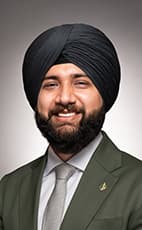
Iqwinder Gaheer
In the 90 days to October 1, 2026, Iqwinder Gaheer had one registered lobbying meeting — about Health. It was with York University (via their in-house lobbyist Lisa Philipps). Its registration describes the goal as “Raising awareness about York University's strengths in research, teaching, and scholarship and differentiation among post-secondary…”. That's fewer than the average MP, who had 6 meetings over the same period.
Based on federal lobbying registry data to October 1, 2026
In the House · Oct 5–9
Iqwinder Gaheer this week
- No speeches in the House · the average MP spoke 5 times
- FORC-39, second reading — Respecting certain measures to strengthen the economy · passed 296–26
- AGAINSTC-218, second reading — Medical assistance in dying · defeated 141–187
- AGAINSTOpposition Motion (Diesel prices) · defeated 133–196
- FORFifth report of the Standing Committee on Health · passed 196–132
Get Iqwinder Gaheer's week in your inbox every Monday
What they said, how they voted, and who lobbied them. Free, no ads, unsubscribe anytime.
How Iqwinder Gaheer actually voted
Their recorded positions on the issues Canadians care about — pulled straight from the parliamentary record.
- Voted Against
- Voted For
Healthcare
Fifth report of the Standing Committee on Health
Oct 2026 · Passed
- Voted For
Labour & Employment
Establish a national framework respecting skilled trades and labour mobility
C-266 · Sep 2026 · Passed · Tell your MP what you think
- Voted For
Economy & Taxation
Implement certain provisions of the spring economic update tabled in Parliament on April 28, 2026
C-30 · Jun 2026 · Passed · Tell your MP what you think
- Voted For
Housing
Authorize certain payments to be made out of the Consolidated Revenue Fund for the purpose of improving housing supply
C-26 · Jun 2026 · Passed · Tell your MP what you think
Overall leanings
100%
voted with the Liberal line this Parliament
100%
vote attendance (178/178)
Who's lobbying Iqwinder
Individual meeting records from the federal lobbying registry
| Organization | |
|---|---|
| York University2026-08-10 · Health; Infrastructure | |
| Association of Equipment Manufacturers (AEM)2026-05-13 · Telecommunications; Employment and Training; Environment; Forestry; Health | |
| Global Poverty Project Canada (Global Citizen)2026-05-01 · International Development | |
| Maple Leaf Foods Inc.2026-04-02 · Health; Immigration; Industry; Labour; Agriculture | |
| Council of Canadian Innovators2026-04-01 · Health; Science and Technology |
Write to Iqwinder Gaheer
Pick what it's about. You'll get a letter you can edit, then send it from your own email.
Other ways to reach Iqwinder
613-992-4211 is the House of Commons switchboard — ask to be connected to your MP's office. For constituency office contact details, or if iqwinder.gaheer@parl.gc.ca bounces, visit their Parliament profile.
Top Lobbying Clients
Companies with the most meetings with this MP since July 2008
What Iqwinder talks about
- Criminal Code8 speeches · 2022
- RCMP Allegations of Foreign Interference by the Government of India8 speeches · 2024
- Allegations Against Government of India5 speeches · 2023
- Bail and Sentencing Reform Act5 speeches · 2025
- Budget Implementation Act, 2023, No. 14 speeches · 2023
Recent Speeches
Mr. Speaker, yesterday Bill C-22 was referred to committee. This is important legislation in our digital age. It gives law enforcement exactly the tools it has asked for. Our government's work is closely aligned with many child protection organizations, like Peel Children's Aid Society in my very ow… Read full speechShow less
Mr. Speaker, yesterday Bill C-22 was referred to committee. This is important legislation in our digital age. It gives law enforcement exactly the tools it has asked for. Our government's work is closely aligned with many child protection organizations, like Peel Children's Aid Society in my very own riding. Can the Minister of Public Safety please elaborate on what the movement of this bill means for keeping our communities safe?
Mr. Speaker, when Hindu Brahmins from the Kashmir Valley faced persecution from Mughal emperor Aurangzeb, they sought refuge with the ninth Sikh guru, Tegh Bahadur, whose name means “brave with a sword”. Aurangzeb had offered them a cruel choice: abandon their faith or offer a great sacrifice. On he… Read full speechShow less
Mr. Speaker, when Hindu Brahmins from the Kashmir Valley faced persecution from Mughal emperor Aurangzeb, they sought refuge with the ninth Sikh guru, Tegh Bahadur, whose name means “brave with a sword”. Aurangzeb had offered them a cruel choice: abandon their faith or offer a great sacrifice. On hearing this, a young Gobind Rai, who would go on to become the 10th Sikh guru and who was the son of Tegh Bahadur, looked to his father and asked, “Father, what sacrifice could be greater than your own?” With those words echoing in his heart and mind, Guru Tegh Bahadur set out for Delhi, with the faithful standing firm at his side. They accepted torture and death, but they did not bend and they did not yield. They stood unbroken in their own faith, and in so doing, they protected the faith of another. It is in memory of this that I rise today.
Mr. Speaker, I rise in the House today to address an issue that goes to the very heart of Canadians' confidence in their justice system: bail reform. This is not a matter of legal procedure. It is about the safety of our communities, and it is directly tied to the responsibility that we bear as parl… Read full speechShow less
Mr. Speaker, I rise in the House today to address an issue that goes to the very heart of Canadians' confidence in their justice system: bail reform. This is not a matter of legal procedure. It is about the safety of our communities, and it is directly tied to the responsibility that we bear as parliamentarians to uphold both justice and fairness. Across the country, Canadians are seeing the impacts of more sophisticated criminal networks, of repeat violent offenders and of organized crime-driven offences. They are asking us a very simple question: Are we doing enough to keep them safe? That question carries immense weight because when public trust in the justice system erodes, the very fabric of our democracy is weakened. With the introduction of Bill C-14, the bail and sentencing reform act, we strengthen this fabric. The bill sets out a clear, responsible path forward, one that protects public safety and upholds the rights enshrined in the charter. The purpose of our bail law is straightforward. It is to ensure that individuals awaiting trial are managed in a way that reduces risk, that supports accountability and that maintains the presumption of innocence. Let me be clear. The conversation about safety is not theoretical. It is not happening in law school lecture halls or legal symposiums. It is happening in living rooms, in small businesses and in community safety meetings. In Mississauga—Malton, I have heard from families, from workers and from local leaders who see the consequences of repeat violent offending and organized crime first-hand. That is why our response, guided by experts throughout the justice system, introduces stronger and smarter tools for courts to assess risk and impose meaningful conditions. Let me be clear. We do not abandon restraint. We honour it, but restraint cannot mean complacency. Restraint cannot mean turning a blind eye. Restraint cannot come at the expense of public safety. We know the stakes. We are not debating abstract principles. We are debating whether a survivor of violence feels safe coming forward, whether a neighbourhood struggling with auto theft sees justice done and whether families feel secure walking home at night, knowing that dangerous repeat offenders are not slipping through the cracks. This legislation recognizes the urgency of that reality. Firstly, we are expanding the reverse onus provision so that individuals charged with some of the most serious offences, from human trafficking to violent extortion and organized crime-related auto theft, must demonstrate why they should be released. That is a balanced approach, one that puts public safety first while safeguarding constitutional rights. Secondly, we strengthen bail conditions, ensuring that courts consider real, concrete restrictions, including curfews, geographic limits and prohibitions on weapons or break-in tools. Thirdly, we give judges more information. We extend the look-back period for prior convictions from five to 10 years, because courts should see the full pattern of behaviour and not just a fragment of it. We also reinforce the critical principle that Canadians have been championing: that victims and communities deserve to feel safe. Let me say this clearly, because the stakes demand clarity. These reforms are not about abandoning the presumption of innocence. These changes are not designed to punish those who pose no risk at all. They are about ensuring that when someone poses a demonstrable risk, such as a repeat violent offender, a member of a criminal organization or an individual with a pattern of dangerous conduct, our justice system has the tools to respond firmly and responsibly. That balance is a cornerstone of a democratic society where, by protecting rights, we protect people. Bill C-14 speaks to the kind of country we want to be in, a country where our justice system is not feared but trusted. In my riding, many people work late hours in logistics, transportation, airport services and hospitality. Many are newcomers who walk home at night alone or who rely on public transit at unconventional hours. These are the people who stand to benefit the most from a justice system that takes repeat violent offenders seriously. These are the people to whom I am accountable when I stand in the chamber. Our laws must evolve to respond to the challenges that we face right now. We must hold close to something else: Justice cannot simply be punitive, because justice without hope is not justice, accountability without rehabilitation is not progress, and punishment without possibility leads to dangerous cycles that we have seen before. We must hold dear the belief that we can make ourselves into better people even after we have wronged, and in fact especially after we have wronged. The justice system should be a part of that rehabilitation. We need to make sure that the policies we bring forward work in criminal law terms, that they have a positive effect on recidivism and that we are not simply punishing people who should be helped through other channels. We have to keep in mind that in sentencing less-serious crimes, imprisonment is often ineffective and unduly punitive, and leads people down a path from which they may not return. We must remain a country that is vigilant about equity. We shamefully know that indigenous, Black and marginalized Canadians are disproportionately represented in the criminal justice system. That is why the implementation of the bill would be accompanied by clear data, careful oversight and continued collaboration with provinces and territories, because safety and fairness are not opposing forces; they are dual pillars of a society committed to justice. The debate on bail reform is not simply about legislation; it is about the protection of Canadians, the strength of our democracy and the trust people place in their justice system every single day. Our government's reforms strike the right balance: firm where firmness is required, fair where fairness is essential, and grounded in the belief that public safety is inseparable from justice. I urge all members of the House to support the legislation, stand for safer communities and stand for a justice system worthy of the people we serve, not for political gain but for the families, workers and small business owners in their riding and in all ridings across this country who simply want to feel safe in the place they call home.
Mr. Speaker, I think Canadians hold the Charter of Rights and Freedoms very dear in their hearts. During the election and during periods when the Leader of the Opposition campaigns, he has consistently referred to the “three strikes and you're out” rule. That law would be unconstitutional from the v… Read full speechShow less
Mr. Speaker, I think Canadians hold the Charter of Rights and Freedoms very dear in their hearts. During the election and during periods when the Leader of the Opposition campaigns, he has consistently referred to the “three strikes and you're out” rule. That law would be unconstitutional from the very foundation of where it comes from. It is not the type of law and society Canadians want. They want laws that work synchronously with the Charter of Rights and Freedoms.
Mr. Speaker, I think the question is unfounded, because if my colleague were to listen to my speech and actually read the bill, he would know that we would be strengthening bail laws so bail would be harder to get in a case exactly like the one the member mentioned. If he supports the rights of vict… Read full speechShow less
Mr. Speaker, I think the question is unfounded, because if my colleague were to listen to my speech and actually read the bill, he would know that we would be strengthening bail laws so bail would be harder to get in a case exactly like the one the member mentioned. If he supports the rights of victims, and the victims whom I have spoken to support the bill, I hope my colleagues from the other side can get on board as well.
MyMP is free and run by one person in Edmonton. Reader support keeps it that way. Chip in