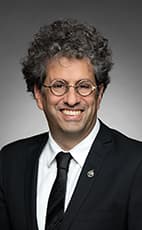
Karim Bardeesy
In the 90 days to September 18, 2026, 14 organizations lobbied Karim Bardeesy across 15 meetings — most often about Economic Development. The most frequent visitor was University of Alberta (2 meetings, via their in-house lobbyist Bill Flanagan). Its registration describes the goal as “Advocacy related to university engagement in Canadian priorities in artificial intelligence, data systems and related computing science and…”. That's more than the average MP, who had 6 meetings over the same period.
Based on federal lobbying registry data to September 18, 2026
In the House · Oct 5–6
Karim Bardeesy this week
- No speeches in the House · the average MP spoke 2 times
- AGAINSTC-218, second reading — Medical assistance in dying · defeated 141–187
- AGAINSTOpposition Motion (Diesel prices) · defeated 133–196
- FORFifth report of the Standing Committee on Health · passed 196–132
Get Karim Bardeesy's week in your inbox every Monday
What they said, how they voted, and who lobbied them. Free, no ads, unsubscribe anytime.
How Karim Bardeesy actually voted
Their recorded positions on the issues Canadians care about — pulled straight from the parliamentary record.
- Voted Against
- Voted For
Healthcare
Fifth report of the Standing Committee on Health
Oct 2026 · Passed
- Voted For
Labour & Employment
Establish a national framework respecting skilled trades and labour mobility
C-266 · Sep 2026 · Passed · Tell your MP what you think
- Voted For
Economy & Taxation
Implement certain provisions of the spring economic update tabled in Parliament on April 28, 2026
C-30 · Jun 2026 · Passed · Tell your MP what you think
- Voted For
Housing
Authorize certain payments to be made out of the Consolidated Revenue Fund for the purpose of improving housing supply
C-26 · Jun 2026 · Passed · Tell your MP what you think
Overall leanings
100%
voted with the Liberal line this Parliament
99%
vote attendance (176/177, missed 1)
Who's lobbying Karim
Individual meeting records from the federal lobbying registry
| Date | Organization | |
|---|---|---|
| 2026-08-28 | McMaster University | |
| 2026-08-26 | BILD | |
| 2026-08-14 | Ontario Centre of Innovation | |
| 2026-08-12 | Council of Canadian Innovators | |
| 2026-08-12 | Cohere Inc. |
Write to Karim Bardeesy
Pick what it's about. You'll get a letter you can edit, then send it from your own email.
Other ways to reach Karim
613-992-4211 is the House of Commons switchboard — ask to be connected to your MP's office. For constituency office contact details, or if karim.bardeesy@parl.gc.ca bounces, visit their Parliament profile.
Committee Memberships
Top Lobbying Clients
Companies with the most meetings with this MP since July 2008
What Karim talks about
- Automotive Industry18 speeches · 2025–2026
- Canada's Auto Industry8 speeches · 2025
- Weights and Measures Act7 speeches · 2026
- Build Canada Homes Act6 speeches · 2026
- Finance6 speeches · 2025–2026
Recent Speeches
Mr. Speaker, I am very engaged in this debate and my colleague's speech. We share adjoining ridings. Therefore, some of the concerns and questions that my colleague is hearing are also being asked in Taiaiako'n—Parkdale—High Park. I want to ask her, given her experience in this Parliament, to speak … Read full speechShow less
Mr. Speaker, I am very engaged in this debate and my colleague's speech. We share adjoining ridings. Therefore, some of the concerns and questions that my colleague is hearing are also being asked in Taiaiako'n—Parkdale—High Park. I want to ask her, given her experience in this Parliament, to speak about the continuity pieces around the environmental regulations here. Also, would she not agree that it is important for people on the many sides of the environmental and resources extraction debate to agree that a quick decision is better than a slow decision, no matter which side of the debate they are on?
Mr. Speaker, my colleague did a very good job of explaining the context that gave rise to this bill. Can she tell us more about what this bill will do for the people of Terrebonne?
Mr. Speaker, I really enjoyed the speech by my colleague from Bourassa. As he pointed out, this bill is targeted and aims to address a very specific situation in today's global context. Could he explain how this measure is in keeping with the government's wider range of efforts, including those he h… Read full speechShow less
Mr. Speaker, I really enjoyed the speech by my colleague from Bourassa. As he pointed out, this bill is targeted and aims to address a very specific situation in today's global context. Could he explain how this measure is in keeping with the government's wider range of efforts, including those he himself had in mind to improve affordability and the cost of living?
Mr. Speaker, it is a pleasure to be back here with our colleagues of all sides. I will be sharing my time with the member for Winnipeg Centre. We are all treaty people. This is something we sometimes say in our communities. This is something we sometimes say in the House of Commons. This is somethin… Read full speechShow less
Mr. Speaker, it is a pleasure to be back here with our colleagues of all sides. I will be sharing my time with the member for Winnipeg Centre. We are all treaty people. This is something we sometimes say in our communities. This is something we sometimes say in the House of Commons. This is something we say to each other in classrooms, hopefully in boardrooms, in places across Canada. The question is, what do we mean by that? How do we animate those words? Regardless of when a person or their family arrived on this land, all of us live within relationships that were shaped by treaties. We are all immigrants, except for the first peoples of this place. Treaties are living arrangements. They are a recognition that indigenous peoples were and remain self-governing nations with which Canada must maintain an ongoing relationship. Today, at this third reading, Bill C-10 asks us to strengthen those foundations. Long before Confederation, indigenous nations entered into treaties and diplomatic relationships with European powers and later with the Crown. These agreements were often understood by everyone involved, including indigenous peoples, as commitments to share land, to coexist peacefully, and to maintain enduring nation-to-nation relationships. In fact, we use those words often in our own land acknowledgements. We refer to these treaties explicitly. We talk about what those treaties were committing to. The treaty relationship was not meant to be temporary; it was meant to last. It was a commitment that was signed. These were oaths that were made, commitments made, and yet, as we know, the history that followed was marked more often by broken promises, unilateral decisions, exclusion from governance, and policies of displacement and assimilation. Many treaty commitments were delayed, others ignored. Some were interpreted, incredibly narrowly, by governments. Indigenous peoples, later nations, and others spent generations advocating, organizing, litigating, cajoling and negotiating, simply to have those existing treaties which, yes, were decades or centuries old, to be honoured; agreements that were signed for generations to come. The good news is that in this era, treaties continue to be signed. Yes, we are getting a bit better, hopefully, at recognizing those treaties or reacting to the litigation that results in the recognition of those treaties. In this era, in the modern era, modern treaties, sometimes called comprehensive land claim agreements, reflect contemporary realities while building on long-standing indigenous rights and relationships to the land, including rights that are recognized in the charter and in other pieces of legislation. Since the 1970s, dozens of these agreements have been concluded across the country, particularly in northern Canada and British Columbia, addressing matters such as self-government, land management, resource sharing, environmental stewardship and economic development, but the challenge is, as it was, implementation. Indigenous treaty partners have repeatedly pointed out that signing an agreement is only the first step. An agreement on paper means little if governments fail to follow through consistently and transparently. That is where Bill C-10 comes in. Bill C-10 would establish an independent commissioner for modern treaty implementation and an accompanying office to support that work. The commissioner would review and audit how federal institutions are fulfilling Canada's obligations under modern treaties and would report publicly on findings. I hear some mention on the other side about bureaucracy, about process, but this is actually about accountability. I think our forefathers and foremothers would have wanted some further accountability on the treaties that were signed. Is it not possible that those treaties that were signed decades and centuries ago would have been less honoured in the breach and more honoured in the practice if we had had a commissioner, if we had some institution that was a bit removed from government, that was answerable to Parliament, to call for accountability on the treaties that had been signed? Treaties that, yes, are decades or centuries old, but that represented real, enduring commitments that were being made by all parties, not just for themselves, not just for the people that they represent, but for the future generations that they were binding. That is what treaties are. They are binding commitments across generations as well as peoples. I believe this piece of legislation, and my colleague, the Minister of Crown-Indigenous Relations, has done an excellent job outlining some of its benefits, including in this era, is going to be a very important piece of accountability, a very important piece of the framework that we need to continue on this reconciliation journey, to continue to honour not only the spirit, but also the meaning, of what it means to all be treaty people. This legislation also gives me an opportunity to speak a bit about how this issue relates to our riding of Taiaiako'n—Parkdale—High Park. Those who are more veterans of this place know that the name of the riding used to be Parkdale—High Park and through the federal electoral boundaries commission, the decision was made and adopted to add the name Taiaiako'n. What is Taiaiako'n, and where is Taiaiako'n? It is a settlement near what is now Baby Point, in the northwest corner of our riding, in a beautiful corner of west Toronto, just along the Humber River, and it has been a place of commerce, fishing and recreational activity for millennia. It was part of something called the Carrying Place trail, an important trading route that linked Lake Ontario to the upper Great Lakes. Taiaiako'n has been settled or inhabited in some way since at least 6000 BCE. There have been millennia of continuous human settlement in this beautiful part of west Toronto. It is a former Iroquois village, but many different inhabitants, the historical record suggests, have been there over the years. The record shows the presence of the Seneca, the Haudenosaunee under the Iroquois, the Wendat peoples, the Mississaugas, the Anishinabe and, much more recently, French Canadians. It is an important commercial space, place of exchange and place of dialogue. As I have learned from conversations with community members, historians and indigenous knowledge keepers, the story of Taiaiako'n is neither simple nor singular. In the English reckoning, there are different spellings of the word Taiaiako'n. There are also different pronunciations. Some pronounce it Taiaiako'n. We in the riding have chosen to pronounce it as Taiaiako'n, but there are multiple ways to speak about this community, this beautiful part of west Toronto that is now part of the Baby Point neighbourhood. The archaeological record continues to show a really significant presence of indigenous peoples and a variety of indigenous settlements all the way along the trail and the river, including what we believe are some burial mounds in High Park. All of this is the story of the indigenous presence in west Toronto. All of this is the story of Taiaiako'n. All of this is the story also of reconciliation. As I mentioned, there are multiple different ways of pronouncing our riding's name. There are different stories about who was there when. A lot of good research has been done, including by the City of Toronto and by the Taiaiako'n Historical Preservation Society. Just to refer to the ongoing connections of these ideas and these practices in our riding, I want to point out to constituents and people across west Toronto the opportunity to gather in our riding on Wednesday, September 30, the National Day for Truth and Reconciliation, when at the Dundas Roncesvalles Peace Garden, starting at 3:30 p.m., there will be the sixth annual Orange Shirt Day walk in commemoration of that very important day, and we will walk south from there. The event starts at 3:30 p.m. eastern time. The walk starts at around 4:15 p.m. eastern time. Too often we look for a singular story, but indigenous knowledge systems frequently teach us to value multiple perspectives, multiple voices and multiple ways of understanding the same place. We continue to be enriched through events connected to the National Day for Truth and Reconciliation, through events related to Indigenous History Month, including through the variety of activities that continue to happen in Toronto, particularly in Taiaiako'n—Parkdale—High Park, and work by groups like the Taiaiako'n Historical Preservation Society, organizations such as the High Park Nature Centre, and by people such as Abby Bushby, those of the Dundas Roncesvalles Peace Garden, and young spiritual elder Philip Cote, who has enriched my understanding of these issues significantly. This bill would create the legal underpinning of the values we all espouse, a further legal underpinning to follow from the charter, the Constitution and the United Nations Declaration on the Rights of Indigenous Peoples, which has been adopted by the House and reflected in the calls to action and recommendations. These emerged from the commissions for which indigenous peoples, along with allies, fought for tirelessly to establish and were eventually recognized in the House through really significant and important reports on missing and murdered indigenous women and on the disaster of residential schools. This bill creates part of the legal underpinning to live our values and respond to some of that advocacy, to those stories, to what we heard in those reports, and to build on what we committed to, whether it was in 1982, in 2006-07 or decades or centuries ago, or whether it is with new treaties that are going to follow. It strengthens the nation-to-nation relationships that are essential to Canada's future. For that reason, I am pleased to support Bill C-10 at third reading. I encourage all members of the House to do the same.
Mr. Speaker, it is a very good question. We create these structures to drive accountability. The existence of officers of Parliament is a very important structure to create accountability. The existence of the Department of Indigenous Services has helped in responding to some of the issues that were… Read full speechShow less
Mr. Speaker, it is a very good question. We create these structures to drive accountability. The existence of officers of Parliament is a very important structure to create accountability. The existence of the Department of Indigenous Services has helped in responding to some of the issues that were identified, especially those around clean drinking water, something that I recall working on when I was working in the Premier of Ontario Kathleen Wynne's office, knowing that the response was not fast enough and that we needed some pressure, yes, from the inside but also from the outside to respond. It is that combination of institutions, along with the commitments we make in Parliament when we decide to endorse a piece of legislation like this, that is part of the solution.