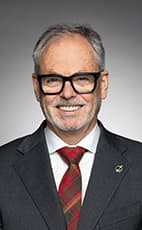
Louis Villeneuve
In the 90 days to September 18, 2026, 1 organization lobbied Louis Villeneuve across 1 meeting — most often about Regional Development. The most frequent visitor was IBM Canada Limited (1 meeting, via their in-house lobbyist Deb Pimentel). Its registration describes the goal as “Communicating with government officials about procurement policies, procedures and processes, including proposals to modernize and…”. That's fewer than the average MP, who had 6 meetings over the same period.
Based on federal lobbying registry data to September 18, 2026
In the House · Sep 21–25
Louis Villeneuve this week
“As a family doctor, my colleague treated thousands of patients during his career. I would like to know why affordability is so important to him.”
- Spoke 2 times in the House · the average MP spoke 4 times
- FORC-266, second reading — Establish a national framework respecting skilled trades and labour mobility · passed 295–21
Get Louis Villeneuve's week in your inbox every Monday
What they said, how they voted, and who lobbied them. Free, no ads, unsubscribe anytime.
How Louis Villeneuve actually voted
Their recorded positions on the issues Canadians care about — pulled straight from the parliamentary record.
- Voted For
Labour & Employment
Establish a national framework respecting skilled trades and labour mobility
C-266 · Sep 2026 · Passed · Tell your MP what you think
- Voted For
Economy & Taxation
Implement certain provisions of the spring economic update tabled in Parliament on April 28, 2026
C-30 · Jun 2026 · Passed · Tell your MP what you think
- Voted For
Housing
Authorize certain payments to be made out of the Consolidated Revenue Fund for the purpose of improving housing supply
C-26 · Jun 2026 · Passed · Tell your MP what you think
- Voted For
Criminal Justice
Hate propaganda, hate crime and access to religious or cultural places
C-9 · Jun 2026 · Passed · Tell your MP what you think
- Voted For
Overall leanings
99%
voted with the Liberal line this Parliament · broke ranks 1×
100%
vote attendance (174/174)
Who’s in Louis’s ear
31
lobbying meetings
19
companies & groups
41
speeches in Parliament
Top lobbying relationship: IBM Canada Limited — met 5 times · most lobbied on Economic Development.
See who’s lobbying Louis →Who's lobbying Louis
Individual meeting records from the federal lobbying registry
| Date | Organization | |
|---|---|---|
| 2026-07-03 | IBM Canada Limited | |
| 2026-06-04 | Canadian Federation of Independent Business (CFIB) | |
| 2026-06-02 | Trans Canada Trail | |
| 2026-04-29 | Unknown | |
| 2026-04-20 | Rogers Communications Inc. |
Write to Louis Villeneuve
Pick what it's about. You'll get a letter you can edit, then send it from your own email.
Other ways to reach Louis
613-992-4211 is the House of Commons switchboard — ask to be connected to your MP's office. For constituency office contact details, or if louis.villeneuve@parl.gc.ca bounces, visit their Parliament profile.
Committee Memberships
What Louis talks about
- Conservation Donations7 speeches · 2025–2026
- An Act to Implement the Protocol on the Accession of the United Kingdom of Great Britain and Northern Ireland to the Comprehensive and Progressive Agreement for Trans-Pacific Partnership2 speeches · 2026
- The Budget2 speeches · 2025
- 150th Anniversary of Cowansville1 speeches · 2026
- 150th Anniversary of Farnham1 speeches · 2026
Recent Speeches
Mr. Speaker, as a family doctor, my colleague treated thousands of patients during his career. I would like to know why affordability is so important to him.
Mr. Speaker, I would like to begin by acknowledging the quality of my colleague's French. He has nothing to worry about. His French was very good. I would also like to reassure him that our Prime Minister listens to his caucus. I think that is very important. I am going to stick to Bill C-10. The go… Read full speechShow less
Mr. Speaker, I would like to begin by acknowledging the quality of my colleague's French. He has nothing to worry about. His French was very good. I would also like to reassure him that our Prime Minister listens to his caucus. I think that is very important. I am going to stick to Bill C-10. The government wants to move things forward. I know my colleague is doing his job, but it is important to note that some Conservative members have, in the past, delayed the passage of legislation affecting indigenous peoples. What assurances can the Conservatives give us that this time their party will work to pass the bill quickly and without unnecessary delay to help modern treaty partners in their ridings?
Mr. Speaker, like my colleague, I began my career in radio. That was in 1974. I would imagine he was quite young then. At that time, more people were tuning into AM radio. I rise today with great interest to support Bill C-268. This bill, introduced by my colleague, aims to improve cellular coverage… Read full speechShow less
Mr. Speaker, like my colleague, I began my career in radio. That was in 1974. I would imagine he was quite young then. At that time, more people were tuning into AM radio. I rise today with great interest to support Bill C-268. This bill, introduced by my colleague, aims to improve cellular coverage in rural areas across Canada. The member who introduced this bill is my riding neighbour. We often go around together, and we call each other and chat from time to time. There are times when one of us misses something the other just said because the line cut out. We experience these problems, too. I would like to begin by commending her leadership on this issue. I believe she is taking a serious, well-thought-out approach that is deeply rooted in the reality faced by citizens in all regions of the country. Beyond the policies and regulatory frameworks, this debate is about something very simple, in my opinion: enabling Canadians to stay connected to loved ones, to services, to the economy and, most importantly, to their safety. Over the past several years, we have collectively made significant progress in terms of improving Internet access. This was discussed earlier. Substantial investments have been made to bridge the digital divide, which had become unacceptable. However, while progress has been made on that front, there is another equally fundamental and persistent issue, that of cellular connectivity. Today, in Canada, nearly one-quarter of provincial highways have no reliable cellular coverage. Let us imagine what that means in practical terms. It means that a parent driving on a highway with their kids may have no way to reach someone in an emergency. It also means that a worker driving around a rural region may not have cell service for tens of kilometres. It also means that an accident could happen and there could be no immediate way to call for help. This is not some hypothetical situation. This is an everyday reality. In my riding of Brome—Missisquoi, these situations are all too real. Dead zones are part of the landscape there. These include stretches of rural roads, forested areas, valleys, entire concessions and villages. I am thinking of Clarenceville, Saint‑Ignace‑de‑Stanbridge and the area between Bromont and Cowansville. Even at home, I have to wave my phone around to get a signal. I am not talking about a connection that is simply slow or unstable. I am talking about total silence: no calls, no messages, no access. The consequences are very real. For instance, farmers tell me that they have to deal with disruptions in their daily operations, even as modern agriculture increasingly relies on connected technologies. Entrepreneurs also tell me that this limits their ability to innovate, attract clients and grow their businesses. Self-employed workers tell me about contracts they have lost simply because they could not be reached. Above all, citizens confide in me that they feel vulnerable when they are on the road, when a loved one is travelling and when they realize that, in certain situations, they are completely cut off from the rest of the world. The impact of these disruptions is not limited to full-time residents of our regions. In a riding like Brome—Missisquoi, we get tens of thousands of visitors a year. They include families, cyclists and outdoor enthusiasts who come to enjoy our scenery, our wineries and our local attractions. A lot of these visitors are city dwellers who are used to uninterrupted connectivity, and when they encounter our dead zones, the consequences for them and for local residents are very real. People may get lost, be unable to use GPS, have trouble reaching emergency services if needed, or simply be unable to communicate with loved ones. Situations like these can quickly turn a positive tourism experience into a source of stress and anxiety. In addition to the impact on individuals, this situation also has economic repercussions, because an area with unstable connectivity is less attractive. Visitors may be reluctant to come back. Tourism companies may lose business opportunities. All this is to say that the cellular coverage issue in the regions does not just affect the year-round residents. It affects everyone who visits, invests and contributes to the economic vitality of our communities. In a riding like mine, cell service is not a luxury. It is a matter of public safety. It is a matter of economic development and a matter of regional equity. However, the official data make it seem like the issue has largely been resolved. The data shows coverage rates as high as 97%. Let me just say I know one thing about coverage: If the phone is showing just half a bar, there is no coverage. It is important to remember that this data is largely based on information self-reported by telecommunications companies, without any systematic independent verification. This makes no sense. As a result, there is a disconnect between what the numbers suggest and what citizens actually experience. When the data is flawed, so are the decisions. That is why the first good thing about Bill C-268 is that it tackles this problem at its root: the quality of the information. The bill requires the CRTC to establish a mechanism for independent verification of cellular coverage data. I believe this is a simple, reasonable and essential measure. Before we can fix a problem, we must first see it clearly, and right now, we cannot do that. Today, underserved areas are all too often underestimated or even invisible in decision-making tools. The second pillar of this bill is just as important: modernizing our spectrum policy framework. This framework has not been updated since 2007. At that time, smart phones were barely a thing. In fact, they were only just coming onto the scene. Digital usage patterns were radically different. Data requirements were incomparable to what they are today. Since then, everything has changed, except the framework. Continuing to rely on a framework designed for a different era means accepting that our policies are lagging behind reality. That is why the bill provides for a comprehensive review within 18 months. This review must address a fundamental question: Does our current approach truly enable us to serve the whole of Canada? In light of the experiences of regions like mine, the answer is quite clearly “no”. Market forces alone have not been able to ensure equitable coverage. This is not a criticism; it is a statement of fact. In densely populated areas, investment happens naturally. However, in rural areas like ours, in remote regions where costs are higher and where, obviously, return on investment is less immediate, roll-out remains limited. That is precisely why the third pillar of the bill is essential. It introduces a clear priority for underserved areas. It requires that future spectrum policy decisions consider, in a clear and deliberate manner, the needs of rural areas, remote communities, indigenous communities and roadside coverage. Roads are not trivial matters. They are the lifelines of our country. They connect our communities and support our economy. I want to conclude by once again congratulating my colleague. She did tremendous work and I think the issue needed to be tackled head-on.
Mr. Speaker, I would first like to tell my colleague how deeply moved I am by what he just said. I also want to go back to the comments that a Conservative member made yesterday about the noose, which I think were shameful. Here in Canada, no one should feel unsafe because of who they are, what reli… Read full speechShow less
Mr. Speaker, I would first like to tell my colleague how deeply moved I am by what he just said. I also want to go back to the comments that a Conservative member made yesterday about the noose, which I think were shameful. Here in Canada, no one should feel unsafe because of who they are, what religion they practise, or where they gather. Recent incidents of Islamophobia have left too many people feeling vulnerable. Could my colleague tell us how Bill C-9 will help our constituents feel safer?
Mr. Speaker, municipalities and community organizations are asking us for more tools to help them build affordable housing. Can my colleague explain how to create this new Crown corporation to meet those needs?
Recent activity
21 activities across speeches, bills, and lobbying communications.
September 2026
Government Orders
Mr. Speaker, as a family doctor, my colleague treated thousands of patients during his career. I would like to know why affordability is so important to him.
Government Orders
Mr. Speaker, I would like to begin by acknowledging the quality of my colleague's French. He has nothing to worry about. His French was very good. I would also like to reassure him that our Prime Mini… Read full speechShow less
Mr. Speaker, I would like to begin by acknowledging the quality of my colleague's French. He has nothing to worry about. His French was very good. I would also like to reassure him that our Prime Minister listens to his caucus. I think that is very important. I am going to stick to Bill C-10. The government wants to move things forward. I know my colleague is doing his job, but it is important to note that some Conservative members have, in the past, delayed the passage of legislation affecting indigenous peoples. What assurances can the Conservatives give us that this time their party will work to pass the bill quickly and without unnecessary delay to help modern treaty partners in their ridings?
June 2026
Private Members' Business
Mr. Speaker, like my colleague, I began my career in radio. That was in 1974. I would imagine he was quite young then. At that time, more people were tuning into AM radio. I rise today with great inte… Read full speechShow less
Mr. Speaker, like my colleague, I began my career in radio. That was in 1974. I would imagine he was quite young then. At that time, more people were tuning into AM radio. I rise today with great interest to support Bill C-268. This bill, introduced by my colleague, aims to improve cellular coverage in rural areas across Canada. The member who introduced this bill is my riding neighbour. We often go around together, and we call each other and chat from time to time. There are times when one of us misses something the other just said because the line cut out. We experience these problems, too. I would like to begin by commending her leadership on this issue. I believe she is taking a serious, well-thought-out approach that is deeply rooted in the reality faced by citizens in all regions of the country. Beyond the policies and regulatory frameworks, this debate is about something very simple, in my opinion: enabling Canadians to stay connected to loved ones, to services, to the economy and, most importantly, to their safety. Over the past several years, we have collectively made significant progress in terms of improving Internet access. This was discussed earlier. Substantial investments have been made to bridge the digital divide, which had become unacceptable. However, while progress has been made on that front, there is another equally fundamental and persistent issue, that of cellular connectivity. Today, in Canada, nearly one-quarter of provincial highways have no reliable cellular coverage. Let us imagine what that means in practical terms. It means that a parent driving on a highway with their kids may have no way to reach someone in an emergency. It also means that a worker driving around a rural region may not have cell service for tens of kilometres. It also means that an accident could happen and there could be no immediate way to call for help. This is not some hypothetical situation. This is an everyday reality. In my riding of Brome—Missisquoi, these situations are all too real. Dead zones are part of the landscape there. These include stretches of rural roads, forested areas, valleys, entire concessions and villages. I am thinking of Clarenceville, Saint‑Ignace‑de‑Stanbridge and the area between Bromont and Cowansville. Even at home, I have to wave my phone around to get a signal. I am not talking about a connection that is simply slow or unstable. I am talking about total silence: no calls, no messages, no access. The consequences are very real. For instance, farmers tell me that they have to deal with disruptions in their daily operations, even as modern agriculture increasingly relies on connected technologies. Entrepreneurs also tell me that this limits their ability to innovate, attract clients and grow their businesses. Self-employed workers tell me about contracts they have lost simply because they could not be reached. Above all, citizens confide in me that they feel vulnerable when they are on the road, when a loved one is travelling and when they realize that, in certain situations, they are completely cut off from the rest of the world. The impact of these disruptions is not limited to full-time residents of our regions. In a riding like Brome—Missisquoi, we get tens of thousands of visitors a year. They include families, cyclists and outdoor enthusiasts who come to enjoy our scenery, our wineries and our local attractions. A lot of these visitors are city dwellers who are used to uninterrupted connectivity, and when they encounter our dead zones, the consequences for them and for local residents are very real. People may get lost, be unable to use GPS, have trouble reaching emergency services if needed, or simply be unable to communicate with loved ones. Situations like these can quickly turn a positive tourism experience into a source of stress and anxiety. In addition to the impact on individuals, this situation also has economic repercussions, because an area with unstable connectivity is less attractive. Visitors may be reluctant to come back. Tourism companies may lose business opportunities. All this is to say that the cellular coverage issue in the regions does not just affect the year-round residents. It affects everyone who visits, invests and contributes to the economic vitality of our communities. In a riding like mine, cell service is not a luxury. It is a matter of public safety. It is a matter of economic development and a matter of regional equity. However, the official data make it seem like the issue has largely been resolved. The data shows coverage rates as high as 97%. Let me just say I know one thing about coverage: If the phone is showing just half a bar, there is no coverage. It is important to remember that this data is largely based on information self-reported by telecommunications companies, without any systematic independent verification. This makes no sense. As a result, there is a disconnect between what the numbers suggest and what citizens actually experience. When the data is flawed, so are the decisions. That is why the first good thing about Bill C-268 is that it tackles this problem at its root: the quality of the information. The bill requires the CRTC to establish a mechanism for independent verification of cellular coverage data. I believe this is a simple, reasonable and essential measure. Before we can fix a problem, we must first see it clearly, and right now, we cannot do that. Today, underserved areas are all too often underestimated or even invisible in decision-making tools. The second pillar of this bill is just as important: modernizing our spectrum policy framework. This framework has not been updated since 2007. At that time, smart phones were barely a thing. In fact, they were only just coming onto the scene. Digital usage patterns were radically different. Data requirements were incomparable to what they are today. Since then, everything has changed, except the framework. Continuing to rely on a framework designed for a different era means accepting that our policies are lagging behind reality. That is why the bill provides for a comprehensive review within 18 months. This review must address a fundamental question: Does our current approach truly enable us to serve the whole of Canada? In light of the experiences of regions like mine, the answer is quite clearly “no”. Market forces alone have not been able to ensure equitable coverage. This is not a criticism; it is a statement of fact. In densely populated areas, investment happens naturally. However, in rural areas like ours, in remote regions where costs are higher and where, obviously, return on investment is less immediate, roll-out remains limited. That is precisely why the third pillar of the bill is essential. It introduces a clear priority for underserved areas. It requires that future spectrum policy decisions consider, in a clear and deliberate manner, the needs of rural areas, remote communities, indigenous communities and roadside coverage. Roads are not trivial matters. They are the lifelines of our country. They connect our communities and support our economy. I want to conclude by once again congratulating my colleague. She did tremendous work and I think the issue needed to be tackled head-on.
Government Orders
Mr. Speaker, I would first like to tell my colleague how deeply moved I am by what he just said. I also want to go back to the comments that a Conservative member made yesterday about the noose, which… Read full speechShow less
Mr. Speaker, I would first like to tell my colleague how deeply moved I am by what he just said. I also want to go back to the comments that a Conservative member made yesterday about the noose, which I think were shameful. Here in Canada, no one should feel unsafe because of who they are, what religion they practise, or where they gather. Recent incidents of Islamophobia have left too many people feeling vulnerable. Could my colleague tell us how Bill C-9 will help our constituents feel safer?
Government Orders
Mr. Speaker, municipalities and community organizations are asking us for more tools to help them build affordable housing. Can my colleague explain how to create this new Crown corporation to meet th… Read full speechShow less
Mr. Speaker, municipalities and community organizations are asking us for more tools to help them build affordable housing. Can my colleague explain how to create this new Crown corporation to meet those needs?
Statements by Members
Mr. Speaker, today I want to highlight an act of generosity that deserves recognition. Recently, my father, who is 94 years old, had his mobility scooter break down. This vehicle is much more than a m… Read full speechShow less
Mr. Speaker, today I want to highlight an act of generosity that deserves recognition. Recently, my father, who is 94 years old, had his mobility scooter break down. This vehicle is much more than a means of transportation for him. It also represents his independence and freedom. We called Remorquage Boissonneault for help. Once the vehicle had been towed, I asked the tow operator, Luc Dumont, how much we owed him. His response was that we did not owe him anything and that he does not charge seniors for that type of service. My father was touched by this simple gesture, which allows seniors, who often live on modest incomes, to avoid an extra expense and maintain their mobility. At a time when we often talk about the major challenges that our seniors face, it is important to recognize these concrete gestures that are truly making a difference in their daily lives. I want to thank Remorquage Boissonneault for their generosity and for their example of solidarity with our entire community.
Government Orders
Mr. Speaker, many women who experience intimate partner violence face obstacles in accessing justice. Can my colleague explain how Bill C-16 would improve access to justice for women who experience in… Read full speechShow less
Mr. Speaker, many women who experience intimate partner violence face obstacles in accessing justice. Can my colleague explain how Bill C-16 would improve access to justice for women who experience intimate partner violence?
Government Orders
Mr. Speaker, does my colleague not find it surprising that the Conservatives describe Canada as a complete failure when millions of Canadians are working, investing, creating businesses and contributi… Read full speechShow less
Mr. Speaker, does my colleague not find it surprising that the Conservatives describe Canada as a complete failure when millions of Canadians are working, investing, creating businesses and contributing every day to one of the strongest economies in the world?
Oral Questions
Mr. Speaker, we know that the Conservatives prefer punchy catchphrases, sometimes to the detriment of the facts. Here are the facts: The Canadian economy grew by an estimated 1.7% in 2025 and is expec… Read full speechShow less
Mr. Speaker, we know that the Conservatives prefer punchy catchphrases, sometimes to the detriment of the facts. Here are the facts: The Canadian economy grew by an estimated 1.7% in 2025 and is expected to post the second-fastest growth in the G7 in 2026‑27. That is a fact. Canada has just reached an 18-year high in attracting direct foreign investment. That is a fact. We will never hear the Conservatives cheer for our economy or cheer for our workers. Could the Minister of Industry explain why?
May 2026
Government Orders
Mr. Speaker, I am very proud of what we are doing as a government in the current geopolitical context. I come from a rural area. I come from Brome—Missisquoi, a riding that is also very rural. I would… Read full speechShow less
Mr. Speaker, I am very proud of what we are doing as a government in the current geopolitical context. I come from a rural area. I come from Brome—Missisquoi, a riding that is also very rural. I would like my colleague to tell me something. How will the efforts to build Canada strong also help to build strong rural communities?
Government Orders
Mr. Speaker, I want to thank my colleague for her speech. As a francophone, I would like to know how Bill C-11 will help protect and promote the work and artistic creations of francophone artists.
Government Orders
Mr. Speaker, I would also like to add that I do not agree with my Bloc Québécois colleague. Our government is not caving in, quite the contrary. I would therefore like to ask my colleague how this CRT… Read full speechShow less
Mr. Speaker, I would also like to add that I do not agree with my Bloc Québécois colleague. Our government is not caving in, quite the contrary. I would therefore like to ask my colleague how this CRTC decision will help protect and promote Canadian and francophone voices so that our culture remains strong and well represented.
Statements By Members
Mr. Speaker, I rise today to recognize the remarkable contribution made by Happy Yak, an innovative company from Cowansville, in my riding, to the Artemis II mission. Happy Yak's expertise in sustaina… Read full speechShow less
Mr. Speaker, I rise today to recognize the remarkable contribution made by Happy Yak, an innovative company from Cowansville, in my riding, to the Artemis II mission. Happy Yak's expertise in sustainable and functional food was a perfect fit for the rigorous demands of space exploration, as the company has developed solutions tailored to some of the most extreme environments imaginable. Its participation in the Artemis II mission is a testament to the exceptional expertise found in our regions and the ability of our businesses to make an impact far beyond our borders. Happy Yak's commitment demonstrates that local innovation can have a global and even an extraterrestrial impact. This is a great source of pride for Brome—Missisquoi, for Quebec and for all of Canada. I want to congratulate Guy Dubuc and his entire team on this inspiring achievement and on the example it sets for young people who dream of science, innovation and bold action.
Statements by Members
Mr. Speaker, today I want to share a heartwarming story. It is a story from back home in Mansonville about Vladyslav and Yulia. They are two Ukrainians who came here in 2022 to rebuild their lives. Th… Read full speechShow less
Mr. Speaker, today I want to share a heartwarming story. It is a story from back home in Mansonville about Vladyslav and Yulia. They are two Ukrainians who came here in 2022 to rebuild their lives. Their journey has not been easy. There were complicated processes to navigate and moments of uncertainty along the way, but they never gave up. They hung in there, and most importantly, they found a community that chose to stand by them. I am thinking of NexKemina, their employer, which has been there for them every step of the way. I am thinking of the Missisquoi-Nord volunteer centre and its director, Mabel Hastings, who welcomed them as if they were part of the family. The wonderful thing today is that Vladyslav and Yulia can continue working and are now giving back. They are getting involved and are part of our community. When we went to meet them, there were tears, but above all, a great deal of gratitude. That is the Quebec and Canada we love: a community that sticks together and chooses hope.
April 2026
Statements by Members
Mr. Speaker, today, I would like to pay tribute to the Neville family from Venise-en-Québec in my riding of Brome—Missisquoi, who donated 75 hectares of ecologically valuable land to the Nature Conser… Read full speechShow less
Mr. Speaker, today, I would like to pay tribute to the Neville family from Venise-en-Québec in my riding of Brome—Missisquoi, who donated 75 hectares of ecologically valuable land to the Nature Conservancy of Canada. This gesture is part of a family story that dates back to 1846. Seven generations have lived on this land, and now they are choosing to make it part of our collective legacy. This kind of leadership truly makes a difference. It shows that protecting our natural environment is the responsibility not only of governments but also of citizens who choose to take action for future generations. That is exactly the purpose of Motion No. 15, which we adopted recently: to provide better support for the voluntary conservation of private land, while recognizing the importance of ecological gifts, whether in the form of land or money. I want to give my thanks to the Neville family and to all people who are stepping up to protect our natural environment. Their leadership is inspiring, and their legacy will live on for generations to come.
Government Orders
Mr. Speaker, the Minister of National Defence has been clear that he is committed to ensuring that the defence team provides a workplace where all members, both military and civilian, feel supported a… Read full speechShow less
Mr. Speaker, the Minister of National Defence has been clear that he is committed to ensuring that the defence team provides a workplace where all members, both military and civilian, feel supported and respected and have the opportunity to reach their full potential in their work. This is a top priority. Bill C-11 is a critical step toward achieving lasting institutional reform that will foster a culture of respect and accountability and strengthen confidence in the military justice system. With its proposed targeted amendments to the National Defence Act, the bill represents the next critical step in our efforts to implement the recommendations from the independent external comprehensive review and the third independent review of the National Defence Act. This bill is also essential to support future legislative changes that may be required over time to implement additional recommendations and to advance future efforts to foster culture change. Today, I would like to provide an overview of these external independent reviews and talk about the progress that the Department of National Defence and the Canadian Armed Forces have made in addressing the recommendations from these reviews. Let us start with the independent external comprehensive review, also know as the IECR. The review was launched in April 2021 and led by former Supreme Court Justice Louise Arbour to examine harassment and sexual misconduct within the Department of National Defence and the Canadian Armed Forces, as well as the policies, procedures, programs, practices and culture that have allowed these harms to persist. This includes reviewing policies surrounding the administration of military justice. The final report was released on May 30, 2022. The then defence minister welcomed the 48 recommendations. When the final report was received, 17 recommendations were accepted immediately, including recommendation 48, which is to appoint an external monitor, mandated to oversee the implementation of the IECR recommendations. The then minister appointed Jocelyne Therrien to the position of external monitor. During her tenure, she regularly provided the minister with updates on the implementation of the IECR recommendations. Those updates, which are available to the public, helped us perform our work in a focused and transparent manner in keeping with the expectations of Canadian Armed Forces personnel and the Canadian public. In August 2023, the new defence minister also announced the implementation of recommendations 7 and 9 to change the military grievance and harassment processes. Today, any Canadian Armed Forces member who has experienced any kind of sexual misconduct while performing their duties now has the option of filing a complaint directly with the Canadian Human Rights Commission, without being required to exhaust every possible internal grievance and harassment process first. Moreover, as the external monitor underscored in her June 2024 report, the repeal of the duty to report regulations was one of the most significant changes that the Canadian Armed Forces made to its sexual misconduct policy in recent years. In her recommendation 11, Justice Arbour underscored that, although well-intentioned, the regulations requiring military personnel to report cases of misconduct deprived survivors of their agency and control over the reporting process and could sometimes end up re-victimizing the very people they were meant to protect. In recommendation 28 and in the first part of recommendation 29, the IECR report also made recommendations concerning the military college system. In December 2023, the minister announced the names of the seven individuals selected to sit on the Canadian Military Colleges Review Board to review the situation at Canada's two military colleges. Two members came from the department and the Canadian Armed Forces, and five were external experts on education and culture. In March 2025, the review board released its report, which included 49 recommendations covering a variety of areas, including costs, governance and quality of education and training. The implementation of recommendations from the Arbour report has continued, and the Department of National Defence and the Canadian Armed Forces have already started acting on some of the recommendations at Canada's two military colleges. Ultimately, this is a cornerstone of Bill C‑11. The Department of National Defence and the Canadian Armed Forces are also taking into account the key aspects of IECR recommendation 15 by seeking to remove military jurisdiction over the investigation and prosecution of Criminal Code sexual offences that are committed in Canada. As of December 2021, all new charges for Criminal Code sexual offences are being laid in the civilian justice system, and none of these offences are being tried in the military justice system. The Canadian Forces Military Police Group is leading a working group on the operational framework for Criminal Code sexual offences, in conjunction with the Ontario Association of Chiefs of Police, Ontario's Solicitor General and Ontario's Ministry of the Attorney General, to develop a framework for transferring cases. In November 2020, former Supreme Court justice Morris J. Fish was appointed to conduct an independent review of specific provisions of the National Defence Act and their application. In June 2021, the department tabled the report in Parliament. Justice Fish presented the department with 107 sweeping recommendations, the majority of which support the ongoing modernization of the military justice system. He also offered recommendations aimed at strengthening the independence of the military police and others concerning the grievance process. Bill C‑11 also addresses several of these recommendations.
Oral Questions
Mr. Speaker, Canada's new government recently announced a new strategy to protect nature. Backed by a $3.8-billion investment, this new strategy will help protect and restore critical habitats, ensure… Read full speechShow less
Mr. Speaker, Canada's new government recently announced a new strategy to protect nature. Backed by a $3.8-billion investment, this new strategy will help protect and restore critical habitats, ensure that industrial strategies complement our conservation efforts and mobilize new capital for nature. Can the Secretary of State for Nature tell Canadians about our new plan to protect our natural environment for generations to come?
Private Members' Business
Mr. Speaker, today, the debate on Motion No. 15 is coming to an end. Basically, this motion brings us back to a very simple yet fundamental question: What are we actually doing to protect our lands in… Read full speechShow less
Mr. Speaker, today, the debate on Motion No. 15 is coming to an end. Basically, this motion brings us back to a very simple yet fundamental question: What are we actually doing to protect our lands in Canada in 2026? That may seem like a broad question, but on the ground, it takes a very practical form. As our Prime Minister so rightly said, “The beauty of Canada's nature — from lakes and forests to mountains and coastlines — is central to our history, our identity, and our way of life. As Canadians, we have the responsibility to protect the lands and waters we have inherited”. In my riding of Brome—Missisquoi, in the Eastern Townships, this is a reality that we experience every day. We live in a region where the richness of our land is part of our identity. However, this richness is fragile and much of it is found on private land. I regularly meet with concerned landowners, families and citizens who want to protect their land because they care about preserving what they have received and passing it on to future generations. These people are making important choices that have a direct impact on biodiversity, the quality of our living environments and the future of our regions, but they cannot do it alone. Right there beside them are conservation organizations, such as Appalachian Corridor and the Société de conservation du Mont Brome, which work tirelessly to protect these areas. They support owners, organize projects and manage protected areas over the long term. In short, they make conservation possible from a practical perspective. What these people on the ground are telling us is that the Canadian model of voluntary conservation is working but that it could be improved. Today, our system recognizes ecological gifts of land. That is a good thing. However, the reality of conservation is not just about acquiring land. It is also about everything that comes before and after: management, maintenance and protection over the long term. That depends largely on the organizations' ability to act. Motion No. 15 raises the issue of fairness and consistency. It invites us to ensure that our tax tools accurately reflect this reality as a whole and that the various ways of contributing to conservation are recognized in a fair and balanced way because, ultimately, the goal is to sustainably protect our natural environments. This discussion is also part of a broader context. The Government of Canada recently announced a new national nature strategy, which clearly recognizes that we need to mobilize more private capital to meet our conservation goals. That is a very important point. Governments have a role to play, but we know that we will not meet our goals without citizen engagement. We will not succeed without the help of the private sector. Most importantly, we will not succeed without creating the right tools. A large portion of the land to be protected is privately owned. That means one thing: We have to work with local residents. We have to give them tools. We have to recognize their contribution. We have to ensure that the framework they operate in is consistent, effective and adapted to today's reality. Motion No. 15 reinforces exactly that. By improving tax incentives, we are creating the conditions needed to mobilize more private capital for conservation. We are transforming willingness into true capacity for action. That is exactly the spirit behind Motion No. 15. This approach is not coercive. It is not a one-size-fits-all approach. It is based on collaboration, voluntary commitment and shared responsibility. Obviously, as in any serious debate, concerns have been raised and they are important. We must always ensure that the measures that we put in place are properly regulated and responsible and that they achieve the desired results. Motion No. 15 proposes that we take a step back and begin considering this in a structured way drawing on expertise from the field, from organizations and from citizens. This is an invitation to improve what already exists. Protecting our land is not an abstract issue. It is real. It is local. It often starts with individual decisions, decisions made by people who choose to protect a woodland or natural environment, to contribute to something bigger than themselves. Our role as parliamentarians is to ensure that these people are recognized, supported and encouraged. Motion No. 15 sends a clear message that protecting our natural heritage is a shared responsibility; that, at a time when Canada is setting ambitious targets, we also need to give ourselves the means to achieve them, particularly by mobilizing private capital; and that it is in our collective interest to give ourselves the means to act together in an intelligent, consistent and sustainable manner. In closing, I want to thank Stéphanie and Anne from my office, who supported me tirelessly and whose work was essential in putting forward this motion in the House.
Private Members' Business
Mr. Speaker, I request a recorded division.
March 2026
House of Commons
20 communications with 11 clients
Top clients: [{"name": "IBM Canada Ltd.", "count": 4}, {"name": "Frontier Duty Free Associati…
Government Orders
Mr. Speaker, during the debates on the Comprehensive and Progressive Agreement for Trans-Pacific Partnership, in 2018, the Conservative member for Mégantic—L'Érable—Lotbinière said, “We will obviously… Read full speechShow less
Mr. Speaker, during the debates on the Comprehensive and Progressive Agreement for Trans-Pacific Partnership, in 2018, the Conservative member for Mégantic—L'Érable—Lotbinière said, “We will obviously work with the government to adopt the CPTPP as quickly as possible, because it is important to our industry and to farmers.” During debate on the original version of this agreement, the Conservatives voted unanimously in favour of it. Today, we welcome the United Kingdom as our first new member. This is good news. Does the member agree that adding a G7 partner will strengthen this trade agreement?