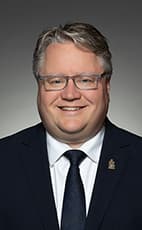
Richard Bragdon
In the 90 days to September 18, 2026, 4 organizations lobbied Richard Bragdon across 5 meetings — most often about Health. The most frequent visitor was Canadian Dental Association (2 meetings, via Kirk Preston). Its registration describes the goal as “EXCISE TAX ACT: GST AND DENTAL SERVICES: Changes to the application of the GST (zero-rate) on Dental practices”. That's fewer than the average MP, who had 6 meetings over the same period.
Based on federal lobbying registry data to September 18, 2026
In the House · Sep 21–25
Richard Bragdon this week
“I would like to begin by reflecting on an old story that I have referenced before but that certainly applies yet again here in the House. There was a father who had two sons, and he challenged them to go to work in his vineyard.”
- Spoke 6 times in the House · the average MP spoke 4 times
- FORC-266, second reading — Establish a national framework respecting skilled trades and labour mobility · passed 295–21
Get Richard Bragdon's week in your inbox every Monday
What they said, how they voted, and who lobbied them. Free, no ads, unsubscribe anytime.
How Richard Bragdon actually voted
Their recorded positions on the issues Canadians care about — pulled straight from the parliamentary record.
- Voted For
Labour & Employment
Establish a national framework respecting skilled trades and labour mobility
C-266 · Sep 2026 · Passed · Tell your MP what you think
- Voted Against
Economy & Taxation
Implement certain provisions of the spring economic update tabled in Parliament on April 28, 2026
C-30 · Jun 2026 · Passed · Tell your MP what you think
- Voted Against
Housing
Authorize certain payments to be made out of the Consolidated Revenue Fund for the purpose of improving housing supply
C-26 · Jun 2026 · Passed · Tell your MP what you think
- Voted Against
Criminal Justice
Hate propaganda, hate crime and access to religious or cultural places
C-9 · Jun 2026 · Passed · Tell your MP what you think
- Voted Against
Overall leanings
100%
voted with the Conservative line this Parliament
98%
vote attendance (170/174, missed 4)
Who’s in Richard’s ear
211
lobbying meetings
129
companies & groups
269
speeches in Parliament
Top lobbying relationship: Frontier Duty Free Association — met 7 times · most lobbied on Agriculture.
See who’s lobbying Richard →Who's lobbying Richard
Individual meeting records from the federal lobbying registry
| Date | Organization | |
|---|---|---|
| 2026-08-24 | Canadian Dental Association | |
| 2026-08-19 | Canadian Propane Association | |
| 2026-08-14 | Aerial Vehicle Safety Solutions, Inc. | |
| 2026-06-24 | WORLD VISION CANADA | |
| 2026-06-09 | Secure Future Research Ltd DBA ControlAI |
Write to Richard Bragdon
Pick what it's about. You'll get a letter you can edit, then send it from your own email.
Other ways to reach Richard
613-992-4211 is the House of Commons switchboard — ask to be connected to your MP's office. For constituency office contact details, or if richard.bragdon@parl.gc.ca bounces, visit their Parliament profile.
Committee Memberships
Top Lobbying Clients
Companies with the most meetings with this MP
What Richard talks about
- Criminal Code13 speeches · 2021–2024
- The Economy12 speeches · 2021–2026
- Carbon Pricing11 speeches · 2022–2024
- Canada-Newfoundland and Labrador Atlantic Accord Implementation Act8 speeches · 2023
- Budget 2025 Implementation Act, No. 16 speeches · 2025
Recent Speeches
Mr. Speaker, it is an absolute honour to rise in the people's House again and speak to this important piece of legislation that the government has brought forth. I would like to begin by reflecting on an old story that I have referenced before but that certainly applies yet again here in the House. … Read full speechShow less
Mr. Speaker, it is an absolute honour to rise in the people's House again and speak to this important piece of legislation that the government has brought forth. I would like to begin by reflecting on an old story that I have referenced before but that certainly applies yet again here in the House. There was a father who had two sons, and he challenged them to go to work in his vineyard. He said, “I need you to go out and work on the farm. I have some big tasks ahead.” He commissioned them to go into the field. The first son rose enthusiastically and made a grand proclamation and a great announcement: “That's a wonderful idea. I'm going to do that right away. You can count on me. I'm going to do that. You don't have to worry one bit.” He made the grand proclamation, but he did not end up in the field. Then there was the second son who was approached, and he said, “I can't go. I'm sorry to disappoint you. I can't go.” However, he got to thinking about it and feeling bad, and he said to himself, “I owe this to my dad. I'm going to go out and work in the field like he asked me to do.” Basically, the conclusion to that story is to ask which son was more pleasing to the father, who had asked them to go out into the vineyard. Well, obviously, it was the second son. Even though his initial response was disappointing and did not rise to the occasion as was expected, the results were outstanding because he went and did what needed to be done and got the job done, whereas the other son made a grand announcement and a tremendous proclamation, got the hopes up of everyone around, sounded like things were going to be wonderful, but the end result was that he did nothing and was a grand disappointment. I cannot help but see the correlation. Once again, we are having grand proclamations and excellent announcements: “Don't you worry. No matter what problem faces this country, you hang on. There will be another announcement within five minutes, and it will be okay.” People will look, and they will ask, “Where is the result?” The answer is, “Oh, don't you worry. We're going to come and make another announcement.” There is another announcement, and yet a few months go by, and Canadians wait for the results and do not see any. “But don't you worry. There's another proclamation on its way.” They come, and their hearts are filled with anticipation. Much like cotton candy, the announcement provides an instant sugar high and makes us feel good and warm and fuzzy, but then comes the crash of no results and limited outcomes. What Canadians are looking for is tangible results and real outcomes, and I could not help but think about that story as I was preparing my remarks today. Look, these are challenging times, and we all admit that. We want what is best for Canadians, and we want Canada to move forward because Canada is a nation of incredible potential and overwhelmingly abundant blessings that we have both under our feet on our lands and in our people. We need to unleash and unlock that potential so Canada can live up to that potential and our people can enjoy the benefits of all those bountiful blessings that we have been given. Therefore, I challenge the government today. With this grand announcement, I hope there is a firm commitment to deliver real results for real Canadians. They are tired of announcements and proclamations and grand theatre and great speeches on big stages. What they want to know is, will this deliver the potential for me to find real work, make a decent paycheque, be able to put groceries on my table, help us make the mortgage payment, keep the vehicle payments up, help our kids get through school and have them actually dream of maybe someday owning a home of their own? If we do not deliver that, we are not living up to our promise and to the expectation that has been made of us by Canadians. I have been reflecting on this and looking at some of the announcements that have been made, and it was not long ago that there was yet another grand announcement: “We are forming a special projects office.” That sounds great. I love it. Over 500 announcements have been made and placed under the jurisdiction of the special projects office. However, I have to ask the House, how many have been approved? It is zero. We have had 500 announcements, many designations and grand proclamations and yet again the disappointment of no real deliverables. The time for deliverables has come. The time for results has come. We have to get to a place where we are doing real things. The good news is that our party has put forward some real, tangible solutions for some of the challenges facing Canada's industry, workers and people. We are calling for projects to be expedited and to be approved within six months. We are calling for the repeal of job-killing laws and antidevelopment laws, like Bill C-69 and Bill C-48, that impede Canada's progress. We are also calling for a genuine one-project, one-review approach that would give proponents certainty instead of making them go through multiple layers of endless regulation and red tape. It is time to unlock our resources and unleash our potential, move beyond the announcement phase and get to the deliverables and results phase. We do that by streamlining. We do that by making sure that this gets done and does not turn into yet another grand announcement that gets our hopes up but does not deliver what Canadians need in this time of stress. We are fighting hard on this side of the House to save people and Canadians money, but also to have real projects and real jobs made available and done for Canadians. As we have seen, after a year and a half of announcements, we cannot point to concrete examples of things getting done. Nothing leads to more frustration than unmet expectations. When many expectations arise, when rhetoric soars in the moment and when we do not deliver on what we have promised to Canadians, they grow more suspect, more weary and more frustrated. Then they begin to look with a very jaundiced eye at anything that any parliamentarian or politician ever says. Why is that? It is because we have promised much and delivered little. We have to get to the place where we are delivering real, concrete results for Canadians, because this country has unbelievable, incredible potential. I want to conclude with one final analogy from an ancient story that came to me as I was preparing for today. It is a story of a lady who was in a desperate situation and did not know where to turn. She sought solutions from various places. She went to doctor after doctor and could find no help. In fact, she just got further diagnosed, with more diagnoses and more prognoses, and spent more of her hard-earned money, ending up with nothing left in her pocket while living with the consequences of false hopes and many broken promises. The good news is that this story did not end with her in a place of unmet expectation. The good news is that she pressed through the crowds and doubts, and she overcame the obstacles, as many Canadians are doing right now. She sought out a great physician and got her answer. Her answer came when she told her whole story. After she told her story and that great physician heard her story and gave her the answer, she went away whole. Canadians become whole when those who are elected to represent them take the time to hear their stories, and not just hear their stories, but take direct action to bring real solutions to their problems. It is time to get beyond the diagnoses in this country, get beyond the announcements, proclamations and false hopes, and deliver real results for real Canadians in real time.
Mr. Speaker, it is always good to have a debate with fellow Maritimers in the House. I will say this. Once again, the projects the member just listed are projects that have been announced but have not yet been delivered. We need real results to start kicking into place. Let us not blame Canadians fo… Read full speechShow less
Mr. Speaker, it is always good to have a debate with fellow Maritimers in the House. I will say this. Once again, the projects the member just listed are projects that have been announced but have not yet been delivered. We need real results to start kicking into place. Let us not blame Canadians for being somewhat skeptical when they hear more proclamations from the government. Let us remember that this is the same government that for 10 years called some of our most valuable resources dirty oil and dirty gas and said we should keep it in the ground. It also said that anyone who advocated for those resources and the development of those resources was a planet burner. I am glad the Liberals have experienced an absolute backflip and inverted suplex on themselves and are now embracing our policies, at least verbally. However, now we need proof of that change and transformation with real action, the real construction of pipelines, and real development.
Mr. Speaker, I thank my colleague from the beautiful province of Quebec. What we need now is a government that will actually do something. We need a government that gets real things done for Canadians. When we rank 38 out of 38 among OECD nations for GDP per capita, that is an indictment of the gove… Read full speechShow less
Mr. Speaker, I thank my colleague from the beautiful province of Quebec. What we need now is a government that will actually do something. We need a government that gets real things done for Canadians. When we rank 38 out of 38 among OECD nations for GDP per capita, that is an indictment of the government's policies, which have failed to deliver real results. Even though the pronouncements are grand, the results have been very much disastrous as it relates to competitiveness for our industries, for our workers and for affordability for Canadians from coast to coast. It is time to get results for them.
Mr. Speaker, I thank my hon. colleague from Swift Current—Grasslands—Kindersley. What a great representative he is for his people in standing up for hard-working Canadians, farmers and resource workers. One expression comes to mind. There's a song that has words that say that we need “a little less … Read full speechShow less
Mr. Speaker, I thank my hon. colleague from Swift Current—Grasslands—Kindersley. What a great representative he is for his people in standing up for hard-working Canadians, farmers and resource workers. One expression comes to mind. There's a song that has words that say that we need “a little less talk and a lot more action”. It is time for action now to get results for Canadians.
Mr. Speaker, I rise with a heavy heart. The announced idling of the AV Nackawic mill is putting hundreds of hard-working Canadians out of a job heading into Christmas. This is not the first time my hometown has experienced this. My father worked at the same mill for over 50 years and experienced a c… Read full speechShow less
Mr. Speaker, I rise with a heavy heart. The announced idling of the AV Nackawic mill is putting hundreds of hard-working Canadians out of a job heading into Christmas. This is not the first time my hometown has experienced this. My father worked at the same mill for over 50 years and experienced a closure in 2005. I am receiving calls from families wondering how they will make their house payments, keep their kids in sports or put food on the table. Will the government commit to working with me to do everything necessary to secure the livelihoods of my home community?
Bills Sponsored
Recent activity
24 activities across speeches, bills, and lobbying communications.
September 2026
Government Orders
Mr. Speaker, it is an absolute honour to rise in the people's House again and speak to this important piece of legislation that the government has brought forth. I would like to begin by reflecting on… Read full speechShow less
Mr. Speaker, it is an absolute honour to rise in the people's House again and speak to this important piece of legislation that the government has brought forth. I would like to begin by reflecting on an old story that I have referenced before but that certainly applies yet again here in the House. There was a father who had two sons, and he challenged them to go to work in his vineyard. He said, “I need you to go out and work on the farm. I have some big tasks ahead.” He commissioned them to go into the field. The first son rose enthusiastically and made a grand proclamation and a great announcement: “That's a wonderful idea. I'm going to do that right away. You can count on me. I'm going to do that. You don't have to worry one bit.” He made the grand proclamation, but he did not end up in the field. Then there was the second son who was approached, and he said, “I can't go. I'm sorry to disappoint you. I can't go.” However, he got to thinking about it and feeling bad, and he said to himself, “I owe this to my dad. I'm going to go out and work in the field like he asked me to do.” Basically, the conclusion to that story is to ask which son was more pleasing to the father, who had asked them to go out into the vineyard. Well, obviously, it was the second son. Even though his initial response was disappointing and did not rise to the occasion as was expected, the results were outstanding because he went and did what needed to be done and got the job done, whereas the other son made a grand announcement and a tremendous proclamation, got the hopes up of everyone around, sounded like things were going to be wonderful, but the end result was that he did nothing and was a grand disappointment. I cannot help but see the correlation. Once again, we are having grand proclamations and excellent announcements: “Don't you worry. No matter what problem faces this country, you hang on. There will be another announcement within five minutes, and it will be okay.” People will look, and they will ask, “Where is the result?” The answer is, “Oh, don't you worry. We're going to come and make another announcement.” There is another announcement, and yet a few months go by, and Canadians wait for the results and do not see any. “But don't you worry. There's another proclamation on its way.” They come, and their hearts are filled with anticipation. Much like cotton candy, the announcement provides an instant sugar high and makes us feel good and warm and fuzzy, but then comes the crash of no results and limited outcomes. What Canadians are looking for is tangible results and real outcomes, and I could not help but think about that story as I was preparing my remarks today. Look, these are challenging times, and we all admit that. We want what is best for Canadians, and we want Canada to move forward because Canada is a nation of incredible potential and overwhelmingly abundant blessings that we have both under our feet on our lands and in our people. We need to unleash and unlock that potential so Canada can live up to that potential and our people can enjoy the benefits of all those bountiful blessings that we have been given. Therefore, I challenge the government today. With this grand announcement, I hope there is a firm commitment to deliver real results for real Canadians. They are tired of announcements and proclamations and grand theatre and great speeches on big stages. What they want to know is, will this deliver the potential for me to find real work, make a decent paycheque, be able to put groceries on my table, help us make the mortgage payment, keep the vehicle payments up, help our kids get through school and have them actually dream of maybe someday owning a home of their own? If we do not deliver that, we are not living up to our promise and to the expectation that has been made of us by Canadians. I have been reflecting on this and looking at some of the announcements that have been made, and it was not long ago that there was yet another grand announcement: “We are forming a special projects office.” That sounds great. I love it. Over 500 announcements have been made and placed under the jurisdiction of the special projects office. However, I have to ask the House, how many have been approved? It is zero. We have had 500 announcements, many designations and grand proclamations and yet again the disappointment of no real deliverables. The time for deliverables has come. The time for results has come. We have to get to a place where we are doing real things. The good news is that our party has put forward some real, tangible solutions for some of the challenges facing Canada's industry, workers and people. We are calling for projects to be expedited and to be approved within six months. We are calling for the repeal of job-killing laws and antidevelopment laws, like Bill C-69 and Bill C-48, that impede Canada's progress. We are also calling for a genuine one-project, one-review approach that would give proponents certainty instead of making them go through multiple layers of endless regulation and red tape. It is time to unlock our resources and unleash our potential, move beyond the announcement phase and get to the deliverables and results phase. We do that by streamlining. We do that by making sure that this gets done and does not turn into yet another grand announcement that gets our hopes up but does not deliver what Canadians need in this time of stress. We are fighting hard on this side of the House to save people and Canadians money, but also to have real projects and real jobs made available and done for Canadians. As we have seen, after a year and a half of announcements, we cannot point to concrete examples of things getting done. Nothing leads to more frustration than unmet expectations. When many expectations arise, when rhetoric soars in the moment and when we do not deliver on what we have promised to Canadians, they grow more suspect, more weary and more frustrated. Then they begin to look with a very jaundiced eye at anything that any parliamentarian or politician ever says. Why is that? It is because we have promised much and delivered little. We have to get to the place where we are delivering real, concrete results for Canadians, because this country has unbelievable, incredible potential. I want to conclude with one final analogy from an ancient story that came to me as I was preparing for today. It is a story of a lady who was in a desperate situation and did not know where to turn. She sought solutions from various places. She went to doctor after doctor and could find no help. In fact, she just got further diagnosed, with more diagnoses and more prognoses, and spent more of her hard-earned money, ending up with nothing left in her pocket while living with the consequences of false hopes and many broken promises. The good news is that this story did not end with her in a place of unmet expectation. The good news is that she pressed through the crowds and doubts, and she overcame the obstacles, as many Canadians are doing right now. She sought out a great physician and got her answer. Her answer came when she told her whole story. After she told her story and that great physician heard her story and gave her the answer, she went away whole. Canadians become whole when those who are elected to represent them take the time to hear their stories, and not just hear their stories, but take direct action to bring real solutions to their problems. It is time to get beyond the diagnoses in this country, get beyond the announcements, proclamations and false hopes, and deliver real results for real Canadians in real time.
Government Orders
Mr. Speaker, it is always good to have a debate with fellow Maritimers in the House. I will say this. Once again, the projects the member just listed are projects that have been announced but have not… Read full speechShow less
Mr. Speaker, it is always good to have a debate with fellow Maritimers in the House. I will say this. Once again, the projects the member just listed are projects that have been announced but have not yet been delivered. We need real results to start kicking into place. Let us not blame Canadians for being somewhat skeptical when they hear more proclamations from the government. Let us remember that this is the same government that for 10 years called some of our most valuable resources dirty oil and dirty gas and said we should keep it in the ground. It also said that anyone who advocated for those resources and the development of those resources was a planet burner. I am glad the Liberals have experienced an absolute backflip and inverted suplex on themselves and are now embracing our policies, at least verbally. However, now we need proof of that change and transformation with real action, the real construction of pipelines, and real development.
Government Orders
Mr. Speaker, I thank my colleague from the beautiful province of Quebec. What we need now is a government that will actually do something. We need a government that gets real things done for Canadians… Read full speechShow less
Mr. Speaker, I thank my colleague from the beautiful province of Quebec. What we need now is a government that will actually do something. We need a government that gets real things done for Canadians. When we rank 38 out of 38 among OECD nations for GDP per capita, that is an indictment of the government's policies, which have failed to deliver real results. Even though the pronouncements are grand, the results have been very much disastrous as it relates to competitiveness for our industries, for our workers and for affordability for Canadians from coast to coast. It is time to get results for them.
Government Orders
Mr. Speaker, I thank my hon. colleague from Swift Current—Grasslands—Kindersley. What a great representative he is for his people in standing up for hard-working Canadians, farmers and resource worker… Read full speechShow less
Mr. Speaker, I thank my hon. colleague from Swift Current—Grasslands—Kindersley. What a great representative he is for his people in standing up for hard-working Canadians, farmers and resource workers. One expression comes to mind. There's a song that has words that say that we need “a little less talk and a lot more action”. It is time for action now to get results for Canadians.
Oral Questions
Mr. Speaker, I rise with a heavy heart. The announced idling of the AV Nackawic mill is putting hundreds of hard-working Canadians out of a job heading into Christmas. This is not the first time my ho… Read full speechShow less
Mr. Speaker, I rise with a heavy heart. The announced idling of the AV Nackawic mill is putting hundreds of hard-working Canadians out of a job heading into Christmas. This is not the first time my hometown has experienced this. My father worked at the same mill for over 50 years and experienced a closure in 2005. I am receiving calls from families wondering how they will make their house payments, keep their kids in sports or put food on the table. Will the government commit to working with me to do everything necessary to secure the livelihoods of my home community?
Oral Questions
Mr. Speaker, a young lady who contacted me was wondering how her family was going to make ends meet, let alone provide a Christmas for her children with her husband now facing unemployment. We know th… Read full speechShow less
Mr. Speaker, a young lady who contacted me was wondering how her family was going to make ends meet, let alone provide a Christmas for her children with her husband now facing unemployment. We know that forestry mills are facing huge competitive disadvantages here in Canada, namely because of tariffs, over-regulation and the industrial carbon tax, which costs the mill in Nackawic over $2 million a year. Will the government commit to removing the barriers for our businesses so that this young lady and many others like her can have some hope for a brighter future?
June 2026
Oral Questions
Mr. Speaker, where are the results? New Brunswick families are feeling the effects of this Liberal recession every day. Canada is the only G20 country in a recession. GDP has shrunk for three of the l… Read full speechShow less
Mr. Speaker, where are the results? New Brunswick families are feeling the effects of this Liberal recession every day. Canada is the only G20 country in a recession. GDP has shrunk for three of the last four quarters, and unemployment is the second highest in the G7. If things are going to well, why will the Prime Minister not stand up and defend his record?
Oral Questions
Mr. Speaker, according to that member on that side of the House, everyone should just be happy. That member is getting an announcement. Another member is getting an announcement. Another member is get… Read full speechShow less
Mr. Speaker, according to that member on that side of the House, everyone should just be happy. That member is getting an announcement. Another member is getting an announcement. Another member is getting a commission. Members are getting rhetoric. Guess what? There are still no results. Canadians want results. Show us the results.
Routine Proceedings
Mr. Speaker, I have the honour to present to the House, in both official languages, a report of the Canadian section of the Canada-United States Inter-Parliamentary Group. This report describes the gr… Read full speechShow less
Mr. Speaker, I have the honour to present to the House, in both official languages, a report of the Canadian section of the Canada-United States Inter-Parliamentary Group. This report describes the group's congressional visit to Washington, D.C., from March 17 to 19. I had the pleasure of co-leading this delegation of nine parliamentarians alongside Senator Michael MacDonald.
Statements by Members
Mr. Speaker, today, the Prime Minister arrives at the G7 as the only leader who has driven his country into a recession. While families struggle through this full-blown recession, the Liberals continu… Read full speechShow less
Mr. Speaker, today, the Prime Minister arrives at the G7 as the only leader who has driven his country into a recession. While families struggle through this full-blown recession, the Liberals continue to offer announcements instead of results. On Thursday, the Liberals brought yet another food affordability strategy, but grocery bills remain sky-high. Canadians are making impossible choices just to survive. In New Brunswick, one man was forced to postpone open-heart surgery because he simply could not afford to stop working and recover. Meanwhile in Moncton, there were over 300 opioid overdoses in just two weeks. Things are getting desperate. While families struggle to buy groceries, the Prime Minister is leaving on a jet plane and is not sure when he will be back again. He has spent nearly $1 million on luxury inflight catering over 14 trips so far. When two in five Canadians are struggling to put food on the table, they are right to ask why the Liberals are funding luxury while their families are struggling to just get by.
Routine Proceedings
Mr. Speaker, I have the honour to present to the House, in both official languages, four reports of the Canadian section of the Canada-United States Inter-Parliamentary Group. I had the privilege of l… Read full speechShow less
Mr. Speaker, I have the honour to present to the House, in both official languages, four reports of the Canadian section of the Canada-United States Inter-Parliamentary Group. I had the privilege of leading several of these missions alongside the Hon. Senator MacDonald as co-chairs of the Canadian section of the interparliamentary group. The first concerns the IPG's participation at the west annual meeting of the Council of State Governments, known as CSG, in Jackson, Wyoming, from September 16 to 19, 2025. The second concerns the IPG's participation at the CSG national conference in Chicago, Illinois, from December 9 to 13, 2025. The third concerns the interparliamentary group's first-ever mission to Mexico City, from January 13 to 15, to participate in CUSMA-focused discussions and round tables. The fourth overviews the IPG's contributions to the Future Borders Coalition transportation border summit in Washington, D.C., on January 21 and 22, as well as our discussions with U.S. counterparts from the interparliamentary group.
Routine Proceedings
Mr. Speaker, it gives me great honour to rise today. Mr. Speaker, I have the honour to present to the House, in both official languages, eight reports of the Canadian section of the Canada-United Stat… Read full speechShow less
Mr. Speaker, it gives me great honour to rise today. Mr. Speaker, I have the honour to present to the House, in both official languages, eight reports of the Canadian section of the Canada-United States Inter-Parliamentary Group. The first concerns the interparliamentary group's participation at the national conference of the Council of State Governments, which is known as CSG, in New Orleans, Louisiana, from December 4 to 7, 2024. The second concerns the IPG's participation at the Canadian embassy's inauguration event for the 47th President of the United States of America in Washington, D.C., on January 19 and 20, 2025. The third concerns IPG's annual congressional visit to Washington, D.C., on March 4 and 5, 2025. The fourth concerns IPG's participation at the CSG's South Southern Legislative Annual Conference in Birmingham, Alabama, from July 19 to 23, 2025. The fifth concerns IPG's contributions to the Pacific Northwest Economic Region's 34th annual summit in Bellevue, Washington, from July 20 to 24, 2025. The sixth concerns IPG's participation at the CSG Midwest Legislative Regional Conference in Saskatoon, Saskatchewan, from July 27 to 30, 2025. The seventh concerns IPG's contributions to the legislative summit of the National Conference of State Legislatures in Boston, Massachusetts, from August 4 to 6, 2025. The eighth and final report concerns the IPG's participation at the CSG Eastern Regional Conference in Providence, Rhode Island, from August 17 to 20, 2025.
Routine Proceedings
Mr. Speaker, I rise today to present a certified electronic petition signed by over 1,080 Canadians. The petitioners are calling on the government, specifically the Minister of Fisheries, to halt the … Read full speechShow less
Mr. Speaker, I rise today to present a certified electronic petition signed by over 1,080 Canadians. The petitioners are calling on the government, specifically the Minister of Fisheries, to halt the proposed closure of the Mactaquac Biodiversity Facility. The petitioners note that this facility plays a critical role in preserving endangered wild Atlantic salmon populations and supporting local ecosystems. Therefore, they request that the Minister of Fisheries keep the Mactaquac Biodiversity Facility's programs operational and consult with the Wolastoqey Nation in New Brunswick, several of whose chiefs are here in the nation's capital this week, regarding the future of the biodiversity facility. Petitioners want the government to reaffirm Canada's commitment to Atlantic salmon conservation and ensure that all salmon at the facility are released.
May 2026
Routine Proceedings
Mr. Speaker, I have the honour to present to the House, in both official languages, five reports of the Canadian section of the Canada-United States Inter-Parliamentary Group, also called the Group. T… Read full speechShow less
Mr. Speaker, I have the honour to present to the House, in both official languages, five reports of the Canadian section of the Canada-United States Inter-Parliamentary Group, also called the Group. The first concerns the interparliamentary group's participation at the 78th annual meeting of the Council of State Governments Southern Legislative Conference in Greenville, West Virginia, from July 21 to 25, 2024. The second concerns the IPG's participation at the Pacific Northwest Economic Region's 33rd annual summit in Whistler, British Columbia, from July 21 to 25, 2024. The third concerns the IPG's participation at the 63rd annual meeting of the CSG Eastern Regional Conference in Baltimore, Maryland, from July 28 to 31, 2024. The fourth concerns the IPG's contributions to the National Conference of State Legislatures annual meeting in Louisville, Kentucky, from August 5 to 7, 2024. The fifth and final report concerns the IPG's participation in the Democratic National Convention in Chicago, Illinois, from August 19 to 22, 2024.
Routine Proceedings
Mr. Speaker, it is an honour to rise in the people's House to present this petition on behalf of the great citizens of Nova Scotia and Canadians from coast to coast who are calling upon the Government… Read full speechShow less
Mr. Speaker, it is an honour to rise in the people's House to present this petition on behalf of the great citizens of Nova Scotia and Canadians from coast to coast who are calling upon the Government of Canada to pause its planned closure of the important agricultural research facility in Nappan, Nova Scotia. The research facility does incredible work for our beef producers, livestock producers and 4-H producers across the country, especially in the Atlantic region. With this petition, they are hereby calling upon the government to pause its planned closure and to listen and engage meaningfully with the agriculture producers and residents of those rural communities.
Private Members' Business
Mr. Speaker, it is an honour to rise in the people's House, and it is a joy to rise on this occasion to offer our support for this private member's bill. The member for Compton—Stanstead has worked ha… Read full speechShow less
Mr. Speaker, it is an honour to rise in the people's House, and it is a joy to rise on this occasion to offer our support for this private member's bill. The member for Compton—Stanstead has worked hard on this issue. I hear her refer often to people in rural communities and in the rural areas of her riding and district. I congratulate her on her efforts in addressing this area of grave concern. Across the country, in rural and remote areas, connectivity is a huge, ongoing challenge. I represent a district that is well acquainted with this challenge. There will be times when I am in the middle of a great conversation, enthralled and just getting to the highlight, and then all of a sudden I am talking to myself. “That didn't work so well”, I think. Whether it is in Arthurette, in Craig Flats, in Brockway or heading toward Forest City, there are lots of dead zones. For many of the citizens and residents of my region, that is a huge concern for public safety and for health care. If they are in a rural area and do not have really good reception, they are not sure they can get the help they need when they need it. We want to address this and take any steps we can. The bill is one of the steps we can take to address this issue by helping to hold the providers accountable and by bringing transparency. We commend and support those efforts. We are looking forward to supporting the bill through to committee and then continuing to press the government to do all it can to address the ongoing need for increased coverage and broadband access across the rural and remote areas and regions of our country. Many times, rural Canada feels forgotten, left aside and not thought about or considered in policy deliberations that take place in the House. I understand that a disproportionate amount of the population is concentrated in urban centres, but so much of what makes Canada a truly incredible country is housed in rural Canada and in remote Canada. Whether that is our vast natural resources of our incredible oil and gas sector, our energy sector and our mining sector, or our agriculture sector, many of the centres and hubs of tremendous resources and financial capacity are housed in rural and remote communities. Part of making sure that those areas remain vital, vibrant and prosperous is ensuring that people can inhabit those places, still function at a high level and participate in society in a meaningful way. Part of that is connectivity so people can continue to work, do business and be able to reside in these places. Whether they are working in a lumberyard, whether they are on a tractor on a farm and are in need of GPS, or whether they are in the resource sector, working, providing livelihood and gaining substance from that, having the ability to connect is critical. The bill is one step toward making sure we are holding providers to account and bringing transparency, and we are going to ensure that they are meeting the objectives and the targets that need to be there. It is an important step, but obviously we need continued focus on broadening and opening up competition, on allowing and encouraging more providers to get into the space so access can become more affordable for Canadians and so Canadians who live in rural and remote areas can have options for connectivity. We will continue to press, from this side of the House, for the bill to remain a priority and for it to get the support it needs. We will also press for an enhanced discussion. Beyond discussion, enhanced action needs to take place to bring connectivity to those Canadians who have oftentimes been overlooked and forgotten. As I was preparing my speech, I could not help but reflect a bit. I was reflecting on an ancient story that came back to me as I was reflecting on the importance of connection and connectivity. I got to thinking about people and what they go through when they feel disconnected. Oftentimes, it goes far beyond just cell and broadband access. There is a deeper lesson in this, which is that, when anyone feels disconnected, it comes with all kinds of other societal challenges. Social isolation is a big problem. It is very real. Social anxiety is a big problem. When people feel disconnected from family, that leads to many issues. When they feel disconnected from help, that leads to issues. If they feel disconnected from resources and services, that leads to multiple issues. I was reflecting on an old story, and I believe there is a correlation. It goes like this. There was once a man who was travelling from one community to another. The way it is written, it is said that he fell among thieves. He was robbed, beaten, left on the side of the road and abandoned. After they had stripped him and taken his goods, they left him there half dead. This man was lying in a ditch with no help. He was feeling isolated, cut off from help, cut off from resources and cut off from his family. He was left to die. The man heard the sound of footprints coming down the road and was probably feeling happy that help was on the way. I am sure his hopes were rising, even though his strength was faint and he did not have the capacity to help himself fully. He thought that this was his answer because he heard help coming down the road. As this gentleman came up to him, his hopes, which had been rising so quickly, were quickly dashed. Why? It is because this gentleman, who was a priest, a religious man, looked at the man in the ditch and decided he did not have the time to deal with him. It was too messy and too complicated. He had to get to an important meeting, so he crossed over on the other side and kept on walking. Then came another man. The man in the ditch thought about how the last one did not work out well, how he left him more hurt, isolated and disappointed, but that maybe this one was his answer. Along came a very educated man. He was prestigious, a lawyer, a scribe. He was well regarded in the community. He was distinguished and had all kinds of resources. The man in the ditch thought to himself that this guy could help him, he could get him connected to what he needed to get better. Surely this was his answer. We can see that the hope was rising up inside the man who was lying by the wayside, in the ditch. He was thinking that surely this was the guy who could get him connected. Though it promised much and the man had the ability to do so, he looked at the man in the ditch and figured that he was too far gone and he had no time for that. He had more important things to deal with. He was busy, so he crossed over to the other side and kept on walking. The man in the ditch grew worse and more despairing. Then there was a third gentleman who came along that road. Members will recall the story. He did not come from much pedigree. He was not known as a person in a position of great authority. He was a stranger and a commoner, but something happened inside that man when he saw the man in the ditch, who was disconnected, cut off from resources and the sources of help he needed and was desperate for. This kind stranger was so moved, he got off his donkey, climbed down into the ditch, bandaged up his wounds and spent some time with him. Thankfully, he did not just give him a band-aid or put a bandage on him and move on. He did something very important, which relates to this bill, believe it or not. He took the man and connected him. He decided to take him to the local area hospital and make sure that he got the help he needed. He made sure that he was connected, had found a new circle and had the resources he needed to be hooked back up on the way to recovery and wholeness. Of course, that is the ever-famous story of the good Samaritan. There is good news in this bill. I see a correlation. If we can help people get connected to the help they need, if they are isolated and cut off, hurt by life circumstances, maybe because of where they live or because they do not have access to all the latest technology, we can somehow build a bridge of connectivity to them and help them gain access to the help, public safety, health care and resources they need to better their situation. I thank the hon. colleague across the way for her efforts on this bill.
April 2026
Routine Proceedings
Mr. Speaker, I rise on behalf of Canadians and residents of Canada to present a petition in the House of Commons calling upon the federal government and the House of Commons to recognize the efforts o… Read full speechShow less
Mr. Speaker, I rise on behalf of Canadians and residents of Canada to present a petition in the House of Commons calling upon the federal government and the House of Commons to recognize the efforts of the free people of Iran to establish an open, free democracy and to stand with the good people of Iran who have been longing, for 47 years, for freedom from the oppressive regime they have been under. It gives me great honour to present this petition today on their behalf.
Routine Proceedings
Mr. Speaker, I have the honour to present to the House, in both official languages, three reports of the Canadian section of the Canada-United States Inter-Parliamentary Group, or CEUS. The first repo… Read full speechShow less
Mr. Speaker, I have the honour to present to the House, in both official languages, three reports of the Canadian section of the Canada-United States Inter-Parliamentary Group, or CEUS. The first report concerns the Canada-United States Inter-Parliamentary Group's participation at the 77th Annual Meeting of the Council of State Governments, CSG, Western Legislative Conference in Portland, Oregon, from July 9 to 12, 2024. The second concerns the IPG's participation at the Republican National Convention in Milwaukee, Wisconsin, from July 15 to 18, 2024. The third concerns the IPG's participation at the 78th Annual Meeting of the CSG Midwestern Legislative Conference in Columbus, Ohio, from July 21 to 24, 2024.
Government Orders
Mr. Speaker, it is an honour to rise in the people's House today to address Bill C-10, in regard to appointing a commissioner for modern treaty implementation. As I begin my remarks, I cannot help but… Read full speechShow less
Mr. Speaker, it is an honour to rise in the people's House today to address Bill C-10, in regard to appointing a commissioner for modern treaty implementation. As I begin my remarks, I cannot help but think that we are yet again dealing with another announcement and a “no results in sight” type of proclamation. We continuously hear the members on the other side making grand announcements and pronouncements but with really no sincere or legitimate prospects of delivery. What we are hearing in the bill is, once again, a government that is high in the art of optics but really, really grades low as it relates to actual deliverables and measurable results. I could not help but think of an old story I was told several years ago, before I was elected, by a gentleman who is quite astute, who follows politics in New Brunswick and nationally and has for some time. He told me this story a few years ago, and it came back to me as I was preparing my remarks. He said there is always a tell in politics. He said we can tell when we are being set up for something. I asked him what it was. I said, “Please, do tell.” He said that oftentimes we know we are being set up when in politics, a politician or parliamentarian or legislator sits us down and hears our story. They nod their head. They show an empathetic look and even a listening ear. They nod graciously, and they will agree occasionally. They will sigh when it is appropriate to sigh, and they will shake their head when it is appropriate to shake their head. They will look greatly concerned. However, he said, we can tell for sure that probably not a whole lot is going to get done that matters or is consequential when they say they are seized with this matter, that they are laser focused on this matter and are absolutely consumed with this matter. They will say it is a high priority for them to make sure that this matter is dealt with. In fact, they are so concerned with this matter that they are going to put it under active study. They are going to establish a committee and a commission to further examine the problem that we have brought to them here today. He said, “Young man, I want to assure you, as soon as a politician or parliamentarian or legislator begins to talk like that, I can guarantee you that your issue is not their priority.” I walked away from that meeting realizing I had probably heard a sound lesson in politics. How often have we heard in the House that the Liberals are laser focused on this matter, that they are seized with this issue, that this is of the utmost priority for the government, that they will put that under active study, enact another commission and appoint a commissioner to look at it? That commissioner has no real authority and does not really have any responsibility, but they want us to know they are seized with the issue, so we should take great comfort in that. Thus, I draw the conclusion that, likely, we had better take this particular pronouncement with a whole lot of salt. I will go on further to say to Canadians that I know our aspirations may be good in this and our intentions may be well, but I hear, as it were, the old song that says what we are looking for is a little less talk and a whole lot more action. I find myself kind of thinking that what we are looking for is a little R-E-S-P-E-C-T. It is time that we had a little more respect and a little more action that is concrete, tangible and measurable, and that has results and metrics by which we can determine whether they have actually implemented the grandiose response to the urgent need before the House. I will say that after all of this, I have come to the conclusion that the bill would be, once again, great in optics but probably not overwhelmingly successful in outcomes. I think what we want is to get to the place where outcomes are going to be the priority of any of these types of implementations. It is one thing that we have treaties, and that is important, and they need to be respected and acted upon. Modern treaties can be done. We know this can happen because under the previous Conservative government, no fewer than six treaties were implemented in five years, and believe it not, they did not have a commissioner. The Crown, the government and the minister took on their area of responsibility and implemented the treaty. Oh my land, it is an amazing concept. When that concept is embraced by our dear friends on the other side of the aisle, I know Canadians will be thrilled and satisfied with real results rather than yet another announcement of a grand commissioner and a grand commission to further examine, illustrate, study and review. Let us come up with someone who is going to take action, and that can be the government or the minister, acting upon the treaties that are agreed to, to get real projects done that will enhance the lives of all Canadians, our indigenous friends as well as all Canadians from coast to coast to coast. I get excited about the potential of these things getting enacted. However, like a lot of Canadians, I view this with a little skepticism when it comes to yet another proclamation of another layer of bureaucracy. We do not need another office established. We do not need another commission established. We do not need yet another person hired or more consultants hired or another grand project announced. What we need is action on what has already been laid out and put forward by many of our indigenous friends across the country, as well as those who have great insights: provincial governments, municipal governments and the private sector with projects they would like to undertake, in agreement and in accordance with our indigenous friends. Why not start to implement those good ideas rather than establishing another layer of government? Let us get beyond that and start enacting these things. I think when we do, then Canadians will be encouraged. I am going to conclude quickly. I could not help but think of a famous story, an ancient story. It goes back some time. As I was reflecting on my remarks today, I could not help but think of it. It is a story of a father who had two sons. He approached the first son, and he said, “Son, I need you to go and take care of this.” The first son, he was really matter-of-fact: “No, I can't do that. Sorry, I can't do it.” He ended up saying no, but the more he thought about it later, he felt bad. He repented of that and said, “I am going to go and do what's right,” and he ended up doing it. The second son, when he was approached by the father, enthusiastically said, “Oh yes, we're going to do this. I'll do it, Father. Don't you worry.” However, he decided not to do it. He said great things but did bad things. The other son did not have the right initial response, but he took the right action. Guess which son pleased the father. Obviously it was the first son. Even though his initial response was not good, he did the right thing in the end. I believe our indigenous friends and our Canadian friends from coast to coast to coast are looking to us in this House. I know we have not always gotten it right, and I know it has not always been done right in the past, but let us do what is right now, turn from the things that are wrong, take the right steps, do a lot less talking and a lot more walking, and get things done that are right for Canada without another grand commission.
Government Orders
Mr. Speaker, I have a lot of respect for my colleague on the other side of the aisle as well and enjoy our conversations. I must say the position we are taking is with respect to removing yet another … Read full speechShow less
Mr. Speaker, I have a lot of respect for my colleague on the other side of the aisle as well and enjoy our conversations. I must say the position we are taking is with respect to removing yet another barrier to direct communications between those who want to put the actions into place and get the projects done. Why not have those direct consultations, those direct conversations with the ministers, the Crown and the indigenous peoples and then get the projects done? I think that removes a layer of bureaucracy that is not necessary at this time.
March 2026
House of Commons
184 communications with 112 clients
Top clients: [{"name": "Frontier Duty Free Association", "count": 7}, {"name": "Canadian Aqua…
October 2025
House of Commons
5 communications with 4 clients
Top clients: [{"name": "Canadian Egg Marketing Agency COB Egg Farmers of Canada", "count": 2}…