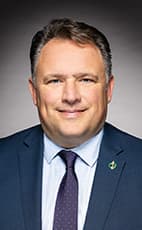
Rob Moore
In the 90 days to September 18, 2026, 1 organization lobbied Rob Moore across 1 meeting — most often about Energy. The most frequent visitor was Canadian Propane Association (1 meeting, via their in-house lobbyist Shannon Watt). Its registration describes the goal as “Discussions with government officials regarding the national electricity strategy and the role of propane, renewable propane and rDME in…”. That's fewer than the average MP, who had 6 meetings over the same period.
Based on federal lobbying registry data to September 18, 2026
In the House · Sep 21–25
Rob Moore this week
- No speeches in the House · the average MP spoke 4 times
- FORC-266, second reading — Establish a national framework respecting skilled trades and labour mobility · passed 295–21
Get Rob Moore's week in your inbox every Monday
What they said, how they voted, and who lobbied them. Free, no ads, unsubscribe anytime.
How Rob Moore actually voted
Their recorded positions on the issues Canadians care about — pulled straight from the parliamentary record.
- Voted For
Labour & Employment
Establish a national framework respecting skilled trades and labour mobility
C-266 · Sep 2026 · Passed · Tell your MP what you think
- Voted Against
Economy & Taxation
Implement certain provisions of the spring economic update tabled in Parliament on April 28, 2026
C-30 · Jun 2026 · Passed · Tell your MP what you think
- Voted Against
Housing
Authorize certain payments to be made out of the Consolidated Revenue Fund for the purpose of improving housing supply
C-26 · Jun 2026 · Passed · Tell your MP what you think
- Voted Against
Criminal Justice
Hate propaganda, hate crime and access to religious or cultural places
C-9 · Jun 2026 · Passed · Tell your MP what you think
- Voted Against
Overall leanings
100%
voted with the Conservative line this Parliament
100%
vote attendance (174/174)
Who’s in Rob’s ear
242
lobbying meetings
149
companies & groups
261
speeches in Parliament
Top lobbying relationship: Canadian Federation of Independent Business (CFIB) — met 7 times · most lobbied on Health.
See who’s lobbying Rob →Who's lobbying Rob
Individual meeting records from the federal lobbying registry
| Date | Organization | |
|---|---|---|
| 2026-08-19 | Canadian Propane Association | |
| 2026-03-31 | Canadian Mental Health Association of New Brunswick | |
| 2025-11-18 | Alliance of Manufacturers & Exporters Canada (CME) | |
| 2025-10-16 | Canadian Propane Association | |
| 2025-09-24 | Canada's National Firearms Association |
Write to Rob Moore
Pick what it's about. You'll get a letter you can edit, then send it from your own email.
Other ways to reach Rob
613-992-4211 is the House of Commons switchboard — ask to be connected to your MP's office. For constituency office contact details, or if rob.moore@parl.gc.ca bounces, visit their Parliament profile.
Top Lobbying Clients
Companies with the most meetings with this MP
What Rob talks about
- Criminal Code59 speeches · 2021–2024
- Justice38 speeches · 2021–2025
- Public Safety11 speeches · 2021–2025
- Judges Act10 speeches · 2022
- Protecting Victims Act7 speeches · 2026
Recent Speeches
Mr. Speaker, when I was last speaking, I was talking about the irrefutable fact that, since 2015, when the Liberal government took power, we have seen skyrocketing rates of crime. That is due to some deliberate actions that the government took. I am thinking, specifically, of Bill C-5, which did awa… Read full speechShow less
Mr. Speaker, when I was last speaking, I was talking about the irrefutable fact that, since 2015, when the Liberal government took power, we have seen skyrocketing rates of crime. That is due to some deliberate actions that the government took. I am thinking, specifically, of Bill C-5, which did away with mandatory penalties for serious drug and gun crime and allowed for house arrest for serious offences like arson. It allowed someone to commit a violent crime, even burn down someone's house, and serve their sentence from the comfort of their own home and in the community where they offended. Bill C-75 was the notorious law that was brought in, which introduced a principle of restraint that has really tied the hands of our system and forced people out on bail who have no business being out on bail. We have seen the results. What are the results? Since 2015, human trafficking has increased by 84%. Sexual assaults are up by 76%. Violent crime is up by almost 55%. My home province of New Brunswick is not immune to this skyrocketing crime. When I speak to my constituents, there are concerns about violent crime, property crime and all manner of crime that people have seen skyrocket, such as drug-related crime. The numbers are staggering. The total number of violent crimes in New Brunswick alone is up over 70%. As for total violent firearms offences, this is a government that talks a talk on firearms. The problem is that every measure the Liberals take has been completely ineffective because they target law-abiding citizens, the people who I represent in my riding of Fundy Royal, while completely going soft on hardened criminals. What is the result? Violent firearms offences are up over 150%. Extortion is up over 300%. Theft of motor vehicle offences are up over 150% since that time. What they have done with the bill is unfortunate. There is something called a mandatory minimum penalty. It is a penalty in the Criminal Code that says that we, as parliamentarians, recognize that, sometimes, an offence is so grave that it should carry with it a certain minimum amount of time in custody. There have been mandatory minimum penalties brought in by previous Liberal governments. There have been mandatory minimum penalties brought in by Conservative governments, and which have been constitutionally upheld, but because the Liberal government is so ideologically opposed to Parliament having its say, listening to our constituents and saying that certain crimes deserve to have a mandatory penalty if someone has committed the offence, the Liberals have introduced in the legislation a clause that would allow judges to ignore the mandatory penalty for someone convicted of these serious crimes. One could look up the definition of “mandatory” in Webster's, but I am pretty sure that allowing someone to ignore a mandatory penalty means it is no longer a mandatory penalty, What is the result of that? Certain mandatory penalties for offences, many of them considered by the courts and constitutionally upheld, will now be able to be ignored, offences like aggravated sexual assault with a gun, human trafficking, multiple violent firearms offences, extortion with a firearm, weapons trafficking and drive-by shootings with restricted or prohibited firearms. In the Criminal Code, there is a mandatory penalty for someone convicted of those offences. The bill would allow judges to ignore that mandatory penalty when they are sentencing. I can tell members, having served on the justice committee, that we heard many times about how there has not been a huge increase in the number of criminals in Canada. There has been a very prolific number of criminals who do a great job at what they do. They are committing crimes non-stop because they have a system in which, once they are caught, once the police have done their job and have caught someone, once they have been tried and convicted, they are out on bail, if they are pretrial, and, once convicted, they may be serving their sentence in house arrest. I will sum up by quoting an individual who appeared at our justice committee. She urged members to restore justice to the justice system. As a victim of crime, she said she does not feel we have a justice system anymore in Canada. She feels we have a legal system, not a justice system. I urge everyone to listen to those words and do our job. It is, rightly, the job of parliamentarians to say we are the ones who draft the Criminal Code, set out mandatory penalties and maximum and minimum sentences, and distinguish between different offences. There is a tremendous amount of flexibility in the system when the police have discretion and prosecutors have the discretion on whether to proceed by summary conviction or indictment. At the end of the day, we, as parliamentarians, are responsible for the safety of our constituents. We must ensure that our actions illustrate this and that we take strong measures. I would like at this time to move: That the debate be now adjourned.
Mr. Speaker, it is great to be here this evening with colleagues debating this important issue. That is what we do in the House. We debate, we discuss important issues for Canadians and we have some great discussions. One thing, though, that is really not debatable, if we believe at all in evidence,… Read full speechShow less
Mr. Speaker, it is great to be here this evening with colleagues debating this important issue. That is what we do in the House. We debate, we discuss important issues for Canadians and we have some great discussions. One thing, though, that is really not debatable, if we believe at all in evidence, is that the Liberals have had a failed justice policy, and the last decade has been one where Canadians have demonstrably suffered when it comes to justice. As a former member of the justice committee, I will never forget when a witness, who was a victim of crime herself, appeared and said that in Canada now we have a legal system, but we do not have a justice system. I was very impacted by those words and determined, like many of my colleagues on this side, to listen to those voices and make a better, truly just system that Canadians could be proud of and that would make them feel safe. I know if I asked my constituents, and I do, and if many here asked their constituents if they felt safer than they did 10 years ago, they would say that things have changed. Do they feel safe to send their kids to the mall or to walk to school? Do they feel safe when they leave their home? Do they feel safe to leave their vehicle? In the community I live in, my whole life, we did not lock our car doors. Many people did not lock their houses; they just left them unlocked. That was the kind of neighbourhood and community it was. That has now changed, and it has changed because of a failed Liberal justice system. I heard some of the commentary this evening about mandatory minimum penalties, etc. However, where there is no debate and no doubt is that the Liberals do not know what they are doing when it comes to Canada's justice system. Some of the statistics are absolutely staggering. Since 2015, which is when the Liberals formed government, human trafficking in Canada has increased 84%, sexual assaults are up 76% and violent crime is up 55%. In just the first nine years after forming government, total homicides are up 28% and violent firearms offences are up 117%. This is nine consecutive years of increases. Extortion is up almost 400%, auto theft is up 50% and sexual violations against children are up over 100%. Forcible confinement or kidnapping, indecent harassing and communications and trafficking in persons are up almost 100%. When we speak of these things, they are not just statistics. Each one of those represents a victim, a victim's family and a community that feels less safe than it did before. The cumulative effect of terrible pieces of legislation is the statistics and the heartbreak that has flowed from them over this last decade. What are some of these terrible pieces of legislation? Did this happen by accident? Was it things, as the Liberal government members like to say, outside of their control? No, these were things that were very much within the control of the government, and it took active steps that made the situation demonstrably worse. What am I talking about? There is Bill C‑75, which fundamentally changed our bail system and introduced a so-called principle of restraint that meant judges were forced to use the least onerous provisions possible when it came to decisions around bail. It led to absolutely outrageous and ludicrous situations like the one we heard about at the justice committee. The Toronto Police Service testified that individuals who had already received bail for a previous gun crime were being let out on bail again for gun crimes. They had committed a firearms offence, received bail, were then arrested again for a serious firearms offence, received bail again and had then been arrested a third time. They were out on bail both previous times. That was not an uncommon situation. Bill C‑75 changed the rules around bail, police forces and victims groups throughout our country. Provincial attorneys general have all commented and beseeched us to address the soft-on-crime bail that the government has introduced. The other bill that comes to mind is Bill C-5. We have heard some discussion this evening about mandatory jail times. Conservatives believe that for serious offences, there should be mandatory jail time. Some of these Liberal members who are speaking positively about tougher sentencing were, just a few years ago, defending Bill C-5, which eliminated mandatory jail time for importing, exporting and producing serious drugs, schedule I drugs. It eliminated mandatory jail time for offences like arson, drive-by shootings and serious firearms offences. It not only eliminated the mandatory penalties but allowed for house arrest. Someone could burn down a person's house but serve their sentence from the comfort of their own home, playing video games, etc., as one can imagine. Individuals could commit serious violent offences, and people would be forced to see the perpetrators still in the community, even after having been sentenced, because they were sentenced to house arrest for the type of offence where someone should not get house arrest. That brings us here to this particular piece of legislation, Bill C-16. Bill C-16 has another “get out of jail free” card. The Liberals cannot help themselves. There are many mandatory minimum penalties, mandatory sentences for crimes that Parliament deems to be serious. Even though there are many of them in the Criminal Code that have been upheld constitutionally, many of them that are sound, that are in our code and that are effective, the bill would create a release valve whereby a judge can decide not to apply the mandatory penalty, even for offences where the mandatory penalty has been upheld. Some of the offences for which Bill C-16 would allow judges to ignore the mandatory prison time that this Parliament and previous Parliaments have seen fit to introduce include aggravated sexual assault with a gun, human trafficking, multiple violent firearms offences, extortion with a firearm, weapons trafficking and drive-by shootings with restricted or prohibited firearms. Canadians have had enough. They have had enough of violent crime and extortion. They have had enough with the assaults, sexual assaults and property crime. This bill would undermine our justice system by allowing judges to ignore the mandatory penalties that Parliament saw fit to put in place. Parliament put those penalties in place to protect the Canadians who are so deserving of that protection. It speaks to that witness who appeared at our justice committee and said we need to have not just a legal system but a justice system. That witness implored us to take steps to ensure that we have a justice system. Well, I can assure my colleagues that allowing for the elimination of all mandatory minimum penalties, as this legislation would, is not what this individual had in mind. I want to recognize a couple of my colleagues, our justice shadow minister, the member for Brantford—Brant South—Six Nations; our public safety shadow minister, the member for Kamloops—Thompson—Nicola; and indeed our entire team on this side. For the last decade, in areas around auto theft, drugs, extortion, violent crime and crimes against children, every area where we could protect individuals in our communities, Conservative members of Parliament have been standing up and putting forward private members' bills. One that I put forward would restore the mandatory penalties for trafficking in fentanyl and cocaine and for those who are running meth labs. These are the mandatory penalties the Liberal government, in its wisdom, decided to remove. If we were to ask whether the drug crime and drug abuse situation in Canada is better today, under the Liberal policies, than it was 10 years ago, there is not a person in this room, in this chamber, who would say things have gotten better. Unless they are willing to deny the evidence that comes to us from Stats Canada, there is not a person in this chamber who would say that the situation when it comes to violent crime, property crime, crimes against women and crimes against children is getting better. When we look at solutions, we need to look at solutions that are going to be effective, not half measures. What this piece of legislation would do, and this is a provision I certainly cannot support, is allow judges to ignore mandatory minimum penalties that have been constitutionally upheld, that exist in the Criminal Code and that were put in there for a reason, because they recognize the seriousness of the offences that are covered. I often hear in this place that the number one thing, the most important thing we can do, is to protect our fellow Canadians. I take that challenge very seriously. For a number of people I know in this chamber, colleagues I have talked to, improving our criminal justice system is one of the principal drivers of why they got involved in politics and why they were eventually elected as members of Parliament. We need to ensure that we are doing our very best. Some mandatory minimums have been struck down, but to allow judges to ignore those that have been upheld in the past would be a major fault. We must stand up for the victims of crime.
Madam Speaker, I rise on a point of order. I would like to give notice, under Standing Order 43(2)(a), that all remaining Conservative caucus speaking slots are hereby divided in two.
Mr. Speaker, it is an honour to speak today on our opposition day motion. I do want to say at the outset that I will be splitting my time with the member for Kitchener Centre. Why are we speaking on this today? I listened with interest to the government members' speeches, which touched very little o… Read full speechShow less
Mr. Speaker, it is an honour to speak today on our opposition day motion. I do want to say at the outset that I will be splitting my time with the member for Kitchener Centre. Why are we speaking on this today? I listened with interest to the government members' speeches, which touched very little on the realities that Canadians are facing in my riding of Fundy Royal, in my province of New Brunswick and throughout the country. The results of over 10 years of Liberal governance are seen in the stats today: delinquencies are up, bankruptcies are up, crime is up and food bank use is up. The percentage of people's income going toward just paying tax, at a time when they can least afford it, is up, with 32% more of Canadians' dollars going toward taxes than just 10 years ago. Unfortunately, rather than taking accountability for this situation and proposing changes that would actually help the individuals who are struggling, hard-working Canadian taxpayers, we see avoidance of the issue. Our proposal recognizes a few things. The government members love to say that this is all due to international things out of their control. We have all heard the excuse that the dog ate my homework; this is the government equivalent of that. It is someone else's fault that they are not doing the job they are supposed to be doing. The job the government should be doing is making life as safe and affordable as possible for hard-working Canadians. Gas prices are 13% higher in Canada than they are in the United States. That equates to 22¢ Canadian more on average per litre. Gas costs now 50¢ more per litre than when global oil prices were at the exact same level in 2014. One might ask how this is possible. It is because of the greed of government, a government that knows no bounds when it comes to greed. When people are down and suffering, the government is raking in record windfalls directly off the backs of hard-working Canadians. I mentioned food bank use being at a high. In my home province of New Brunswick, the results are staggering, with a 55% increase in food bank use in just one year. There are 50,000 visits per month by New Brunswickers to our community food banks. We have great food banks. I am thinking, in my riding of Fundy Royal, of the Hampton food bank, and the work it does every day, every week, providing help to neighbours and those who are in need. However, what I hear from many volunteers is that they are stretched to the limit. They have never seen demand at the level that it is. We must ask ourselves what we can do to help out. One of the ways Conservatives are saying we can help out, to the tune of $1,200 per year, is to take the taxes off gasoline for this year. Gasoline and diesel is at a record high, so we are saying to take the taxes off fuel. What are those taxes we are talking about? We are talking about the clean fuel standard, the GST, the industrial carbon tax and the fuel excise tax. I have to mention, illustrating the greed of government, that not only are these taxes on the cost of gasoline, which keeps going up and up, but these taxes are also on each other. We tax the tax in this country, so when one tax goes up and the price of gas goes up, the tax on that tax goes up. This results in Canadians being gouged at the pump when they can least afford it. Our proposal is one that would provide savings to Canadian families who are doing such things as driving their kids to a hockey game, driving their kids to baseball practice, driving to work, trying to get back and forth to visit family or maybe taking a vacation this summer where they get in their vehicle and explore someplace in New Brunswick, such as the Hopewell Rocks or the Fundy Trail, or someplace throughout Canada. At every turn, this government is making life more expensive for those families who are just trying to provide a livelihood for their family and provide those basic necessities. We are not talking about luxuries any more. Many Canadians have long given up on luxuries. On the decisions that families and seniors are now facing, I hear often from seniors in my riding who are struggling with the cost of rent, fuel and food. All of these things have increased, not one or the other, but all of them have increased dramatically under this government. Pay raises have not kept pace. Seniors' benefits have not kept pace. Each year, individuals are falling further and further behind. This is the result of a decade of Liberal credit card budgets, and of waste and mismanagement. This motion today calls on the government to offer Canadians immediate relief by ending all federal taxes on gas and diesel for the rest of the year, including the GST, and permanently scrap the clean fuel standard. The GST is a special case in this situation, because every time fuel increases, even by 1¢, the share that this government greedily scoops up from GST revenue also goes up. When the price of fuel increases by 10¢, the GST on that fuel also increases. This is an unbudgeted windfall for the government due to skyrocketing prices that it is raking in on the backs of everyday Canadians. I would love to call it a half-measure, and a half-measure would have been pretty good, but this is not even a one-third measure of what should be done to help Canadians with the cost of fuel this year. For the entire year, the Canadian hidden industrial carbon tax, the clean fuel standard, the GST, all fuel taxes, should be removed from the price of fuel. Members only need to go to their local gas station to fill up to hear the talk around the pumps about how difficult it is to fill up that tank. That tank of gas means a livelihood for some people. It means getting to a loved one this summer when people go to visit family. It means getting kids to sports. It is quite heartbreaking to see parents making that difficult decision of not being able to do some of the things they love to do, some of those family traditions, all because of government greed. We are not asking the government today to fix every problem. I already mentioned that delinquencies are up, bankruptcies are up, food bank use is up and crime has skyrocketed over a decade of Liberal governance. What we are asking the Liberals to do today is to take this one meaningful step in this one area. We are calling on them, for today, to remove all these taxes on fuel and to stop blaming everyone else. We have demonstrated today, and I heard some of my Conservative colleagues speak about this, why the cost of fuel in Canada is more than in the U.S. It comes down to the taxes we pay. While this government and its members, and I have seen them, are pointing their finger everywhere except at themselves, the blame lies with the government as to why Canadians today, when they fill up their vehicle, are being gouged. I would ask all hon. members in the House to think about their constituents back home, think about the people they represent, and ask them, if they were standing at the pump talking to constituents as they filled up their van, pickup or their car, if they thought we should be gouging them right now by charging ever-increasing amounts of GST and other taxes on fuel, or if they thought we should help them out. I think they would listen to their constituents and remove the taxes from fuel.
Mr. Speaker, the fact of the matter is that the numbers do not lie. If the government was doing a good job on affordability, I would be the first to say, “Hey, you guys are doing a great job.” Unfortunately, the numbers and constituents, if she were to talk to her constituents the way I am talking t… Read full speechShow less
Mr. Speaker, the fact of the matter is that the numbers do not lie. If the government was doing a good job on affordability, I would be the first to say, “Hey, you guys are doing a great job.” Unfortunately, the numbers and constituents, if she were to talk to her constituents the way I am talking to my constituents, say we are living in an affordability crisis. The cost of food, groceries, fuel and housing is higher after a decade of Liberal governing. I am very proud to speak to my constituents and say that I will fight tooth and nail for more affordability in our communities, our province and our country.
Bills Sponsored
Recent activity
26 activities across speeches, bills, and lobbying communications.
June 2026
Government Orders
Mr. Speaker, when I was last speaking, I was talking about the irrefutable fact that, since 2015, when the Liberal government took power, we have seen skyrocketing rates of crime. That is due to some … Read full speechShow less
Mr. Speaker, when I was last speaking, I was talking about the irrefutable fact that, since 2015, when the Liberal government took power, we have seen skyrocketing rates of crime. That is due to some deliberate actions that the government took. I am thinking, specifically, of Bill C-5, which did away with mandatory penalties for serious drug and gun crime and allowed for house arrest for serious offences like arson. It allowed someone to commit a violent crime, even burn down someone's house, and serve their sentence from the comfort of their own home and in the community where they offended. Bill C-75 was the notorious law that was brought in, which introduced a principle of restraint that has really tied the hands of our system and forced people out on bail who have no business being out on bail. We have seen the results. What are the results? Since 2015, human trafficking has increased by 84%. Sexual assaults are up by 76%. Violent crime is up by almost 55%. My home province of New Brunswick is not immune to this skyrocketing crime. When I speak to my constituents, there are concerns about violent crime, property crime and all manner of crime that people have seen skyrocket, such as drug-related crime. The numbers are staggering. The total number of violent crimes in New Brunswick alone is up over 70%. As for total violent firearms offences, this is a government that talks a talk on firearms. The problem is that every measure the Liberals take has been completely ineffective because they target law-abiding citizens, the people who I represent in my riding of Fundy Royal, while completely going soft on hardened criminals. What is the result? Violent firearms offences are up over 150%. Extortion is up over 300%. Theft of motor vehicle offences are up over 150% since that time. What they have done with the bill is unfortunate. There is something called a mandatory minimum penalty. It is a penalty in the Criminal Code that says that we, as parliamentarians, recognize that, sometimes, an offence is so grave that it should carry with it a certain minimum amount of time in custody. There have been mandatory minimum penalties brought in by previous Liberal governments. There have been mandatory minimum penalties brought in by Conservative governments, and which have been constitutionally upheld, but because the Liberal government is so ideologically opposed to Parliament having its say, listening to our constituents and saying that certain crimes deserve to have a mandatory penalty if someone has committed the offence, the Liberals have introduced in the legislation a clause that would allow judges to ignore the mandatory penalty for someone convicted of these serious crimes. One could look up the definition of “mandatory” in Webster's, but I am pretty sure that allowing someone to ignore a mandatory penalty means it is no longer a mandatory penalty, What is the result of that? Certain mandatory penalties for offences, many of them considered by the courts and constitutionally upheld, will now be able to be ignored, offences like aggravated sexual assault with a gun, human trafficking, multiple violent firearms offences, extortion with a firearm, weapons trafficking and drive-by shootings with restricted or prohibited firearms. In the Criminal Code, there is a mandatory penalty for someone convicted of those offences. The bill would allow judges to ignore that mandatory penalty when they are sentencing. I can tell members, having served on the justice committee, that we heard many times about how there has not been a huge increase in the number of criminals in Canada. There has been a very prolific number of criminals who do a great job at what they do. They are committing crimes non-stop because they have a system in which, once they are caught, once the police have done their job and have caught someone, once they have been tried and convicted, they are out on bail, if they are pretrial, and, once convicted, they may be serving their sentence in house arrest. I will sum up by quoting an individual who appeared at our justice committee. She urged members to restore justice to the justice system. As a victim of crime, she said she does not feel we have a justice system anymore in Canada. She feels we have a legal system, not a justice system. I urge everyone to listen to those words and do our job. It is, rightly, the job of parliamentarians to say we are the ones who draft the Criminal Code, set out mandatory penalties and maximum and minimum sentences, and distinguish between different offences. There is a tremendous amount of flexibility in the system when the police have discretion and prosecutors have the discretion on whether to proceed by summary conviction or indictment. At the end of the day, we, as parliamentarians, are responsible for the safety of our constituents. We must ensure that our actions illustrate this and that we take strong measures. I would like at this time to move: That the debate be now adjourned.
Government Orders
Mr. Speaker, it is great to be here this evening with colleagues debating this important issue. That is what we do in the House. We debate, we discuss important issues for Canadians and we have some g… Read full speechShow less
Mr. Speaker, it is great to be here this evening with colleagues debating this important issue. That is what we do in the House. We debate, we discuss important issues for Canadians and we have some great discussions. One thing, though, that is really not debatable, if we believe at all in evidence, is that the Liberals have had a failed justice policy, and the last decade has been one where Canadians have demonstrably suffered when it comes to justice. As a former member of the justice committee, I will never forget when a witness, who was a victim of crime herself, appeared and said that in Canada now we have a legal system, but we do not have a justice system. I was very impacted by those words and determined, like many of my colleagues on this side, to listen to those voices and make a better, truly just system that Canadians could be proud of and that would make them feel safe. I know if I asked my constituents, and I do, and if many here asked their constituents if they felt safer than they did 10 years ago, they would say that things have changed. Do they feel safe to send their kids to the mall or to walk to school? Do they feel safe when they leave their home? Do they feel safe to leave their vehicle? In the community I live in, my whole life, we did not lock our car doors. Many people did not lock their houses; they just left them unlocked. That was the kind of neighbourhood and community it was. That has now changed, and it has changed because of a failed Liberal justice system. I heard some of the commentary this evening about mandatory minimum penalties, etc. However, where there is no debate and no doubt is that the Liberals do not know what they are doing when it comes to Canada's justice system. Some of the statistics are absolutely staggering. Since 2015, which is when the Liberals formed government, human trafficking in Canada has increased 84%, sexual assaults are up 76% and violent crime is up 55%. In just the first nine years after forming government, total homicides are up 28% and violent firearms offences are up 117%. This is nine consecutive years of increases. Extortion is up almost 400%, auto theft is up 50% and sexual violations against children are up over 100%. Forcible confinement or kidnapping, indecent harassing and communications and trafficking in persons are up almost 100%. When we speak of these things, they are not just statistics. Each one of those represents a victim, a victim's family and a community that feels less safe than it did before. The cumulative effect of terrible pieces of legislation is the statistics and the heartbreak that has flowed from them over this last decade. What are some of these terrible pieces of legislation? Did this happen by accident? Was it things, as the Liberal government members like to say, outside of their control? No, these were things that were very much within the control of the government, and it took active steps that made the situation demonstrably worse. What am I talking about? There is Bill C‑75, which fundamentally changed our bail system and introduced a so-called principle of restraint that meant judges were forced to use the least onerous provisions possible when it came to decisions around bail. It led to absolutely outrageous and ludicrous situations like the one we heard about at the justice committee. The Toronto Police Service testified that individuals who had already received bail for a previous gun crime were being let out on bail again for gun crimes. They had committed a firearms offence, received bail, were then arrested again for a serious firearms offence, received bail again and had then been arrested a third time. They were out on bail both previous times. That was not an uncommon situation. Bill C‑75 changed the rules around bail, police forces and victims groups throughout our country. Provincial attorneys general have all commented and beseeched us to address the soft-on-crime bail that the government has introduced. The other bill that comes to mind is Bill C-5. We have heard some discussion this evening about mandatory jail times. Conservatives believe that for serious offences, there should be mandatory jail time. Some of these Liberal members who are speaking positively about tougher sentencing were, just a few years ago, defending Bill C-5, which eliminated mandatory jail time for importing, exporting and producing serious drugs, schedule I drugs. It eliminated mandatory jail time for offences like arson, drive-by shootings and serious firearms offences. It not only eliminated the mandatory penalties but allowed for house arrest. Someone could burn down a person's house but serve their sentence from the comfort of their own home, playing video games, etc., as one can imagine. Individuals could commit serious violent offences, and people would be forced to see the perpetrators still in the community, even after having been sentenced, because they were sentenced to house arrest for the type of offence where someone should not get house arrest. That brings us here to this particular piece of legislation, Bill C-16. Bill C-16 has another “get out of jail free” card. The Liberals cannot help themselves. There are many mandatory minimum penalties, mandatory sentences for crimes that Parliament deems to be serious. Even though there are many of them in the Criminal Code that have been upheld constitutionally, many of them that are sound, that are in our code and that are effective, the bill would create a release valve whereby a judge can decide not to apply the mandatory penalty, even for offences where the mandatory penalty has been upheld. Some of the offences for which Bill C-16 would allow judges to ignore the mandatory prison time that this Parliament and previous Parliaments have seen fit to introduce include aggravated sexual assault with a gun, human trafficking, multiple violent firearms offences, extortion with a firearm, weapons trafficking and drive-by shootings with restricted or prohibited firearms. Canadians have had enough. They have had enough of violent crime and extortion. They have had enough with the assaults, sexual assaults and property crime. This bill would undermine our justice system by allowing judges to ignore the mandatory penalties that Parliament saw fit to put in place. Parliament put those penalties in place to protect the Canadians who are so deserving of that protection. It speaks to that witness who appeared at our justice committee and said we need to have not just a legal system but a justice system. That witness implored us to take steps to ensure that we have a justice system. Well, I can assure my colleagues that allowing for the elimination of all mandatory minimum penalties, as this legislation would, is not what this individual had in mind. I want to recognize a couple of my colleagues, our justice shadow minister, the member for Brantford—Brant South—Six Nations; our public safety shadow minister, the member for Kamloops—Thompson—Nicola; and indeed our entire team on this side. For the last decade, in areas around auto theft, drugs, extortion, violent crime and crimes against children, every area where we could protect individuals in our communities, Conservative members of Parliament have been standing up and putting forward private members' bills. One that I put forward would restore the mandatory penalties for trafficking in fentanyl and cocaine and for those who are running meth labs. These are the mandatory penalties the Liberal government, in its wisdom, decided to remove. If we were to ask whether the drug crime and drug abuse situation in Canada is better today, under the Liberal policies, than it was 10 years ago, there is not a person in this room, in this chamber, who would say things have gotten better. Unless they are willing to deny the evidence that comes to us from Stats Canada, there is not a person in this chamber who would say that the situation when it comes to violent crime, property crime, crimes against women and crimes against children is getting better. When we look at solutions, we need to look at solutions that are going to be effective, not half measures. What this piece of legislation would do, and this is a provision I certainly cannot support, is allow judges to ignore mandatory minimum penalties that have been constitutionally upheld, that exist in the Criminal Code and that were put in there for a reason, because they recognize the seriousness of the offences that are covered. I often hear in this place that the number one thing, the most important thing we can do, is to protect our fellow Canadians. I take that challenge very seriously. For a number of people I know in this chamber, colleagues I have talked to, improving our criminal justice system is one of the principal drivers of why they got involved in politics and why they were eventually elected as members of Parliament. We need to ensure that we are doing our very best. Some mandatory minimums have been struck down, but to allow judges to ignore those that have been upheld in the past would be a major fault. We must stand up for the victims of crime.
May 2026
Government Orders
Madam Speaker, I rise on a point of order. I would like to give notice, under Standing Order 43(2)(a), that all remaining Conservative caucus speaking slots are hereby divided in two.
Government Orders
Mr. Speaker, it is an honour to speak today on our opposition day motion. I do want to say at the outset that I will be splitting my time with the member for Kitchener Centre. Why are we speaking on t… Read full speechShow less
Mr. Speaker, it is an honour to speak today on our opposition day motion. I do want to say at the outset that I will be splitting my time with the member for Kitchener Centre. Why are we speaking on this today? I listened with interest to the government members' speeches, which touched very little on the realities that Canadians are facing in my riding of Fundy Royal, in my province of New Brunswick and throughout the country. The results of over 10 years of Liberal governance are seen in the stats today: delinquencies are up, bankruptcies are up, crime is up and food bank use is up. The percentage of people's income going toward just paying tax, at a time when they can least afford it, is up, with 32% more of Canadians' dollars going toward taxes than just 10 years ago. Unfortunately, rather than taking accountability for this situation and proposing changes that would actually help the individuals who are struggling, hard-working Canadian taxpayers, we see avoidance of the issue. Our proposal recognizes a few things. The government members love to say that this is all due to international things out of their control. We have all heard the excuse that the dog ate my homework; this is the government equivalent of that. It is someone else's fault that they are not doing the job they are supposed to be doing. The job the government should be doing is making life as safe and affordable as possible for hard-working Canadians. Gas prices are 13% higher in Canada than they are in the United States. That equates to 22¢ Canadian more on average per litre. Gas costs now 50¢ more per litre than when global oil prices were at the exact same level in 2014. One might ask how this is possible. It is because of the greed of government, a government that knows no bounds when it comes to greed. When people are down and suffering, the government is raking in record windfalls directly off the backs of hard-working Canadians. I mentioned food bank use being at a high. In my home province of New Brunswick, the results are staggering, with a 55% increase in food bank use in just one year. There are 50,000 visits per month by New Brunswickers to our community food banks. We have great food banks. I am thinking, in my riding of Fundy Royal, of the Hampton food bank, and the work it does every day, every week, providing help to neighbours and those who are in need. However, what I hear from many volunteers is that they are stretched to the limit. They have never seen demand at the level that it is. We must ask ourselves what we can do to help out. One of the ways Conservatives are saying we can help out, to the tune of $1,200 per year, is to take the taxes off gasoline for this year. Gasoline and diesel is at a record high, so we are saying to take the taxes off fuel. What are those taxes we are talking about? We are talking about the clean fuel standard, the GST, the industrial carbon tax and the fuel excise tax. I have to mention, illustrating the greed of government, that not only are these taxes on the cost of gasoline, which keeps going up and up, but these taxes are also on each other. We tax the tax in this country, so when one tax goes up and the price of gas goes up, the tax on that tax goes up. This results in Canadians being gouged at the pump when they can least afford it. Our proposal is one that would provide savings to Canadian families who are doing such things as driving their kids to a hockey game, driving their kids to baseball practice, driving to work, trying to get back and forth to visit family or maybe taking a vacation this summer where they get in their vehicle and explore someplace in New Brunswick, such as the Hopewell Rocks or the Fundy Trail, or someplace throughout Canada. At every turn, this government is making life more expensive for those families who are just trying to provide a livelihood for their family and provide those basic necessities. We are not talking about luxuries any more. Many Canadians have long given up on luxuries. On the decisions that families and seniors are now facing, I hear often from seniors in my riding who are struggling with the cost of rent, fuel and food. All of these things have increased, not one or the other, but all of them have increased dramatically under this government. Pay raises have not kept pace. Seniors' benefits have not kept pace. Each year, individuals are falling further and further behind. This is the result of a decade of Liberal credit card budgets, and of waste and mismanagement. This motion today calls on the government to offer Canadians immediate relief by ending all federal taxes on gas and diesel for the rest of the year, including the GST, and permanently scrap the clean fuel standard. The GST is a special case in this situation, because every time fuel increases, even by 1¢, the share that this government greedily scoops up from GST revenue also goes up. When the price of fuel increases by 10¢, the GST on that fuel also increases. This is an unbudgeted windfall for the government due to skyrocketing prices that it is raking in on the backs of everyday Canadians. I would love to call it a half-measure, and a half-measure would have been pretty good, but this is not even a one-third measure of what should be done to help Canadians with the cost of fuel this year. For the entire year, the Canadian hidden industrial carbon tax, the clean fuel standard, the GST, all fuel taxes, should be removed from the price of fuel. Members only need to go to their local gas station to fill up to hear the talk around the pumps about how difficult it is to fill up that tank. That tank of gas means a livelihood for some people. It means getting to a loved one this summer when people go to visit family. It means getting kids to sports. It is quite heartbreaking to see parents making that difficult decision of not being able to do some of the things they love to do, some of those family traditions, all because of government greed. We are not asking the government today to fix every problem. I already mentioned that delinquencies are up, bankruptcies are up, food bank use is up and crime has skyrocketed over a decade of Liberal governance. What we are asking the Liberals to do today is to take this one meaningful step in this one area. We are calling on them, for today, to remove all these taxes on fuel and to stop blaming everyone else. We have demonstrated today, and I heard some of my Conservative colleagues speak about this, why the cost of fuel in Canada is more than in the U.S. It comes down to the taxes we pay. While this government and its members, and I have seen them, are pointing their finger everywhere except at themselves, the blame lies with the government as to why Canadians today, when they fill up their vehicle, are being gouged. I would ask all hon. members in the House to think about their constituents back home, think about the people they represent, and ask them, if they were standing at the pump talking to constituents as they filled up their van, pickup or their car, if they thought we should be gouging them right now by charging ever-increasing amounts of GST and other taxes on fuel, or if they thought we should help them out. I think they would listen to their constituents and remove the taxes from fuel.
Government Orders
Mr. Speaker, the fact of the matter is that the numbers do not lie. If the government was doing a good job on affordability, I would be the first to say, “Hey, you guys are doing a great job.” Unfortu… Read full speechShow less
Mr. Speaker, the fact of the matter is that the numbers do not lie. If the government was doing a good job on affordability, I would be the first to say, “Hey, you guys are doing a great job.” Unfortunately, the numbers and constituents, if she were to talk to her constituents the way I am talking to my constituents, say we are living in an affordability crisis. The cost of food, groceries, fuel and housing is higher after a decade of Liberal governing. I am very proud to speak to my constituents and say that I will fight tooth and nail for more affordability in our communities, our province and our country.
Government Orders
Mr. Speaker, this is about providing Canadians, at a time when we are in an affordability crisis, a measure of relief. It is not total relief, but it is a measure of relief. As my colleague would know… Read full speechShow less
Mr. Speaker, this is about providing Canadians, at a time when we are in an affordability crisis, a measure of relief. It is not total relief, but it is a measure of relief. As my colleague would know, just one part of this is the GST. The GST is on the cost of fuel and on top of other taxes. Every time the cost of fuel increases, punishing Canadians, the government says, “We know this fuel increase is hurting Canadians, but what we're going to do, rather than lend a helping hand, is take even more for ourselves.” That is exactly what is happening, and that is what we are calling for an end to: an end to the GST on this very expensive fuel for this year, to provide Canadians up to $1,200 for a family of four in savings, and an end to all taxes on fuel for this year.
Government Orders
Mr. Speaker, like my hon. colleague in his riding, in my riding we also hear from young people who have given up hope on the Canadian dream, which is to own their own home, to raise a family here in C… Read full speechShow less
Mr. Speaker, like my hon. colleague in his riding, in my riding we also hear from young people who have given up hope on the Canadian dream, which is to own their own home, to raise a family here in Canada, to have a good job, to be able to save up some money and, heaven forbid, to be able to fill their car with gas. What I would say is that help is on its way. Conservatives will keep fighting for affordability and fighting for those families. We are calling on the government today to adopt our motion to end the tax on fuel for this year.
Statements by Members
Mr. Speaker, despite the illusions from the Liberal Prime Minister, it is more cost, more carbon taxes and more of the same. He is just another Liberal. The Liberals claim that the price of gas is sky… Read full speechShow less
Mr. Speaker, despite the illusions from the Liberal Prime Minister, it is more cost, more carbon taxes and more of the same. He is just another Liberal. The Liberals claim that the price of gas is skyrocketing because oil is $100 a barrel. However, the last time oil was $100 a barrel was under our Conservative government in 2014, and gas was only $1.38 a litre then. The same $100 barrel under the Conservatives was 45¢ cheaper. The difference is that Canadians were not being forced to pay high Liberal gas taxes. On top of the newly renamed carbon tax, the Liberals are charging GST on the cost of gas and on the cost of their gas taxes. Is the Prime Minister putting government revenues from gas taxes ahead of struggling Canadians, or is making gas and diesel unaffordable just good business for a government that pushes an out-of-touch EV mandate? The Liberals should take our common-sense plan to remove all of the taxes on gas all of the year, unblock our oil and gas production and make Canada affordable and strong—
April 2026
Oral Questions
Mr. Speaker, we have the only shrinking economy in the G7. As the Prime Minister dithers, even Mexico is making progress on a deal. Why does he seem to keep wanting to drag this on? Why is he not figh… Read full speechShow less
Mr. Speaker, we have the only shrinking economy in the G7. As the Prime Minister dithers, even Mexico is making progress on a deal. Why does he seem to keep wanting to drag this on? Why is he not fighting for the 2.6 million Canadians whose jobs rely on trade with the U.S.? With millions of jobs at stake, when will the Prime Minister deliver results instead of the same speeches, excuses and failures?
Oral Questions
Mr. Speaker, once again, the Liberals have shown Canadians that the best solution for taxpayers is found in the Conservative Party of Canada. Instead of committing to real relief at the pumps for the … Read full speechShow less
Mr. Speaker, once again, the Liberals have shown Canadians that the best solution for taxpayers is found in the Conservative Party of Canada. Instead of committing to real relief at the pumps for the rest of the year, this Prime Minister announced a short-term pause that only affects one-third of his government's taxes on fuel for only one-third of the year. He is still refusing to pause the GST on gas and diesel, the industrial carbon tax and the clean fuel standard. Why do the Liberals insist on part measures instead of adopting our Conservative plan to remove all federal taxes on gas and diesel to save Canadians 25¢ a litre for the rest of the year?
Oral Questions
Mr. Speaker, it is too generous to call the Liberals' latest proposal announced today even a half measure. People are suffering under the increased fuel costs and increased fuel taxes, yet the governm… Read full speechShow less
Mr. Speaker, it is too generous to call the Liberals' latest proposal announced today even a half measure. People are suffering under the increased fuel costs and increased fuel taxes, yet the government has decided that it will continue to reap a massive GST windfall on the backs of overtaxed Canadians. By fully committing to our plan, a family of four would save more than $1,200 just this year. Will the Liberals do the right thing and adopt our plan to save 25¢ a litre by cutting all federal fuel taxes for Canadian drivers for the rest of this year?
Government Orders
Mr. Speaker, I am going to be splitting my time with the member for Montmorency—Charlevoix. A big part of the conversation around this legislation, coming from the government, seems to be about why th… Read full speechShow less
Mr. Speaker, I am going to be splitting my time with the member for Montmorency—Charlevoix. A big part of the conversation around this legislation, coming from the government, seems to be about why the Conservatives are doing their job. Why are we studying this bill? Why are we fulfilling our role as the official opposition? Why do we not just trust the government with criminal justice legislation? That is something on which one could write volumes. Suffice it to say that when all of us, as members of Parliament, were in our ridings over the last couple of weeks, what we heard was that there is a crisis when it comes to our criminal justice system. I know I heard this loud and clear in my riding of Fundy Royal, which stretches from suburban areas to rural areas outside of cities. Having sat on the justice committee at one time, I was impacted by the testimony of one witness who said to our committee members that in Canada, we do not have a justice system anymore. We have a legal system, but not a justice system. Why is that? It is because this is a system that has failed victims over and over again. Why would we not just trust the Liberals when it comes to criminal justice legislation? Well, over the last 11 years that they have been in government, there are some things they have been very good at. When it comes to making a grandiose promise or coming up with an expensive and wasteful program, they can knock those out of the park. However, when it comes to things like staying on budget, controlling costs, criminal justice legislation and keeping us safe, one of the most fundamental values we should have as an institution, the government has demonstrably failed Canadians. I have to look at some of the stats to back up what I am saying. Since 2015, violent crime in Canada is up 50%, homicides are up 30%, and sexual assaults are up 75%. This is a party that loves to talk about firearms, so one would think that maybe the Liberals have done some good things, but no, violent firearms offences are up 116% since the Liberals took government. Extortion is up 357%. It does not matter which part of the country or which province one is in, whether in urban or rural areas; every one of us who owns a vehicle and pays insurance is impacted by auto theft, which is up 50% in Canada since the Liberals took government. We might ask why, over the last 11 years, we have seen this. How has this possibly happened? Why have we seen such a spike? It is a spike that, if we are honest, in talking to our constituents, every one of us is hearing of. If we were to ask Canadians if they feel as safe as they did 10 years ago sending their child to run an errand in the community on their bike or walking, or walking through one of their community parks, or going out to dinner uptown, they would say they do not. It is not just a feeling. It is the reality. Canadians are not as safe as they were 10 years ago. Why? It is because we have a government that created this crisis through the deliberate actions it was warned would result in the kind of chaos we are experiencing right now. Here are just a couple of examples, but I could go on. Bill C-5 eliminated mandatory jail time for violent gun crimes like robbery or extortion with a firearm. It eliminated mandatory jail time for criminals charged with importing, exporting or producing dangerous drugs like meth and fentanyl. Bill C-75, which created the revolving-door justice system, introduced a principle of restraint that all judges are forced to abide by. That essentially means that someone who is arrested and brought before a judge is going to be let back out on the street on bail. We heard testimony at the justice committee of individuals who were caught and brought before a judge for a gun crime. They were out on bail for when they were caught for a previous gun crime, and they were allowed out on bail again. No matter what legislation the government brings forward, if we are going to allow repeat and violent offenders, property crime offenders and drug dealers to continue to be back out on the street, then all the legislation in the world is not going to help, and we are going to continue to see the rise in crime that I just listed. What have Conservatives been doing? We have been listening to our communities and law enforcement. We introduced the protection against extortion act to restore mandatory jail time for the offence of extortion with a firearm. The Liberals voted against it. We introduced the combatting motor vehicle theft act so that convicted car thieves could no longer serve their time from the comfort of their own home. The Liberals voted against it. In the last Parliament, I introduced the stronger sentences for safer streets act. It would have reversed what was introduced in Bill C-5 when it comes to sentences for those who produce, import and export dangerous schedule I drugs such as fentanyl, heroin, cocaine and meth. Of course, the Liberals were against that. When Conservatives have stood up for our constituents and brought forward common-sense legislation, the government failed, again, to take appropriate action. We have all read, and I heard the reference of one of the previous speakers, a decision out of New Brunswick in which an individual from Nigeria had their sentence reduced so that they would not be deported back to Nigeria. An offender had a judge reduce their sentence so it would not impact their claim to stay here in Canada. We, on this side of the House, are not going to take lessons when it comes to criminal justice. We are listening to our constituents and the experts, and we are going to take the time to study legislation. Time and time again, the government has brought in legislation that, rather than helping Canadians be safer, has put Canadians directly in the crosshairs of those criminals. When it comes to gun crime, rather than focusing on the border, law enforcement, cracking down on repeat violent gun offenders and putting them behind bars where they belong, the government is currently spending hundreds of millions of taxpayers' dollars to buy back guns from law-abiding Canadians. These individuals are licensed, legally bought their firearms and are legal owners of their firearms. They are not the problem. We are focusing hundreds of millions of dollars of Canadians' resources to go after individuals who are not the problem, all the while turning a deliberate blind eye to repeat offenders, reducing sentences for offenders, or not having them sentenced at all, and releasing people on bail who have no business being out on bail. We are going to study this legislation, listen to law enforcement and our communities and continue to stand up for laws that actually restore the word “justice” to our justice system. It is on that basis that we will continue to do our job as the official opposition, with our priority always being to keep Canadians safe.
Government Orders
Mr. Speaker, there they go again, criticizing us for doing our jobs and with the selective quoting of law enforcement. I could show members page after page of police associations and police services a… Read full speechShow less
Mr. Speaker, there they go again, criticizing us for doing our jobs and with the selective quoting of law enforcement. I could show members page after page of police associations and police services across this country that are saying it is a waste of their time and resources to try to participate in the Liberal gun confiscation program, but the Liberals do not want to talk about that. I could talk about the police organizations that supported our jail not bail bill for repeat violent offenders. They do not want to talk about that, so we will do our job. We will study this legislation, and we will act in accordance with what is in the best interests of the safety of Canadians.
Government Orders
Mr. Speaker, my hon. colleague is correct, and that is precisely why we need to bring in experts, study this legislation and listen to those who are impacted by the legislation. Of course, legislation… Read full speechShow less
Mr. Speaker, my hon. colleague is correct, and that is precisely why we need to bring in experts, study this legislation and listen to those who are impacted by the legislation. Of course, legislation like this involves privacy concerns, and why would we, on this side of the House, want to deeply study these things? It is because at every opportunity this government has had to trample on the rights of law-abiding citizens, it has done so. The original version of the bill included many outrageous items, including banning cash transactions, which is something that would have impacted the right of individuals in my riding of Fundy Royal to use Canadian currency to buy something. Absolutely, it illustrates why we will do our job, we will study this legislation, we will listen to experts and we will continue to stand up for the privacy rights of all Canadians.
Government Orders
Mr. Speaker, absolutely, our role as elected members is to stand in this place, debate legislation and study how it is going to impact our constituents. I listed a couple of previous Liberal bills, Bi… Read full speechShow less
Mr. Speaker, absolutely, our role as elected members is to stand in this place, debate legislation and study how it is going to impact our constituents. I listed a couple of previous Liberal bills, Bill C-5 and Bill C-75, which have had a tremendous impact on all of our constituents. There is not a Canadian who has not been impacted by that legislation. Every Canadian who feels less safe than they did 10 years ago has been impacted by the legislation of this government. We are not going to take lessons from the Liberals on criminal justice, on studying legislation or on doing our job as the official opposition to make sure that we give this legislation the scrutiny that Canadians deserve for it to have.
March 2026
Oral Questions
Mr. Speaker, it is clear today that the Liberals want to talk about everything but the affordability crisis Canadians are suffering. The Prime Minister has not reversed the affordability crisis in Can… Read full speechShow less
Mr. Speaker, it is clear today that the Liberals want to talk about everything but the affordability crisis Canadians are suffering. The Prime Minister has not reversed the affordability crisis in Canada as he promised, because he refuses to acknowledge that his radical environmental agenda is driving up costs and driving investment out of our country. Canadians need permanent relief from Liberal policies like the industrial carbon tax, which impacts the cost of just about everything we grow, ship and purchase. Everything is more expensive, from housing to gas and groceries. Will the Liberals finally stop attacking vital—
Oral Questions
Mr. Speaker, under the Liberal Prime Minister, Canadians are suffering due to this affordability crisis, and the cost of everything is going up. It used to be the case in this country that if the pric… Read full speechShow less
Mr. Speaker, under the Liberal Prime Minister, Canadians are suffering due to this affordability crisis, and the cost of everything is going up. It used to be the case in this country that if the price of oil went up, our dollar went up, but thanks to radical Liberal policies, that is no longer the case. Canadians have suffered long enough under the Liberal government. Will the Liberals reverse their radical policies, like the industrial carbon tax, that are driving down our dollar and give Canadians relief from this cost of living crisis?
Statements by Members
Mr. Speaker, I rise today to acknowledge the excellent work of Don and Geraldine Bettle, third-generation farmers in Passekeag, New Brunswick. Their farm has been in operation along the Kennebecasis R… Read full speechShow less
Mr. Speaker, I rise today to acknowledge the excellent work of Don and Geraldine Bettle, third-generation farmers in Passekeag, New Brunswick. Their farm has been in operation along the Kennebecasis River since the 1800s. The river is a major factor on the farm, and the Bettles are committed to protecting water quality and biodiversity on their land. The systems that the Bettles have put in place benefit the community and the local ecosystem, and they help to ensure that New Brunswickers can enjoy this river for years to come. In September, the Canadian Cattle Association chose Don and Geraldine to receive the Environmental Stewardship Award for 2025, which recognizes cattle producers who explore innovative ways to protect and enhance operations and the environment. I congratulate Don and Geraldine Bettle on receiving this award, and I thank them for all the great work they do.
February 2026
Private Members' Business
Mr. Speaker, I would like to wish all members a good constituency week as they travel back to their riding. I would like to ask the government deputy House leader what the plan is when we return to Ot… Read full speechShow less
Mr. Speaker, I would like to wish all members a good constituency week as they travel back to their riding. I would like to ask the government deputy House leader what the plan is when we return to Ottawa from our constituency break.
Government Orders
Mr. Speaker, it is an honour to speak here today to this important subject matter. To understand where we are today, it is important to understand where we have come from, particularly over the last d… Read full speechShow less
Mr. Speaker, it is an honour to speak here today to this important subject matter. To understand where we are today, it is important to understand where we have come from, particularly over the last decade. Over this past decade, we have seen lax Liberal laws deliberately reshape the balance of our justice system. They are deliberately going much easier on criminals and much harder on law-abiding citizens, such as the law-abiding citizens in my riding of Fundy Royal. These are people who get up every morning, work hard, provide for their families, take their kids to hockey and volunteer in the community. Those people have the right to feel protected and safe in their communities, and for a long time, they did. I know in my hometown of Quispamsis, like many of the towns throughout Fundy Royal, up until recently, people did not even lock their homes at night. I know it is a cliché, but they also did not lock their cars. They felt safe and secure. Now, after 10 years of Liberal governments, people in those communities no longer feel safe. They no longer feel secure, whether it is from violent crime, drug-related crime or property crime. I cannot find a person in my riding of Fundy Royal who does not know someone who has had their home, garage, car or shed broken into. Is this because there are so many more criminals than there were 10 years ago? No, it is not. It is because there are no more consequences for the commission of these crimes. We have a failed justice system because of the steps the government has taken over the last 10 years. This is not just my anecdotal observation. I want to share some of the facts in Canada. They are absolutely alarming, and it is no wonder Canadians have lost confidence in the justice system. In fact, when I served on the justice committee, we once heard powerful testimony from the sister of a victim of crime. She said that she does not feel like we have a justice system anymore. She said that we have a legal system, but we do not have a justice system, particularly for victims. I have to echo those concerns. Canadians do not feel a sense of justice. They do not feel safe in their communities. Why is that? Let us look at some of the facts. Under the government, since 2015, so over the last 10-plus years, violent crime is up 54%, homicides are up 29%, sexual assaults are up 76% and gun crime is up 130%. This one is unbelievable: Extortion has skyrocketed 330% over its 2015 level. Fraud, and we all know individuals who have been touched by this, has increased by 94% over the last 10 years. These are absolutely horrific numbers, but this is not about the numbers. Behind every one of these statistics are real people and real victims from our communities. They are our friends and our family. They are feeling the very real consequences of the soft-on-crime policies that have been undertaken by the Liberal government. All too often we learn that the criminals committing these crimes have a lengthy criminal record, and after the commission of many of these crimes, they are out on bail. Why are they out on bail? It is so frustrating for Canadians to hear that someone who has committed a serious sexual offence or another offence is out on bail. Why are they out on bail? How does this happen? How is it just? How is it safe? They are out on bail because the government, with Bill C-75 , changed the law. It introduced a principle of restraint, and that ties the hands of judges. It says that the will of Parliament is that individuals are to be released at the earliest possible opportunity and held under the least onerous provisions. They are held as loosely as possible, which means that rather than being in custody, they are out on the street. This frustrates not only the victims and our communities but also the police. We can imagine arresting someone for a gun crime or auto theft, doing the work as a police officer. The individual is then brought before a judge, and before the officer has finished their shift, that person is back out on the street. That is not right, and the Liberals continue to defend the indefensible when it comes to soft-on-crime laws, such as Bill C-5 and Bill C-75 . I just spoke about Bill C-75. Bill C-5 shockingly eliminated mandatory jail time for violent gun crimes such as robbery with a firearm and extortion with a firearm. The government, under its so-called criminal justice legislation, eliminated mandatory jail time for those serious gun crimes. Let us refer back to what I said a few minutes ago. Let us see how that is working. How is that approach of letting people who have committed serious crimes out on bail, under Bill C-75, working? As well, if someone is sentenced, they are not going to have mandatory jail time, under Bill C-5. What is the combined effect of that? Maybe gun crime is down. Let us take a look. Unfortunately, gun crime is up a mere 130% under these policies. This is a serious indictment now. The facts are in. This is a serious indictment of this government's agenda. Conservatives have put forward common-sense legislation to undo some of the damage done by Bill C-5. We introduced the protection against extortion act to restore mandatory jail time for the offence of extortion with a firearm. We introduced the combatting motor vehicle theft act so that convicted car thieves would no longer serve their time from the comfort of their home, from where they can simply walk out the door to steal another vehicle. Of course, the Liberals voted against it. Bill C-5 weakened sentences for the producers, importers and exporters of dangerous drugs. These are the drugs that are affecting people throughout all of our communities, and there have been skyrocketing deaths due to drugs. In the last Parliament, I introduced the stronger sentences for safer streets act, which would have reinstated mandatory jail time for criminals who import, produce and export dangerous schedule 1 drugs, such as meth, heroin, cocaine and fentanyl, but the Liberals' soft-on-crime policies have not made anyone safer. In fact, the numbers say that it is just the opposite; they have done much worse. That is why, in speaking to this legislation today, we have to be aware of what the Liberals have done. Embedded in this legislation is a further deterioration of the will of Parliament when it comes to serious offences. The will of Parliament has been, if there has been a serious offence, say a serious gun crime, there must be mandatory jail time associated with it. With this legislation, the Liberals would allow an override valve with which a judge would be able to not impose the mandatory minimum sentence set out by Parliament. There is a myth out there that mandatory minimum sentences are somehow unconstitutional. I was looking at an old backgrounder on Bill C-5 that the government produced. These are not my words, but the Government of Canada's own words from its backgrounder on mandatory minimum penalties for, for example, gun crimes, serious gun crimes. It says that, when those were challenged before a court of law, 52% of them, over half, were upheld as being in line with Canadian law, the Constitution and charter values. While there are some positive steps in the legislation, mostly things that were copied from my hard-working Conservative colleagues, with this legislation, the Liberals have said that, even for the mandatory penalties for serious gun crimes that have been upheld as being in line with the charter, a judge could give an offender less than two years for a serious gun crime, less than two years for a serious sexual offence or less than the mandatory penalty for any other serious crimes that involve a mandatory sentence. There is some good in this bill, but we always have to be aware that the Liberals' track record is awful. Conservatives will continue to hold them to account and restore once again a justice system for Canadians.
November 2025
Members of the House of Commons
227 communications with 143 clients
Top clients: [{"name": "Canadian Federation of Independent Business (CFIB)", "count": 7}, {"n…
June 2024
C-394 — Stronger Sentences for Safer Streets Act
View bill details →March 2015
Industry Canada
9 communications with 5 clients
Top clients: [{"name": "Rocky Mountaineer Vacations", "count": 4}, {"name": "Restaurants Cana…
September 2011
Industry Canada
5 communications with 2 clients
Top clients: [{"name": "Tourism Industry Association of Canada", "count": 4}, {"name": "Sport…