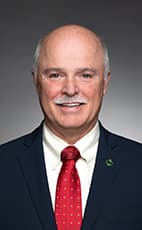
Tom Osborne
In the 90 days to October 1, 2026, 14 organizations lobbied Tom Osborne across 17 meetings — most often about Energy. The most frequent visitor was Ligado Networks Corp. (2 meetings, via Greg MacNeil of NorthStar Public Affairs Inc.). Its registration describes the goal as “Discussions with federal government officials regarding Innovation, Science and Economic Development Canada's consultation on L-band…”. That's more than the average MP, who had 6 meetings over the same period.
Based on federal lobbying registry data to October 1, 2026
In the House · Oct 5–9
Tom Osborne this week
“Part of the problem we are facing in the country in these current geopolitical times is the fact that a proponent must go through a process where in one department, a silo, a number of boxes need to be checked, and in another department, another silo, a…”
- Spoke 1 time in the House · the average MP spoke 5 times
- FORC-39, second reading — Respecting certain measures to strengthen the economy · passed 296–26
- AGAINSTC-218, second reading — Medical assistance in dying · defeated 141–187
- AGAINSTOpposition Motion (Diesel prices) · defeated 133–196
- FORFifth report of the Standing Committee on Health · passed 196–132
Get Tom Osborne's week in your inbox every Monday
What they said, how they voted, and who lobbied them. Free, no ads, unsubscribe anytime.
How Tom Osborne actually voted
Their recorded positions on the issues Canadians care about — pulled straight from the parliamentary record.
- Voted Against
- Voted For
Healthcare
Fifth report of the Standing Committee on Health
Oct 2026 · Passed
- Voted For
Labour & Employment
Establish a national framework respecting skilled trades and labour mobility
C-266 · Sep 2026 · Passed · Tell your MP what you think
- Voted For
Economy & Taxation
Implement certain provisions of the spring economic update tabled in Parliament on April 28, 2026
C-30 · Jun 2026 · Passed · Tell your MP what you think
- Voted For
Housing
Authorize certain payments to be made out of the Consolidated Revenue Fund for the purpose of improving housing supply
C-26 · Jun 2026 · Passed · Tell your MP what you think
Overall leanings
100%
voted with the Liberal line this Parliament
99%
vote attendance (177/178, missed 1)
Who's lobbying Tom
Individual meeting records from the federal lobbying registry
| Organization | |
|---|---|
| Memorial University of Newfoundland2026-09-24 · Employment and Training; Energy; Environment; Fisheries; Government Procurement | |
| Canadian ETF Association2026-09-14 · Financial Institutions; Taxation and Finance | |
| AST & Science, LLC2026-08-31 · Telecommunications | |
| Canadian Propane Association2026-08-31 · Energy; Environment; Agriculture; Taxation and Finance; Transportation | |
| Ligado Networks Corp.2026-08-31 · Telecommunications; Infrastructure; Regional Development |
Write to Tom Osborne
Pick what it's about. You'll get a letter you can edit, then send it from your own email.
Other ways to reach Tom
613-992-4211 is the House of Commons switchboard — ask to be connected to your MP's office. For constituency office contact details, or if tom.osborne@parl.gc.ca bounces, visit their Parliament profile.
Committee Memberships
What Tom talks about
- Main Estimates, 2025-20269 speeches · 2025
- An Act to Implement the Protocol on the Accession of the United Kingdom of Great Britain and Northern Ireland to the Comprehensive and Progressive Agreement for Trans-Pacific Partnership5 speeches · 2025
- Finance3 speeches · 2025
- Employment2 speeches · 2026
- Labour2 speeches · 2026
Recent Speeches
Madam Speaker, part of the problem we are facing in the country in these current geopolitical times is the fact that a proponent must go through a process where in one department, a silo, a number of boxes need to be checked, and in another department, another silo, a number of boxes need to be chec… Read full speechShow less
Madam Speaker, part of the problem we are facing in the country in these current geopolitical times is the fact that a proponent must go through a process where in one department, a silo, a number of boxes need to be checked, and in another department, another silo, a number of boxes need to be checked. Some of those are duplicates. I am asking the minister to comment on the importance of ensuring that we are competitive as a country so that we can attract business in this country, as opposed to it going to other countries, such as south of the border.
Mr. Speaker, ensuring the safety and security of Canadians is a top priority for our government. Indeed, it is a top priority that is shared by all members of the House. Bill C-232 proposes new rules that would require dangerous offenders and those convicted of more than one first-degree murder to s… Read full speechShow less
Mr. Speaker, ensuring the safety and security of Canadians is a top priority for our government. Indeed, it is a top priority that is shared by all members of the House. Bill C-232 proposes new rules that would require dangerous offenders and those convicted of more than one first-degree murder to spend their entire sentence in a maximum-security environment. The bill maintains that doing so would support public safety. Our government stands with victims and all Canadians who want to keep our communities safe. We understand and appreciate the intent behind the legislation. That said, we believe the approach proposed in the bill has significant shortcomings. Firstly, the bill contradicts the very purpose and principles of the federal correctional system and its mandate to effectively rehabilitate and reintegrate offenders. The vast majority of offenders re-enter society after serving their sentences. The goal is to ensure that they do so as law-abiding, productive members of our communities. Punishment alone does not make our communities safer. We must also focus on rehabilitation. The current Corrections and Conditional Release Act is carefully designed to balance punishment, public safety and the eventual reintegration of offenders. The act is designed to ensure that an offender's transfer to medium or minimum security only occurs when they no longer pose an undue risk to society and where they can be safely managed. All transfer decisions are based on comprehensive professional assessments by case management teams, psychiatrists and security professionals. Bill C-232 would undermine the expertise of our corrections professionals and tie the hands of those responsible for managing these offenders. Maximum-security institutions are, by necessity, highly restrictive environments focused primarily on containment. They offer fewer opportunities for offenders to access the programs required, such as education, domestic violence and substance abuse treatment, and job and skills training, to address their criminality. Based on years of evidence, we know that access to these programs is a proven tool for reforming criminal behaviour. Programs like these are more readily available in minimum-security institutions. By keeping offenders in maximum security longer than necessary, we are preventing offenders with determinate sentences from getting the treatment and skills training they need to re-enter society safely upon their release. In other words, by mandating that offenders remain in maximum security regardless of their behaviour, programming success or reduction in risk, we would, in fact, achieve the very opposite of the stated purpose of the bill. Keeping offenders in maximum-security prisons does not mean that they will never re-enter society. It means that we are failing in our responsibilities to ensure that offenders are effectively rehabilitated and able to safely reintegrate when they eventually re-enter the community. Under Bill C-232, we would, in effect, be less safe because individuals would go directly from maximum security to release into the community without any chance of rehabilitation. Furthermore, limiting access to the programs that offenders require to address their criminality would ultimately make our institutions less safe. It could create increased tension, anger and behavioural issues that would lead to more violence in our prisons. This would also put staff and those who work in these environments at risk. The government is also concerned that Bill C-232 would be likely to exacerbate the experience of indigenous people in maximum security. It would further limit their access to culturally appropriate interventions and programming, as well as conditional releases. Furthermore, the bill would create significant charter concerns because of its application to current inmates and its ability to negatively impact their prospects for conditional release. An offender's classification must be a dynamic process, not a static label that is assigned at the time of their sentencing. Let me be clear: Our government agrees that we need tough sentences for violent criminals. Indeed, when individuals have committed serious crimes, they must serve their time. The bill makes for catchy sound bites and clips, but our responsibility to Canadians is to pursue policies that will actually make our communities safer. Evidence has shown that effective rehabilitation and reintegration programming are an essential part of ensuring public safety. Under the existing system, an offender is placed in maximum security when they pose a threat to the public, to staff or to the security of the institution, and they remain there until their risk factors are mitigated. Objective risk assessments must first prove it is safe before any easing of restrictions can occur. Even then, they occur gradually and are closely monitored. Bill C-232 would make our communities less safe, because it puts political will ahead of evidence of what works most effectively to increase public safety. Canadians deserve better. For those reasons, I urge all members to vote against Bill C-232.
Madam Speaker, when Conservatives vote against affordability measures and then complain about affordability, Canadians see that as disingenuous. What is also disingenuous is when they talk down the Canadian economy while we are trying to find solutions. The U.S. is Canada's largest trading partner. … Read full speechShow less
Madam Speaker, when Conservatives vote against affordability measures and then complain about affordability, Canadians see that as disingenuous. What is also disingenuous is when they talk down the Canadian economy while we are trying to find solutions. The U.S. is Canada's largest trading partner. It only stands to reason that we would have the largest impact. We are building Canadian infrastructure using Canadian labour and Canadian materials. We are building trade corridors with other countries. I ask the other party to join us in believing in Canada, in believing in Canadians and in believing in building Canada—
Madam Speaker, what has happened in the last year is that our largest trading partner has put in unfair tariffs against this country. The Conservatives try to pretend that did not happen. The largest impact would be on the largest trading partner, but we have planted the seeds of a stronger economy.… Read full speechShow less
Madam Speaker, what has happened in the last year is that our largest trading partner has put in unfair tariffs against this country. The Conservatives try to pretend that did not happen. The largest impact would be on the largest trading partner, but we have planted the seeds of a stronger economy. We are building Canada strong and building more infrastructure in Canada using Canadian materials and Canadian labour, with more trading partners. Let us allow those seeds to bear fruit. Instead of talking down the Canadian economy, the Conservatives should join us in building Canada strong.
Mr. Speaker, as members may recall, the government made a clear commitment to Canadians to be fiscally responsible and bring discipline to the federal budget. We were also elected with the mandate to spend less on government operations so that we can invest more in workers, businesses, defence and n… Read full speechShow less
Mr. Speaker, as members may recall, the government made a clear commitment to Canadians to be fiscally responsible and bring discipline to the federal budget. We were also elected with the mandate to spend less on government operations so that we can invest more in workers, businesses, defence and nation-building infrastructure that will grow our economy and strengthen the country. As part of this effort, the government launched the comprehensive expenditure review to meet its commitment to responsible, cost-effective spending that delivers results for Canadians. This review required federal organizations to bring forward savings proposals, to spend less on the day-to-day running of government by targeting programs and activities that are not core to their federal mandate, that are duplicative or that are not aligned with government priorities. Organizations also considered ways to work more efficiently, leveraging existing and emerging technologies, such as artificial intelligence, where it makes sense. Budget 2025, tabled last November, presented the results of this review, which identified savings across government of $13 billion annually by 2028-29. This will include decreasing the size of the public service by approximately 16,000 full-time equivalents. It will also look to reduce 1,000 executive positions over the next two years. The reductions are being managed with fairness and compassion, relying on attrition and voluntary departures to the greatest extent possible. That is why we have the early retirement incentive. Organizations are required to follow established workforce adjustment policies outlined in collective agreements or, in the case of executives, career transition measures. Both set out clear processes and supports for employees who may be affected. In a workforce adjustment situation, there are specific provisions governing how this is done that are co-developed or negotiated with bargaining agents. Indeed, the government is leveraging all available tools to limit involuntary departures. This includes the proposed early retirement incentive, a program that would provide an opportunity for eligible employees to retire without a penalty for early departure. These reductions are being carried out fairly and responsibly, in line with the government's obligations as an employer. They are part of a necessary and major “recalibration” in government spending that will redirect funds to investing in Canada. They are what this moment calls for and an investment in our future.
MyMP is free and run by one person in Edmonton. Reader support keeps it that way. Chip in