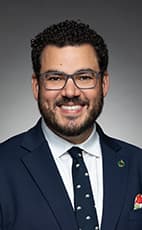
Will Greaves
In the 90 days to September 18, 2026, 15 organizations lobbied Will Greaves across 21 meetings — most often about Environment. The most frequent visitor was Environmental Defense Fund (2 meetings, via AARON FREEMAN of Pivot Strategic Consulting). Its registration describes the goal as “Improving monitoring, reporting and verification requirement for oil and gas methane emissions”. That's more than the average MP, who had 6 meetings over the same period.
Based on federal lobbying registry data to September 18, 2026
In the House · Sep 21–25
Will Greaves this week
- No speeches in the House · the average MP spoke 4 times
- FORC-266, second reading — Establish a national framework respecting skilled trades and labour mobility · passed 295–21
Get Will Greaves's week in your inbox every Monday
What they said, how they voted, and who lobbied them. Free, no ads, unsubscribe anytime.
How Will Greaves actually voted
Their recorded positions on the issues Canadians care about — pulled straight from the parliamentary record.
- Voted For
Labour & Employment
Establish a national framework respecting skilled trades and labour mobility
C-266 · Sep 2026 · Passed · Tell your MP what you think
- Voted For
Economy & Taxation
Implement certain provisions of the spring economic update tabled in Parliament on April 28, 2026
C-30 · Jun 2026 · Passed · Tell your MP what you think
- Voted For
Housing
Authorize certain payments to be made out of the Consolidated Revenue Fund for the purpose of improving housing supply
C-26 · Jun 2026 · Passed · Tell your MP what you think
- Voted For
Criminal Justice
Hate propaganda, hate crime and access to religious or cultural places
C-9 · Jun 2026 · Passed · Tell your MP what you think
- Voted For
Overall leanings
100%
voted with the Liberal line this Parliament
99%
vote attendance (173/174, missed 1)
Who’s in Will’s ear
125
lobbying meetings
79
companies & groups
46
speeches in Parliament
Top lobbying relationship: City of Victoria — met 6 times · most lobbied on Environment.
See who’s lobbying Will →Who's lobbying Will
Individual meeting records from the federal lobbying registry
| Date | Organization | |
|---|---|---|
| 2026-09-17 | Environmental Defense Fund | |
| 2026-08-17 | Invasive Species Centre | |
| 2026-08-17 | Ecojustice Canada | |
| 2026-08-13 | British Columbia's Children's Hospital Foundation | |
| 2026-08-12 | Environmental Defense Fund |
Write to Will Greaves
Pick what it's about. You'll get a letter you can edit, then send it from your own email.
Other ways to reach Will
613-992-4211 is the House of Commons switchboard — ask to be connected to your MP's office. For constituency office contact details, or if will.greaves@parl.gc.ca bounces, visit their Parliament profile.
Committee Memberships
Top Lobbying Clients
Companies with the most meetings with this MP
What Will talks about
- Commissioner for Modern Treaty Implementation Act5 speeches · 2025
- Clean Coasts Act4 speeches · 2026
- Bail and Sentencing Reform Act3 speeches · 2025
- Budget 2025 Implementation Act, No. 12 speeches · 2025
- Forestry Industry2 speeches · 2026
Recent Speeches
Mr. Speaker, across British Columbia, workers and communities know how important the forestry sector is to our economy. As Canada's forest ministers met this week in Langford on southern Vancouver Island—
Mr. Speaker, across British Columbia, workers and communities know how important the forestry sector is to our economy. As Canada's forest ministers met this week in Langford on beautiful Vancouver Island to discuss the future of forestry, workers face unjustified U.S. softwood lumber tariffs and co… Read full speechShow less
Mr. Speaker, across British Columbia, workers and communities know how important the forestry sector is to our economy. As Canada's forest ministers met this week in Langford on beautiful Vancouver Island to discuss the future of forestry, workers face unjustified U.S. softwood lumber tariffs and conditions that will require us to make our forestry sector more competitive. Can the Minister of Industry update the House on how our government is working with provinces and territories to strengthen the sector and support forestry workers from coast to coast to coast?
Mr. Speaker, wild Pacific salmon are a part of who we are for everyone who calls British Columbia or Yukon home. Climate change and habitat loss are already putting additional pressure on this threatened species. We have a responsibility to help this species rebuild. Can the Minister of Fisheries te… Read full speechShow less
Mr. Speaker, wild Pacific salmon are a part of who we are for everyone who calls British Columbia or Yukon home. Climate change and habitat loss are already putting additional pressure on this threatened species. We have a responsibility to help this species rebuild. Can the Minister of Fisheries tell us what this government is doing to help protect wild salmon populations for everyone in British Columbia and along the west coast?
Mr. Speaker, today I am pleased to speak as the member of Parliament for Victoria in support of the clean coasts act, put forward by my colleague, the hon. member for West Vancouver—Sunshine Coast—Sea to Sky Country. Those of us who live in and represent coastal communities know that the ocean is ou… Read full speechShow less
Mr. Speaker, today I am pleased to speak as the member of Parliament for Victoria in support of the clean coasts act, put forward by my colleague, the hon. member for West Vancouver—Sunshine Coast—Sea to Sky Country. Those of us who live in and represent coastal communities know that the ocean is our lifeline but also our responsibility. Even before being elected to the House, I heard from people in my community daily about the negative effects of derelict vessels in our waterways. After every storm, we see more and more vessels that have fallen into disrepair and been abandoned by irresponsible owners for others to deal with. These so-called “dead boats” do not just serve as an eyesore for our community; they pose serious safety and environmental risks, often with no one around to be held accountable. There is not one perfect solution to this issue, but I commend my colleague for putting forward Bill C-244, which would take important steps in the right direction. The bill would target the irresponsible transfer of vessel ownership. In Victoria, I hear of these instances far too often. An owner sells a rotting hull for a dollar, sometimes less, to somebody who they know cannot maintain it, effectively washing their hands of the environmental liability of responsibly disposing of that vessel. By prohibiting the transfer of vessels to those who lack the resources or the intent to actually maintain them, we would help stop the cycle of abandoned and wrecked vessels before they end up on our beaches and in our marinas. We would be demanding accountability at the point of sale, not just when the taxpayer is forced to foot the bill for a clean-up or removal of a derelict vessel, and not simply relying on the goodwill of local organizations and hard-working volunteers. I would like to take this opportunity to recognize the often thankless work by organizations in my riding, such as the Cadboro Bay Dead Boats Society, the Royal Victoria Yacht Club, the Veins of Life Watershed Society, and the Dead Boats Disposal Society, as well as others who have given their time and energy to address this issue, often taking on personal costs and liability. I would also like to thank the Canadian Coast Guard's western region and Transport Canada for their role in environmental response but acknowledge that they do not have the capacity or the mandate to single-handedly shoulder this burden. As always, we also wish to express our thanks and our appreciation to the Lekwungen-speaking peoples of southern—
Mr. Speaker, as always, we also wish to express our thanks and our appreciation to the Lekwungen-speaking peoples of southern Vancouver Island, the Songhees, Esquimalt and W̱SÁNEĆ nations, whose stewardship and care for these lands and waters since time immemorial set a high bar for our communities … Read full speechShow less
Mr. Speaker, as always, we also wish to express our thanks and our appreciation to the Lekwungen-speaking peoples of southern Vancouver Island, the Songhees, Esquimalt and W̱SÁNEĆ nations, whose stewardship and care for these lands and waters since time immemorial set a high bar for our communities and our governments to uphold today—
Recent activity
21 activities across speeches, bills, and lobbying communications.
June 2026
Oral Questions
Mr. Speaker, across British Columbia, workers and communities know how important the forestry sector is to our economy. As Canada's forest ministers met this week in Langford on southern Vancouver Isl… Read full speechShow less
Mr. Speaker, across British Columbia, workers and communities know how important the forestry sector is to our economy. As Canada's forest ministers met this week in Langford on southern Vancouver Island—
Oral Questions
Mr. Speaker, across British Columbia, workers and communities know how important the forestry sector is to our economy. As Canada's forest ministers met this week in Langford on beautiful Vancouver Is… Read full speechShow less
Mr. Speaker, across British Columbia, workers and communities know how important the forestry sector is to our economy. As Canada's forest ministers met this week in Langford on beautiful Vancouver Island to discuss the future of forestry, workers face unjustified U.S. softwood lumber tariffs and conditions that will require us to make our forestry sector more competitive. Can the Minister of Industry update the House on how our government is working with provinces and territories to strengthen the sector and support forestry workers from coast to coast to coast?
April 2026
Oral Questions
Mr. Speaker, wild Pacific salmon are a part of who we are for everyone who calls British Columbia or Yukon home. Climate change and habitat loss are already putting additional pressure on this threate… Read full speechShow less
Mr. Speaker, wild Pacific salmon are a part of who we are for everyone who calls British Columbia or Yukon home. Climate change and habitat loss are already putting additional pressure on this threatened species. We have a responsibility to help this species rebuild. Can the Minister of Fisheries tell us what this government is doing to help protect wild salmon populations for everyone in British Columbia and along the west coast?
March 2026
House of Commons
55 communications with 41 clients
Top clients: [{"name": "City of Victoria", "count": 6}, {"name": "Small Change Fund", "count"…
February 2026
Private Members' Business
Mr. Speaker, today I am pleased to speak as the member of Parliament for Victoria in support of the clean coasts act, put forward by my colleague, the hon. member for West Vancouver—Sunshine Coast—Sea… Read full speechShow less
Mr. Speaker, today I am pleased to speak as the member of Parliament for Victoria in support of the clean coasts act, put forward by my colleague, the hon. member for West Vancouver—Sunshine Coast—Sea to Sky Country. Those of us who live in and represent coastal communities know that the ocean is our lifeline but also our responsibility. Even before being elected to the House, I heard from people in my community daily about the negative effects of derelict vessels in our waterways. After every storm, we see more and more vessels that have fallen into disrepair and been abandoned by irresponsible owners for others to deal with. These so-called “dead boats” do not just serve as an eyesore for our community; they pose serious safety and environmental risks, often with no one around to be held accountable. There is not one perfect solution to this issue, but I commend my colleague for putting forward Bill C-244, which would take important steps in the right direction. The bill would target the irresponsible transfer of vessel ownership. In Victoria, I hear of these instances far too often. An owner sells a rotting hull for a dollar, sometimes less, to somebody who they know cannot maintain it, effectively washing their hands of the environmental liability of responsibly disposing of that vessel. By prohibiting the transfer of vessels to those who lack the resources or the intent to actually maintain them, we would help stop the cycle of abandoned and wrecked vessels before they end up on our beaches and in our marinas. We would be demanding accountability at the point of sale, not just when the taxpayer is forced to foot the bill for a clean-up or removal of a derelict vessel, and not simply relying on the goodwill of local organizations and hard-working volunteers. I would like to take this opportunity to recognize the often thankless work by organizations in my riding, such as the Cadboro Bay Dead Boats Society, the Royal Victoria Yacht Club, the Veins of Life Watershed Society, and the Dead Boats Disposal Society, as well as others who have given their time and energy to address this issue, often taking on personal costs and liability. I would also like to thank the Canadian Coast Guard's western region and Transport Canada for their role in environmental response but acknowledge that they do not have the capacity or the mandate to single-handedly shoulder this burden. As always, we also wish to express our thanks and our appreciation to the Lekwungen-speaking peoples of southern—
Private Members' Business
Mr. Speaker, as always, we also wish to express our thanks and our appreciation to the Lekwungen-speaking peoples of southern Vancouver Island, the Songhees, Esquimalt and W̱SÁNEĆ nations, whose stewa… Read full speechShow less
Mr. Speaker, as always, we also wish to express our thanks and our appreciation to the Lekwungen-speaking peoples of southern Vancouver Island, the Songhees, Esquimalt and W̱SÁNEĆ nations, whose stewardship and care for these lands and waters since time immemorial set a high bar for our communities and our governments to uphold today—
Private Members' Business
I was hearing the interpretation earlier, Mr. Speaker, and I am not seeing any technical issues on this side.
Private Members' Business
Mr. Speaker, I appreciate the opportunity to continue. I want to start again by expressing the thanks and appreciation that everybody in my community has to the Lekwungen-speaking peoples of southern … Read full speechShow less
Mr. Speaker, I appreciate the opportunity to continue. I want to start again by expressing the thanks and appreciation that everybody in my community has to the Lekwungen-speaking peoples of southern Vancouver Island, the Songhees, Esquimalt and W̱SÁNEĆ nations, whose stewardship of and care for the lands and waters that we live on today since time immemorial sets a high bar for our governments and communities to achieve today. The bill before us proposes important amendments to the Canadian Environmental Protection Act to ensure that no person or ship can “allow the disposal” of substances in our waters. This is about proactive stewardship. It ensures that negligence is no longer a legal defence for polluting our marine ecosystems. The Salish Sea, which surrounds my region and my riding, is an intricate ecosystem, home to species such as the southern resident killer whale and the chinook salmon. These species are put at risk when pollutants are introduced in our waterways, and we have a duty to act. The clean coasts act is a common-sense, preventative measure. It would protect our blue economy, save millions in future salvage costs and honour our commitment to maintaining the health, beauty and accessibility of the B.C. coast and all of Canada's coasts for everyone. I sincerely thank my colleague the hon. member for West Vancouver—Sunshine Coast—Sea to Sky Country for bringing this bill forward, and I urge all members of the House to support this important piece of legislation to keep our coasts clean, to keep owners accountable and to keep our oceans thriving.
Government Orders
Mr. Speaker, I understand what a challenge the extortion crisis is in my colleague's community, and I understand the passion that he brings to this issue speaking on behalf of his community members to… Read full speechShow less
Mr. Speaker, I understand what a challenge the extortion crisis is in my colleague's community, and I understand the passion that he brings to this issue speaking on behalf of his community members today. My colleagues on this side of the aisle, especially those of us from British Columbia, have spoken extensively about the extortion crisis. We understand what a challenge this is in many communities across the country. That is why we have spoken with the Premier of British Columbia, cabinet ministers from British Columbia, mayors from municipalities affected most directly in the Lower Mainland, law enforcement officials and chiefs of police. The messages we have received from all those different levels of government and all those different stakeholders are very consistent. We have been told that law enforcement needs more tools, more resources, more cross-border and inter-jurisdictional coordination, and for the House to pass Bill C-2 and Bill C-14. Will the member agree with just about every other public official on this issue?
Government Orders
Madam Speaker, it is a bit like living through an episode of The Twilight Zone to hear the opposition talk about carbon pricing in this country. Being from British Columbia, I know that the first cons… Read full speechShow less
Madam Speaker, it is a bit like living through an episode of The Twilight Zone to hear the opposition talk about carbon pricing in this country. Being from British Columbia, I know that the first consumer price on carbon in North America was introduced in British Columbia in 2007 by a right-of-centre government that some members of the opposition benches supported at the time. There is no historical memory opposite of the reality of climate change and climate policy in this country. There is nary an honest word that the opposition has to share on this topic. For a new member of the House such as myself, it is deeply disillusioning. I wonder whether my hon. colleague from Kingston and the Islands would elaborate on the government's approach to combatting climate change.
Government Orders
Madam Speaker, I think we should all in this chamber sympathize because our Conservative colleagues are having a bad week. The polling clearly shows Canadians are rallying behind the leadership of the… Read full speechShow less
Madam Speaker, I think we should all in this chamber sympathize because our Conservative colleagues are having a bad week. The polling clearly shows Canadians are rallying behind the leadership of the Prime Minister. The polling clearly shows most Canadians do not have confidence in the Leader of the Opposition. To add insult to injury, just today the last Conservative to serve as prime minister was in the House, reminding our colleagues opposite of that vanishing sensation of winning an election. My sympathies are with them, but I think it is intolerable to hear our Conservative colleagues working so hard to divide Canadians. As we heard just a few minutes ago, they are dividing rural Canada from urban Canada as though many of our ridings do not straddle both, as though the members in this chamber do not have an obligation to represent all of our constituents and as though urban MPs do not know and love rural Canada. My question for my hon. colleague from Winnipeg is whether he would agree that the reason Canadians are supporting the Prime Minister at this time is that he is deeply committed to bringing Canadians together, as he did when he announced last year that the consumer price on carbon would be removed because it was divisive. It was divisive because Conservatives had been attacking it relentlessly for years. The Prime Minister wants to bring Canadians together. Does my colleague agree?
Government Orders
Madam Speaker, it is again disappointing to hear that the leading strategy of the opposition party is nothing less than pitting Canadians against each other, trying to convince rural Canadians and Can… Read full speechShow less
Madam Speaker, it is again disappointing to hear that the leading strategy of the opposition party is nothing less than pitting Canadians against each other, trying to convince rural Canadians and Canadians from across the prairie provinces that the government does not care about them. The insistence by opposition members that only they speak for real Canadians is one of the core divisive pieces of our politics. It is shameful. The members should, in fact, apologize to the House. They should apologize to my hon. colleague. I will ask my colleague from St. Paul's whether she would like to elaborate on the way in which affordability challenges related to food are an issue that many Canadians face, Canadians in cities and Canadians in rural Canada, and how the government is addressing those needs while bringing the country together.
Private Members' Business
Mr. Speaker, I thank my hon. colleague for Cumberland—Colchester for the touching and personal remarks she shared with all of us in the chamber today. I also represent a riding that has a significant … Read full speechShow less
Mr. Speaker, I thank my hon. colleague for Cumberland—Colchester for the touching and personal remarks she shared with all of us in the chamber today. I also represent a riding that has a significant number of Canadian Armed Forces and Department of National Defence properties. While the hon. member opposite's point is taken that many members, I am sure, do have an idea of what we might do in our ridings with some of those properties, I would suggest that the merit of my colleague's motion is to have a systematic review of all of those properties across Canada so that, instead of an ad hoc process where individual MPs are putting forward their own favourite projects, we might actually have a more broad, wide-reaching and systematic assessment of the properties that the federal government could use to better effect for Canadians, and in this case, for veterans. Would my colleague care to comment?
December 2025
Government Orders
Mr. Speaker, I was greatly encouraged to hear the member refer to the need for us to maintain robust and effective climate and environmental policies in this country. I could not agree more. I think i… Read full speechShow less
Mr. Speaker, I was greatly encouraged to hear the member refer to the need for us to maintain robust and effective climate and environmental policies in this country. I could not agree more. I think it is fair to say that many Canadians, at least for the last 35 years or so, have not associated the Conservative Party with a strong environmental record, although there is a rich lineage of Conservative environmental policy going back before that. Could the member share with the House what his party supports in terms of measures to support a clean environment, reduce our emissions and improve the health of Canadians?
November 2025
Oral Questions
Mr. Speaker, in 2011, the Harper Conservative government created the conditions for Driver Inc., an illegal scheme where trucking companies misclassify drivers as independent contractors to avoid payi… Read full speechShow less
Mr. Speaker, in 2011, the Harper Conservative government created the conditions for Driver Inc., an illegal scheme where trucking companies misclassify drivers as independent contractors to avoid paying payroll taxes. This has hurt workers, distorted competition in the market and deprived the federal government of important revenue that it should be able to use to invest in Canadians. In budget 2025, our new Liberal government took action to end this scheme. Can the Secretary of State for the CRA please inform the House of the measures our government has taken to end Driver Inc.?
Statements by Members
Mr. Speaker, I rise today to acknowledge the passing of one of Canada's great military historians, my stepfather, Donald Edmund Graves. Don served as a military historian with the Government of Canada… Read full speechShow less
Mr. Speaker, I rise today to acknowledge the passing of one of Canada's great military historians, my stepfather, Donald Edmund Graves. Don served as a military historian with the Government of Canada before later founding his own firm and advising governments, private organizations and filmmakers in Britain and North America. He was the author or editor of nearly two dozen books on many topics, but his greatest passion was the War of 1812. As Canada's leading expert on that conflict, which defined our country so early on, Don advised the U.S., Canadian and British governments for the war's bicentennial celebrations in 2012. From Don, I learned a love of history and strategy, as well as deep respect for the women and men who wear Canada's uniform. I also gained a lifelong appreciation for the importance of good friends, country living and a family dog. It is fitting that such a great military historian died on Remembrance Day, and today I extend my condolences to Don's son, Matthew, and his extended family, friends and colleagues in the military history community. His contributions will be missed but never forgotten.
Government Orders
Mr. Speaker, I appreciate my colleague's drawing such focused attention to the fiscal disaster that the previous Progressive Conservative government left to the Liberals in the 1990s, which necessitat… Read full speechShow less
Mr. Speaker, I appreciate my colleague's drawing such focused attention to the fiscal disaster that the previous Progressive Conservative government left to the Liberals in the 1990s, which necessitated the very challenging fiscal decisions that were made at that time. That is clear; that is the historical record, and the member seems well aware of that challenge. In the context of our colleagues' concerns about the level of federal spending over the last couple of years, I would encourage them to be a bit more specific in terms of what they would have chosen not to spend on. Would it be the Canada child benefit that the Conservative Party would not have supported and not have spent money on? Would it be $10-a-day child care? Would it be the Trans Mountain pipeline expansion? Would it be national defence spending such that Canada would meet its 2% NATO target? Would it be CERB, which rescued Canadians from the effect of the pandemic, or the other pandemic supports that the government provided? What would you not have spent?
Government Orders
Mr. Speaker, everybody agrees that the government has a responsibility to continue to reduce crime in this country. We have heard from several Conservative colleagues just this morning about the high … Read full speechShow less
Mr. Speaker, everybody agrees that the government has a responsibility to continue to reduce crime in this country. We have heard from several Conservative colleagues just this morning about the high rates of crime, in particular in the province of Saskatchewan. Indeed, unfortunately Saskatchewan does have the highest crime rate of any province in Canada, according to data released by Statistics Canada earlier this year. To that end, I wonder whether the member has spoken with his colleagues in the Government of Saskatchewan, who have been in power for nearly 20 years, about what they are doing to address crime in their province. More to the point, Conservatives are keen to talk down this country at every available opportunity. In doing so, they miss the good news. Crime is down in Saskatchewan by 5% over the previous year and nationwide by 4%. Will Conservatives help maintain that trend by supporting the government's bail and sentencing reforms?
Government Orders
Mr. Speaker, my hon. colleague, who is also from B.C., omitted the good news that the crime severity index in our province has decreased by 11% year over year, according to Stats Canada. At the heart … Read full speechShow less
Mr. Speaker, my hon. colleague, who is also from B.C., omitted the good news that the crime severity index in our province has decreased by 11% year over year, according to Stats Canada. At the heart of the Conservatives' complaints about this matter is the fact that Canadians fundamentally chose our party to form government. Are Canadians confident that the government will reduce crime? That is the member's question. Evidently, based on the election seven months ago, the answer to that question is yes. If Conservatives were serious about the question of confidence, then they would not be playing games in this chamber on confidence motions; their House leader would not be hiding behind those curtains, pretending his voting app is not working; and Conservative MPs would not be making flimsy excuses for why they do not show up to vote non-confidence in the government. At the end of the day, Conservative members are asking whether Canadians have confidence in the government. The real question is whether Conservatives are prepared to accept the confidence Canadians have expressed in the government, our vision for the future and our efforts to resolve these challenges.
Government Orders
Mr. Speaker, as a newer member of this House, I wonder if the Speaker could speak to whether it is appropriate to use personal adjectives and describe other members as “very annoying” in comments made… Read full speechShow less
Mr. Speaker, as a newer member of this House, I wonder if the Speaker could speak to whether it is appropriate to use personal adjectives and describe other members as “very annoying” in comments made on the floor.
October 2025
Routine Proceedings
Mr. Speaker, I am honoured to rise today to present petition e-6770, signed by over 2,000 Canadians in solidarity with survivors and victims of intimate partner violence. I present this petition on be… Read full speechShow less
Mr. Speaker, I am honoured to rise today to present petition e-6770, signed by over 2,000 Canadians in solidarity with survivors and victims of intimate partner violence. I present this petition on behalf of B.C. resident and survivor Carrie Wiebe, in memory of Bailey McCourt, who was tragically killed in an act of heinous violence by her ex-partner earlier this year. The reality is that across Canada, one woman is murdered by an intimate partner every six days. The intimate partner violence prevention and enforcement act would introduce evidence-based and life-saving reforms to prevent and protect against intimate partner violence. I gratefully recognize the ongoing work the government is already doing with recent announcements on bail reform legislation that supports the basis of this petition. The petitioners call for bail reform, restriction of legal name changes for IPV offenders, a requirement for criminal record checks for marriage licences, and court-ordered treatment programs and monitoring of high-risk offenders. The act further calls for the establishment of a specialized IPV enforcement unit, a fatality review committee and an independent IPV commissioner to enhance oversight and accountability. The petitioners call upon this House to honour the memory of these women and to prevent further tragedies by considering the intimate partner violence prevention and enforcement act without delay.