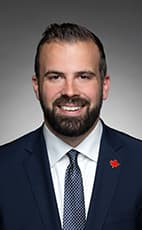
Aaron Gunn
In the 90 days to September 18, 2026, 1 organization lobbied Aaron Gunn across 1 meeting — most often about Transportation. The most frequent visitor was Air Line Pilots Association, International (1 meeting, via their in-house lobbyist Tim Perry). Its registration describes the goal as “Communications regarding transportation policy, bilateral air transport agreements, and international trade”. That's fewer than the average MP, who had 6 meetings over the same period.
Based on federal lobbying registry data to September 18, 2026
In the House · Sep 21–25
Aaron Gunn this week
- No speeches in the House · the average MP spoke 4 times
- FORC-266, second reading — Establish a national framework respecting skilled trades and labour mobility · passed 295–21
Get Aaron Gunn's week in your inbox every Monday
What they said, how they voted, and who lobbied them. Free, no ads, unsubscribe anytime.
How Aaron Gunn actually voted
Their recorded positions on the issues Canadians care about — pulled straight from the parliamentary record.
- Voted For
Labour & Employment
Establish a national framework respecting skilled trades and labour mobility
C-266 · Sep 2026 · Passed · Tell your MP what you think
- Voted Against
Economy & Taxation
Implement certain provisions of the spring economic update tabled in Parliament on April 28, 2026
C-30 · Jun 2026 · Passed · Tell your MP what you think
- Voted Against
Housing
Authorize certain payments to be made out of the Consolidated Revenue Fund for the purpose of improving housing supply
C-26 · Jun 2026 · Passed · Tell your MP what you think
- Voted Against
Criminal Justice
Hate propaganda, hate crime and access to religious or cultural places
C-9 · Jun 2026 · Passed · Tell your MP what you think
- Voted Against
Criminal Justice
Child protection, gender-based violence, delays and other measures
C-16 · Jun 2026 · Passed · Tell your MP what you think
Overall leanings
99%
voted with the Conservative line this Parliament · broke ranks 1×
98%
vote attendance (170/174, missed 4)
Who’s in Aaron’s ear
27
lobbying meetings
21
companies & groups
87
speeches in Parliament
Top lobbying relationship: Paper Excellence Canada — met 3 times · most lobbied on Fisheries.
See who’s lobbying Aaron →Who's lobbying Aaron
Individual meeting records from the federal lobbying registry
| Date | Organization | |
|---|---|---|
| 2026-07-30 | Air Line Pilots Association, International | |
| 2026-06-04 | Canada's National Firearms Association | |
| 2026-06-04 | BC Salmon Purse Seine Association | |
| 2026-06-02 | Mining Association of British Columbia | |
| 2026-06-02 | Northisle Copper and Gold Inc. |
Write to Aaron Gunn
Pick what it's about. You'll get a letter you can edit, then send it from your own email.
Other ways to reach Aaron
613-992-4211 is the House of Commons switchboard — ask to be connected to your MP's office. For constituency office contact details, or if aaron.gunn@parl.gc.ca bounces, visit their Parliament profile.
Committee Memberships
What Aaron talks about
- Finance7 speeches · 2025–2026
- Forestry Industry7 speeches · 2025–2026
- Combatting Hate Act5 speeches · 2026
- Softwood Lumber Industry5 speeches · 2025
- Natural Resources4 speeches · 2025–2026
Recent Speeches
Mr. Speaker, I rise to present a petition to provide our beloved police service dogs with the veterinary care in retirement that these valued police partners deserve. The petitioners recognize that these dogs serve faithfully alongside police officers right across Canada, providing protection, detec… Read full speechShow less
Mr. Speaker, I rise to present a petition to provide our beloved police service dogs with the veterinary care in retirement that these valued police partners deserve. The petitioners recognize that these dogs serve faithfully alongside police officers right across Canada, providing protection, detection and life-saving support to Canadians and members of law enforcement. It is support that often results in injuries or the development of service-related conditions. Disappointingly, in Canada, there is currently nothing to assist with the veterinary costs of looking after our K-9 friends after they have finished serving Canada with such distinction. Therefore, the petitioners are calling for all police service dogs who have completed three years or more of active duty to have their veterinary care fully covered for all injuries directly linked to their policing service, and 50% covered for the remainder of their general veterinary care. After their service to this country and their fellow officers, it is the least that we can do.
There used to be a promise here in Canada, Mr. Speaker, that if a person worked hard, paid their taxes and followed the law, they could afford a home, groceries and a decent standard of living. Now, after 10 years of the Liberal government, for most Canadians that promise no longer exists. According… Read full speechShow less
There used to be a promise here in Canada, Mr. Speaker, that if a person worked hard, paid their taxes and followed the law, they could afford a home, groceries and a decent standard of living. Now, after 10 years of the Liberal government, for most Canadians that promise no longer exists. According to a new survey from the United Way, 60% of Canadians now feel anxious about their finances, 38% struggle with food insecurity, and 40% are losing sleep. When will the Prime Minister acknowledge that his policies of more spending, more debt and jet-setting around the world are just not delivering real results?
Mr. Speaker, I can tell the House that most people on Vancouver Island know one thing, which is that the economic policies of the Liberal government have been hurting young Canadians the most, young people who can no longer afford homes in the communities they grew up in, whose jobs have been shippe… Read full speechShow less
Mr. Speaker, I can tell the House that most people on Vancouver Island know one thing, which is that the economic policies of the Liberal government have been hurting young Canadians the most, young people who can no longer afford homes in the communities they grew up in, whose jobs have been shipped overseas or taken by temporary foreign workers, whose streets on which they play have been flooded with dangerous drugs and whose futures have been mortgaged this year alone with $80 billion in new debt. When will the government reverse its policies and stop throwing the next generation under the bus?
Mr. Speaker, I always thought the role of the media was to hold the powerful accountable and to unapologetically seek the truth. Apparently, however, the CBC views it as trying to deceive and trick individual Canadians into bizarre and intentional traps. A new TV series from the CBC lied and used fi… Read full speechShow less
Mr. Speaker, I always thought the role of the media was to hold the powerful accountable and to unapologetically seek the truth. Apparently, however, the CBC views it as trying to deceive and trick individual Canadians into bizarre and intentional traps. A new TV series from the CBC lied and used fictitious production companies, aliases and made-up stories in an effort to dupe Canadians for the purpose of political propaganda. It deceived RCMP veterans by inviting them to fake ceremonies only to publicly humiliate them. It targeted ordinary citizens who had concerns about land claims and private property rights. It partnered with well-known, far-left American activists to attack Canadian history, Canadian institutions and Canada's first prime minister. It was all paid for using taxpayer money. The CBC is a Crown corporation. Its mandate is to serve all Canadians, not to target them, not to deceive them and certainly not to produce political propaganda designed to denigrate their beliefs.
Mr. Speaker, Canadians are outraged to learn that taxpayer dollars went to deceive and lie to individual Canadians, including RCMP veterans. A CBC production used fake websites, fake names and fake companies to lure them into supposed interviews about their lives after retirement, but it was all jus… Read full speechShow less
Mr. Speaker, Canadians are outraged to learn that taxpayer dollars went to deceive and lie to individual Canadians, including RCMP veterans. A CBC production used fake websites, fake names and fake companies to lure them into supposed interviews about their lives after retirement, but it was all just a front, a set-up for some sort of twisted humiliation ritual in front of a live studio audience. This is insane. Does the minister really think that it is acceptable for the state broadcaster to use taxpayer money to lie and deceive, and to smear the reputations of individual Canadians?
Recent activity
21 activities across speeches, bills, and lobbying communications.
June 2026
Routine Proceedings
Mr. Speaker, I rise to present a petition to provide our beloved police service dogs with the veterinary care in retirement that these valued police partners deserve. The petitioners recognize that th… Read full speechShow less
Mr. Speaker, I rise to present a petition to provide our beloved police service dogs with the veterinary care in retirement that these valued police partners deserve. The petitioners recognize that these dogs serve faithfully alongside police officers right across Canada, providing protection, detection and life-saving support to Canadians and members of law enforcement. It is support that often results in injuries or the development of service-related conditions. Disappointingly, in Canada, there is currently nothing to assist with the veterinary costs of looking after our K-9 friends after they have finished serving Canada with such distinction. Therefore, the petitioners are calling for all police service dogs who have completed three years or more of active duty to have their veterinary care fully covered for all injuries directly linked to their policing service, and 50% covered for the remainder of their general veterinary care. After their service to this country and their fellow officers, it is the least that we can do.
Oral Questions
There used to be a promise here in Canada, Mr. Speaker, that if a person worked hard, paid their taxes and followed the law, they could afford a home, groceries and a decent standard of living. Now, a… Read full speechShow less
There used to be a promise here in Canada, Mr. Speaker, that if a person worked hard, paid their taxes and followed the law, they could afford a home, groceries and a decent standard of living. Now, after 10 years of the Liberal government, for most Canadians that promise no longer exists. According to a new survey from the United Way, 60% of Canadians now feel anxious about their finances, 38% struggle with food insecurity, and 40% are losing sleep. When will the Prime Minister acknowledge that his policies of more spending, more debt and jet-setting around the world are just not delivering real results?
Oral Questions
Mr. Speaker, I can tell the House that most people on Vancouver Island know one thing, which is that the economic policies of the Liberal government have been hurting young Canadians the most, young p… Read full speechShow less
Mr. Speaker, I can tell the House that most people on Vancouver Island know one thing, which is that the economic policies of the Liberal government have been hurting young Canadians the most, young people who can no longer afford homes in the communities they grew up in, whose jobs have been shipped overseas or taken by temporary foreign workers, whose streets on which they play have been flooded with dangerous drugs and whose futures have been mortgaged this year alone with $80 billion in new debt. When will the government reverse its policies and stop throwing the next generation under the bus?
May 2026
Statements by Members
Mr. Speaker, I always thought the role of the media was to hold the powerful accountable and to unapologetically seek the truth. Apparently, however, the CBC views it as trying to deceive and trick in… Read full speechShow less
Mr. Speaker, I always thought the role of the media was to hold the powerful accountable and to unapologetically seek the truth. Apparently, however, the CBC views it as trying to deceive and trick individual Canadians into bizarre and intentional traps. A new TV series from the CBC lied and used fictitious production companies, aliases and made-up stories in an effort to dupe Canadians for the purpose of political propaganda. It deceived RCMP veterans by inviting them to fake ceremonies only to publicly humiliate them. It targeted ordinary citizens who had concerns about land claims and private property rights. It partnered with well-known, far-left American activists to attack Canadian history, Canadian institutions and Canada's first prime minister. It was all paid for using taxpayer money. The CBC is a Crown corporation. Its mandate is to serve all Canadians, not to target them, not to deceive them and certainly not to produce political propaganda designed to denigrate their beliefs.
Oral Questions
Mr. Speaker, Canadians are outraged to learn that taxpayer dollars went to deceive and lie to individual Canadians, including RCMP veterans. A CBC production used fake websites, fake names and fake co… Read full speechShow less
Mr. Speaker, Canadians are outraged to learn that taxpayer dollars went to deceive and lie to individual Canadians, including RCMP veterans. A CBC production used fake websites, fake names and fake companies to lure them into supposed interviews about their lives after retirement, but it was all just a front, a set-up for some sort of twisted humiliation ritual in front of a live studio audience. This is insane. Does the minister really think that it is acceptable for the state broadcaster to use taxpayer money to lie and deceive, and to smear the reputations of individual Canadians?
Government Orders
Mr. Speaker, members can imagine waking up one morning in beautiful British Columbia. The sun is out. The birds are chirping. We can see the mountains, the forest and, if we are lucky, maybe even the … Read full speechShow less
Mr. Speaker, members can imagine waking up one morning in beautiful British Columbia. The sun is out. The birds are chirping. We can see the mountains, the forest and, if we are lucky, maybe even the ocean from our home. Life on the surface is actually pretty good, but that scenic reality masks a much deeper and darker anxiety. The title to that home, that deed that was signed however long ago, may no longer mean what we thought it meant. The financial investment that we built our entire life around, our home that we spent our entire life savings toward, may no longer belong to us, at least not in the same way we thought it did. I wish I could say this was just some sort of reoccurring bad dream for many B.C. homeowners. However, the truth is that this uncertainty is already their reality today. This past August, the B.C. Supreme Court issued a landmark ruling that has since reverberated across the province and, in time, will undoubtedly reverberate across the entire country. The ruling recognizes aboriginal title over 800 acres of riverfront property in Richmond, B.C., including over the personal homes of individual citizens, declaring fee simple title invalid and ruling aboriginal title as prior and senior title to the land. What does all this mean? No one really knows, which is a big part of the problem. However, the ruling, which is now known as the Cowichan decision, has shaken B.C. politics to its core. Because around 95% of B.C. was settled without formal treaties, the consequences of this decision are not limited to 800 acres in Richmond, but potentially impact nearly the entire province itself. While the decision is, of course, being appealed, and while the result of that appeal remains unclear, the consequences of the ruling are already being felt today. Homeowners are now being taxed on property the legal status of which is uncertain. Some are having difficulty selling their home, while businesses and industry groups have pulled billions of dollars of investment out of British Columbia as one of the key guardrails of the rule of law begins to break down. When a citizen pays their taxes, follows the law, maintains their property and still cannot be certain that they own their own home, something has gone profoundly wrong. Private property rights are not a luxury, not an appendage to our system of government, not some kind of optional add-on to our society, to our democracy. They are quite literally the foundation on which western civilization, capitalism and our economy are built. They form the basis for our savings, our security, our independence and our autonomy as a human being. Without them, we own nothing. We are a slave to our government or whatever other powers there may be. To have them infringed upon so suddenly, so brazenly, so harshly without compensation flies in the face of everything that it means to be Canadian. It also wakes up a very important fact, which is that Canada is one of the few democracies in the world today without property rights enshrined in our Constitution. That was left out of the Canadian Charter of Rights and Freedoms in 1982 by our old prime minister, Pierre Elliott Trudeau, and decades later, we are now living with the consequences. As a member of Parliament for a riding in British Columbia that itself comprises entire communities with homeowners facing similar legal uncertainty, it is my duty to speak out for my constituents and articulate my position and my views on this issue. For me, the defence of private property is and always will be a red line. It is not and should never be up for negotiation. It is in every way a fundamental human right, and we must never submit to trade it away to simply appease or placate the latest ideological fad or in the name of political convenience. Every citizen must know that their government will do whatever it takes to ensure that Canadians can trust that what they own is truly theirs without exception. Unfortunately, that is the exact opposite of what the Liberal government in Ottawa and the NDP government in B.C. have actually done. First, in 2018, the Liberal government instructed its lawyers, Crown counsel, to abandon their own citizens, ordering them to discard the long-held legal argument that the granting of fee simple private property took precedence over or extinguished any aboriginal title claim. That directive remains Liberal party policy to this day. Second, after the bombshell Cowichan ruling, the Liberals should have immediately halted any further agreements or treaty negotiations with first nations unless explicit protections for private property were included. Instead, again, they did the exact opposite, pushing ahead with the controversial Musqueam agreement, which essentially recognized aboriginal title over much of metro Vancouver and nearly one million Canadian homes with zero explicit protections for private property. It should be noted that a member of Parliament from within the Liberal caucus called for, in his words, the return of unceded land. Then the Liberals went ahead and negotiated three new, unprecedented quasi treaties, otherwise referred to as living agreements, all of which involved huge transfers of land, money and resources to individual first nations, again with no explicit protections for private property included. When the Liberals and the NDP are pressed on their contradicting claims that they too support the private property rights of Canadians and will defend them at all costs, their rhetorical defence is that they claim they are appealing the Cowichan decision and hope that they will win. Hope is not a strategy and prayers are not a plan. The uncertainty created by their actions is already having real-world effects today. The Liberal government must act to restore certainty to homeowners now. It must act to restore confidence to businesses and industry and reverse the billions of dollars in investment that is fleeing British Columbia. Just as importantly, the government must act to prevent the further fraying of the social fabric between indigenous and non-indigenous Canadians that its policies have caused. Before writing this speech, I actually looked up a dictionary definition of “reconciliation”, and it is the act of causing two people or two groups of people to become friendly again after a falling out, an argument or a disagreement. In other words, it is about bridging divides and moving forward together. This is precisely the opposite of what the Liberal Party and the NDP have managed to accomplish over the last 10 years. It is exactly the opposite, as they are driving a wedge between indigenous and non-indigenous Canadians, playing identity politics and prioritizing virtue signalling and rhetoric over tangible, real-world results. I see that, instead of creating a framework that would bring Canadians together as one, they created an agenda that has driven them further apart. It is breeding resentment and frustration between communities instead of bridging divides and moving together as one country, Canada. The vision behind our nation, from the very beginning, has always been one of working together toward a common goal and of achieving together what we could not accomplish on our own. We need to once again harness that vision to bring back and realize that mythology of Canada. That includes, as an essential component, the mutually beneficial partnership between indigenous and non-indigenous Canadians, from the fur trade to the War of 1812, but for that partnership to truly flourish, private property rights must remain sacrosanct. There must be no equivocation on the part of the government. It must never allow fee simple title and the rights of private property owners to be abridged or up for debate. In each new agreement with first nations, these rights must be enshrined. In each and every court defence, the case to defend these rights must be made, and if absolutely necessary, if the courts continue to interpret legislation or the Constitution in ways that undermine Canada's sovereignty, our economic viability or the rights of individual citizens, then whatever changes that are needed in that legislation, or even the Constitution, however difficult, must be done.
Government Orders
Mr. Speaker, I agree with the member across the way. It does not mention private property, and that is the problem. There are no explicit protections for private property in the agreement and we are c… Read full speechShow less
Mr. Speaker, I agree with the member across the way. It does not mention private property, and that is the problem. There are no explicit protections for private property in the agreement and we are currently in a legal scenario. We are in legal limbo as we await the appeal process of the Cowichan decision. As we said, as the Conservative Party, we have demanded that every new agreement, every new treaty with first nations, must have explicit protections for private property. It is a fundamental human right. That is what we are going to continue to push for on this side of the aisle.
Government Orders
Mr. Speaker, the first thing to do is to remove these legal guidelines that have restricted our Crown counsel from defending private property rights with all of the tools in their tool kit. There shou… Read full speechShow less
Mr. Speaker, the first thing to do is to remove these legal guidelines that have restricted our Crown counsel from defending private property rights with all of the tools in their tool kit. There should be no further agreements or treaties made with first nations without explicit protections for private property embedded within. As far as what comes beyond that, my position, which I believe is also the position of my colleagues, is that when it comes to defending private property, we do whatever it takes. Obviously, we are going to support the appeal of the Cowichan decision through the courts, but there is no step along this way, along this path, where we are going to allow the private property rights, the fundamental human rights of our fellow Canadians, to be abridged and to be up for debate.
Government Orders
Mr. Speaker, the mayor of Richmond is simply stating the facts as they are. The federal government and the provincial government in B.C. failed to make legal arguments to defend private property. That… Read full speechShow less
Mr. Speaker, the mayor of Richmond is simply stating the facts as they are. The federal government and the provincial government in B.C. failed to make legal arguments to defend private property. That is a fact. However, what may be even more inexcusable is that after that court decision was made, they continued to go out and sign agreements, whether they were treaties in British Columbia or the Musqueam agreement, that did not explicitly protect private property in this new era of legal uncertainty that we now find ourselves in. That is not fair to homeowners in B.C. That is not fair to private businesses. We need to get a government that is actually putting the private property rights of Canadians first.
Routine Proceedings
Mr. Speaker, I rise once again in this House to submit yet another petition on behalf of the people of North Island—Powell River opposing ongoing attempts by a Bermuda-based company, Brookfield Renewa… Read full speechShow less
Mr. Speaker, I rise once again in this House to submit yet another petition on behalf of the people of North Island—Powell River opposing ongoing attempts by a Bermuda-based company, Brookfield Renewables, to receive an unprecedented 30-year export permit to send Canadian hydroelectricity out of Powell River to the United States, in the middle of a trade war I might add, with no benefit to the people who live in the city, the province or our country. While the petitioners are encouraged to hear the process is now proceeding to a more thorough full licensing review, they remain concerned that the granting of a simple permit may still come, and that the power, which used to supply the local pulp mill and support thousands of jobs, may be permanently and irreversibly sent out of the country. The petitioners are outraged that there is still no plan to hold public hearings in the city of Powell River.
Statements by Members
Mr. Speaker, what a a colossal and grotesque waste of taxpayer money. How else could one describe the deliberate Liberal decision to double the size of Canada's deficit and add $1 trillion to Canada's… Read full speechShow less
Mr. Speaker, what a a colossal and grotesque waste of taxpayer money. How else could one describe the deliberate Liberal decision to double the size of Canada's deficit and add $1 trillion to Canada's debt? It will increase the amount of taxpayer money wasted on interest payments to $80 billion every single year. That is $5,000 per Canadian household not going toward health care, education or roads. That is money taken from the pockets of everyday, hard-working Canadians and squandered. If we keep borrowing all this money with no plan to pay it all back, this story will end only one way. It will end with ever-increasing interest charges consuming a larger and larger share of Canada's budget, meaning less money to pay for the essential government services on which we all rely and a deeper hole that will become only more difficult to dig ourselves out of. I implore the Liberal Prime Minister to put down the shovel, stop digging and restore fiscal discipline and fiscal sanity to this country.
April 2026
Oral Questions
Mr. Speaker, there used to be a political consensus in this country that government, like the rest of us, had to live within its means. This was a shared understanding that money does not grow on tree… Read full speechShow less
Mr. Speaker, there used to be a political consensus in this country that government, like the rest of us, had to live within its means. This was a shared understanding that money does not grow on trees and that eventually all bills come due. Liberals shattered that consensus, borrowing more money over the past 10 years than every other government in the history of our country combined. The Prime Minister promised to do things differently. Instead he has somehow managed to spend and borrow even more. When will the Prime Minister end his costly credit card budgets and stop leaving future generations with the bill?
Oral Questions
Mr. Speaker, more spending and more debt seems to be the Liberals' solution to every problem they create, forever increasing the size of government and using Canada's credit card to foot the bill. How… Read full speechShow less
Mr. Speaker, more spending and more debt seems to be the Liberals' solution to every problem they create, forever increasing the size of government and using Canada's credit card to foot the bill. However, all this deficit spending comes with an inflationary cost: the worst grocery inflation in all of the G7, the worst household debt in all of the G7 and the worst housing costs. When will the Prime Minister realize that more spending, more debt and more government is not the solution to Canada's economic problems? The Liberals are the problem.
Government Orders
Mr. Speaker, I will be splitting my time with the member for Dufferin—Caledon. Why do we get involved in politics? Why do those in this chamber put their names forward to stand for an election and all… Read full speechShow less
Mr. Speaker, I will be splitting my time with the member for Dufferin—Caledon. Why do we get involved in politics? Why do those in this chamber put their names forward to stand for an election and all that it entails? The answer, of course, varies and is undoubtedly different for different people. Some run for office to seek change in their local community. Others are motivated by matters of principle or feel compelled to act on behalf of deeply held ideas or beliefs. As we have seen recently, others get into politics for the sole reason of furthering their personal interests, cozying up to power and, maybe worst of all, accumulating power for the sake of power itself, even if it means selling out their constituents and betraying those they were elected to represent. For the first time in more than 150 years of Canadian history, a Prime Minister has sought the almost unlimited power of a majority government in Canada not through a mandate from voters but through deception and deceit, quietly courting a handful of self-interested, duplicitous MPs through backroom deals and who knows what else, effectively overturning the results of an election and concentrating power that he may covet but has not democratically earned. The result is millions of Canadian voters who are angry and thousands who feel as if their vote was stolen, and I can see why. When someone is elected under a party banner, it is not just a personal victory. It is a commitment to the people who supported them and that platform, those principles and that vision for the country. In the last election, none of these elected MPs communicated to voters that they would consider crossing the floor just months after the vote. That matters, as does the context within which their decisions were made. It has been less than a year since the last election. The major party leaders are exactly the same. The party platforms are essentially the same. The primary issues facing this country, unfortunately, such as the cost of living, increasing crime, a faltering economy and the ongoing trade dispute with the United States, are also the same now as they were one year ago. If these MPs wanted to represent the Liberal Party of Canada and defend the Liberal platform in this Parliament, they should have made that decision before the last election. Then again if they had, most, and probably all, would have lost their seats. Therein lies the problem. The Prime Minister is accumulating political power he was specifically and unequivocally denied the last time Canadians went to the polls. We are not just talking, of course, about a handful of individual seats without any broader consequences. We are talking about fundamentally changing the balance of power here in Ottawa, radically remaking the minority government that voters delivered last April, when the Liberal Party and the current Prime Minister were restrained by the need to compromise and consult with opposition parties and were held accountable at committees with production orders, witness testimony and investigative motions. It was a minority government that has now been transformed through backroom deals and floor crossings to a majority that never should have been. It is unethical, it is fundamentally undemocratic, and it has had the effect of essentially disenfranchising thousands of Canadian voters. If a party wants a majority government in this country, it should have to earn it at the ballot box, just like every other government since 1867 in our country. Here we are. What is done is done, as they say. The next question is, what comes next? It only took a matter of days for the Liberals to tip their hand, moving a motion that we are debating here today to stack committees with not one but two additional Liberal MPs, trampling the oversight powers of Parliament, limiting transparency and laying the groundwork to ram through their agenda. This is from a party that loves to engage in lofty rhetoric about compromise, the defence of institutions and bringing people together. However, at the end of the day, I think what all this exposes is that the only real principle the Liberal Party knows is power, power at all costs, power even as an end onto itself. The Liberals are not about to let something as inconvenient as an election result get in the way. What will they do with all this newly acquired power and the ability to pass essentially whatever they want? We have seen, over the past 12 months, that what the Liberals say they want during an election and what they actually end up doing can be two very different things. For one, they promised to get Canada's fiscal situation under control and to rein in the excesses of Justin Trudeau, who doubled Canada's debt in just 10 years. Instead, under the Prime Minister, the deficit has actually increased. They also promised to prioritize Canadians' public safety after the increases we saw over the past decade in violent crime of 50%. Instead, the first bill they submitted to the justice committee did not target repeat violent offenders at all but rather the free speech of law-abiding Canadians. As for their signature promise, to negotiate a trade deal with the United States by July 2025, well, it has now been a year since the last election. There is still no deal, and the tariffs remain in place. In fact, the tariffs are higher now than they were back then. Meanwhile, some other legislation that the Liberals actually campaigned on, such as speeding up the construction of projects deemed in the national interest and introduced as Bill C-5, has been supported by the Conservatives and indeed improved through negotiations and the committee process. It all raises the question: For what purpose do the Liberals seek their near-unlimited power today? For what purpose do they seek to upset a 159-year-old Canadian political convention? Is it that they seek to restrict the opposition from conducting inquiries into their many conflicts of interest? Is it to shield the sunlight of transparency by blocking requests and blocking production orders for government documents and reports? Is it that they tend to introduce radical legislation they did not campaign on and know that none of the opposition parties would be able to support? Maybe it is a combination of all three. One year ago, I was elected in my riding of North Island—Powell River as the Conservative Party candidate. I ran on a clear platform, a clear set of commitments and a clear vision for this country: to stand up for Canada's resource sector, with forestry, mining, oil and natural gas; to target the real criminals in our country, the repeat violent offenders, not those exercising free speech and not law-abiding firearm owners who have never committed a crime in their life; to stop the reckless spending and endless deficits; to get the cost of living under control; and, finally, to get our men and women in uniform the equipment and support they desperately need and deserve, while always standing up for our country. I intend to honour the promises I made and the guarantees to those who entrusted me with their support and their vote. Today, with the Liberal motion, this patently naked grasp for political power, there is no denying one very simple fact: My job and the job of my opposition colleagues is certainly about to get a lot more difficult. However, that just means we will have to redouble our efforts and work harder than ever before to hold the government to account, to be the voice of our constituents and to be the voice, as always, of Conservative common sense. We can then ensure that the very real concerns and interests of hard-working, tax-paying and law-abiding Canadians are not ignored and that their priorities, through our efforts and our pressure, become the priorities of the government, however reluctant it is.
Government Orders
Mr. Speaker, I was elected to the House to voice my opinions. This is not a quote from me. What I can tell the member, which I totally pointed out in my speech, is that there have been many floor cros… Read full speechShow less
Mr. Speaker, I was elected to the House to voice my opinions. This is not a quote from me. What I can tell the member, which I totally pointed out in my speech, is that there have been many floor crossings in the history of Canada, but never in 159 years has a government openly courted a large number of MPs to cross the floor to try to change the balance of power in Ottawa and give them a majority government that they did not earn during the last election. This is what is happening today. This is why so many Canadians are angry; this is why thousands of Canadians feel disenfranchised, and this is what we are standing up against.
Government Orders
Mr. Speaker, the truth is that this is a question Canadians would like to have answered. I do not have the answers. We do not know what conversations were happening behind closed doors. We do not know… Read full speechShow less
Mr. Speaker, the truth is that this is a question Canadians would like to have answered. I do not have the answers. We do not know what conversations were happening behind closed doors. We do not know what was offered or what enticements were made. That is the very essence of the problem. Is the balance of power in this chamber, in this House, about to be upset because of conversations that Canadians were not subject to, did not have a say in and did not have a vote on? I wish I had the answers to my hon. colleague's questions, and I think Canadians wish they had those answers as well.
Government Orders
Mr. Speaker, Parliament and the workings of the House should reflect the democratic mandate given during the last election. The Liberal Party and the Prime Minister sought, and did not receive, a majo… Read full speechShow less
Mr. Speaker, Parliament and the workings of the House should reflect the democratic mandate given during the last election. The Liberal Party and the Prime Minister sought, and did not receive, a majority government from Canadians. What they have now done, through backroom deals and who knows what else, is manufacture a majority government. Their first order of business is not to try to do something to help Canadians, but it is to radically stack committees with Liberal members of Parliament. We believe in more transparency, more oversight and more accountability for the government, and that is exactly what we are going to continue to push for in opposition, even if the government is about to make our job much more difficult.
March 2026
Government Orders
Mr. Speaker, what kind of society and what kind of country do we want to be? Is it one where the government has the power to decide what we can or cannot say, to decide what religious texts we can or … Read full speechShow less
Mr. Speaker, what kind of society and what kind of country do we want to be? Is it one where the government has the power to decide what we can or cannot say, to decide what religious texts we can or cannot read and which opinions we can or cannot hear, or do we want to be a country where citizens are allowed to express themselves freely without fear of persecution or intimidation from the state, where citizens are allowed to voice their opinions, speak their truths and engage in robust political debate, and where we recognize that the price of free speech includes having to occasionally hear things that we disagree with, that are distasteful, that are repugnant and that at times may even contain hate? That is the price of free speech, is it not? That is the price of denying government the power to regulate the words we speak and, I should say, that is the price of free speech in Canada today. In years and generations past, the price paid to protect this fundamental freedom was much greater, measured not in courtrooms, in parliamentary committees or even on the floor of this House but measured on battlefields around the world by the blood spilled and lives lost to defend it. The question of whether to sacrifice some of our freedom to feel more secure and more comfortable is a question as old at least as western civilization itself, but it represents a false choice. Our security, our unity and our strength of spirit as a nation exist not in spite of our freedom but because of it, and attempts by some to erode that for the benefit and glee of others who would regulate, intimidate and control are misguided and wrong. Over the last 10 years, Liberal governments have consistently introduced legislation that is part of a trend in our country, a trend of increasing the influence of those who would wield the wand of censorship and empowering those who seek to control what we think by controlling what we can see and discuss online. It is a trend of consistently undermining the free expression of individual Canadians and attempting to stifle and socially engineer public debate, whether it was with the former Liberal Bill C-11, which decided the government, in its infinite wisdom, should have the power to manipulate the algorithms and the search results of YouTube, Facebook and other social media companies and thereby influence the information that we see and consume, or the former Bill C-63, which attempted to further criminalize and regulate speech. Now we have before the House Liberal Bill C-9, a bill that, as originally presented, would have watered down the definition of hate speech and removed important guardrails to reckless and politically motivated prosecutions. It is a bill that, at its very core, would make it easier for the government and any future government to prosecute and jail Canadians based not on their actions but on their words, and make it easier for individuals in positions of authority to wield that power as a tool of intimidation to scare those with minority or unpopular views to seek the safety of self-censorship or else risk the wrath of the almighty state. While at committee, thanks to the determination and perseverance of a handful of Conservative MPs, we were able to remove many of the most dangerous and shameful elements from the legislation. Another new alarming amendment was added. In a deal struck between the Liberals and separatist Bloc Québécois, it was agreed to remove a provision from the existing Criminal Code that prevented the prosecution of Canadians for expressing in good faith the beliefs or words of ancient religious texts, opening the door to politically motivated prosecutions on the basis of religious expression and belief, and in so doing compromising not one but two of Canadians' fundamental charter rights. To think that in a country where free speech and freedom of religion serve as two of the foundational principles and values, the bedrock on which this nation is built, a government would seek to criminalize the expression of sincerely held religious beliefs and to criminalize the reading of certain religious texts just seems so outrageous, so absurd and so fundamentally un-Canadian. This is not an exaggeration. The Liberal chair of the justice committee at the time literally singled out specific passages from both the Christian Bible and Jewish Torah, declaring them hateful in the context of further criminalizing religious speech. Beyond the obvious issues with infringing on the charter rights of Canadians, there is another issue. It is that this bill ignores, deflects and distracts from the very real and the very same challenges in Canada today that it purports to address. There is an issue in this country with some trying to hide behind the charter right of free expression to genuinely incite violence, but that is already illegal. There is an issue in our country with some attempting to intimidate and obstruct those seeking to practice and exercise their faith, but that too is already illegal. There is an issue in this country of repeat violent offenders assaulting or otherwise harming those for little or no apparent reason, some of which is undoubtedly motivated by hate. The government's response has been to repeatedly weaken Canada's justice system over the past 10 years and to refuse to aggressively pursue those guilty of breaking Canada's existing laws today, focusing not on those causing immeasurable physical harm in our cities and our streets, but on redirecting finite police resources to chase down ill-defined crimes of speech and on redeploying officers from our communities and towns to Internet message boards, Facebook posts and tweets. In the last 10 years, under the Liberal government, violent crime in Canada has increased by 50%. Homicides are up by 27%, and more than a third of these murders have been committed by known offenders on some sort of judicial release. This is the direct result of Liberal bills like Bill C-5 and Bill C-75, which have made our communities increasingly less safe by prioritizing the release of violent offenders and by weakening sentences for serious crimes. If the Liberal government actually cares about the safety and security of Canadians, it should start by fixing the problem it helped create, not by targeting the fundamental charter rights of Canadians, not by making it easier to prosecute speech and not by going after those for expressing sincerely held religious beliefs.
Government Orders
Mr. Speaker, I know it might be hard for my hon. colleague across the way to understand this, but those of us on this side have deeply committed beliefs when it comes to charter rights, free speech an… Read full speechShow less
Mr. Speaker, I know it might be hard for my hon. colleague across the way to understand this, but those of us on this side have deeply committed beliefs when it comes to charter rights, free speech and free expression. We are not making a political calculation. This comes down to a simple question: Do we want to live in a country where the government has the right to decide what we can or cannot say, or do we want to live in a country that, despite the fact that people might say things that we disagree with or find disgusting or even hateful, we still defend to the death the right of those individuals to say it? I know the type of country I want to live in. I wish my colleague across the way wanted to live in the same.
Government Orders
Mr. Speaker, further to the point that I just made, the choice is a simple one. As soon as we start placing these restrictions on free speech and free expression, the question becomes who gets to defi… Read full speechShow less
Mr. Speaker, further to the point that I just made, the choice is a simple one. As soon as we start placing these restrictions on free speech and free expression, the question becomes who gets to define where the limits are. Where do we draw the line on what we can or cannot say? The bill proposes that it is the government that would have the right to look over its citizenry and decide how we are allowed to freely express ourselves. I believe that is a God-given right that rests with every single Canadian, and no government should have the right to control the words that come out of our mouths.
House of Commons
17 communications with 14 clients
Top clients: [{"name": "Paper Excellence Canada", "count": 3}, {"name": "Tlowitsis Nation", "…