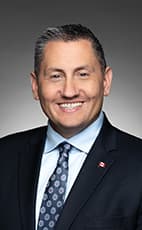
Jamie Schmale
In the 90 days to September 18, 2026, 1 organization lobbied Jamie Schmale across 1 meeting — most often about Defence. The most frequent visitor was Gwich'in Tribal Council (1 meeting, via DAVID MACMARTIN of Indigenous Peoples Consultation Issues Management). Its registration describes the goal as “Advocacy with the Government of Canada and with the Major Projects Office (MPO) concerning implementation of the Gwich'in Tribal Council…”. That's fewer than the average MP, who had 6 meetings over the same period.
Based on federal lobbying registry data to September 18, 2026
In the House · Sep 21–25
Jamie Schmale this week
“I want to thank the minister for her speech. I hope she had a very productive summer. As said many times in this debate, we agree with the diagnosis that governments of all stripes over 155-plus years have fallen short on their commitments with indigenous…”
- Spoke 9 times in the House · the average MP spoke 4 times
- FORC-266, second reading — Establish a national framework respecting skilled trades and labour mobility · passed 295–21
Get Jamie Schmale's week in your inbox every Monday
What they said, how they voted, and who lobbied them. Free, no ads, unsubscribe anytime.
How Jamie Schmale actually voted
Their recorded positions on the issues Canadians care about — pulled straight from the parliamentary record.
- Voted For
Labour & Employment
Establish a national framework respecting skilled trades and labour mobility
C-266 · Sep 2026 · Passed · Tell your MP what you think
- Voted Against
Economy & Taxation
Implement certain provisions of the spring economic update tabled in Parliament on April 28, 2026
C-30 · Jun 2026 · Passed · Tell your MP what you think
- Voted Against
Housing
Authorize certain payments to be made out of the Consolidated Revenue Fund for the purpose of improving housing supply
C-26 · Jun 2026 · Passed · Tell your MP what you think
- Voted Against
Criminal Justice
Hate propaganda, hate crime and access to religious or cultural places
C-9 · Jun 2026 · Passed · Tell your MP what you think
- Voted Against
Overall leanings
100%
voted with the Conservative line this Parliament
100%
vote attendance (174/174)
Who’s in Jamie’s ear
439
lobbying meetings
230
companies & groups
388
speeches in Parliament
Top lobbying relationship: First Nations Finance Authority — met 13 times · most lobbied on Aboriginal Affairs.
See who’s lobbying Jamie →Who's lobbying Jamie
Individual meeting records from the federal lobbying registry
| Date | Organization | |
|---|---|---|
| 2026-08-05 | Gwich'in Tribal Council | |
| 2026-06-02 | Wolastoqey Nation in New Brunswick | |
| 2026-05-25 | First Nation Land Governance Registry Inc. | |
| 2026-05-25 | Lands Advisory Board Resource Centre | |
| 2026-05-25 | Gwich'in Tribal Council |
Write to Jamie Schmale
Pick what it's about. You'll get a letter you can edit, then send it from your own email.
Other ways to reach Jamie
613-992-4211 is the House of Commons switchboard — ask to be connected to your MP's office. For constituency office contact details, or if jamie.schmale@parl.gc.ca bounces, visit their Parliament profile.
Committee Memberships
Top Lobbying Clients
Companies with the most meetings with this MP
What Jamie talks about
- Commissioner for Modern Treaty Implementation Act26 speeches · 2025–2026
- Indigenous Affairs22 speeches · 2021–2026
- Criminal Code18 speeches · 2022–2026
- The Economy15 speeches · 2022–2026
- National Council for Reconciliation Act14 speeches · 2022–2024
Recent Speeches
Mr. Speaker, I want to thank the minister for her speech. I hope she had a very productive summer. As said many times in this debate, we agree with the diagnosis that governments of all stripes over 155-plus years have fallen short on their commitments with indigenous people. What we disagree with i… Read full speechShow less
Mr. Speaker, I want to thank the minister for her speech. I hope she had a very productive summer. As said many times in this debate, we agree with the diagnosis that governments of all stripes over 155-plus years have fallen short on their commitments with indigenous people. What we disagree with is the prescription that the government is coming out with now. We agree with modern treaties. In fact, the Harper government signed six throughout its term from 2006 to 2015. What we have an issue with is that during committee we heard that there would be no guarantee, other than naming and shaming departments that are falling short on their commitments, that there would be fewer court cases. Also, through multiple Auditor General reports showing failures within both departments, ISC and Crown-indigenous relations, we have found years of failure but no correction. In fact, on May 4, 2006, we see, “Overall, Indigenous Services Canada did not effectively implement, monitor, or assess the New Fiscal Relationship initiatives it committed to with First Nation.” That was signed in 2016. This is a recent example. To the minister's word, let us go from intention to implementation. Why have we not started already?
Mr. Speaker, we have listened to the minister's responses over the past few minutes, and we still have not heard any concrete action the government has taken to correct the mistakes shown in multiple auditors general reports. We still have outstanding issues dealing with education, drinking water, g… Read full speechShow less
Mr. Speaker, we have listened to the minister's responses over the past few minutes, and we still have not heard any concrete action the government has taken to correct the mistakes shown in multiple auditors general reports. We still have outstanding issues dealing with education, drinking water, governance and programs, and the list goes on. Unfortunately, there has been no correction. This is the issue we raised about Bill C-10. There were no mechanisms to have enforcement, as I said earlier, other than naming and shaming. What actions is the government going to take to get results for indigenous people and, in this case, first nations?
Mr. Speaker, I thank the member from the Bloc for her work on this file and at the indigenous and northern affairs committee. It has been a pleasure working with that individual on this piece of legislation. As she would have heard in the committee process, this piece of legislation is not expected … Read full speechShow less
Mr. Speaker, I thank the member from the Bloc for her work on this file and at the indigenous and northern affairs committee. It has been a pleasure working with that individual on this piece of legislation. As she would have heard in the committee process, this piece of legislation is not expected to stop the number of court cases being brought before the government right now. It is a mechanism, basically, to name and shame government departments that are not living up to their word. We agree on this side of the House that governments of all stripes over many years have not lived up to their word with indigenous peoples, but yet we do not see in this piece of legislation a mechanism that has some kind of accountability when these failures do happen. The Auditor General has outlined report after report about failures within the department, but nothing seems to change. Would the member opposite like to see some kind of teeth in this legislation that could actually hold departments accountable?
Mr. Speaker, Conservatives on this side of the House agree with the diagnosis that governments of all stripes have failed indigenous peoples for way too many years. Even in the member's speech, he listed a number of areas that the government is working on. For all of those areas the member outlined … Read full speechShow less
Mr. Speaker, Conservatives on this side of the House agree with the diagnosis that governments of all stripes have failed indigenous peoples for way too many years. Even in the member's speech, he listed a number of areas that the government is working on. For all of those areas the member outlined in his speech, the Auditor General has released report after report on the continuous failures within various government departments when it comes to indigenous peoples. Given this legislation, which was commented on at committee as having no teeth to actually enforce ongoing failures, what mechanisms does the government have in place to ensure accountability?
Mr. Speaker, I would like to split my time with the member for Edmonton Northwest. At second reading, Conservatives raised a fundamental question about Bill C-10 and the government's proposal to create a new commissioner for modern treaty implementation. The question was not whether Canada must hono… Read full speechShow less
Mr. Speaker, I would like to split my time with the member for Edmonton Northwest. At second reading, Conservatives raised a fundamental question about Bill C-10 and the government's proposal to create a new commissioner for modern treaty implementation. The question was not whether Canada must honour its treaty obligations. Of course it must; there is no question there. It is not whether the federal government should be accountable to indigenous peoples when it fails to meet the commitments it has made. Of course it should. The question is actually much simpler: Will creating another federal office actually fix the failures of the last 100-plus years? The Conservative position throughout the consideration of this legislation has been that Canada's problem is not a shortage of reports, commissioners, bureaucracies or oversight mechanisms. It is a shortage of accountability for the people already responsible for negotiating and implementing Canada's treaties. That distinction is important. Bill C-10 would establish an independent commissioner and office to audit, review and report on federal institutions, ministerial responsibility, measurable implementation requirements, parliamentary oversight and consequences when departments fail to fulfill treaty obligations. After this bill has proceeded through Parliament, that fundamental concern is still on the table. The Office of the Auditor General already examines treaty negotiations, modern treaty implementation, self-government agreements and treaty land entitlements. Its work in this field stretches back decades. The federal government has also created the modern treaty implementation office, the assessment of modern treaty implementation process, the performance management framework, the modern treaty management environment, the deputy minister's oversight committee and the reconciliation secretariat. The argument Conservatives are making and have been making this whole time is not that nobody is watching. It is that too few people are being held responsible. Events outside this chamber since legislation was first debated make that question even more important. We should be looking at the actual results. I know that government members have said a few times in their speeches that now is the time to have results. Well, I will give one example, from May 4, 2026. This is from an Auditor General's report, the first one on the page: Overall, Indigenous Services Canada did not effectively implement, monitor, or assess the New Fiscal Relationship initiatives it committed to with First Nations. The Government of Canada and the Assembly of First Nations agreed in 2016 [which is pretty recent] to establish the initiatives to advance First Nations’ right to self-determination and support efforts to close persistent socio‑economic gaps between First Nations and other Canadians. This agreement was signed between the government and the AFN. We have had 10 years and an Auditor General's report that says nothing has been done and that they are not being held accountable. The government is not seeing changes at its own end. We have all these departments already looking into what the government is doing wrong. We have report after report. We just have to go to the Auditor General's website to see there is a whole slew of reports going back decades noting where the government and governments before it have been failing, yet nothing is changing within the departmental structure. All that is changing is that we are adding one more department after another, with more reports and more reports. We are just piling them on, but no one is being held accountable. It was even said at committee when we studied this bill that Bill C-10 is basically a name and shame bill. We see that in the Auditor General's reports when the Auditor General puts forward analyses on different governments, programs and departments. Not only that, but Indigenous Services Canada, which I mentioned in the story just a few moments ago, has over 8,000 bureaucrats right now. This government department is relatively new, but its whole mandate is to put itself out of business, and it is going in the complete wrong direction. If it is going to put itself out of business, we need to see more power given to indigenous communities, less power controlled in Ottawa and less reliance on nations coming to Ottawa to seek more money for various programs. It is not supposed to work that way. The government says it is working on it. The government says this is its vision. We heard that from the former prime minister. It somewhat continues today but it is just getting bigger. It is getting bigger and more bloated and we do not have any accountability from the government bureaucracies themselves. Why is that happening? That is the fundamental question. That is what we should be asking each other today, not whether we need another department to name and shame for one day. Maybe it circulates in the media for a day or two, longer if a Conservative is in power, and then we look at it and nothing really changes. That is the problem. The Auditor General is an officer of Parliament. We are going to create another officer of Parliament to create another report. See how this goes? See what happens? It is just more circular action. Nothing actually changes. We do not actually see any measurable changes for indigenous communities. That is the whole problem. I would have loved to ask the member for Winnipeg North, who was talking about accountability, a question, if I had had the opportunity when he was talking about that. Let us use the Auditor General's report that I had just talked about a few seconds ago. Given that there has been 10 years of failure, who has been held accountable? Has anything changed within the department? Clearly, nothing has changed. They had 10 years to work on that new fiscal agreement. It was signed by the government. The government is still here. Nothing has changed. We have another report that says it has not. What is actually changing? Nothing is actually changing. This is the whole problem. The commissioner for modern treaty implementation cannot negotiate a good treaty. That is for the government to do. The commissioner cannot substitute for the Minister of Crown-Indigenous Relations. A commissioner cannot substitute for the Minister of Justice. A commissioner certainly cannot be a substitute for Parliament. The question for Parliament, because nobody is being held responsible when things go wrong, and clearly there is a lot of that, is how Parliament can better hold governments to account. We cannot do that because there is no accountability within the departmental structure. That is the whole problem. I look at the Auditor General's website. There are failures in education, in clean drinking water, in emergency response and the list goes on and on. Most of the reports that I am looking at on the Auditor General's website are just follow-ups from previous reports. There is very little action. If we are saying that we want Ottawa, which has created the problem in the first place, to fix the problem, and if it is not doing that, we need to name and shame for a day, but nothing actually improves. Again, we are going in a circle. Nothing is changing. By creating another office with another bureaucracy, with more and more reports and staff and offices, we are not actually fixing the problem. Conservatives, on this side of the House, agree with the diagnosis. There has been a massive problem. What we disagree with is the prescription the government has presented to us today, and that is Bill C-10, which would create yet another level of bureaucracy but little to no action.
Recent activity
21 activities across speeches, bills, and lobbying communications.
September 2026
Government Orders
Mr. Speaker, I want to thank the minister for her speech. I hope she had a very productive summer. As said many times in this debate, we agree with the diagnosis that governments of all stripes over 1… Read full speechShow less
Mr. Speaker, I want to thank the minister for her speech. I hope she had a very productive summer. As said many times in this debate, we agree with the diagnosis that governments of all stripes over 155-plus years have fallen short on their commitments with indigenous people. What we disagree with is the prescription that the government is coming out with now. We agree with modern treaties. In fact, the Harper government signed six throughout its term from 2006 to 2015. What we have an issue with is that during committee we heard that there would be no guarantee, other than naming and shaming departments that are falling short on their commitments, that there would be fewer court cases. Also, through multiple Auditor General reports showing failures within both departments, ISC and Crown-indigenous relations, we have found years of failure but no correction. In fact, on May 4, 2006, we see, “Overall, Indigenous Services Canada did not effectively implement, monitor, or assess the New Fiscal Relationship initiatives it committed to with First Nation.” That was signed in 2016. This is a recent example. To the minister's word, let us go from intention to implementation. Why have we not started already?
Government Orders
Mr. Speaker, we have listened to the minister's responses over the past few minutes, and we still have not heard any concrete action the government has taken to correct the mistakes shown in multiple … Read full speechShow less
Mr. Speaker, we have listened to the minister's responses over the past few minutes, and we still have not heard any concrete action the government has taken to correct the mistakes shown in multiple auditors general reports. We still have outstanding issues dealing with education, drinking water, governance and programs, and the list goes on. Unfortunately, there has been no correction. This is the issue we raised about Bill C-10. There were no mechanisms to have enforcement, as I said earlier, other than naming and shaming. What actions is the government going to take to get results for indigenous people and, in this case, first nations?
Government Orders
Mr. Speaker, I thank the member from the Bloc for her work on this file and at the indigenous and northern affairs committee. It has been a pleasure working with that individual on this piece of legis… Read full speechShow less
Mr. Speaker, I thank the member from the Bloc for her work on this file and at the indigenous and northern affairs committee. It has been a pleasure working with that individual on this piece of legislation. As she would have heard in the committee process, this piece of legislation is not expected to stop the number of court cases being brought before the government right now. It is a mechanism, basically, to name and shame government departments that are not living up to their word. We agree on this side of the House that governments of all stripes over many years have not lived up to their word with indigenous peoples, but yet we do not see in this piece of legislation a mechanism that has some kind of accountability when these failures do happen. The Auditor General has outlined report after report about failures within the department, but nothing seems to change. Would the member opposite like to see some kind of teeth in this legislation that could actually hold departments accountable?
Government Orders
Mr. Speaker, Conservatives on this side of the House agree with the diagnosis that governments of all stripes have failed indigenous peoples for way too many years. Even in the member's speech, he lis… Read full speechShow less
Mr. Speaker, Conservatives on this side of the House agree with the diagnosis that governments of all stripes have failed indigenous peoples for way too many years. Even in the member's speech, he listed a number of areas that the government is working on. For all of those areas the member outlined in his speech, the Auditor General has released report after report on the continuous failures within various government departments when it comes to indigenous peoples. Given this legislation, which was commented on at committee as having no teeth to actually enforce ongoing failures, what mechanisms does the government have in place to ensure accountability?
Government Orders
Mr. Speaker, I would like to split my time with the member for Edmonton Northwest. At second reading, Conservatives raised a fundamental question about Bill C-10 and the government's proposal to creat… Read full speechShow less
Mr. Speaker, I would like to split my time with the member for Edmonton Northwest. At second reading, Conservatives raised a fundamental question about Bill C-10 and the government's proposal to create a new commissioner for modern treaty implementation. The question was not whether Canada must honour its treaty obligations. Of course it must; there is no question there. It is not whether the federal government should be accountable to indigenous peoples when it fails to meet the commitments it has made. Of course it should. The question is actually much simpler: Will creating another federal office actually fix the failures of the last 100-plus years? The Conservative position throughout the consideration of this legislation has been that Canada's problem is not a shortage of reports, commissioners, bureaucracies or oversight mechanisms. It is a shortage of accountability for the people already responsible for negotiating and implementing Canada's treaties. That distinction is important. Bill C-10 would establish an independent commissioner and office to audit, review and report on federal institutions, ministerial responsibility, measurable implementation requirements, parliamentary oversight and consequences when departments fail to fulfill treaty obligations. After this bill has proceeded through Parliament, that fundamental concern is still on the table. The Office of the Auditor General already examines treaty negotiations, modern treaty implementation, self-government agreements and treaty land entitlements. Its work in this field stretches back decades. The federal government has also created the modern treaty implementation office, the assessment of modern treaty implementation process, the performance management framework, the modern treaty management environment, the deputy minister's oversight committee and the reconciliation secretariat. The argument Conservatives are making and have been making this whole time is not that nobody is watching. It is that too few people are being held responsible. Events outside this chamber since legislation was first debated make that question even more important. We should be looking at the actual results. I know that government members have said a few times in their speeches that now is the time to have results. Well, I will give one example, from May 4, 2026. This is from an Auditor General's report, the first one on the page: Overall, Indigenous Services Canada did not effectively implement, monitor, or assess the New Fiscal Relationship initiatives it committed to with First Nations. The Government of Canada and the Assembly of First Nations agreed in 2016 [which is pretty recent] to establish the initiatives to advance First Nations’ right to self-determination and support efforts to close persistent socio‑economic gaps between First Nations and other Canadians. This agreement was signed between the government and the AFN. We have had 10 years and an Auditor General's report that says nothing has been done and that they are not being held accountable. The government is not seeing changes at its own end. We have all these departments already looking into what the government is doing wrong. We have report after report. We just have to go to the Auditor General's website to see there is a whole slew of reports going back decades noting where the government and governments before it have been failing, yet nothing is changing within the departmental structure. All that is changing is that we are adding one more department after another, with more reports and more reports. We are just piling them on, but no one is being held accountable. It was even said at committee when we studied this bill that Bill C-10 is basically a name and shame bill. We see that in the Auditor General's reports when the Auditor General puts forward analyses on different governments, programs and departments. Not only that, but Indigenous Services Canada, which I mentioned in the story just a few moments ago, has over 8,000 bureaucrats right now. This government department is relatively new, but its whole mandate is to put itself out of business, and it is going in the complete wrong direction. If it is going to put itself out of business, we need to see more power given to indigenous communities, less power controlled in Ottawa and less reliance on nations coming to Ottawa to seek more money for various programs. It is not supposed to work that way. The government says it is working on it. The government says this is its vision. We heard that from the former prime minister. It somewhat continues today but it is just getting bigger. It is getting bigger and more bloated and we do not have any accountability from the government bureaucracies themselves. Why is that happening? That is the fundamental question. That is what we should be asking each other today, not whether we need another department to name and shame for one day. Maybe it circulates in the media for a day or two, longer if a Conservative is in power, and then we look at it and nothing really changes. That is the problem. The Auditor General is an officer of Parliament. We are going to create another officer of Parliament to create another report. See how this goes? See what happens? It is just more circular action. Nothing actually changes. We do not actually see any measurable changes for indigenous communities. That is the whole problem. I would have loved to ask the member for Winnipeg North, who was talking about accountability, a question, if I had had the opportunity when he was talking about that. Let us use the Auditor General's report that I had just talked about a few seconds ago. Given that there has been 10 years of failure, who has been held accountable? Has anything changed within the department? Clearly, nothing has changed. They had 10 years to work on that new fiscal agreement. It was signed by the government. The government is still here. Nothing has changed. We have another report that says it has not. What is actually changing? Nothing is actually changing. This is the whole problem. The commissioner for modern treaty implementation cannot negotiate a good treaty. That is for the government to do. The commissioner cannot substitute for the Minister of Crown-Indigenous Relations. A commissioner cannot substitute for the Minister of Justice. A commissioner certainly cannot be a substitute for Parliament. The question for Parliament, because nobody is being held responsible when things go wrong, and clearly there is a lot of that, is how Parliament can better hold governments to account. We cannot do that because there is no accountability within the departmental structure. That is the whole problem. I look at the Auditor General's website. There are failures in education, in clean drinking water, in emergency response and the list goes on and on. Most of the reports that I am looking at on the Auditor General's website are just follow-ups from previous reports. There is very little action. If we are saying that we want Ottawa, which has created the problem in the first place, to fix the problem, and if it is not doing that, we need to name and shame for a day, but nothing actually improves. Again, we are going in a circle. Nothing is changing. By creating another office with another bureaucracy, with more and more reports and staff and offices, we are not actually fixing the problem. Conservatives, on this side of the House, agree with the diagnosis. There has been a massive problem. What we disagree with is the prescription the government has presented to us today, and that is Bill C-10, which would create yet another level of bureaucracy but little to no action.
Government Orders
Mr. Speaker, the majority of what I have to say was said before question period, but I would be remiss if I did not point out that there were a number of important indigenous organizations that did a … Read full speechShow less
Mr. Speaker, the majority of what I have to say was said before question period, but I would be remiss if I did not point out that there were a number of important indigenous organizations that did a lot of work on the treaty commission suggestion to the government and its work on Bill C-10. The Land Claims Agreement Coalition is one. There were many, many more. We understand that the treaty partners have waited years for governments to fulfill the obligations that Canada freely undertook. We understand that a signed treaty cannot become a document that governments celebrate with ceremony and then neglect afterward. Canada must keep its word. The disagreement, again, is therefore not over whether accountability is necessary. We want to see accountability. We do not believe this piece of legislation lives up to that. We do not believe that there will be a meaningful response from the government to any information that comes out of the treaty commissioner. We have seen no action on the Auditor General's reports, for report after report. We want to see action. We support the minister's word when she says they want intention rather than implementation. Let us see that. Let us give the bill some teeth. Let us have the government finish up its work.
Government Orders
Madam Speaker, it is interesting because we get the frustration indigenous peoples have with government in general, and in this case, the government opposite. We actually acknowledge that governments … Read full speechShow less
Madam Speaker, it is interesting because we get the frustration indigenous peoples have with government in general, and in this case, the government opposite. We actually acknowledge that governments of all stripes over decades have failed to live up to their word, and that is the issue. The member opposite knows that the Auditor General is an officer of Parliament. She, at this point, reports to Parliament. On May 4, 2026, the Auditor General produced yet another report showing that Indigenous Services Canada is not living up to its word to implement, monitor and assess a new fiscal relationship with indigenous peoples. This was signed in 2016 and is only 10 years old, but the Liberals have not done anything. If they are not going to live up to their word after they have signed on the dotted line, when are we going to see some accountability?
Government Orders
Madam Speaker, I hope the member opposite had a restful summer. It is always good to see our Bloc friends back in the House holding the government to account. I do agree that this piece of legislation… Read full speechShow less
Madam Speaker, I hope the member opposite had a restful summer. It is always good to see our Bloc friends back in the House holding the government to account. I do agree that this piece of legislation does not have the teeth necessary to see changes within the way government deals with such things as modern treaties. We have pointed it out time and time again. In fact, in the committee process, it came out that this piece of legislation would produce a report that would name and shame a government department not living up to its word. The Auditor General already does that, but after that, there is still that lingering question of what actually happens. Does a government department get restructured? Does anyone lose their job? Are we seeing consequences in any meaningful form? The answer is no. What we found out at committee is that this might actually cause more court cases, and that is the opposite of what the government should be doing. That is not reconciliation.
Government Orders
Madam Speaker, yes, the member is correct.
June 2026
Government Orders
Mr. Speaker, I found it interesting that the member opposite was talking about Conservatives not caring about affordability. I would argue that all we talk about, day in and day out, is affordability.… Read full speechShow less
Mr. Speaker, I found it interesting that the member opposite was talking about Conservatives not caring about affordability. I would argue that all we talk about, day in and day out, is affordability. What we have an issue with is how many times the Liberal government fails, over and over again. For the grocery plan, the finance minister brought the CEOs to Ottawa to give them what for, but it did not lower the price of groceries. Now we have had an announcement in front of a fake house. When are we actually going to get things built?
Government Orders
Mr. Speaker, I thank the minister for her tabling of the legislation and her work on the file. In regard to pushing forward Bill C‑27, we did note that, in 2022 to 2024, then prime minister Trudeau an… Read full speechShow less
Mr. Speaker, I thank the minister for her tabling of the legislation and her work on the file. In regard to pushing forward Bill C‑27, we did note that, in 2022 to 2024, then prime minister Trudeau announced an expansion of one million square kilometres within the Northwest Territories, covering 25% of its land and waters, and to reach that goal by 2025. That announcement was included. Now, Imperial Oil in Norman Wells announced just a few months ago that it will be ceasing operations within that village. The village itself receives about 70% of its tax base from the operations of Imperial Oil. There is a pipeline that would take energy from Norman Wells down to Alberta, line 21, that is caught in three separate environmental assessments. What is the minister doing to spark economic activity for the people of Norman Wells?
Government Orders
Mr. Speaker, the government speaks quite often about creating this economy and doing it in speeds never felt in generations, yet we have an existing pipeline, line 21, that runs from Norman Wells to A… Read full speechShow less
Mr. Speaker, the government speaks quite often about creating this economy and doing it in speeds never felt in generations, yet we have an existing pipeline, line 21, that runs from Norman Wells to Alberta that has already been in operation for decades. It now needs to be replaced because it is coming to the end of its useful life, yet the government has turned the Northwest Territories basically into a park. It has caught this pipeline up in three separate environmental assessments, causing Imperial Oil to shut down its operation in Norman Wells. There are 750 people in Norman Wells on the verge of unemployment because the government cannot get its act together. This is an emergency. We need our energy sector strong. Why is the government not acting quickly to get this pipeline approved?
Government Orders
Mr. Speaker, what we see in the House is that when the government does the job correctly, legislation can move fairly quickly through this place. However, we have growing unease in British Columbia th… Read full speechShow less
Mr. Speaker, what we see in the House is that when the government does the job correctly, legislation can move fairly quickly through this place. However, we have growing unease in British Columbia that continues to create a massive amount of uncertainty. Now we have U.S. tribes trying to get legal standing within the British Columbia framework for energy projects that affect Canada. We also have the fact that these U.S. tribes are moving in on the consultation process and requiring their say-so to approve energy projects within Canada. The government has really done nothing to stand up to these U.S. tribes to say, no, there is no foreign interference on projects on our soil. When do we expect that to happen?
Government Orders
Mr. Speaker, I am pleased to rise today to speak to Bill C-27, legislation to implement the final self-government agreement for the Tłegǫ́hłı̨ Got’įnę, for the Sahtu Dene and Métis of Norman Wells in … Read full speechShow less
Mr. Speaker, I am pleased to rise today to speak to Bill C-27, legislation to implement the final self-government agreement for the Tłegǫ́hłı̨ Got’įnę, for the Sahtu Dene and Métis of Norman Wells in the Northwest Territories. The name breaks down into two main parts: Tłegǫ́hłı is the place where the oil is, and Got’įnę is the government of the people. At the outset, I want to be clear about the Conservative position. We will be supporting this legislation at second reading and to send it to committee for further study. I mentioned this a few moments ago, but we do so because we recognize the importance of meaningful reconciliation. We respect the rights of indigenous communities to pursue self-governance, and we believe that decisions affecting northern communities are often best made by the people who live, work, raise families and build their futures there. This agreement before us is the product of decades of mostly Conservative-led negotiations. It builds upon the 1993 Sahtu Dene and Métis comprehensive land claim agreement and represents another step in the long evolution of governance in Canada's north. It recognizes that TGG's inherent right to self-government establishes a new indigenous government and creates a framework through which that government can exercise authority over matters that are of importance to its citizens. Those are goals, of course, that Conservatives can support. In fact, support for northern self-government and devolution is not new to our party. It is part of a long Conservative tradition that stretches back decades. In 1993, under the leadership of Prime Minister Brian Mulroney and then minister of, at the time, Indian and northern affairs, Tom Siddon, whose wife Pat, I am told, was a strong advocate of good local and constituency work and often attended events on his behalf when he was working elsewhere, Canada signed the Sahtu Dene and Métis comprehensive land claim agreement. This agreement provided certainty. It recognized rights. It established the foundation upon which agreements like the one we are debating today are built. Years later, under Prime Minister Stephen Harper, Conservatives advanced one of the most ambitious northern agendas in Canadian history. Our government at the time recognized that Canada's north was not simply a remote region to be administered from Ottawa. It is home to vibrant communities, rich cultures, extraordinary natural resources and tremendous economic potential. Prime Minister Harper at the time developed a comprehensive northern strategy built around four pillars: one, exercising Canada's sovereignty; two, promoting social and economic development; three, protecting our natural and environmental heritage; and four, improving and devolving northern governance. This strategy reflected the simple but very important principle: Northerners are in the best position to make decisions about the future of the north. That principle guided us throughout our term in government. The north has always been a defining part of our national identity, but for too long, decisions affecting the north were made thousands of kilometres away by people who would never experience the consequences of those decisions. Conservatives worked to change that. Then minister of indigenous affairs Bernard Valcourt described devolution as one of the final major steps in the political evolution of the Northwest Territories. He argued that northerners should have the same opportunity as others to make decisions about their lands, their waters, their resources. He was right then, and he is right today. The Northwest Territories Devolution Act was not simply about transferring administrative responsibilities. It was about trust. It was about recognizing that northerners understand northern realities better than federal bureaucracies ever could. It was also about economic opportunity. Conservatives understood that when communities have greater authority over their own affairs, they can respond more quickly to opportunities that attract investment, create jobs and build prosperity. The success of the Yukon following its devolution demonstrated exactly that. Greater local control led to stronger economic growth, increased investment and greater confidence in the future. This same principle applies today. Self-government and devolution are not merely constitutional exercises. They are practical tools that allow communities to chart their own course and build a stronger future for the next generation. That principle guided our support, the Conservative government at the time, for the expansion of the Nahanni National Park Reserve, announced at the time by the late Jim Prentice, who was environment minister, and the late Chuck Strahl, the minister of Indian and northern affairs. Again, that guided our efforts to improve northern regulatory systems. It guided the Northwest Territories Devolution Act, and it guided our support for indigenous self-government agreements throughout the north. Indeed, in 2015, Bernard Valcourt, Conservative member of Parliament and then minister of Indian and northern affairs, introduced Bill C-15, the Northwest Territories Devolution Act. During debate on the legislation, Minister Valcourt noted that the opportunities and challenges facing the north are best handled by the people who understand them best: the people who live there. That, again, remains true today. The north is not strengthened when decisions are imposed from Ottawa. The north is strengthened when local communities are empowered to shape their own future. That is why Conservatives have always supported devolution. We believe that local governments understand local needs. We believe that communities understand local priorities. We believe that people are more likely to achieve prosperity when they have greater control over the decisions that affect their lives. The TGG agreement is consistent with that principle. It recognizes that the indigenous population of Norman Wells should have a stronger voice in matters affecting their community, their culture and their future. It creates governance structures that are accountable to their citizens. It allows the community to exercise authority over matters such as citizenship, culture, language, social services and governance. While we may not always agree with every element of every self-government agreement, we recognize that moving beyond the Indian Act and empowering indigenous communities to govern their own affairs can represent meaningful progress. This agreement contains unique provisions, reflecting the realities of Normal Wells. Unlike the Déline agreement, which the minister spoke about a little while ago and which combined indigenous and municipal governance, this agreement keeps the two separate but has the possibility for a future merging. The Town of Norman Wells will continue to exist as a municipal government, while the TGG exercises authorities in areas assigned to it under the agreement. At the same time, this agreement contemplates the possibility that municipal powers could eventually be transferred if certain demographic thresholds are met. Importantly, the agreement contains provisions intended to ensure that if such a transaction occurs, the democratic rights of all, indigenous and non-indigenous, are protected. Residents of Norman Wells, indigenous and non-indigenous, would continue to have voting rights and the ability to seek elected office, and of course that matters. Reconciliation and self-government should strengthen democracy, not weaken it. The agreement must work for not only the TGG citizens, but also the broader community that calls Norman Wells home. One of the most compelling aspects of this agreement is the potential contribution to economic reconciliation. Too often, reconciliation is discussed only in terms of governance, structures and legal frameworks. Those matters are important, but reconciliation must create all kinds of opportunities. Communities need jobs. Families need incomes. Young people need reasons to stay, build careers and raise families in their home community, if they so choose. Economic reconciliation means ensuring that indigenous communities have the tools necessary to participate fully in the economy. Norman Wells, unfortunately, now faces some significant economic challenges. The region has long depended on resource development. The energy sector has provided employment, investment and revenues that support local services and community infrastructure. Unfortunately, recent announcements regarding the winding down of operations have created uncertainty about the future, and that is the operations of Imperial Oil, as I mentioned a little while ago. Now, the story of Norman Wells is inseparable from the story of northern economic development. For more than a century, oil production has been part of the community's identity. It is actually in the name of the bill we are discussing today, in the indigenous translation. Norman Wells helped fuel northern development, supported generations of workers and families, and provided economic stability for the entire region. As I have mentioned many times, the planned wind-down of Imperial Oil operations has created understandable concern throughout the community. Jobs are now at stake, local revenues are at stake and future opportunities are at stake. The Tłegǫ́hłı̨ Got’įnę have been very clear that greater local control over economic decision-making can help address these challenges. They want to be active participants in shaping the future of their region instead of just observers. Conservatives can very much support that objective. We believe indigenous communities should be partners in economic development. We believe resource projects should create opportunities for all. We believe northern communities should have a meaningful role in determining how development occurs within their region. The future of Norman Wells cannot be built solely on government transfers and bureaucratic programs. It must also be built on jobs, investment, entrepreneurship and responsible development. That is what economic reconciliation looks like. It means ensuring indigenous communities possess not only the authority to govern, but also the tools necessary to create prosperity for their people. The Tłegǫ́hłı̨ Got’įnę have argued that greater local control over those development decisions can help support economic growth, attract investment and ensure future opportunities benefit the community. Unfortunately, as I mentioned a little while ago, the Imperial Oil company has decided to shut down its operations. It has a pipeline that has existed for decades, line 21, taking energy from Norman Wells into Alberta. The pipeline has come to the end of its useful life. It is caught within three separate environmental assessments. The Prime Minister tells us that we need to build at speeds not known before, yet we are seeing a pipeline in existence for decades, creating jobs, opportunity and wealth, being shut down because of a lack of action by the government. There are 750 or so people living in the village of Norman Wells and 70% of their tax revenue is from the energy sector. Those people need those jobs, and the government is turning its back on those people. As members have probably guessed, we have always believed that responsible resource development and indigenous participation go hand in hand. We reject the false choice between economic activity and indigenous prosperity. The reality is that everybody, indigenous and non-indigenous, wants jobs. They want opportunities. They want infrastructure. They want partnerships. They want the ability to make their own decisions about development on their own terms. Economic reconciliation means saying yes to prosperity. It means creating conditions that allow communities to benefit from resources located within their traditional territories. It means ensuring that indigenous governments are partners in growth rather than spectators. That is why Conservatives have consistently supported responsible resource development in the north. For those reasons, Conservatives, again, can support this piece of legislation. We look forward to dealing with it as it goes through committee, probably in the very near future. We also look at how the government has dealt with a few other indigenous issues within Canada; British Columbia, for one. Of course, the Cowichan Tribes court decision created a lot of questions about fee simple property within the city of Richmond. The government, unfortunately, through a series of bad decisions, led us to the point that we have arrived at today. In 2018, a directive by the government given to their lawyers not to argue for private property rights was given. The province did the same. Only the City of Richmond argued for fee simple property. Why? We have no idea, but it is the uncertainty that was created because of those decisions. Now there is a K’ómoks Treaty that has passed the B.C. legislature that will be coming to Parliament at some point. It has neighbouring nations questioning whether consultation was done properly. Neighbouring nations want to wait. They have interests in the territory mentioned in this treaty, overlapping jurisdictions. They have what is called a living document, which means it can be opened every 10 years. That goes against the whole view of establishing a treaty. It is a finality that everyone is looking for; this legislation gives that finality. However, it is not given in the K’ómoks Treaty. Why? We have no idea. Again, as I said at the start, when things are done correctly, legislation can move very quickly through this House. However, the government continues to do things that boggle the mind, perhaps to create a level of uncertainty within British Columbia so that no development ever happens again. That seems to be what the government is doing here. On the other hand, it is saying it wants to build as fast as possible and get the economy back on track. It cannot do the two at the same time. It cannot create uncertainty in a province that needs access to the Pacific coast. That scares off investment. There has to be that certainty. There has to be the ability to attract that investment. That is the certainty people are looking for, as well as the protection for private property owners so they know their property is protected. That is the underpinning of our society. I mentioned the Déline agreement earlier. It was negotiated under Stephen Harper and Minister Bernard Valcourt. It was a self-government agreement, as the minister mentioned in her speech, one of five potentially coming our way. The government at the time recognized the potential for people to create their own path forward. Again, that is something we support wholeheartedly. Also, as I mentioned a bit in my speech, although I did not get into it as much as I wanted to, as I am running out of time, a hybrid indigenous-municipal government was created as a result. The town of Fort Franklin is now known as Déline because of the actions by the Harper government to recognize that opportunity means opportunity for all. Reconciliation means reconciliation on both sides, creating a strong economy and a level of certainty to attract investment and create jobs, opportunity and wealth. What has this government done? In 2022, it basically announced that the Northwest Territories would be a park, shutting down development, shutting down existing pipelines already in operation and shutting down the ability to create opportunities for the local population. That is deeply unfortunate, because the north has so much potential and so much going for it. These are amazing people, and we want to see them succeed. As the opposition, we will support this piece of legislation, Bill C-27. However, we would like to see the government take a more focused approach to creating economic activity and employing more people in the Northwest Territories. I only have a few moments left, so I will yield the rest of my time and take questions.
Government Orders
Mr. Speaker, I am excited to see those future agreements when they come forward. I would like to say that the government knows where our lines are in the sand. If it is going to impact private propert… Read full speechShow less
Mr. Speaker, I am excited to see those future agreements when they come forward. I would like to say that the government knows where our lines are in the sand. If it is going to impact private property, that is something we cannot really accept on this side of the House. However, if the legislation is laid out clean, as it is here, I think there is greater potential for that to happen. Of course, this legislation, Bill C-27, is built on the framework of the Déline agreement, Bill C-15, which was brought under Stephen Harper. Again, when it is done properly, we can get things done quickly here.
Government Orders
Mr. Speaker, in this context, we are talking about prosperity if we are to build energy projects pretty much anywhere in the country, but mostly we are focused on expanding opportunities to the Pacifi… Read full speechShow less
Mr. Speaker, in this context, we are talking about prosperity if we are to build energy projects pretty much anywhere in the country, but mostly we are focused on expanding opportunities to the Pacific. That is a lot of what we are talking about. A lot of these projects, pretty much all of them, run through first nations land, either treaty territory or land claims. Therefore, if we are going to build in that direction, out west, we need to ensure that consultation is done properly, ensure that first nations are active partners in projects and ensure that they are receiving benefits through jobs, impact benefit agreements; what we were proposing before the election, the resource charge; and transferring and ceding tax room on the federal level, providing the opportunity for the companies to pay the nations directly for those taxes. We need to ensure that they are getting all benefits available to them, to ensure that they share in the prosperity of all.
Government Orders
Mr. Speaker, that would be impossible to say, because most self-government agreements include a land claim, so those two things are not separate. They can have modern treaties that involve land in wha… Read full speechShow less
Mr. Speaker, that would be impossible to say, because most self-government agreements include a land claim, so those two things are not separate. They can have modern treaties that involve land in what we would be supporting. What I was going to say to supplement, and should have said during the first round, is that what makes this piece of legislation very easy to accept is that the land claim was done in 1993. The land claim was already settled. This one, however, is focused on government, but there are many treaties that have come forward that we have supported, one being that of Whitecap Dakota Nation, that actually involved land and that we supported and rushed through the House in just a few days. Therefore, there are opportunities for treaties that involve land, as long as they are not impacting private property, or they include protections for private property. That is a line we cannot cross.
Government Orders
Mr. Speaker, that also brings the point we were discussing earlier, and yesterday in committee, that there are U.S. tribes that are trying to seek legal standing in decisions to be made in Canada, spe… Read full speechShow less
Mr. Speaker, that also brings the point we were discussing earlier, and yesterday in committee, that there are U.S. tribes that are trying to seek legal standing in decisions to be made in Canada, specifically around consultation, whether about energy projects or otherwise. U.S. tribes should not be interfering in decisions made in Canada. These are our projects and our resources, and these are our benefits to achieve. We do not need interference from any outside sources, so the government should be doing everything it can to ensure that our decisions are made domestically, not internationally.
Government Orders
Mr. Speaker, we understand that solving land claims and self-governance are good things. They are not always mutually exclusive. They often intertwine and are the same. We are more than happy for land… Read full speechShow less
Mr. Speaker, we understand that solving land claims and self-governance are good things. They are not always mutually exclusive. They often intertwine and are the same. We are more than happy for land claims be resolved and for there to be self-government over those lands. We would be very supportive, but the government is mixing up the two. The land claim here, and I am talking about Bill C-27, not anything else at this moment, was already dealt with, so we are dealing only with the governance structure of it. Whitecap Dakota Nation had the self-governance and cleaned up the land claim as well, which was supported. They both can become one, and they both can be supported by us, except when the government creates something where it stops arguing for fee simple property, such as in the Cowichan decision, which allowed uncertainty to take hold in the city of Richmond. That is something we have an issue with. There is a Musqueam agreement that is like a menu, in which the government, knowing the uncertainty Cowichan created, did not ensure that private property was not available for negotiation. It may not include private property at the end of the day, but the fact that the government failed to take it off the table is a shortfall on its part.
Government Orders
Mr. Speaker, I think I have answered this. It depends what the government is putting on the table. I think we have outlined what we will support and what we will not. If the minister, in the time avai… Read full speechShow less
Mr. Speaker, I think I have answered this. It depends what the government is putting on the table. I think we have outlined what we will support and what we will not. If the minister, in the time available, would like to lay out a specific example, maybe I could give a better answer. She is throwing out, “Will Conservatives support this?”, but we do not know what would be in it. If the K'ómoks Treaty were done properly, I think we would have a better chance of pushing it through the House. If the Cowichan decision were argued properly, I think we would have a different outcome for the people of the city of Richmond. To answer this broad question that could include anything, when the government is not putting anything on the table, is very difficult.
February 2026
Federal Economic Development Agency for Southern Ontario (FedDev)
407 communications with 217 clients
Top clients: [{"name": "First Nations Finance Authority", "count": 13}, {"name": "Tourism Ind…