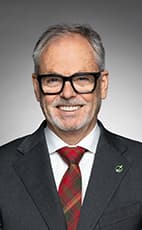
Louis Villeneuve
In the 90 days to October 1, 2026, 3 organizations lobbied Louis Villeneuve across 3 meetings — most often about Taxation and Finance. The most frequent visitor was Canadian ETF Association (1 meeting, via Chris Collins of Aurora Strategy Group). Its registration describes the goal as “The Canadian ETF Association is looking to promote its organization and its priorities with relevant Parliamentarians, public Servants and…”. That's fewer than the average MP, who had 6 meetings over the same period.
Based on federal lobbying registry data to October 1, 2026
In the House · Oct 5–9
Louis Villeneuve this week
“Today I would like to pay tribute to Suzanne‑Marie Landry. Suzanne‑Marie devoted much of her life to promoting culture in the Eastern Townships and in my riding of Brome—Missisquoi. She was passionate, engaged and determined.”
- Spoke 1 time in the House · the average MP spoke 5 times
- FORC-39, second reading — Respecting certain measures to strengthen the economy · passed 296–26
- AGAINSTC-218, second reading — Medical assistance in dying · defeated 141–187
- AGAINSTOpposition Motion (Diesel prices) · defeated 133–196
- FORFifth report of the Standing Committee on Health · passed 196–132
Get Louis Villeneuve's week in your inbox every Monday
What they said, how they voted, and who lobbied them. Free, no ads, unsubscribe anytime.
How Louis Villeneuve actually voted
Their recorded positions on the issues Canadians care about — pulled straight from the parliamentary record.
- Voted Against
- Voted For
Healthcare
Fifth report of the Standing Committee on Health
Oct 2026 · Passed
- Voted For
Labour & Employment
Establish a national framework respecting skilled trades and labour mobility
C-266 · Sep 2026 · Passed · Tell your MP what you think
- Voted For
Economy & Taxation
Implement certain provisions of the spring economic update tabled in Parliament on April 28, 2026
C-30 · Jun 2026 · Passed · Tell your MP what you think
- Voted For
Housing
Authorize certain payments to be made out of the Consolidated Revenue Fund for the purpose of improving housing supply
C-26 · Jun 2026 · Passed · Tell your MP what you think
Overall leanings
99%
voted with the Liberal line this Parliament · broke ranks 1×
100%
vote attendance (178/178)
Who's lobbying Louis
Individual meeting records from the federal lobbying registry
| Organization | |
|---|---|
| Canadian ETF Association2026-09-23 · Financial Institutions; Taxation and Finance | |
| Canadian ETF Association (CETFA)2026-09-23 · Taxation and Finance | |
| IBM Canada Limited2026-07-03 · Regional Development; Economic Development | |
| Canadian Federation of Independent Business (CFIB)2026-06-04 · Employment and Training; Internal Trade; Labour; Small Business; Economic Development | |
| Trans Canada Trail2026-06-02 · Environment; Arts and Culture; Economic Development |
Write to Louis Villeneuve
Pick what it's about. You'll get a letter you can edit, then send it from your own email.
Other ways to reach Louis
613-992-4211 is the House of Commons switchboard — ask to be connected to your MP's office. For constituency office contact details, or if louis.villeneuve@parl.gc.ca bounces, visit their Parliament profile.
Committee Memberships
What Louis talks about
- Conservation Donations7 speeches · 2025–2026
- An Act to Implement the Protocol on the Accession of the United Kingdom of Great Britain and Northern Ireland to the Comprehensive and Progressive Agreement for Trans-Pacific Partnership2 speeches · 2026
- The Budget2 speeches · 2025
- 150th Anniversary of Cowansville1 speeches · 2026
- 150th Anniversary of Farnham1 speeches · 2026
Recent Speeches
Mr. Speaker, today I would like to pay tribute to Suzanne‑Marie Landry. Suzanne‑Marie devoted much of her life to promoting culture in the Eastern Townships and in my riding of Brome—Missisquoi. She was passionate, engaged and determined. She always focused on helping others thrive by providing enco… Read full speechShow less
Mr. Speaker, today I would like to pay tribute to Suzanne‑Marie Landry. Suzanne‑Marie devoted much of her life to promoting culture in the Eastern Townships and in my riding of Brome—Missisquoi. She was passionate, engaged and determined. She always focused on helping others thrive by providing encouragement and motivation. Suzanne‑Marie was a cultural dynamo with a zest for life. How sad it is that she was taken from us far too soon. Suzanne‑Marie understood that culture brings us together, gives us a way to tell our story and breathes life into our regions. She left behind a precious legacy and a lasting imprint on everyone who crossed her path. On the day she died, she called me to ask if I was going to see the show in Bromont that night. I told her that, unfortunately, I had an event to go to and that we could talk the next day. I never had a chance to speak with her again. I want to thank my friend Suzanne‑Marie. May she rest in peace.
Mr. Speaker, as a family doctor, my colleague treated thousands of patients during his career. I would like to know why affordability is so important to him.
Mr. Speaker, I would like to begin by acknowledging the quality of my colleague's French. He has nothing to worry about. His French was very good. I would also like to reassure him that our Prime Minister listens to his caucus. I think that is very important. I am going to stick to Bill C-10. The go… Read full speechShow less
Mr. Speaker, I would like to begin by acknowledging the quality of my colleague's French. He has nothing to worry about. His French was very good. I would also like to reassure him that our Prime Minister listens to his caucus. I think that is very important. I am going to stick to Bill C-10. The government wants to move things forward. I know my colleague is doing his job, but it is important to note that some Conservative members have, in the past, delayed the passage of legislation affecting indigenous peoples. What assurances can the Conservatives give us that this time their party will work to pass the bill quickly and without unnecessary delay to help modern treaty partners in their ridings?
Mr. Speaker, like my colleague, I began my career in radio. That was in 1974. I would imagine he was quite young then. At that time, more people were tuning into AM radio. I rise today with great interest to support Bill C-268. This bill, introduced by my colleague, aims to improve cellular coverage… Read full speechShow less
Mr. Speaker, like my colleague, I began my career in radio. That was in 1974. I would imagine he was quite young then. At that time, more people were tuning into AM radio. I rise today with great interest to support Bill C-268. This bill, introduced by my colleague, aims to improve cellular coverage in rural areas across Canada. The member who introduced this bill is my riding neighbour. We often go around together, and we call each other and chat from time to time. There are times when one of us misses something the other just said because the line cut out. We experience these problems, too. I would like to begin by commending her leadership on this issue. I believe she is taking a serious, well-thought-out approach that is deeply rooted in the reality faced by citizens in all regions of the country. Beyond the policies and regulatory frameworks, this debate is about something very simple, in my opinion: enabling Canadians to stay connected to loved ones, to services, to the economy and, most importantly, to their safety. Over the past several years, we have collectively made significant progress in terms of improving Internet access. This was discussed earlier. Substantial investments have been made to bridge the digital divide, which had become unacceptable. However, while progress has been made on that front, there is another equally fundamental and persistent issue, that of cellular connectivity. Today, in Canada, nearly one-quarter of provincial highways have no reliable cellular coverage. Let us imagine what that means in practical terms. It means that a parent driving on a highway with their kids may have no way to reach someone in an emergency. It also means that a worker driving around a rural region may not have cell service for tens of kilometres. It also means that an accident could happen and there could be no immediate way to call for help. This is not some hypothetical situation. This is an everyday reality. In my riding of Brome—Missisquoi, these situations are all too real. Dead zones are part of the landscape there. These include stretches of rural roads, forested areas, valleys, entire concessions and villages. I am thinking of Clarenceville, Saint‑Ignace‑de‑Stanbridge and the area between Bromont and Cowansville. Even at home, I have to wave my phone around to get a signal. I am not talking about a connection that is simply slow or unstable. I am talking about total silence: no calls, no messages, no access. The consequences are very real. For instance, farmers tell me that they have to deal with disruptions in their daily operations, even as modern agriculture increasingly relies on connected technologies. Entrepreneurs also tell me that this limits their ability to innovate, attract clients and grow their businesses. Self-employed workers tell me about contracts they have lost simply because they could not be reached. Above all, citizens confide in me that they feel vulnerable when they are on the road, when a loved one is travelling and when they realize that, in certain situations, they are completely cut off from the rest of the world. The impact of these disruptions is not limited to full-time residents of our regions. In a riding like Brome—Missisquoi, we get tens of thousands of visitors a year. They include families, cyclists and outdoor enthusiasts who come to enjoy our scenery, our wineries and our local attractions. A lot of these visitors are city dwellers who are used to uninterrupted connectivity, and when they encounter our dead zones, the consequences for them and for local residents are very real. People may get lost, be unable to use GPS, have trouble reaching emergency services if needed, or simply be unable to communicate with loved ones. Situations like these can quickly turn a positive tourism experience into a source of stress and anxiety. In addition to the impact on individuals, this situation also has economic repercussions, because an area with unstable connectivity is less attractive. Visitors may be reluctant to come back. Tourism companies may lose business opportunities. All this is to say that the cellular coverage issue in the regions does not just affect the year-round residents. It affects everyone who visits, invests and contributes to the economic vitality of our communities. In a riding like mine, cell service is not a luxury. It is a matter of public safety. It is a matter of economic development and a matter of regional equity. However, the official data make it seem like the issue has largely been resolved. The data shows coverage rates as high as 97%. Let me just say I know one thing about coverage: If the phone is showing just half a bar, there is no coverage. It is important to remember that this data is largely based on information self-reported by telecommunications companies, without any systematic independent verification. This makes no sense. As a result, there is a disconnect between what the numbers suggest and what citizens actually experience. When the data is flawed, so are the decisions. That is why the first good thing about Bill C-268 is that it tackles this problem at its root: the quality of the information. The bill requires the CRTC to establish a mechanism for independent verification of cellular coverage data. I believe this is a simple, reasonable and essential measure. Before we can fix a problem, we must first see it clearly, and right now, we cannot do that. Today, underserved areas are all too often underestimated or even invisible in decision-making tools. The second pillar of this bill is just as important: modernizing our spectrum policy framework. This framework has not been updated since 2007. At that time, smart phones were barely a thing. In fact, they were only just coming onto the scene. Digital usage patterns were radically different. Data requirements were incomparable to what they are today. Since then, everything has changed, except the framework. Continuing to rely on a framework designed for a different era means accepting that our policies are lagging behind reality. That is why the bill provides for a comprehensive review within 18 months. This review must address a fundamental question: Does our current approach truly enable us to serve the whole of Canada? In light of the experiences of regions like mine, the answer is quite clearly “no”. Market forces alone have not been able to ensure equitable coverage. This is not a criticism; it is a statement of fact. In densely populated areas, investment happens naturally. However, in rural areas like ours, in remote regions where costs are higher and where, obviously, return on investment is less immediate, roll-out remains limited. That is precisely why the third pillar of the bill is essential. It introduces a clear priority for underserved areas. It requires that future spectrum policy decisions consider, in a clear and deliberate manner, the needs of rural areas, remote communities, indigenous communities and roadside coverage. Roads are not trivial matters. They are the lifelines of our country. They connect our communities and support our economy. I want to conclude by once again congratulating my colleague. She did tremendous work and I think the issue needed to be tackled head-on.
Mr. Speaker, I would first like to tell my colleague how deeply moved I am by what he just said. I also want to go back to the comments that a Conservative member made yesterday about the noose, which I think were shameful. Here in Canada, no one should feel unsafe because of who they are, what reli… Read full speechShow less
Mr. Speaker, I would first like to tell my colleague how deeply moved I am by what he just said. I also want to go back to the comments that a Conservative member made yesterday about the noose, which I think were shameful. Here in Canada, no one should feel unsafe because of who they are, what religion they practise, or where they gather. Recent incidents of Islamophobia have left too many people feeling vulnerable. Could my colleague tell us how Bill C-9 will help our constituents feel safer?
MyMP is free and run by one person in Edmonton. Reader support keeps it that way. Chip in