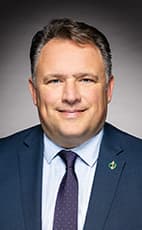
Rob Moore
In the 90 days to October 1, 2026, Rob Moore had one registered lobbying meeting — about Natural Resources. It was with Canadian Propane Association (via their in-house lobbyist Shannon Watt). Its registration describes the goal as “Discussions with government officials regarding the national electricity strategy and the role of propane, renewable propane and rDME in…”. That's fewer than the average MP, who had 6 meetings over the same period.
Based on federal lobbying registry data to October 1, 2026
In the House · Oct 5–9
Rob Moore this week
- No speeches in the House · the average MP spoke 5 times
- FORC-39, second reading — Respecting certain measures to strengthen the economy · passed 296–26
- FORC-218, second reading — Medical assistance in dying · defeated 141–187
- FOROpposition Motion (Diesel prices) · defeated 133–196
- AGAINSTFifth report of the Standing Committee on Health · passed 196–132
Get Rob Moore's week in your inbox every Monday
What they said, how they voted, and who lobbied them. Free, no ads, unsubscribe anytime.
How Rob Moore actually voted
Their recorded positions on the issues Canadians care about — pulled straight from the parliamentary record.
- Voted For
- Voted Against
Healthcare
Fifth report of the Standing Committee on Health
Oct 2026 · Passed
- Voted For
Labour & Employment
Establish a national framework respecting skilled trades and labour mobility
C-266 · Sep 2026 · Passed · Tell your MP what you think
- Voted Against
Economy & Taxation
Implement certain provisions of the spring economic update tabled in Parliament on April 28, 2026
C-30 · Jun 2026 · Passed · Tell your MP what you think
- Voted Against
Housing
Authorize certain payments to be made out of the Consolidated Revenue Fund for the purpose of improving housing supply
C-26 · Jun 2026 · Passed · Tell your MP what you think
Overall leanings
100%
voted with the Conservative line this Parliament
100%
vote attendance (178/178)
Who's lobbying Rob
Individual meeting records from the federal lobbying registry
| Organization | |
|---|---|
| Canadian Propane Association2026-08-19 · Energy; Environment; Agriculture; Taxation and Finance; Transportation | |
| Canadian Mental Health Association of New Brunswick2026-03-31 · Health; Taxation and Finance; Federal-Provincial Relations | |
| Alliance of Manufacturers & Exporters Canada (CME)2025-11-18 · Industry; International Trade; Labour; Taxation and Finance; Economic Development | |
| Canadian Propane Association2025-10-16 · Energy; Environment; Agriculture; Taxation and Finance; Transportation | |
| Canada's National Firearms Association2025-09-24 · Justice and Law Enforcement |
Write to Rob Moore
Pick what it's about. You'll get a letter you can edit, then send it from your own email.
Other ways to reach Rob
613-992-4211 is the House of Commons switchboard — ask to be connected to your MP's office. For constituency office contact details, or if rob.moore@parl.gc.ca bounces, visit their Parliament profile.
Top Lobbying Clients
Companies with the most meetings with this MP since July 2008
What Rob talks about
- Criminal Code59 speeches · 2021–2024
- Justice38 speeches · 2021–2025
- Public Safety11 speeches · 2021–2025
- Judges Act10 speeches · 2022
- Protecting Victims Act7 speeches · 2026
Recent Speeches
Mr. Speaker, when I was last speaking, I was talking about the irrefutable fact that, since 2015, when the Liberal government took power, we have seen skyrocketing rates of crime. That is due to some deliberate actions that the government took. I am thinking, specifically, of Bill C-5, which did awa… Read full speechShow less
Mr. Speaker, when I was last speaking, I was talking about the irrefutable fact that, since 2015, when the Liberal government took power, we have seen skyrocketing rates of crime. That is due to some deliberate actions that the government took. I am thinking, specifically, of Bill C-5, which did away with mandatory penalties for serious drug and gun crime and allowed for house arrest for serious offences like arson. It allowed someone to commit a violent crime, even burn down someone's house, and serve their sentence from the comfort of their own home and in the community where they offended. Bill C-75 was the notorious law that was brought in, which introduced a principle of restraint that has really tied the hands of our system and forced people out on bail who have no business being out on bail. We have seen the results. What are the results? Since 2015, human trafficking has increased by 84%. Sexual assaults are up by 76%. Violent crime is up by almost 55%. My home province of New Brunswick is not immune to this skyrocketing crime. When I speak to my constituents, there are concerns about violent crime, property crime and all manner of crime that people have seen skyrocket, such as drug-related crime. The numbers are staggering. The total number of violent crimes in New Brunswick alone is up over 70%. As for total violent firearms offences, this is a government that talks a talk on firearms. The problem is that every measure the Liberals take has been completely ineffective because they target law-abiding citizens, the people who I represent in my riding of Fundy Royal, while completely going soft on hardened criminals. What is the result? Violent firearms offences are up over 150%. Extortion is up over 300%. Theft of motor vehicle offences are up over 150% since that time. What they have done with the bill is unfortunate. There is something called a mandatory minimum penalty. It is a penalty in the Criminal Code that says that we, as parliamentarians, recognize that, sometimes, an offence is so grave that it should carry with it a certain minimum amount of time in custody. There have been mandatory minimum penalties brought in by previous Liberal governments. There have been mandatory minimum penalties brought in by Conservative governments, and which have been constitutionally upheld, but because the Liberal government is so ideologically opposed to Parliament having its say, listening to our constituents and saying that certain crimes deserve to have a mandatory penalty if someone has committed the offence, the Liberals have introduced in the legislation a clause that would allow judges to ignore the mandatory penalty for someone convicted of these serious crimes. One could look up the definition of “mandatory” in Webster's, but I am pretty sure that allowing someone to ignore a mandatory penalty means it is no longer a mandatory penalty, What is the result of that? Certain mandatory penalties for offences, many of them considered by the courts and constitutionally upheld, will now be able to be ignored, offences like aggravated sexual assault with a gun, human trafficking, multiple violent firearms offences, extortion with a firearm, weapons trafficking and drive-by shootings with restricted or prohibited firearms. In the Criminal Code, there is a mandatory penalty for someone convicted of those offences. The bill would allow judges to ignore that mandatory penalty when they are sentencing. I can tell members, having served on the justice committee, that we heard many times about how there has not been a huge increase in the number of criminals in Canada. There has been a very prolific number of criminals who do a great job at what they do. They are committing crimes non-stop because they have a system in which, once they are caught, once the police have done their job and have caught someone, once they have been tried and convicted, they are out on bail, if they are pretrial, and, once convicted, they may be serving their sentence in house arrest. I will sum up by quoting an individual who appeared at our justice committee. She urged members to restore justice to the justice system. As a victim of crime, she said she does not feel we have a justice system anymore in Canada. She feels we have a legal system, not a justice system. I urge everyone to listen to those words and do our job. It is, rightly, the job of parliamentarians to say we are the ones who draft the Criminal Code, set out mandatory penalties and maximum and minimum sentences, and distinguish between different offences. There is a tremendous amount of flexibility in the system when the police have discretion and prosecutors have the discretion on whether to proceed by summary conviction or indictment. At the end of the day, we, as parliamentarians, are responsible for the safety of our constituents. We must ensure that our actions illustrate this and that we take strong measures. I would like at this time to move: That the debate be now adjourned.
Mr. Speaker, it is great to be here this evening with colleagues debating this important issue. That is what we do in the House. We debate, we discuss important issues for Canadians and we have some great discussions. One thing, though, that is really not debatable, if we believe at all in evidence,… Read full speechShow less
Mr. Speaker, it is great to be here this evening with colleagues debating this important issue. That is what we do in the House. We debate, we discuss important issues for Canadians and we have some great discussions. One thing, though, that is really not debatable, if we believe at all in evidence, is that the Liberals have had a failed justice policy, and the last decade has been one where Canadians have demonstrably suffered when it comes to justice. As a former member of the justice committee, I will never forget when a witness, who was a victim of crime herself, appeared and said that in Canada now we have a legal system, but we do not have a justice system. I was very impacted by those words and determined, like many of my colleagues on this side, to listen to those voices and make a better, truly just system that Canadians could be proud of and that would make them feel safe. I know if I asked my constituents, and I do, and if many here asked their constituents if they felt safer than they did 10 years ago, they would say that things have changed. Do they feel safe to send their kids to the mall or to walk to school? Do they feel safe when they leave their home? Do they feel safe to leave their vehicle? In the community I live in, my whole life, we did not lock our car doors. Many people did not lock their houses; they just left them unlocked. That was the kind of neighbourhood and community it was. That has now changed, and it has changed because of a failed Liberal justice system. I heard some of the commentary this evening about mandatory minimum penalties, etc. However, where there is no debate and no doubt is that the Liberals do not know what they are doing when it comes to Canada's justice system. Some of the statistics are absolutely staggering. Since 2015, which is when the Liberals formed government, human trafficking in Canada has increased 84%, sexual assaults are up 76% and violent crime is up 55%. In just the first nine years after forming government, total homicides are up 28% and violent firearms offences are up 117%. This is nine consecutive years of increases. Extortion is up almost 400%, auto theft is up 50% and sexual violations against children are up over 100%. Forcible confinement or kidnapping, indecent harassing and communications and trafficking in persons are up almost 100%. When we speak of these things, they are not just statistics. Each one of those represents a victim, a victim's family and a community that feels less safe than it did before. The cumulative effect of terrible pieces of legislation is the statistics and the heartbreak that has flowed from them over this last decade. What are some of these terrible pieces of legislation? Did this happen by accident? Was it things, as the Liberal government members like to say, outside of their control? No, these were things that were very much within the control of the government, and it took active steps that made the situation demonstrably worse. What am I talking about? There is Bill C‑75, which fundamentally changed our bail system and introduced a so-called principle of restraint that meant judges were forced to use the least onerous provisions possible when it came to decisions around bail. It led to absolutely outrageous and ludicrous situations like the one we heard about at the justice committee. The Toronto Police Service testified that individuals who had already received bail for a previous gun crime were being let out on bail again for gun crimes. They had committed a firearms offence, received bail, were then arrested again for a serious firearms offence, received bail again and had then been arrested a third time. They were out on bail both previous times. That was not an uncommon situation. Bill C‑75 changed the rules around bail, police forces and victims groups throughout our country. Provincial attorneys general have all commented and beseeched us to address the soft-on-crime bail that the government has introduced. The other bill that comes to mind is Bill C-5. We have heard some discussion this evening about mandatory jail times. Conservatives believe that for serious offences, there should be mandatory jail time. Some of these Liberal members who are speaking positively about tougher sentencing were, just a few years ago, defending Bill C-5, which eliminated mandatory jail time for importing, exporting and producing serious drugs, schedule I drugs. It eliminated mandatory jail time for offences like arson, drive-by shootings and serious firearms offences. It not only eliminated the mandatory penalties but allowed for house arrest. Someone could burn down a person's house but serve their sentence from the comfort of their own home, playing video games, etc., as one can imagine. Individuals could commit serious violent offences, and people would be forced to see the perpetrators still in the community, even after having been sentenced, because they were sentenced to house arrest for the type of offence where someone should not get house arrest. That brings us here to this particular piece of legislation, Bill C-16. Bill C-16 has another “get out of jail free” card. The Liberals cannot help themselves. There are many mandatory minimum penalties, mandatory sentences for crimes that Parliament deems to be serious. Even though there are many of them in the Criminal Code that have been upheld constitutionally, many of them that are sound, that are in our code and that are effective, the bill would create a release valve whereby a judge can decide not to apply the mandatory penalty, even for offences where the mandatory penalty has been upheld. Some of the offences for which Bill C-16 would allow judges to ignore the mandatory prison time that this Parliament and previous Parliaments have seen fit to introduce include aggravated sexual assault with a gun, human trafficking, multiple violent firearms offences, extortion with a firearm, weapons trafficking and drive-by shootings with restricted or prohibited firearms. Canadians have had enough. They have had enough of violent crime and extortion. They have had enough with the assaults, sexual assaults and property crime. This bill would undermine our justice system by allowing judges to ignore the mandatory penalties that Parliament saw fit to put in place. Parliament put those penalties in place to protect the Canadians who are so deserving of that protection. It speaks to that witness who appeared at our justice committee and said we need to have not just a legal system but a justice system. That witness implored us to take steps to ensure that we have a justice system. Well, I can assure my colleagues that allowing for the elimination of all mandatory minimum penalties, as this legislation would, is not what this individual had in mind. I want to recognize a couple of my colleagues, our justice shadow minister, the member for Brantford—Brant South—Six Nations; our public safety shadow minister, the member for Kamloops—Thompson—Nicola; and indeed our entire team on this side. For the last decade, in areas around auto theft, drugs, extortion, violent crime and crimes against children, every area where we could protect individuals in our communities, Conservative members of Parliament have been standing up and putting forward private members' bills. One that I put forward would restore the mandatory penalties for trafficking in fentanyl and cocaine and for those who are running meth labs. These are the mandatory penalties the Liberal government, in its wisdom, decided to remove. If we were to ask whether the drug crime and drug abuse situation in Canada is better today, under the Liberal policies, than it was 10 years ago, there is not a person in this room, in this chamber, who would say things have gotten better. Unless they are willing to deny the evidence that comes to us from Stats Canada, there is not a person in this chamber who would say that the situation when it comes to violent crime, property crime, crimes against women and crimes against children is getting better. When we look at solutions, we need to look at solutions that are going to be effective, not half measures. What this piece of legislation would do, and this is a provision I certainly cannot support, is allow judges to ignore mandatory minimum penalties that have been constitutionally upheld, that exist in the Criminal Code and that were put in there for a reason, because they recognize the seriousness of the offences that are covered. I often hear in this place that the number one thing, the most important thing we can do, is to protect our fellow Canadians. I take that challenge very seriously. For a number of people I know in this chamber, colleagues I have talked to, improving our criminal justice system is one of the principal drivers of why they got involved in politics and why they were eventually elected as members of Parliament. We need to ensure that we are doing our very best. Some mandatory minimums have been struck down, but to allow judges to ignore those that have been upheld in the past would be a major fault. We must stand up for the victims of crime.
Madam Speaker, I rise on a point of order. I would like to give notice, under Standing Order 43(2)(a), that all remaining Conservative caucus speaking slots are hereby divided in two.
Mr. Speaker, it is an honour to speak today on our opposition day motion. I do want to say at the outset that I will be splitting my time with the member for Kitchener Centre. Why are we speaking on this today? I listened with interest to the government members' speeches, which touched very little o… Read full speechShow less
Mr. Speaker, it is an honour to speak today on our opposition day motion. I do want to say at the outset that I will be splitting my time with the member for Kitchener Centre. Why are we speaking on this today? I listened with interest to the government members' speeches, which touched very little on the realities that Canadians are facing in my riding of Fundy Royal, in my province of New Brunswick and throughout the country. The results of over 10 years of Liberal governance are seen in the stats today: delinquencies are up, bankruptcies are up, crime is up and food bank use is up. The percentage of people's income going toward just paying tax, at a time when they can least afford it, is up, with 32% more of Canadians' dollars going toward taxes than just 10 years ago. Unfortunately, rather than taking accountability for this situation and proposing changes that would actually help the individuals who are struggling, hard-working Canadian taxpayers, we see avoidance of the issue. Our proposal recognizes a few things. The government members love to say that this is all due to international things out of their control. We have all heard the excuse that the dog ate my homework; this is the government equivalent of that. It is someone else's fault that they are not doing the job they are supposed to be doing. The job the government should be doing is making life as safe and affordable as possible for hard-working Canadians. Gas prices are 13% higher in Canada than they are in the United States. That equates to 22¢ Canadian more on average per litre. Gas costs now 50¢ more per litre than when global oil prices were at the exact same level in 2014. One might ask how this is possible. It is because of the greed of government, a government that knows no bounds when it comes to greed. When people are down and suffering, the government is raking in record windfalls directly off the backs of hard-working Canadians. I mentioned food bank use being at a high. In my home province of New Brunswick, the results are staggering, with a 55% increase in food bank use in just one year. There are 50,000 visits per month by New Brunswickers to our community food banks. We have great food banks. I am thinking, in my riding of Fundy Royal, of the Hampton food bank, and the work it does every day, every week, providing help to neighbours and those who are in need. However, what I hear from many volunteers is that they are stretched to the limit. They have never seen demand at the level that it is. We must ask ourselves what we can do to help out. One of the ways Conservatives are saying we can help out, to the tune of $1,200 per year, is to take the taxes off gasoline for this year. Gasoline and diesel is at a record high, so we are saying to take the taxes off fuel. What are those taxes we are talking about? We are talking about the clean fuel standard, the GST, the industrial carbon tax and the fuel excise tax. I have to mention, illustrating the greed of government, that not only are these taxes on the cost of gasoline, which keeps going up and up, but these taxes are also on each other. We tax the tax in this country, so when one tax goes up and the price of gas goes up, the tax on that tax goes up. This results in Canadians being gouged at the pump when they can least afford it. Our proposal is one that would provide savings to Canadian families who are doing such things as driving their kids to a hockey game, driving their kids to baseball practice, driving to work, trying to get back and forth to visit family or maybe taking a vacation this summer where they get in their vehicle and explore someplace in New Brunswick, such as the Hopewell Rocks or the Fundy Trail, or someplace throughout Canada. At every turn, this government is making life more expensive for those families who are just trying to provide a livelihood for their family and provide those basic necessities. We are not talking about luxuries any more. Many Canadians have long given up on luxuries. On the decisions that families and seniors are now facing, I hear often from seniors in my riding who are struggling with the cost of rent, fuel and food. All of these things have increased, not one or the other, but all of them have increased dramatically under this government. Pay raises have not kept pace. Seniors' benefits have not kept pace. Each year, individuals are falling further and further behind. This is the result of a decade of Liberal credit card budgets, and of waste and mismanagement. This motion today calls on the government to offer Canadians immediate relief by ending all federal taxes on gas and diesel for the rest of the year, including the GST, and permanently scrap the clean fuel standard. The GST is a special case in this situation, because every time fuel increases, even by 1¢, the share that this government greedily scoops up from GST revenue also goes up. When the price of fuel increases by 10¢, the GST on that fuel also increases. This is an unbudgeted windfall for the government due to skyrocketing prices that it is raking in on the backs of everyday Canadians. I would love to call it a half-measure, and a half-measure would have been pretty good, but this is not even a one-third measure of what should be done to help Canadians with the cost of fuel this year. For the entire year, the Canadian hidden industrial carbon tax, the clean fuel standard, the GST, all fuel taxes, should be removed from the price of fuel. Members only need to go to their local gas station to fill up to hear the talk around the pumps about how difficult it is to fill up that tank. That tank of gas means a livelihood for some people. It means getting to a loved one this summer when people go to visit family. It means getting kids to sports. It is quite heartbreaking to see parents making that difficult decision of not being able to do some of the things they love to do, some of those family traditions, all because of government greed. We are not asking the government today to fix every problem. I already mentioned that delinquencies are up, bankruptcies are up, food bank use is up and crime has skyrocketed over a decade of Liberal governance. What we are asking the Liberals to do today is to take this one meaningful step in this one area. We are calling on them, for today, to remove all these taxes on fuel and to stop blaming everyone else. We have demonstrated today, and I heard some of my Conservative colleagues speak about this, why the cost of fuel in Canada is more than in the U.S. It comes down to the taxes we pay. While this government and its members, and I have seen them, are pointing their finger everywhere except at themselves, the blame lies with the government as to why Canadians today, when they fill up their vehicle, are being gouged. I would ask all hon. members in the House to think about their constituents back home, think about the people they represent, and ask them, if they were standing at the pump talking to constituents as they filled up their van, pickup or their car, if they thought we should be gouging them right now by charging ever-increasing amounts of GST and other taxes on fuel, or if they thought we should help them out. I think they would listen to their constituents and remove the taxes from fuel.
Mr. Speaker, the fact of the matter is that the numbers do not lie. If the government was doing a good job on affordability, I would be the first to say, “Hey, you guys are doing a great job.” Unfortunately, the numbers and constituents, if she were to talk to her constituents the way I am talking t… Read full speechShow less
Mr. Speaker, the fact of the matter is that the numbers do not lie. If the government was doing a good job on affordability, I would be the first to say, “Hey, you guys are doing a great job.” Unfortunately, the numbers and constituents, if she were to talk to her constituents the way I am talking to my constituents, say we are living in an affordability crisis. The cost of food, groceries, fuel and housing is higher after a decade of Liberal governing. I am very proud to speak to my constituents and say that I will fight tooth and nail for more affordability in our communities, our province and our country.
Bills Sponsored
3 since 2001
MyMP is free and run by one person in Edmonton. Reader support keeps it that way. Chip in