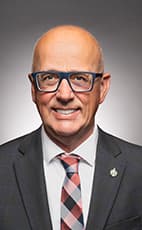
Tako Van Popta
In the 90 days to October 1, 2026, 2 organizations lobbied Tako Van Popta across 2 meetings — most often about Economic Development. The most frequent visitor was British Columbia Maritime Employers Association (1 meeting, via their in-house lobbyist Mike Leonard). Its registration describes the goal as “Consultations to strengthen labour relations and better support workers with respect to the Canada Labour Code and the collective…”. That's fewer than the average MP, who had 6 meetings over the same period.
Based on federal lobbying registry data to October 1, 2026
In the House · Oct 5–9
Tako Van Popta this week
- No speeches in the House · the average MP spoke 5 times
- FORC-39, second reading — Respecting certain measures to strengthen the economy · passed 296–26
- FORC-218, second reading — Medical assistance in dying · defeated 141–187
- FOROpposition Motion (Diesel prices) · defeated 133–196
- AGAINSTFifth report of the Standing Committee on Health · passed 196–132
Get Tako Van Popta's week in your inbox every Monday
What they said, how they voted, and who lobbied them. Free, no ads, unsubscribe anytime.
How Tako Van Popta actually voted
Their recorded positions on the issues Canadians care about — pulled straight from the parliamentary record.
- Voted For
- Voted Against
Healthcare
Fifth report of the Standing Committee on Health
Oct 2026 · Passed
- Voted For
Labour & Employment
Establish a national framework respecting skilled trades and labour mobility
C-266 · Sep 2026 · Passed · Tell your MP what you think
- Voted Against
Economy & Taxation
Implement certain provisions of the spring economic update tabled in Parliament on April 28, 2026
C-30 · Jun 2026 · Passed · Tell your MP what you think
- Voted Against
Housing
Authorize certain payments to be made out of the Consolidated Revenue Fund for the purpose of improving housing supply
C-26 · Jun 2026 · Passed · Tell your MP what you think
Overall leanings
100%
voted with the Conservative line this Parliament
100%
vote attendance (178/178)
Who's lobbying Tako
Individual meeting records from the federal lobbying registry
| Organization | |
|---|---|
| British Columbia Maritime Employers Association2026-08-19 · Labour; Transportation; Economic Development | |
| Montrose Property Holdings Ltd.2026-08-05 · Economic Development | |
| Sacred Waters Development2026-06-09 · Aboriginal Affairs; Housing; Economic Development; Natural Resources | |
| First Nations Education Steering Committee2026-06-08 · Aboriginal Affairs; Taxation and Finance; Education | |
| Mosaic Forest Management Corp.2026-05-21 · Constitutional Issues |
Write to Tako Van Popta
Pick what it's about. You'll get a letter you can edit, then send it from your own email.
Other ways to reach Tako
613-992-4211 is the House of Commons switchboard — ask to be connected to your MP's office. For constituency office contact details, or if tako.vanpopta@parl.gc.ca bounces, visit their Parliament profile.
Committee Memberships
Top Lobbying Clients
Companies with the most meetings with this MP since July 2008
What Tako talks about
- Criminal Code40 speeches · 2021–2024
- Judges Act27 speeches · 2022–2023
- Housing16 speeches · 2021–2026
- The Economy14 speeches · 2022–2026
- Miscarriage of Justice Review Commission Act (David and Joyce Milgaard's Law)13 speeches · 2023–2024
Recent Speeches
Mr. Speaker, this summer, as chair of the Conservative task force on property rights, I travelled B.C., meeting with homeowners, farmers, business owners and industry leaders. Their message was clear. They are worried that the private property security they once took for granted is being eroded. Pro… Read full speechShow less
Mr. Speaker, this summer, as chair of the Conservative task force on property rights, I travelled B.C., meeting with homeowners, farmers, business owners and industry leaders. Their message was clear. They are worried that the private property security they once took for granted is being eroded. Property rights are a cornerstone of a free and prosperous society. They give families the confidence to build a future and businesses the certainty to invest, grow and create jobs. However, through a series of misguided decisions, David Eby's NDP government and the Liberals here in Ottawa have created uncertainty where there should be security, and anxiety where there should be confidence. Only Conservatives are speaking clearly for the principle that what Canadians earn, invest in and own deserves the full protection of the law, because protecting property rights means protecting both prosperity and freedom.
Mr. Speaker, it is great to be back in the House of Commons after a very busy summer at home in my riding of Langley Township—Fraser Heights and throughout British Columbia. Like every member of the House, I am sure, I heard from many Canadians about their concerns about the state of Canada's econom… Read full speechShow less
Mr. Speaker, it is great to be back in the House of Commons after a very busy summer at home in my riding of Langley Township—Fraser Heights and throughout British Columbia. Like every member of the House, I am sure, I heard from many Canadians about their concerns about the state of Canada's economy, so I would like to start with this: Conservatives are focused on saving Canadians money. Liberals are all talk and no results. Liberals are costing Canadians more. They are out of touch, and Canadians are out of money. The Conservative plan, on the other hand, restores the promise of an affordable, safe and independent Canada. It will save people money. It will save Canadian jobs. It will keep people safe. It will fix immigration, and it will put Canada first, always. As I was speaking with people throughout British Columbia, I also heard deep concerns about the economic uncertainty that has arisen under the Cowichan Tribes decision, which, for the first time in Canadian history, declared aboriginal title over fee simple lands. Somehow those two competing interests have to live with each other, and that brings me to the topic of the day: Bill C-10, an act respecting the commissioner for modern treaty implementation. Let me start with this. Conservatives agree with the importance of modern treaties. Treaties are the way forward for Canada. Treaties create certainty. Treaties provide clarity. Treaties are better than endless litigation. Well-negotiated treaties can reconcile indigenous rights, support economic development and provide stable foundations for future generations. Canada continues to grapple with one of the unfinished chapters of Confederation, unresolved indigenous land claims, and nowhere is this more true than in British Columbia, my home province. This summer, as chair of the Conservative Party task force on property rights, I travelled around British Columbia with colleagues, and we met with realtors, bankers, appraisers, ranchers, builders, business owners, indigenous leaders and ordinary Canadian homeowners. I wanted to hear their concerns following the British Columbia Supreme Court decision in the Cowichan Tribes case. As I said, for the first time in Canadian history, aboriginal title has now been declared over privately held lands. The judge in that court case said that the indefeasible title provisions of the British Columbia Land Title Act do not apply to aboriginal title when it is declared over private lands. This is a seismic shift in thinking about private ownership, about private lands. This goes to the very foundation of our modern western economy. Whether one disagrees or agrees with the legal reasoning in that decision, there is no disputing that it has generated significant uncertainty across many sectors in Canada's economy. We heard concerns about mortgage lending and financing. We heard concerns about real estate valuation and investment. We heard concerns about investment decisions. We heard concerns about municipal tax bases and economic development. One real estate property appraiser described the situation this way: He said that, historically, appraisers could rely on the indefeasibility provisions of the land title office to confirm the ownership and determine exactly what interest was being valued. However, after the Cowichan decision, appraisal firms are increasingly inserting disclaimers related to aboriginal title claims. They are putting it right into their report, saying that they assume there are no aboriginal title claims on the property. Well, that goes to the value of the property and undermines certainty. It undermines confidence in our economy. Certainty matters. People buying homes need certainty. Businesses making investment decisions need certainty. Indigenous communities seeking economic development and opportunities also require certainty. Municipalities planning for the future need certainty. As one business leader at one of our round table meetings put it, if we have no certainty in Canada, we have no Canada. I would agree with that. We need to know where we are, going forward. One of our meetings was in Victoria, British Columbia. My colleagues and I met with leaders from the Cowichan tribes, the plaintiffs in the litigation. We had a great meeting. We certainly did not agree on everything, but we agreed on one very important point: The treaty-making process in British Columbia has not adequately resolved these questions for either indigenous or non-indigenous communities. One of the chiefs made an observation that has stayed with me. She described the treaty-making process and the settlement of land claims as the unfinished work of Canada's Confederation, and I agree with that. When British Columbia entered Confederation in 1871, Canada promised to connect the province to the rest of the country with a transcontinental railroad. As settlement expanded westward through Ontario and the Prairies, the federal government negotiated what we call today the numbered treaties, covering most of Ontario, all of the provinces, and even the northeastern section of British Columbia. These treaties facilitated settlement, established a relationship with indigenous communities, provided for certainty as the country grew, and facilitated development and even the railroad. However, when Canada reached the Rocky Mountains, the process largely stopped. Apart from the Douglas treaties in the southern part of Vancouver Island around Victoria and Treaty 8 in the northeast, as I already mentioned, most of British Columbia was left outside the treaty system. The result is that British Columbia remains unique in Canada. Most of the province was never covered by historic treaties. This unresolved reality has shaped decades of litigation and important court cases, all of them originating in my home province: from the Calder decision to the Delgamuukw decision, the Tsilhqot'in decision and most recently the Cowichan decision. Today, most of British Columbia's 204 identified first nations have unresolved claims. There are similar unresolved claims in other parts of Canada as well, such as in the Ottawa Valley, in the Maritimes and in some parts of Quebec, but British Columbia stands out as having a real lack of modern treaties. That is why we say modern treaties are so important. We support them. Negotiated treaties are better than litigation. Clear treaties are better than uncertainty. Final settlements are better than decades of court battles. In fact, many of the constituents I heard from this summer reinforce that very point. The answer to uncertainty is not more uncertainty. The answer is clearer agreements: treaties that define rights, responsibilities and expectations. That brings me to the topic of the day, Bill C-10. Many Canadians hearing about this legislation might reasonably assume that it is designed to accelerate treaty negotiations, settle outstanding claims or help complete the unfinished work of treaty making in Canada. Unfortunately, that is not what the bill would do. Bill C-10 would primarily create a new commissioner and a new institution to oversee the implementation of existing treaties. That work was already being done very effectively by the Office of the Auditor General, but the Liberal government simply chose to ignore those reports. How would this be different with the new treaty commissioner? The problem is not that Canada is suffering from a shortage of commissioners. It is suffering from a shortage of action and results. The Liberals' response to many problems is to create a new office, another agency, another commissioner or another layer of bureaucracy. Permits are being held up, so they create a Major Projects Office. Housing is unaffordable, so they create another office, another bureaucracy for housing that is going to overlook the previous commissions that were not doing their job. If treaty implementation is falling behind, the Liberals say to create another commission. I am saying that the appearance of action is not action itself. We already have the Auditor General's office for that work. The answer is to do the work. Reconciliation cannot be measured by how many commissions there are. It must be measured by outcomes. Canada needs a serious plan to complete the unfinished work of reconciliation and treaty making. Reconciliation and certainty are not competing goals; they are complementary goals. Indeed, the best treaties in history have advanced both. Unfortunately, Bill C-10 would do very little. We do not need more commissions. We need action.
Mr. Speaker, we are absolutely supporting the modern treaty process. We underline how important it is. We underline that treaties are better than endless litigation, which we are seeing in British Columbia. I would just add that the government has mismanaged the litigation file seriously, just as it… Read full speechShow less
Mr. Speaker, we are absolutely supporting the modern treaty process. We underline how important it is. We underline that treaties are better than endless litigation, which we are seeing in British Columbia. I would just add that the government has mismanaged the litigation file seriously, just as it was mismanaging the treaty implementation. The Auditor General has reported on it numerous times. Why do the Liberals not just fill the deficiencies, roll up their sleeves and get the job done?
Mr. Speaker, British Columbia is unique in that most of the territory is not covered by treaties, unlike Ontario, for example. However, there are areas, including my colleague's riding, where treaties have not been negotiated, so this is a Canada-wide problem. The uncertainty arising out of the liti… Read full speechShow less
Mr. Speaker, British Columbia is unique in that most of the territory is not covered by treaties, unlike Ontario, for example. However, there are areas, including my colleague's riding, where treaties have not been negotiated, so this is a Canada-wide problem. The uncertainty arising out of the litigation around property rights is undermining Canadians' confidence in one of the pillars of our economy: private property rights. It must be resolved.
Mr. Speaker, indeed there are a lot of gaps in Bill C-10. As a matter of fact, we are saying that the commissioner is not necessary. It would just be another layer of bureaucracy. We already have the Auditor General's office, which has been reporting on government deficiencies in implementing the mo… Read full speechShow less
Mr. Speaker, indeed there are a lot of gaps in Bill C-10. As a matter of fact, we are saying that the commissioner is not necessary. It would just be another layer of bureaucracy. We already have the Auditor General's office, which has been reporting on government deficiencies in implementing the modern treaties, but rather than admit that it has mismanaged the file, in typical Liberal fashion the government has just made another announcement about another organization that is finally going to solve the problems. I remain unconvinced that this is going to happen. What we need is for the government to roll up its sleeves, get the job done and get it done now.
MyMP is free and run by one person in Edmonton. Reader support keeps it that way. Chip in