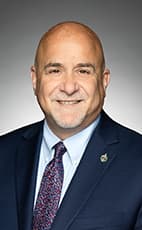
Tony Baldinelli
In the 90 days to September 18, 2026, 5 organizations lobbied Tony Baldinelli across 5 meetings — most often about Transportation. The most frequent visitor was Canadian Vehicle Manufacturers' Association (1 meeting, via their in-house lobbyist Brian Kingston). Its registration describes the goal as “Border/port security policy, capacity, and federal-provincial coordination to combat auto theft”. That's fewer than the average MP, who had 6 meetings over the same period.
Based on federal lobbying registry data to September 18, 2026
In the House · Sep 21–25
Tony Baldinelli this week
“Under the Liberal government's parole regime, a murderer can ask for freedom again and again. Each hearing forces grieving families to relive the worst trauma of their lives. Paul Bernardo's fourth chance at parole is approaching.”
- Spoke 2 times in the House · the average MP spoke 4 times
- FORC-266, second reading — Establish a national framework respecting skilled trades and labour mobility · passed 295–21
Get Tony Baldinelli's week in your inbox every Monday
What they said, how they voted, and who lobbied them. Free, no ads, unsubscribe anytime.
How Tony Baldinelli actually voted
Their recorded positions on the issues Canadians care about — pulled straight from the parliamentary record.
- Voted For
Labour & Employment
Establish a national framework respecting skilled trades and labour mobility
C-266 · Sep 2026 · Passed · Tell your MP what you think
- Voted Against
Economy & Taxation
Implement certain provisions of the spring economic update tabled in Parliament on April 28, 2026
C-30 · Jun 2026 · Passed · Tell your MP what you think
- Voted Against
Housing
Authorize certain payments to be made out of the Consolidated Revenue Fund for the purpose of improving housing supply
C-26 · Jun 2026 · Passed · Tell your MP what you think
- Voted Against
Criminal Justice
Hate propaganda, hate crime and access to religious or cultural places
C-9 · Jun 2026 · Passed · Tell your MP what you think
- Voted Against
Overall leanings
100%
voted with the Conservative line this Parliament
100%
vote attendance (174/174)
Who’s in Tony’s ear
513
lobbying meetings
204
companies & groups
297
speeches in Parliament
Top lobbying relationship: Tourism Industry Association of Canada — met 25 times · most lobbied on Tourism.
See who’s lobbying Tony →Who's lobbying Tony
Individual meeting records from the federal lobbying registry
| Date | Organization | |
|---|---|---|
| 2026-08-21 | Canadian Vehicle Manufacturers' Association | |
| 2026-08-17 | Hotels Canada | |
| 2026-07-22 | Air Canada | |
| 2026-06-30 | Ontario Power Generation Inc. | |
| 2026-06-30 | Atura H2 LP |
Write to Tony Baldinelli
Pick what it's about. You'll get a letter you can edit, then send it from your own email.
Other ways to reach Tony
613-992-4211 is the House of Commons switchboard — ask to be connected to your MP's office. For constituency office contact details, or if tony.baldinelli@parl.gc.ca bounces, visit their Parliament profile.
Committee Memberships
Top Lobbying Clients
Companies with the most meetings with this MP
What Tony talks about
- Automotive Industry9 speeches · 2025–2026
- Corrections and Conditional Release Act9 speeches · 2023–2026
- Economic and Fiscal Update Implementation Act, 20219 speeches · 2022
- Tourism Industry9 speeches · 2021–2025
- Public Safety8 speeches · 2021–2025
Recent Speeches
Mr. Speaker, under the Liberal government's parole regime, a murderer can ask for freedom again and again. Each hearing forces grieving families to relive the worst trauma of their lives. Paul Bernardo's fourth chance at parole is approaching. Once again, the families of Kristen French and Leslie Ma… Read full speechShow less
Mr. Speaker, under the Liberal government's parole regime, a murderer can ask for freedom again and again. Each hearing forces grieving families to relive the worst trauma of their lives. Paul Bernardo's fourth chance at parole is approaching. Once again, the families of Kristen French and Leslie Mahaffy are being forced to relive this nightmare. Victims' families and police are calling for parole reform. Conservatives proposed legislation to make it happen. The Liberals voted no. Why are the Liberals protecting repeat parole hearings for killers instead of protecting victims' families?
Mr. Speaker, I rise to provide some brief remarks on the dissenting opinion put forward by the Conservative Party of Canada, as His Majesty's loyal opposition, on this important study conducted by the science and research committee. First, I want to acknowledge that this report contains contradictin… Read full speechShow less
Mr. Speaker, I rise to provide some brief remarks on the dissenting opinion put forward by the Conservative Party of Canada, as His Majesty's loyal opposition, on this important study conducted by the science and research committee. First, I want to acknowledge that this report contains contradicting opinions and recommendations, and our dissenting opinion not only points this out, but also provides the Conservative position on several of the recommendations. In short, our position emphasizes the need for the Government of Canada, its federal research agencies and our academic institutions to return to merit-based research funding and hiring practices. Simply put, merit matters, and decisions based on merit and on the quality of the research topic and the individual researcher doing the work should be paramount. The report also highlights the decline in viewpoint diversity, as well as the rise and concern of anti-Semitism being spread and fostered in Canadian universities. This report contains and captures excellent witness testimony, and I encourage everyone to review the expressions that were shared with the committee.
Mr. Speaker, Bill C-26 gives the Liberal Minister of Finance a blank cheque to spend $1.7 billion with no guarantees of results, targets or accountability to build homes. In fact, the word “housing” is in this bill only twice. My hon. colleague mentioned the rebate program, the program that was sign… Read full speechShow less
Mr. Speaker, Bill C-26 gives the Liberal Minister of Finance a blank cheque to spend $1.7 billion with no guarantees of results, targets or accountability to build homes. In fact, the word “housing” is in this bill only twice. My hon. colleague mentioned the rebate program, the program that was signed with the Province of Ontario, yet there is no specific program put in place through regulation on how that rebate will work. That is my understanding. I have had developers call me as late as last week. They cannot find out from the Ontario government how the rebate works. When they are told by the province to go to the CRA, the CRA is telling them it does not know how this program works. Perhaps the member can tell us how this rebate program will work.
Mr. Speaker, the member speaks about the Liberal commitment to bail reform, justice reform and listening to police and constituents. Would he not agree that we are here today because of Liberal policies that are soft on crime? We are here today because of Bill C‑75, the principle of restraint and ba… Read full speechShow less
Mr. Speaker, the member speaks about the Liberal commitment to bail reform, justice reform and listening to police and constituents. Would he not agree that we are here today because of Liberal policies that are soft on crime? We are here today because of Bill C‑75, the principle of restraint and bail reform; Bill C‑5 on mandatory minimums; and Bill C‑83, the “least restrictive environment”, which allows Paul Bernardo to be in a medium-security institution. The Liberal backbench voted against my legislation, Bill C‑232, so Paul Bernardo is allowed to stay in medium security. The Liberals talk a good game, but we know, truly, who they are. Why is the member here today dictating to us about this concern when they are actually fixing the problems they created?
Mr. Speaker, it is an honour to rise in the chamber today to share some final thoughts on my private member's bill, Bill C-232, before we conclude second reading debate and proceed to an eventual vote. When I first introduced this bill in the 44th Parliament as Bill C-342, I made a promise to my con… Read full speechShow less
Mr. Speaker, it is an honour to rise in the chamber today to share some final thoughts on my private member's bill, Bill C-232, before we conclude second reading debate and proceed to an eventual vote. When I first introduced this bill in the 44th Parliament as Bill C-342, I made a promise to my constituents to see what I could do to help correct a bad policy decision made by the Liberal government in 2019, when it passed C-83. Reintroducing this bill in this Parliament is evidence of my continued commitment to fulfill that promise to my constituents. If passed, Bill C-232 would require inmates who have been found to be dangerous offenders or convicted of more than one first-degree murder to be assigned a security classification of “maximum” and confined in a maximum-security penitentiary or area in a penitentiary. This legislation should be seen as non-partisan and a common-sense legislative response to the concerns expressed by many of our constituents. This is about doing what is right by ensuring that criminal monsters, such as Paul Bernardo, Mark Smich, Dellen Millard and Luka Magnotta, are returned to serve their sentences in a maximum-security penitentiary where they rightly belong. Earlier in this debate, my Bloc colleague expressed concerns that the bill targets only a single case. It does not, as I demonstrated by the list of notorious criminal names I have just read into this record. My Bloc colleague also expressed concerns about CSC's judgment and that sometimes the justice system makes mistakes. I agree with this. In fact, that is the very reason why this bill is being debated today. It was a mistake by the CSC to transfer Paul Bernardo from maximum to medium security. That needs to be corrected. Downgrading the security classification of these criminal monsters is not justice. It is an injustice to victims and their loved ones. The victims in these cases had their lives stolen, and their surviving loved ones have no choice but to endure a lifetime of pain and hurt. I also wish to take a moment to address some of the things we heard and did not hear from the Liberal members taking part in this debate. Earlier in this debate, my Liberal colleagues spent a lot of time talking about rehabilitation. I would like the Liberals to clarify if they think criminal monsters like Paul Bernardo can be rehabilitated. Let us not forget that former CSC commissioner Anne Kelly, when she appeared before the public safety committee, called Paul Bernardo a “psychopath”. This bill clearly targets the worst of the worst dangerous offenders in Canada. Do the Liberals truly believe Paul Bernardo should be or deserves to be rehabilitated? Sadly, too often in this splendid place we hear why things cannot be done and why we cannot make this type of change. Instead, let us muster our political will, courage and leadership to bring about this important change. My constituent, Marcia Penner, a victims' rights advocate and friend of Kristen French, supports this change. She said, “As someone whose life has been forever impacted by violent crime, I know firsthand that victims and their families carry the consequences of these horrific acts every day. Canadians expect the most dangerous offenders to remain in maximum-security institutions, and Bill C-232 helps restore that common-sense principle while respecting the voices of victims.” Alicia Googoo, the founder of the victims' rights organization Our Heart on Our Sleeve, had this to say about Bill C-232. She said, “As a survivor, I understand the lasting fear and trauma that violent offenders can leave behind. I know the dangers that can exist when society fails to take the risks posed by the most dangerous offenders seriously. Bill C-232 sends a clear message that public safety matters and that the protection of Canadians must remain a priority.” I sincerely hope my colleagues across party lines will strongly consider, and reconsider, their positions and vote in favour of Bill C-232 so that this important legislative move can be brought forward for study at committee.
Bills Sponsored
Recent activity
23 activities across speeches, bills, and lobbying communications.
September 2026
Oral Questions
Mr. Speaker, under the Liberal government's parole regime, a murderer can ask for freedom again and again. Each hearing forces grieving families to relive the worst trauma of their lives. Paul Bernard… Read full speechShow less
Mr. Speaker, under the Liberal government's parole regime, a murderer can ask for freedom again and again. Each hearing forces grieving families to relive the worst trauma of their lives. Paul Bernardo's fourth chance at parole is approaching. Once again, the families of Kristen French and Leslie Mahaffy are being forced to relive this nightmare. Victims' families and police are calling for parole reform. Conservatives proposed legislation to make it happen. The Liberals voted no. Why are the Liberals protecting repeat parole hearings for killers instead of protecting victims' families?
Routine Proceedings
Mr. Speaker, I rise to provide some brief remarks on the dissenting opinion put forward by the Conservative Party of Canada, as His Majesty's loyal opposition, on this important study conducted by the… Read full speechShow less
Mr. Speaker, I rise to provide some brief remarks on the dissenting opinion put forward by the Conservative Party of Canada, as His Majesty's loyal opposition, on this important study conducted by the science and research committee. First, I want to acknowledge that this report contains contradicting opinions and recommendations, and our dissenting opinion not only points this out, but also provides the Conservative position on several of the recommendations. In short, our position emphasizes the need for the Government of Canada, its federal research agencies and our academic institutions to return to merit-based research funding and hiring practices. Simply put, merit matters, and decisions based on merit and on the quality of the research topic and the individual researcher doing the work should be paramount. The report also highlights the decline in viewpoint diversity, as well as the rise and concern of anti-Semitism being spread and fostered in Canadian universities. This report contains and captures excellent witness testimony, and I encourage everyone to review the expressions that were shared with the committee.
June 2026
Government Orders
Mr. Speaker, Bill C-26 gives the Liberal Minister of Finance a blank cheque to spend $1.7 billion with no guarantees of results, targets or accountability to build homes. In fact, the word “housing” i… Read full speechShow less
Mr. Speaker, Bill C-26 gives the Liberal Minister of Finance a blank cheque to spend $1.7 billion with no guarantees of results, targets or accountability to build homes. In fact, the word “housing” is in this bill only twice. My hon. colleague mentioned the rebate program, the program that was signed with the Province of Ontario, yet there is no specific program put in place through regulation on how that rebate will work. That is my understanding. I have had developers call me as late as last week. They cannot find out from the Ontario government how the rebate works. When they are told by the province to go to the CRA, the CRA is telling them it does not know how this program works. Perhaps the member can tell us how this rebate program will work.
Government Orders
Mr. Speaker, the member speaks about the Liberal commitment to bail reform, justice reform and listening to police and constituents. Would he not agree that we are here today because of Liberal polici… Read full speechShow less
Mr. Speaker, the member speaks about the Liberal commitment to bail reform, justice reform and listening to police and constituents. Would he not agree that we are here today because of Liberal policies that are soft on crime? We are here today because of Bill C‑75, the principle of restraint and bail reform; Bill C‑5 on mandatory minimums; and Bill C‑83, the “least restrictive environment”, which allows Paul Bernardo to be in a medium-security institution. The Liberal backbench voted against my legislation, Bill C‑232, so Paul Bernardo is allowed to stay in medium security. The Liberals talk a good game, but we know, truly, who they are. Why is the member here today dictating to us about this concern when they are actually fixing the problems they created?
Private Members' Business
Mr. Speaker, it is an honour to rise in the chamber today to share some final thoughts on my private member's bill, Bill C-232, before we conclude second reading debate and proceed to an eventual vote… Read full speechShow less
Mr. Speaker, it is an honour to rise in the chamber today to share some final thoughts on my private member's bill, Bill C-232, before we conclude second reading debate and proceed to an eventual vote. When I first introduced this bill in the 44th Parliament as Bill C-342, I made a promise to my constituents to see what I could do to help correct a bad policy decision made by the Liberal government in 2019, when it passed C-83. Reintroducing this bill in this Parliament is evidence of my continued commitment to fulfill that promise to my constituents. If passed, Bill C-232 would require inmates who have been found to be dangerous offenders or convicted of more than one first-degree murder to be assigned a security classification of “maximum” and confined in a maximum-security penitentiary or area in a penitentiary. This legislation should be seen as non-partisan and a common-sense legislative response to the concerns expressed by many of our constituents. This is about doing what is right by ensuring that criminal monsters, such as Paul Bernardo, Mark Smich, Dellen Millard and Luka Magnotta, are returned to serve their sentences in a maximum-security penitentiary where they rightly belong. Earlier in this debate, my Bloc colleague expressed concerns that the bill targets only a single case. It does not, as I demonstrated by the list of notorious criminal names I have just read into this record. My Bloc colleague also expressed concerns about CSC's judgment and that sometimes the justice system makes mistakes. I agree with this. In fact, that is the very reason why this bill is being debated today. It was a mistake by the CSC to transfer Paul Bernardo from maximum to medium security. That needs to be corrected. Downgrading the security classification of these criminal monsters is not justice. It is an injustice to victims and their loved ones. The victims in these cases had their lives stolen, and their surviving loved ones have no choice but to endure a lifetime of pain and hurt. I also wish to take a moment to address some of the things we heard and did not hear from the Liberal members taking part in this debate. Earlier in this debate, my Liberal colleagues spent a lot of time talking about rehabilitation. I would like the Liberals to clarify if they think criminal monsters like Paul Bernardo can be rehabilitated. Let us not forget that former CSC commissioner Anne Kelly, when she appeared before the public safety committee, called Paul Bernardo a “psychopath”. This bill clearly targets the worst of the worst dangerous offenders in Canada. Do the Liberals truly believe Paul Bernardo should be or deserves to be rehabilitated? Sadly, too often in this splendid place we hear why things cannot be done and why we cannot make this type of change. Instead, let us muster our political will, courage and leadership to bring about this important change. My constituent, Marcia Penner, a victims' rights advocate and friend of Kristen French, supports this change. She said, “As someone whose life has been forever impacted by violent crime, I know firsthand that victims and their families carry the consequences of these horrific acts every day. Canadians expect the most dangerous offenders to remain in maximum-security institutions, and Bill C-232 helps restore that common-sense principle while respecting the voices of victims.” Alicia Googoo, the founder of the victims' rights organization Our Heart on Our Sleeve, had this to say about Bill C-232. She said, “As a survivor, I understand the lasting fear and trauma that violent offenders can leave behind. I know the dangers that can exist when society fails to take the risks posed by the most dangerous offenders seriously. Bill C-232 sends a clear message that public safety matters and that the protection of Canadians must remain a priority.” I sincerely hope my colleagues across party lines will strongly consider, and reconsider, their positions and vote in favour of Bill C-232 so that this important legislative move can be brought forward for study at committee.
Private Members' Business
Mr. Speaker, I request a recorded division.
Government Orders
Mr. Speaker, I was at the same meeting the member referred to, the heart-on-our-sleeve meeting with victims. I heard their gut-wrenching stories and witnessed their bravery in sharing their stories, s… Read full speechShow less
Mr. Speaker, I was at the same meeting the member referred to, the heart-on-our-sleeve meeting with victims. I heard their gut-wrenching stories and witnessed their bravery in sharing their stories, so I wanted to ask this question: Why did the government vote against excluding child sexual offences from the safety valve? If mandatory minimum penalties can be ignored, what exactly is mandatory about them?
May 2026
Government Orders
Mr. Speaker, I would like to thank the hon. member for her description of the excellence, the talent and the workforce that have been created. I had the pleasure of working for the Ontario government … Read full speechShow less
Mr. Speaker, I would like to thank the hon. member for her description of the excellence, the talent and the workforce that have been created. I had the pleasure of working for the Ontario government in 1995 when we came forward with the Ontario film and tax credit. We have generous tax credits provincially and federally, which have allowed the excellence of that industry to grow. However, does the member not think that the ruling from the CRTC, the penalizing of the revenues up to 15% and the tax that will flow because of it, lead to penalizing the industry and to the loss of jobs and expertise? It is a competitive business. Production companies are being told to go to the United States. Would we lose because of this move?
Government Orders
Mr. Speaker, I have a question for my hon. colleague. Does he think that the tripling of this tax by the CRTC will not hurt the cultural industries and artists we seek to support? I worked for the pro… Read full speechShow less
Mr. Speaker, I have a question for my hon. colleague. Does he think that the tripling of this tax by the CRTC will not hurt the cultural industries and artists we seek to support? I worked for the provincial government back in 1996 when the Ontario government passed the Ontario film and television tax credit. Back then it was Mike Harris's government, and the industry thrived. It grew tremendously. We are putting that at risk, making the industry more uncompetitive, by tripling a tax on them, so companies will not reinvest in Canada. They will make the decision to invest in productions in the United States, not here in Canada, supporting Canadian industries, supporting Canadian artists and telling Canadian stories.
Government Orders
Mr. Speaker, in the short time I have available to me, I want to say how pleased I am to speak on our Conservative motion that “the House call on the Liberal Cabinet to use their powers under the Broa… Read full speechShow less
Mr. Speaker, in the short time I have available to me, I want to say how pleased I am to speak on our Conservative motion that “the House call on the Liberal Cabinet to use their powers under the Broadcasting Act to reject the CRTC's streaming tax increase and eliminate the streaming tax.” For the Canadians who are watching, the Liberal-appointed CRTC recently ordered online streaming services to pay 15% of their annual Canadian revenues to the government. That is up from the current 5%. There are three basic reasons why we are advocating for that to be rolled back and eliminated. First, it is an affordability issue. At a time when families are struggling to afford food, gas and housing, another tax hike makes no sense, particularly now. Second, it hinders investment. It does not do anything to enhance the competitive nature of our cultural industries in Canada. In fact, it will only hinder our cultural industries. It works against what we are trying to do. Earlier, when I was talking to a colleague, I said that in 1996, the Conservative government in the province of Ontario, the government of Mike Harris, introduced an Ontario film and television tax credit, which allowed the industry to grow and thrive and supported the cultural industries and artists. That is being put at risk by an increased tax burden that will only drive those investments away.
Government Orders
Mr. Speaker, I request a recorded division.
Oral Questions
Mr. Speaker, the Liberal Prime Minister falsely claimed to Canadians that “affordability's the best it's [ever] been in over a decade”. We are 11 years into the Liberal government, and one in four Can… Read full speechShow less
Mr. Speaker, the Liberal Prime Minister falsely claimed to Canadians that “affordability's the best it's [ever] been in over a decade”. We are 11 years into the Liberal government, and one in four Canadians is living in a food-insecure household. Two million Canadians are visiting a food bank each month, and over 13,000 residents in Niagara Falls need the services of our food bank, Project Share. Conservatives have a real plan to give Canadians relief from Liberal inflation by removing all federal fuel taxes for the rest of the year. On what date will these Liberals adopt it?
April 2026
Statements by Members
Mr. Speaker, Pete Townsend of The Who wrote the song Won't Get Fooled Again, which has these lines: Meet the new boss Same as the old boss This costly credit card budget confirms that. Can members bel… Read full speechShow less
Mr. Speaker, Pete Townsend of The Who wrote the song Won't Get Fooled Again, which has these lines: Meet the new boss Same as the old boss This costly credit card budget confirms that. Can members believe that the man who claims to be the smartest person in the room has doubled Justin Trudeau's deficit? The Liberals are spending more on their servicing of the debt than they are on health care. These debt-servicing costs will be borne by our children and grandchildren, and they are going to bankers instead of being invested into the health care system to support Canadians from coast to coast. For all the Liberals' new spending, there was no mention of Niagara, no mention of previously promised funding for the Shaw Festival, nor was there an extension of the critically important wine sector support program. The self-proclaimed new Liberal government is just more of the same. It spends more and taxes more while Canadians get less and ultimately are simply left holding the bill. Canadians deserve so much better.
Statements by Members
Mr. Speaker, this week our local food bank held a volunteer appreciation day to thank its supporters for the role they play in helping to address and solve issues of affordability within our community… Read full speechShow less
Mr. Speaker, this week our local food bank held a volunteer appreciation day to thank its supporters for the role they play in helping to address and solve issues of affordability within our community. Project Share has been providing emergency food and support services to residents of Niagara Falls for more than 30 years. Sadly, more than ever, food banks in Niagara and across this country are being stretched beyond their limits by an affordability crisis caused by the Liberals. The PM likes to remind himself, and anyone who will listen, that he is the smartest person in the room, yet he doubled Justin Trudeau's deficit and only added inflationary pressures to the economic hardship Canadians face today. On March 25, the PM told Canadians, “Affordability is the best it has been in over a decade”, but the more the Liberals spend, the worse inflation gets and the more Canadians struggle just to get by. If it is the best in over a decade, he should tell that to the two million Canadians who visit a food bank every month and to the 13,000 residents in Niagara Falls who have to—
Oral Questions
Mr. Speaker, 2.6 million Canadians depend on trade with the United States for their livelihoods. Niagara is home to 641 businesses that generated $6.6 billion in exports to the United States. Trade wi… Read full speechShow less
Mr. Speaker, 2.6 million Canadians depend on trade with the United States for their livelihoods. Niagara is home to 641 businesses that generated $6.6 billion in exports to the United States. Trade with the U.S. is not a weakness, as the Liberal Prime Minister suggests. It is our daily reality. Mexico and the U.S. are talking trade right now. Meanwhile, Canada has not had serious talks with our largest trading partner in five months. Why is the Liberal government dragging its feet?
Statements by Members
Mr Speaker, seven years ago, the Hon. Rob Nicholson announced his retirement after a distinguished 24 years in public service representing the communities of Niagara Falls, Niagara-on-the-Lake and For… Read full speechShow less
Mr Speaker, seven years ago, the Hon. Rob Nicholson announced his retirement after a distinguished 24 years in public service representing the communities of Niagara Falls, Niagara-on-the-Lake and Fort Erie. Having worked for Rob, I considered him my political mentor and viewed his dedication, integrity and character in public office as the embodiment of what is good in politics. This past fall, the City of Niagara Falls renamed a community trail after him. During his remarks, he said, “Public service has been one of the greatest privileges of my life. Every step of the journey was meaningful because of the people I had the chance to represent”. These incredible words demonstrate Rob's commitment to service above self, an attribute all members in this place should carry and exercise when representing and serving their constituents. At the end of the month, Rob will celebrate his 74th birthday. I wish Rob a happy birthday. He is a great friend. Our community was lucky to have him serve as its federal representative.
March 2026
Government Orders
Mr. Speaker, it is an honour for me to rise in my place today to participate in the debate on our opposition motion, which calls on the federal government to support the Conservative plan to double au… Read full speechShow less
Mr. Speaker, it is an honour for me to rise in my place today to participate in the debate on our opposition motion, which calls on the federal government to support the Conservative plan to double automotive production through a tariff-free auto pact. This bold new policy offers a fresh take on a similar policy, embodied by the old auto pact rules that resulted in Canada's auto manufacturing growing from 700,000 units a year to three million by 1999. This Conservative plan makes our goal clear. We seek to double auto production to two million vehicles a year, which are the same levels we had before the Liberal government took office 10 years ago. The viewers at home heard that right. Since the Liberals took office in 2015, auto production in Canada has been halved. In 2016, Canada built 2.3 million vehicles. Last year, that auto production was only 1.2 million. In only one year since the Prime Minister took office, Canada has lost 7.8% of its auto production. As output falls, jobs vanish. In 2015, Canada's passenger vehicle and light truck assembly plants employed 32,700 people. By 2024, that number had dropped to 23,732. In the last year alone, since the Prime Minister took office, Canadians have watched in utter disbelief as 5,000 great-paying auto jobs disappeared and moved to the United States. Under the federal Liberal government, Canada's auto industry has been in decline for 10 years and it is slipping away, with potentially irreparable damage being done to Canada's economy if no immediate federal action is taken. We are seeing this decline in the Niagara region as the local GM powertrain facility in St. Catharines faces great uncertainty because it produces only one line of engines in a facility that is almost two million square feet in size. I am GM proud. I drive a GM vehicle, whose very engine was made in St. Catharines by Canadian GM workers. GM has been in business in St. Catharines since 1929. That is close to 100 years. I also worked at our local GM plant as a student during my university years. At that time, GM in St. Catharines had three plants, employing close to 10,000 workers with great-paying jobs. Today, our local GM footprint has been reduced to just one plant and a much smaller workforce of Unifor Local 199 members. There are roughly 450 active workers at the plant, with 200 laid off. As a Niagara area MP and as the member of Parliament for Niagara Falls—Niagara-on-the-Lake, I have a responsibility to represent the current and former GM workers who reside in the communities in my riding. Last April, the Prime Minister ran a campaign promising an elbows-up approach to Canada-U.S. trade relations. He promised to protect the auto sector. He committed to tabling a plan that would persuade the Americans to remove tariffs on Canadian goods. He promised to get tariffs removed by July 21, 2025, but this was all an illusion, as 246 days after July 21, 2025, American tariffs remain and Canada's auto manufacturers have been forced to pay Donald Trump close to $2 billion. One year since the Liberals' election promises were made, they have been broken, while Canadian auto production continues its decline and Canadian auto job losses are piling up. Rather than doing what he said he was going to do, the Liberal Prime Minister has decided to accept that American tariffs are permanent and he has declared a deep rupture with our largest trading partner, neighbour and ally. Worse, he has introduced a new EV policy and rebate that use Canadian tax dollars to subsidize the purchase of foreign-made automobiles. He is also allowing the import of 49,000 Chinese EV spy cars into this country after declaring a new world order with countries like China, the nation he said was our biggest security threat during the last federal election. Canadian auto workers deserve stronger federal leadership. The last thing they want is imported Chinese EVs taking their jobs away even faster, or the federal government doubling down on a fantasy EV industry that does not exist without the demand, affordability or sufficient charging infrastructure in place. That is why our Conservative leader is stepping up to take initiative and demonstrate leadership. While the Liberals have decided to accept that American tariffs are permanent and declare a deep rupture with our largest trading partner, Conservatives are proposing policy ideas to make it easier to build and buy Canadian by: ...removing the GST on all Canadian-made vehicles, ending counterproductive Liberal EV mandates and [subsidies], and harmonizing tailpipe emissions reductions with our North American partners; ...bringing home production...by implementing a rule where for every car produced in Canada, the same manufacturer would get to sell a car in Canada, duty-free, from a CUSMA partner, on a dollar-for-dollar basis, similar to the 1965 Canada-US Auto Pact; [and] ...protecting North American supply chains by maintaining the minimum 75% North American content and existing CUSMA rules on origin.... Conservatives believe it is possible to get a North American free trade agreement for the auto sector. The Liberals have given up and think that somehow, when it has never happened before, European and Asian EV sales will materialize and make up for the decline that will happen because of the U.S. tariffs. What the Liberal government is proposing is a fallacy. The Liberals' plan includes exporting EVs to Europe. Simply put, more vehicles were stolen in Canada last year, including the the justice minister's vehicle, than were exported to countries in Europe. We have a plan to get tariff-free access to the United States. It would boost auto production. It is supported by Unifor Local 222, which said, “Finally, a common sense plan” to restore auto production. Why can the Liberal government not get on board with us and support our common-sense proposals? Our policy approach would restore manufacturing balance for both Canada and the U.S., thus making a duty-free agreement not only possible, but also beneficial for both countries. For Canada, that would mean increased production of 500,000 to 800,000 units to get North American duty-free access. In addition to this, removal of the GST, a 5% pricing cut, adds up to $30,000 new sales a year, which increases demand and production by the same amount. We forecast that the current production will rise from 1.2 million to two million within a decade. Just today, I met with Unifor representatives who told me that buying Canadian, along with sell here, build here policies, are very important to them. That is what this policy encourages. It is a common-sense plan to protect the livelihoods of thousands of hard-working Ontario auto workers. The Canadian Vehicle Manufacturers' Association saw the benefit of our policy proposal when it stated, “North American integration has underpinned Canada’s auto industry for over 60 years”. This plan recognizes that reality. Conservatives will not sit idly by as our proud Canadian auto industry is hollowed out and lost due to Liberal inaction. We are stepping up, demonstrating federal leadership and offering real solutions to save the jobs of our great Canadian auto workers. They deserve it.
Government Orders
Mr. Speaker, what we do not support is the Liberals' failed EV policy, which they are implementing. They fail to realize that 90% of the autos that are produced in this country are shipped to the Unit… Read full speechShow less
Mr. Speaker, what we do not support is the Liberals' failed EV policy, which they are implementing. They fail to realize that 90% of the autos that are produced in this country are shipped to the United States. The success of the auto industry in Canada was based on the regulatory harmony that existed with our largest trading partner and customer for Canadian-made autos, the United States. The fantasy and the fallacy that the Liberals continue to promote about producing EVs will simply not work. Do members know that, just this year alone, GM had an EV writeoff of $7.6 billion, Honda wrote off $15.7 billion, Ford wrote off $19.5 billion and Stellantis wrote off $27 billion? That is almost $70 billion. The EV policy they are promoting is only going to hurt Canadian auto workers.
Government Orders
Mr. Speaker, there is the notion that Stellantis's failure is partly to be blamed on the government and its failed EV policies. Again, Stellantis has written off $27 billion because of this fallacy of… Read full speechShow less
Mr. Speaker, there is the notion that Stellantis's failure is partly to be blamed on the government and its failed EV policies. Again, Stellantis has written off $27 billion because of this fallacy of an EV mandate that the Liberals have put in place instead of recognizing that the market should determine what the sales levels in autos should be. Why not go back? We met with Unifor today, and the members I met with are talking about buy Canadian, and sell here, build here policies, which we need to promote and encourage. That is what our auto pact plan would do. It would say that, if someone wants to sell a vehicle here, they have to build it here, and that would return jobs to Canadian auto workers all throughout southern Ontario.
Government Orders
Mr. Speaker, through our policy on this Canadian auto pact, we are talking about a policy to buy Canadian, sell here and build here. It only makes sense. We want to encourage those who want to produce… Read full speechShow less
Mr. Speaker, through our policy on this Canadian auto pact, we are talking about a policy to buy Canadian, sell here and build here. It only makes sense. We want to encourage those who want to produce, such as the big three automakers. General Motors has been in my community since 1929. They have invested and grown with this community. They have been in this community for almost 100 years. I want to ensure, through the policy we are promoting, that General Motors can be in our community for another 100 years, employing Canadians and providing good-paying jobs.
February 2026
House of Commons
467 communications with 184 clients
Top clients: [{"name": "Tourism Industry Association of Canada", "count": 24}, {"name": "Hote…