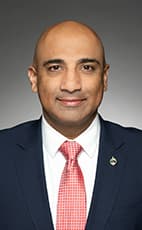
Parm Bains
In the 90 days to September 18, 2026, 9 organizations lobbied Parm Bains across 11 meetings — most often about Employment and Training. The most frequent visitor was British Columbia's Children's Hospital Foundation (2 meetings, via their in-house lobbyist Malcolm Berry). Its registration describes the goal as “Seek funding for the development of a new mental health building on the BC Children’s Hospital campus”. That's more than the average MP, who had 6 meetings over the same period.
Based on federal lobbying registry data to September 18, 2026
In the House · Oct 5–6
Parm Bains this week
- No speeches in the House · the average MP spoke 2 times
- AGAINSTC-218, second reading — Medical assistance in dying · defeated 141–187
- AGAINSTOpposition Motion (Diesel prices) · defeated 133–196
- FORFifth report of the Standing Committee on Health · passed 196–132
Get Parm Bains's week in your inbox every Monday
What they said, how they voted, and who lobbied them. Free, no ads, unsubscribe anytime.
How Parm Bains actually voted
Their recorded positions on the issues Canadians care about — pulled straight from the parliamentary record.
- Voted Against
- Voted For
Healthcare
Fifth report of the Standing Committee on Health
Oct 2026 · Passed
- Voted For
Labour & Employment
Establish a national framework respecting skilled trades and labour mobility
C-266 · Sep 2026 · Passed · Tell your MP what you think
- Voted For
Economy & Taxation
Implement certain provisions of the spring economic update tabled in Parliament on April 28, 2026
C-30 · Jun 2026 · Passed · Tell your MP what you think
- Voted For
Housing
Authorize certain payments to be made out of the Consolidated Revenue Fund for the purpose of improving housing supply
C-26 · Jun 2026 · Passed · Tell your MP what you think
Overall leanings
100%
voted with the Liberal line this Parliament
100%
vote attendance (177/177)
Who's lobbying Parm
Individual meeting records from the federal lobbying registry
| Date | Organization | |
|---|---|---|
| 2026-09-09 | GTMA Canada Global Health Association | |
| 2026-08-25 | Carbon Removal Canada | |
| 2026-08-24 | Riipen Networks Inc. | |
| 2026-08-24 | Canada's Digital Technology Supercluster | |
| 2026-08-13 | British Columbia's Children's Hospital Foundation |
Write to Parm Bains
Pick what it's about. You'll get a letter you can edit, then send it from your own email.
Other ways to reach Parm
613-992-4211 is the House of Commons switchboard — ask to be connected to your MP's office. For constituency office contact details, or if parm.bains@parl.gc.ca bounces, visit their Parliament profile.
Committee Memberships
Top Lobbying Clients
Companies with the most meetings with this MP since July 2008
What Parm talks about
- Budget Implementation Act, 2024, No. 19 speeches · 2024
- RCMP Allegations of Foreign Interference by the Government of India8 speeches · 2024
- National Framework on Skilled Trades and Labour Mobility Act7 speeches · 2026
- Strong Borders Act6 speeches · 2025
- Fall Economic Statement Implementation Act, 20225 speeches · 2022
Recent Speeches
Mr. Speaker, I thank my friends from Vancouver Granville and South Shore—St. Margarets and my colleagues across the way for their passionate support for the skilled trades and workers. It is a great honour to rise in the House after a productive recess spent working closely with constituents and sta… Read full speechShow less
Mr. Speaker, I thank my friends from Vancouver Granville and South Shore—St. Margarets and my colleagues across the way for their passionate support for the skilled trades and workers. It is a great honour to rise in the House after a productive recess spent working closely with constituents and stakeholders. I am particularly pleased that my bill is being debated on the first day of this new session. During the recess, I took the time to visit educational institutions and trade associations to talk with them about Bill C-266, an act to establish a national framework respecting skilled trades and labour mobility. Kwantlen Polytechnic University, in my hometown of Richmond, said this bill is a step toward national harmonization and would make it easier for qualified tradespeople to move fluidly between jurisdictions without administrative friction. By modernizing how qualifications are recognized across provincial borders, the legislation would support secondary institutions like KPU to deliver training that meets the dynamic needs of Canada's economy. Polytechnics Canada supports this bill as well, telling me, “At a time of ongoing labour shortages, improving the harmonization and recognition of skilled trades qualifications across provinces and territories will make it easier for workers to take their skills where they are most needed.” However, it does not end with educational institutions. The Canadian Construction Association welcomes Bill C-266 and the development of a national framework to modernize, streamline and harmonize skilled trade certification processes. Canada's construction industry is held back by a fragmented internal market where labour mobility restrictions create costly barriers for workers and employers alike. These inefficiencies limit economies of scale, slow innovation and suppress productivity growth at a time when the country urgently needs to build more critical infrastructure. Unlocking internal trade requires harmonizing credentials and meaningful engagement with the construction industry to develop solutions that work on the ground. The Mechanical Contractors Association of Canada also supports Bill C-266 and its vision for a national framework on mutual recognition and labour mobility. For plumbers and electricians working across provinces, inconsistent certification and training requirements continue to create inefficiencies, unnecessary administrative burdens, cost overruns and project delays. Improving alignment and mutual recognition across jurisdictions through a coordinated national framework would support a more efficient and productive construction environment. They are encouraged by the bill's focus on collaboration across industry, labour and provincial governments and look forward to the opportunity to contribute their expertise to this framework. Abigail Fulton, executive director of the Construction Foundation, sees first-hand the value of reducing barriers to certification and creating clearer pathways for skilled workers. Canada needs a skilled trades workforce that can move where the work is, but mobility works best when workers are supported to successfully complete their apprenticeships and achieve certification. Bill C-266 would provide an important opportunity for a national conversation about how we strengthen skilled trades mobility while building the certified workforce Canada needs to deliver housing, infrastructure and major projects. As a former aircraft maintenance engineer, I am grateful that the executive director of the British Columbia Aviation Council is fully supportive of Bill C-266, saying that it is a positive step toward labour mobility in Canada, and is reaching out to its two dozen counterpart associations across the country to solicit additional support. The time has come to complete the work that started 30 years ago on the Agreement on Internal Trade, now the Canadian Free Trade Agreement. We can no longer afford to restrict skilled trade workers to guard regional interests. Governments and regulators must come together and respect the training and experience of Canadian workers. This is about unlocking the potential of the next generation of young Canadians, empowering them to pursue rewarding careers, strengthening our workforce, growing our economy and building a stronger Canada. I look forward to seeing this bill at committee and hearing from experts on the need to harmonize credential recognition from coast to coast to coast.
Mr. Speaker, I would like to request a recorded vote.
Mr. Speaker, I appreciate the opportunity to speak today on the matter of the Cowichan court decision, as it has understandably raised questions in the House; in my hometown of Richmond, British Columbia; and across Canada. Let me first say that our government disagrees with the Supreme Court of Bri… Read full speechShow less
Mr. Speaker, I appreciate the opportunity to speak today on the matter of the Cowichan court decision, as it has understandably raised questions in the House; in my hometown of Richmond, British Columbia; and across Canada. Let me first say that our government disagrees with the Supreme Court of British Columbia's decision and that we immediately appealed the court decision. As the case is before the courts, it would not be appropriate for me to comment further on the ongoing aspects of the litigation itself. I will, however, provide background on the history of the case and speak about private property interests. It is helpful at the outset to understand the scope of the litigation and the number of parties involved. Besides the federal Crown, there are five other defendants in the litigation: the Vancouver Fraser Port Authority, the Government of British Columbia, the City of Richmond, the Musqueam first nation, and the Tsawwassen First Nation. The litigation began in November 2014. The Cowichans sought a declaration of aboriginal title to 1,846 acres of land located in the city of Richmond, along with a declaration of an aboriginal right to fish for food in the south arm of the Fraser River. The claimed lands include federal lands owned by Transport Canada and managed by the Vancouver Fraser Port Authority, Richmond municipal lands, and some lands held by private landowners. Given the complexity of the issues and the number of parties involved, it is not surprising that the case unfolded over several years. On August 7, 2025, the British Columbia Supreme Court delivered its decision, ruling that the Cowichan hold aboriginal title over approximately 40% of the claimed area, as well as an aboriginal right to fish for food in the south arm of the Fraser River. Soon after the release of the decision, all parties took further steps within the court process. The court's decision is being appealed by all parties to the litigation, including Canada. Some of the court's findings have potentially significant implications, including with respect to private property rights. Because the decision is not entirely clear on certain points, that clarity is being sought through the proper legal process. I have also been working to seek clarity, and I recognize that the decision has raised questions or concerns. We know that Canada defended the validity of fee simple title granted by the Crown at trial. Canada also defended the principle of transparency in this trial, particularly for parties that are not directly involved in this case but that may be affected by its outcome. In 2017, Canada brought an application seeking an order requiring the plaintiffs to notify private landowners within the claim area in this case. The court declined to exercise its discretion to require the Cowichan to give formal notice to private landowners. I should note that every aboriginal title claim is unique, and the reasoning in this decision will not necessarily apply to other cases. It depends on the facts of the case in question. With that background in mind, I will turn to more recent developments. Three related private real estate companies, which I will refer to as Montrose, operate in Richmond and claim they are the largest landowner in the declared Cowichan title area. Montrose has applied to the British Columbia Supreme Court to reopen the trial, be added as a party and file new evidence and argument. Its application would allow the company to present its perspective on how the declaration of aboriginal title impacts its legal and financial interests. Canada has filed a response to support Montrose's application. It is important for all parties to be heard when they are directly and significantly affected by a court decision. Canada's position is consistent with the application it brought in 2017 regarding the need to provide notice of the trial to private landowners. If successful, Montrose would become an official party to the litigation, and the record would be reopened so the court could receive Montrose's evidence and submissions, including submissions related to the impacts of the ruling. The Montrose application is scheduled to be heard before the British Columbia Supreme Court on May 25 and May 26, 2026. The Government of Canada respects the right of all parties to pursue their own legal strategies. Canada's approach in this litigation reflects the use of appropriate court process to address legal uncertainty, while continuing to advance reconciliation in accordance with the Constitution. I will add that private property rights are fundamental and that our government will always protect them. For the Government of Canada, private property cannot and will not be negotiated. This is not only because our government would never negotiate Canadians’ private property but also because, as members all know, private land ownership and land deeds fall under provincial jurisdiction, not federal jurisdiction. It is important to note that any agreement on aboriginal title at the federal level protects private property. In fact, no modern treaty, negotiated agreement or federal approach has led to Canadians' losing their privately owned land. As the member of Parliament for Richmond East—Steveston, I have been working and will continue to work with the Minister of Crown-Indigenous Relations to address residents' concerns and share constituents’ perspectives with the government, and to advocate for the people of our city. At the same time, I will work with the Richmond city council and all levels of government to ensure that the residents of our city are engaged and informed on these matters as they proceed in the months and years to come.
Mr. Speaker, I think that if we listened to colleagues who spoke earlier, the fearmongering we are talking about has to do with what the members opposite are implying: that private property lands will be taken away. I come back to the issue at hand. This is a provincial matter. I have outlined how t… Read full speechShow less
Mr. Speaker, I think that if we listened to colleagues who spoke earlier, the fearmongering we are talking about has to do with what the members opposite are implying: that private property lands will be taken away. I come back to the issue at hand. This is a provincial matter. I have outlined how the federal government cannot and will not negotiate private lands. Most of these questions should be directed to the province and the Premier of British Columbia. A corresponding decision on a similar case happened in New Brunswick. That court of appeal issued a decision in the context of an aboriginal title claim on the issue of whether aboriginal title can coexist with fee simple title. The court found that it could make a finding of aboriginal title leading to compensation for an indigenous nation, but it went the other way. This is a provincial matter.
Mr. Speaker, I want to thank the member for his hard work on this issue as well. With respect to the other members who are involved, the concerns are there. What they have shared is about having an opportunity to be involved in the case. I would like to mention that the member for Richmond Centre—Ma… Read full speechShow less
Mr. Speaker, I want to thank the member for his hard work on this issue as well. With respect to the other members who are involved, the concerns are there. What they have shared is about having an opportunity to be involved in the case. I would like to mention that the member for Richmond Centre—Marpole, who has been talking quite a bit about this, sat as a Richmond city councillor when this issue was in court. He did not inform residents but is now bringing this issue forward. He also ran for the NDP provincial government that was responsible for the issue at the time, and now we are hearing contradictory information from the other side. Again, it begs the question about why misinformation is being brought forward into the House.
Bills Sponsored
1 since 2001